



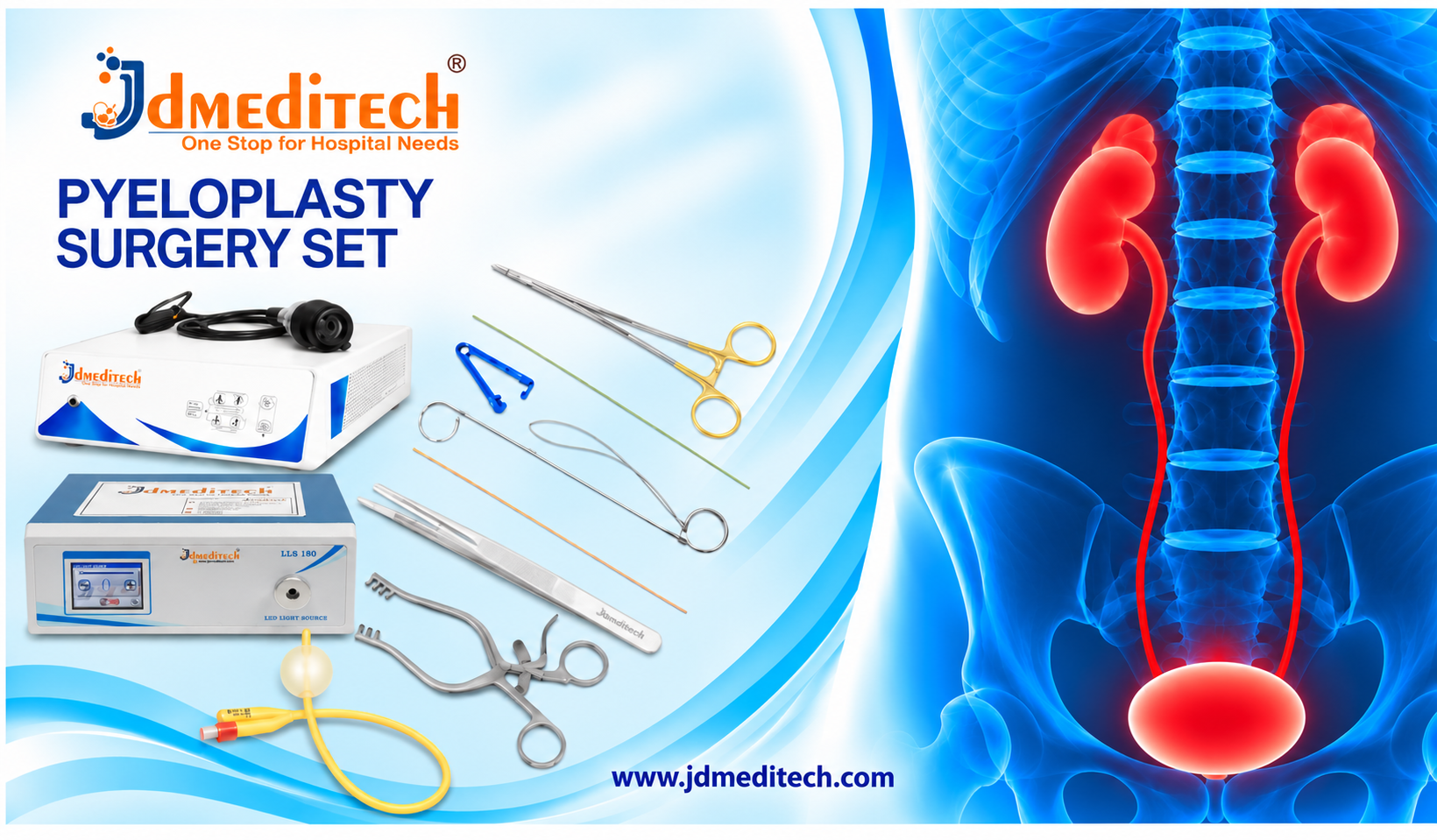
JDMeditech offers urology surgical instruments and accessories for hospitals, surgical centers, and international medical distributors. Moreover, this guide explains common pyeloplasty instruments, clinical applications, benefits, and important equipment selection factors.
What Is a Pyeloplasty Surgery Set?
A Pyeloplasty Surgery Set contains compatible surgical instruments and accessories for selected ureteropelvic junction reconstruction procedures.
The renal pelvis collects urine from the kidney before it enters the ureter. However, narrowing at the ureteropelvic junction can interfere with normal urinary drainage.
As a result, urine may accumulate in the kidney and cause hydronephrosis. Some patients experience pain, recurrent infections, or reduced kidney function.
Therefore, urologists evaluate the underlying condition before recommending surgical reconstruction.
Understanding Pyeloplasty and UPJ Obstruction
Pyeloplasty reconstructs the connection between the renal pelvis and ureter. Its primary goal is to improve urinary drainage across the affected junction.
UPJ obstruction, also called PUJ obstruction, may result from congenital narrowing, abnormal tissue, scarring, or external compression.
For example, an abnormal crossing blood vessel can contribute to obstruction in selected patients.
Depending on the clinical findings, surgeons may recommend open, laparoscopic, or robotic-assisted pyeloplasty.
However, not every patient with hydronephrosis requires surgery. Consequently, specialists assess symptoms, drainage, kidney function, and imaging results before selecting treatment.
Common Instruments Used in a Pyeloplasty Surgery Set
Different surgical approaches require different instruments. Therefore, hospitals should confirm the complete equipment configuration before purchasing.
1. Atraumatic Grasping Forceps
Atraumatic grasping forceps help surgeons handle delicate tissue during reconstructive procedures.
In addition, suitable instrument designs support controlled tissue manipulation during dissection and suturing.
2. Surgical Scissors
Compatible surgical scissors support tissue dissection and preparation during pyeloplasty.
Moreover, surgeons select the scissors according to the operative approach and tissue requirements.
3. Needle Holder
A needle holder supports controlled handling of surgical needles during reconstruction.
As a result, the surgeon can place suitable sutures while creating the connection between the renal pelvis and ureter.
4. Dissecting Forceps
Dissecting forceps support tissue separation and handling within the operative field.
Furthermore, the instrument configuration depends on whether the surgeon uses an open or minimally invasive approach.
5. Double J Ureteral Stent
A Double J ureteral stent may support internal urine drainage across the reconstructed ureteropelvic junction.
However, stenting practices vary. Therefore, the surgeon determines whether a stent is necessary and selects its dimensions and duration.
6. Ureteric Catheter
A ureteric catheter may support selected ureteral access or drainage techniques.
In addition, catheter selection depends on the patient’s anatomy and the planned procedure.
7. Urology Guide Wire
A compatible guide wire may support selected catheter or ureteral stent placement techniques.
Nevertheless, the surgeon determines its use according to the clinical situation and equipment requirements.
8. Laparoscopic Instruments
Laparoscopic pyeloplasty requires compatible minimally invasive instruments.
For example, surgeons may use laparoscopic graspers, scissors, needle holders, and dissection instruments.
However, not every pyeloplasty set includes a complete laparoscopic instrument system.
9. Endoscopic Camera and Monitor
During laparoscopic or robotic-assisted procedures, an appropriate imaging system provides visualization of the operative field.
Furthermore, the surgical team uses the displayed images to guide compatible instruments.
10. Urinary Drainage Accessories
Selected pyeloplasty procedures require urinary drainage devices during postoperative recovery.
However, the treating surgeon determines the appropriate drainage arrangement according to the reconstruction and clinical findings.
Pyeloplasty Surgery Set Components and Functions
The following table explains common pyeloplasty instruments and their functions. However, the actual supplied components depend on the selected surgical configuration.
| Instrument | Primary Function |
|---|---|
| Atraumatic Grasping Forceps | Support delicate tissue handling |
| Surgical Scissors | Support tissue dissection and preparation |
| Needle Holder | Supports surgical suturing |
| Dissecting Forceps | Support tissue manipulation and dissection |
| Double J Ureteral Stent | Supports internal urinary drainage when indicated |
| Ureteric Catheter | Supports selected ureteral access techniques |
| Guide Wire | Supports selected catheter and stent placement |
| Laparoscopic Instruments | Support selected minimally invasive procedures |
| Camera and Monitor | Provide visualization during compatible procedures |
| Urinary Drainage Accessories | Support postoperative drainage when required |
Importantly, these are examples of commonly associated reconstructive urology instruments. Customers should confirm the actual JDMeditech packing list before ordering.
Key Features of a Pyeloplasty Surgery Set
1. Reconstructive Urology Support
The instrument set supports selected procedures that reconstruct the ureteropelvic junction.
Moreover, compatible surgical instruments assist surgeons with dissection, tissue handling, and suturing.
2. Controlled Tissue Handling
Suitable forceps and dissecting instruments support controlled handling of delicate urinary tract tissue.
As a result, surgeons can perform the required reconstruction using instruments appropriate for the selected approach.
3. Suturing Capability
Needle holders and compatible surgical instruments support suturing during reconstruction.
Furthermore, the surgeon selects suitable sutures according to the operative requirements.
4. Urinary Drainage Options
Selected procedures use ureteral stents or other drainage accessories during postoperative healing.
Consequently, the surgical team can select an appropriate drainage arrangement.
5. Different Surgical Approaches
Surgeons may perform pyeloplasty through open, laparoscopic, or robotic-assisted techniques.
However, each approach requires compatible instruments and appropriate surgical expertise.
Applications of a Pyeloplasty Surgery Set
A Pyeloplasty Surgery Set supports selected reconstructive procedures involving the renal pelvis and ureteropelvic junction.
For example, a urologist may recommend pyeloplasty when UPJ obstruction causes clinically significant symptoms or impaired urinary drainage.
- Selected ureteropelvic junction obstruction procedures
- Reconstruction of the renal pelvis and proximal ureter connection
- Management of suitable congenital UPJ abnormalities
- Selected symptomatic hydronephrosis associated with UPJ obstruction
- Selected cases of obstruction affecting kidney drainage
- Open, laparoscopic, or robotic-assisted pyeloplasty procedures
However, pyeloplasty does not suit every patient with hydronephrosis. Therefore, qualified urologists must evaluate the underlying condition before recommending surgery.
How Is Pyeloplasty Surgery Performed?
Trained urologists perform pyeloplasty in an appropriately equipped surgical setting.
First, the healthcare team evaluates the patient’s symptoms, medical history, kidney function, and relevant imaging findings.
Next, the surgeon selects the appropriate reconstruction technique and compatible surgical instruments.
During surgery, the surgeon identifies the affected ureteropelvic junction and prepares the tissue for reconstruction.
Afterward, the surgeon creates a suitable connection between the renal pelvis and ureter.
When indicated, a compatible ureteral stent supports internal urinary drainage during healing.
Finally, the clinical team evaluates the reconstruction and arranges appropriate postoperative monitoring.
However, the exact technique and recovery plan depend on the patient’s anatomy and surgical findings.
Benefits of Pyeloplasty Surgery
1. Improved Urinary Drainage
Pyeloplasty aims to restore appropriate urine flow from the kidney into the ureter.
Consequently, successful reconstruction can improve drainage across the affected junction.
2. Treatment of Selected UPJ Obstruction
Surgeons use pyeloplasty to treat suitable ureteropelvic junction obstruction.
Moreover, the procedure can address certain anatomical causes of urinary drainage problems.
3. Different Surgical Options
Open, laparoscopic, and robotic-assisted techniques provide different surgical approaches.
Therefore, the treating team can evaluate the most suitable method for each patient.
4. Kidney Function Preservation
Appropriate treatment of significant obstruction may help protect kidney function.
However, the outcome depends on existing kidney function, obstruction severity, and other clinical factors.
5. Reconstructive Treatment Approach
Pyeloplasty addresses the affected ureteropelvic junction through surgical reconstruction.
Nevertheless, postoperative follow-up remains important because persistent or recurrent obstruction can occur.
Open vs Laparoscopic Pyeloplasty
Open and laparoscopic pyeloplasty both aim to reconstruct the ureteropelvic junction.
However, they use different surgical access methods.
| Feature | Open Pyeloplasty | Laparoscopic Pyeloplasty |
|---|---|---|
| Surgical Access | Open incision | Small access incisions |
| Visualization | Direct operative visualization | Camera-assisted visualization |
| Common Instruments | Open reconstructive instruments | Compatible laparoscopic instruments |
| Suturing | Open surgical suturing | Laparoscopic suturing |
| Clinical Selection | Depends on patient and surgeon factors | Depends on patient and surgeon factors |
Both approaches have established clinical applications. Therefore, the surgeon should select the appropriate method according to patient needs and available expertise.
Pyeloplasty vs Ureteral Stenting
Pyeloplasty and ureteral stenting serve different purposes in urinary tract management.
Pyeloplasty reconstructs the narrowed ureteropelvic junction. In contrast, ureteral stenting provides an internal pathway for urine drainage.
Moreover, surgeons may use a Double J stent as part of selected pyeloplasty procedures.
However, stenting alone does not necessarily correct the underlying anatomical obstruction. Consequently, the treating urologist must determine whether reconstruction is necessary.
How to Choose the Right Pyeloplasty Surgery Set
Hospitals and medical distributors should evaluate the complete equipment configuration before purchasing a Pyeloplasty Surgery Set.
First, confirm the intended surgical approach. Next, review the required reconstructive instruments and compatible urinary drainage accessories.
Important Selection Factors
- Open, laparoscopic, or robotic-assisted procedure requirements
- Grasping forceps design and dimensions
- Dissecting instrument compatibility
- Surgical scissors configuration
- Needle holder design
- Ureteric catheter size and type
- Double J stent dimensions when required
- Guide wire compatibility
- Endoscopic imaging requirements
- Instrument material and construction
- Reusable or single-use classification
- Cleaning and sterilization instructions
- Approved intended use and manufacturer documentation
Furthermore, purchasing teams should confirm the actual supplied instruments and technical specifications.
As a result, hospitals can select equipment that matches their procedural requirements.
Safety and Maintenance Considerations
Pyeloplasty requires trained surgical personnel, suitable equipment, and appropriate patient selection.
Before surgery, the healthcare team should review infection risk, urinary anatomy, and relevant medical conditions.
Moreover, clinicians must inspect reusable instruments and follow validated reprocessing instructions.
Potential complications include bleeding, infection, urinary leakage, persistent obstruction, and recurrent narrowing.
In addition, selected patients may require imaging or kidney function assessments after reconstruction.
Therefore, appropriate postoperative monitoring remains important.
Pyeloplasty Surgery Set by JDMeditech
JDMeditech offers urology surgical instruments and accessories for hospitals, surgical centers, and international medical distributors.
Our urology product range includes selected reconstructive instruments, ureteral catheters, Double J stents, and related accessories.
Moreover, customers can contact our team to request available configurations, technical specifications, and quotations.
For more information about the Pyeloplasty Surgery Set, visit www.jdmeditech.com.
Frequently Asked Questions About Pyeloplasty Surgery Sets
1. What is a Pyeloplasty Surgery Set?
A Pyeloplasty Surgery Set contains compatible reconstructive instruments and accessories. Together, these instruments support selected ureteropelvic junction reconstruction procedures.
2. What is pyeloplasty surgery?
Pyeloplasty reconstructs the connection between the renal pelvis and ureter. As a result, the procedure aims to improve urinary drainage across an obstructed junction.
3. What is UPJ obstruction?
UPJ obstruction refers to narrowing or blockage at the connection between the renal pelvis and ureter.
4. Which instruments are commonly used during pyeloplasty?
Common instruments include suitable grasping forceps, dissecting instruments, scissors, needle holders, and selected urinary drainage accessories.
5. Does every pyeloplasty procedure require a Double J stent?
No. The surgeon determines whether a ureteral stent is necessary according to the reconstruction technique and clinical circumstances.
6. Can surgeons perform pyeloplasty laparoscopically?
Yes. Surgeons may use laparoscopic techniques for suitable patients. However, the procedure requires appropriate instruments and expertise.
7. What is the difference between pyeloplasty and ureteral stenting?
Pyeloplasty reconstructs the narrowed ureteropelvic junction. In contrast, ureteral stenting provides internal urinary drainage.
8. Is pyeloplasty suitable for every patient with hydronephrosis?
No. The appropriate treatment depends on the underlying cause, symptoms, kidney function, and other clinical factors.
9. What complications can occur after pyeloplasty?
Possible complications include infection, bleeding, urinary leakage, and recurrent obstruction. Therefore, follow-up care remains important.
10. Where can I inquire about JDMeditech pyeloplasty instruments?
Hospitals and distributors can visit JDMeditech for product details, available configurations, and quotations.
Conclusion
A Pyeloplasty Surgery Set supports selected reconstructive procedures involving the renal pelvis and ureteropelvic junction.
Moreover, compatible surgical instruments help surgeons perform tissue handling, dissection, suturing, and selected urinary drainage procedures.
Therefore, hospitals should carefully review instrument compatibility, technical specifications, and clinical requirements before selecting equipment.
Contact JDMeditech for pyeloplasty instruments, reconstructive urology accessories, and international medical device inquiries.
Medical Disclaimer: This article provides general educational information. Qualified healthcare professionals must select suitable procedures and medical devices according to clinical judgment and approved manufacturer instructions.




