



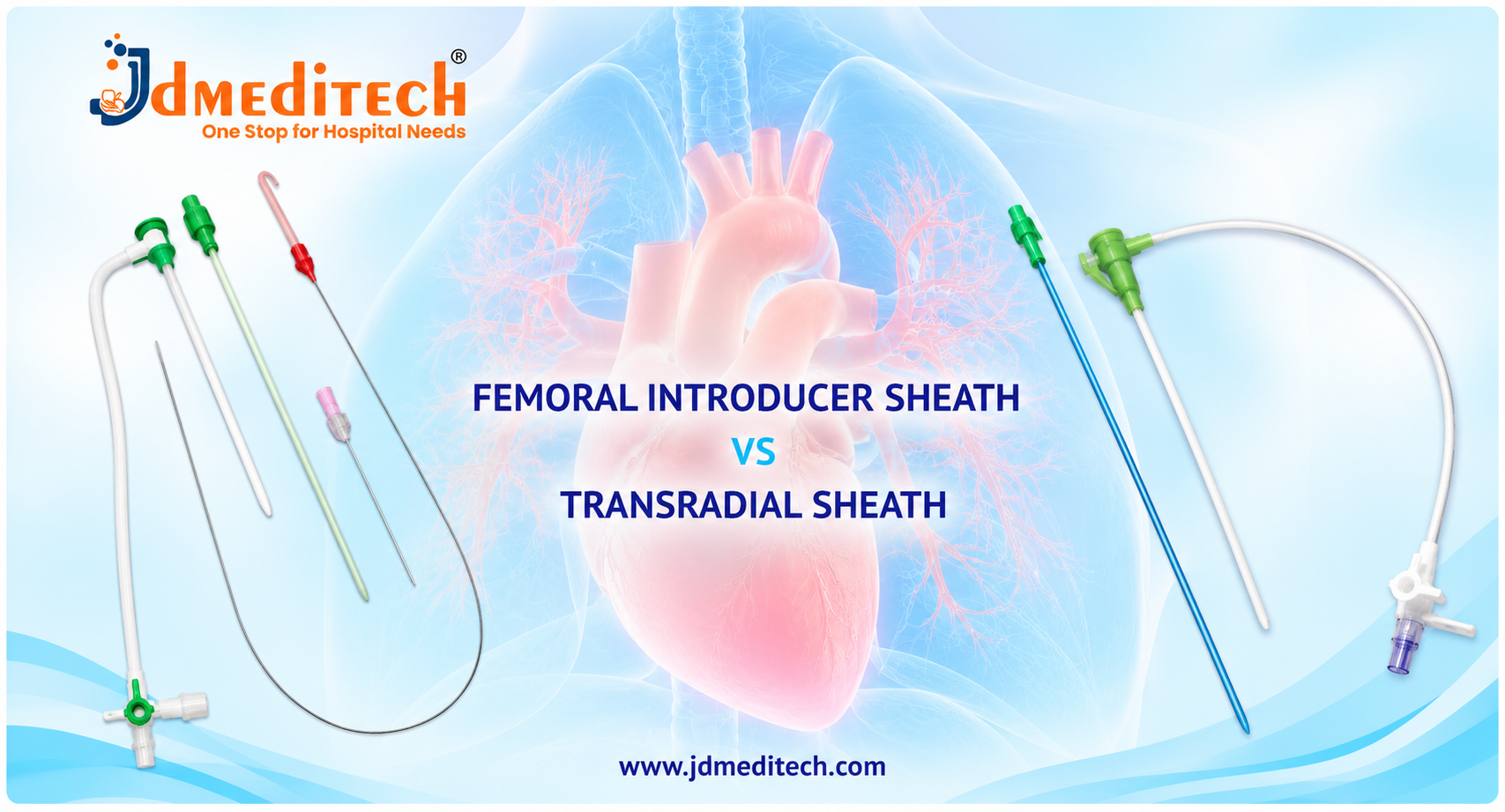
JDMeditech offers cardiology instruments and vascular access accessories for hospitals, catheterization laboratories, and medical distributors. Moreover, this guide explains the differences, features, benefits, and selection factors associated with these devices.
What Is a Femoral Introducer Sheath?
A Femoral Introducer Sheath is a vascular access device that provides a pathway for compatible catheters, guide wires, and other instruments during selected procedures.
Clinicians commonly use femoral arterial access during cardiovascular interventions. In addition, appropriate femoral venous sheaths support selected venous procedures.
The device typically includes a sheath tube, proximal hub, and compatible dilator. Depending on the model, it may also include a hemostatic valve and sidearm.
However, the actual components and dimensions vary between manufacturers and product configurations.
What Is a Transradial Sheath?
A Transradial Sheath, also called a radial introducer sheath, supports vascular access through the radial artery near the wrist.
Cardiologists commonly use radial access during coronary angiography and selected percutaneous coronary interventions (PCI).
Moreover, compatible transradial systems allow clinicians to introduce suitable diagnostic and interventional catheters.
However, the smaller radial artery requires careful assessment of vessel size, sheath dimensions, and device compatibility.
Femoral Introducer Sheath vs Transradial Sheath: Main Differences
Both devices provide vascular access. Nevertheless, their anatomical locations and procedural requirements differ.
| Feature | Femoral Introducer Sheath | Transradial Sheath |
|---|---|---|
| Access Location | Groin | Wrist |
| Common Arterial Access | Femoral artery | Radial artery |
| Common Applications | Selected coronary, peripheral, and structural interventions | Coronary angiography and selected PCI procedures |
| Vessel Characteristics | Generally larger access vessel | Generally smaller access vessel |
| Sheath Selection | Depends on vessel size and procedural requirements | Depends on radial artery size and catheter compatibility |
| Bleeding Considerations | Greater access-site bleeding risk in many coronary intervention comparisons | Lower access-site bleeding risk in many coronary intervention comparisons |
| Patient Mobility | May require longer postprocedure mobility restrictions | Often allows earlier ambulation |
| Large-Bore Access | Suitable for selected large-bore procedures | More limited by radial artery dimensions |
Importantly, these differences describe general clinical practice. Therefore, the treating clinician must select the appropriate approach for each patient.
Common Components of Vascular Introducer Sheaths
Femoral and transradial introducer systems may share several design elements. However, their dimensions and configurations differ.
1. Introducer Sheath Tube
The sheath tube provides a temporary access channel into the selected blood vessel.
Moreover, it allows compatible instruments to pass through the vascular access site.
2. Dilator
A compatible dilator supports introduction of the sheath into the selected vessel.
Therefore, the dilator and sheath must match the manufacturer’s specifications.
3. Hemostatic Valve
Many introducer systems include a hemostatic valve at the proximal hub.
This component helps limit blood leakage during compatible catheter and guide wire exchanges.
4. Sidearm and Stopcock
Selected introducer sheaths include a sidearm with a stopcock.
In addition, the sidearm may support flushing or other approved procedural functions.
5. Guide Wire
A compatible guide wire supports selected vascular access techniques.
However, guide wire diameter, length, and intended use must match the selected introducer system.
6. Access Needle
Some introducer kits include an access needle.
Nevertheless, hospitals should verify whether the selected package includes this component.
Key Features of a Femoral Introducer Sheath
1. Femoral Vascular Access
A femoral introducer sheath provides access through a suitable femoral artery or vein, depending on the device’s intended use.
Consequently, clinicians can perform selected catheter-based procedures through the groin.
2. Compatibility With Different Catheters
Femoral access can accommodate a range of compatible diagnostic and interventional devices.
Moreover, selected procedures may require larger sheath configurations.
3. Support for Complex Interventions
Femoral arterial access remains important for certain complex cardiovascular procedures.
For example, some large-bore interventions require access through a suitable femoral artery.
4. Different Configuration Options
Hospitals can select sheath dimensions and accessories according to procedural needs.
However, clinicians must confirm vessel suitability and equipment compatibility.
Key Features of a Transradial Sheath
1. Wrist-Based Arterial Access
A transradial sheath supports access through the radial artery.
Therefore, clinicians can perform selected coronary procedures without using the femoral artery.
2. Lower Access-Site Bleeding Risk
Clinical studies associate radial access with fewer access-site bleeding complications during many coronary interventions.
Moreover, major cardiology guidelines prefer radial access for suitable patients undergoing PCI.
3. Earlier Patient Ambulation
Radial access often allows patients to walk sooner after the procedure.
As a result, suitable patients may experience fewer mobility restrictions.
4. Dedicated Radial Equipment
Transradial procedures use compatible sheaths, guide wires, and catheters.
Furthermore, clinicians must consider radial artery diameter and the risk of arterial spasm.
Applications of Femoral Introducer Sheaths
Femoral introducer sheaths support various catheter-based procedures when clinicians select an appropriate device.
- Selected coronary angiography procedures
- Selected percutaneous coronary interventions
- Peripheral vascular interventions
- Selected structural heart interventions
- Procedures requiring suitable large-bore arterial access
- Selected venous catheter-based procedures using compatible femoral venous sheaths
However, arterial and venous introducer devices are not automatically interchangeable. Therefore, the medical team must verify the approved intended use.
Applications of Transradial Sheaths
Transradial sheaths primarily support selected arterial catheterization procedures through the wrist.
- Coronary angiography
- Selected percutaneous coronary interventions
- Diagnostic cardiac catheterization
- Selected coronary stent procedures
- Other compatible arterial interventions when clinically appropriate
However, radial access may not suit every patient. Consequently, the operator must evaluate vascular anatomy and procedural requirements.
Benefits of Femoral Introducer Sheaths
1. Access to Larger Vessels
The femoral artery generally offers a larger access vessel than the radial artery.
Therefore, suitable femoral access may accommodate larger compatible devices.
2. Broad Procedural Applications
Femoral introducer systems support selected coronary, peripheral, and structural interventions.
Moreover, appropriate femoral venous access remains important for many catheter-based procedures.
3. Alternative Access Route
Clinicians may choose femoral access when radial access is unsuitable.
For example, certain anatomical or technical conditions can limit the radial approach.
Benefits of Transradial Sheaths
1. Reduced Bleeding Complications
Radial access reduces access-site bleeding and vascular complications in many PCI patient populations.
Therefore, current clinical guidelines recommend radial access for suitable coronary intervention patients.
2. Improved Patient Mobility
Patients can often walk earlier after radial catheterization.
In addition, the wrist access site may require fewer postprocedure movement restrictions.
3. Convenient Access-Site Monitoring
The wrist access site allows clinicians to observe and manage local bleeding with suitable compression techniques.
However, the team must also assess hand circulation and radial artery patency.
Radial vs Femoral Access: Which Is Better for Coronary Angiography?
Radial access is generally preferred for suitable patients undergoing coronary angiography and PCI, particularly in acute coronary syndrome care.
For example, the 2025 ACC/AHA guideline recommends radial access over femoral access for PCI in patients with acute coronary syndromes.
Nevertheless, femoral access remains important when radial access is unsuitable or the procedure requires different equipment.
Therefore, the best access site depends on the patient’s anatomy, clinical condition, and procedural requirements.
Potential Complications of Femoral Access
Femoral arterial access requires careful technique and appropriate monitoring.
Potential complications include bleeding, hematoma, pseudoaneurysm, arterial injury, and, rarely, retroperitoneal bleeding.
Moreover, clinicians should assess access-site suitability and follow established procedural safety practices.
Potential Complications of Radial Access
Radial arterial access also carries potential risks.
For example, complications may include radial artery spasm, radial artery occlusion, hematoma, or vascular injury.
Therefore, clinicians should use appropriate equipment and follow suitable postprocedure monitoring protocols.
How to Choose the Right Introducer Sheath
Hospitals and medical distributors should evaluate the complete equipment configuration before purchasing vascular introducer sheaths.
First, confirm the intended access site and vessel type. Next, review sheath dimensions and catheter compatibility.
Important Selection Factors
- Femoral or radial access requirements
- Arterial or venous intended use
- Sheath French size
- Usable sheath length
- Inner and outer diameter specifications
- Compatible guide wire diameter
- Dilator compatibility
- Hemostatic valve configuration
- Sidearm and stopcock requirements
- Catheter and device compatibility
- Material and coating specifications
- Sterility and single-use classification
- Approved manufacturer instructions
Furthermore, purchasing teams should confirm the actual supplied components and technical specifications.
As a result, hospitals can select appropriate vascular access equipment for their intended procedures.
Femoral Introducer Sheath and Transradial Sheath by JDMeditech
JDMeditech offers cardiology and vascular access products for hospitals, catheterization laboratories, and international medical distributors.
Our cardiology product range includes selected introducer sheaths, guide wires, and related catheterization accessories.
Moreover, customers can contact our team to request available sizes, technical specifications, and quotations.
For more information about Femoral Introducer Sheath vs Transradial Sheath, visit www.jdmeditech.com.
Frequently Asked Questions About Femoral and Transradial Sheaths
1. What is the difference between a femoral introducer sheath and a transradial sheath?
A femoral introducer sheath provides access through a suitable femoral vessel in the groin. In contrast, a transradial sheath provides access through the radial artery near the wrist.
2. What is a femoral introducer sheath used for?
Clinicians use suitable femoral introducer sheaths during selected coronary, peripheral, structural, and venous catheter-based procedures.
3. What is a transradial sheath used for?
A transradial sheath supports radial artery access during coronary angiography and selected interventional procedures.
4. Which access route has a lower bleeding risk?
Radial access generally has a lower access-site bleeding risk than femoral access during many coronary interventions.
5. Why do some procedures require femoral access?
Some interventions require larger devices or different vascular access arrangements. In addition, radial access may be unsuitable for certain patients.
6. Can both sheath types use the same guide wire?
Not necessarily. Guide wire compatibility depends on the sheath dimensions, selected access technique, and manufacturer specifications.
7. What does French size mean in introducer sheaths?
French size is a catheter sizing convention. However, introducer sheath labeling may describe compatible catheter capacity rather than the actual outer diameter.
8. Is radial access always better than femoral access?
No. Although radial access is preferred for many coronary interventions, femoral access remains necessary or advantageous in selected clinical situations.
9. What should hospitals check before purchasing an introducer sheath?
Hospitals should confirm the intended access site, dimensions, guide wire compatibility, sterile packaging, and approved manufacturer instructions.
10. Where can I inquire about JDMeditech vascular introducer sheaths?
Hospitals and distributors can visit JDMeditech for product information, available configurations, and quotations.
Conclusion
Femoral Introducer Sheath vs Transradial Sheath highlights two important vascular access approaches in modern interventional cardiology.
Femoral introducer sheaths support selected procedures through the groin. Meanwhile, transradial sheaths provide wrist-based arterial access for suitable coronary procedures.
Therefore, clinicians and purchasing teams should consider anatomy, procedural requirements, device compatibility, and patient safety before selecting an introducer sheath.
Contact JDMeditech for femoral introducer sheaths, transradial sheaths, cardiology accessories, and international medical device inquiries.
Medical Disclaimer: This article provides general educational information. Qualified healthcare professionals must select vascular access methods and medical devices according to clinical judgment, current guidelines, and approved manufacturer instructions.




