



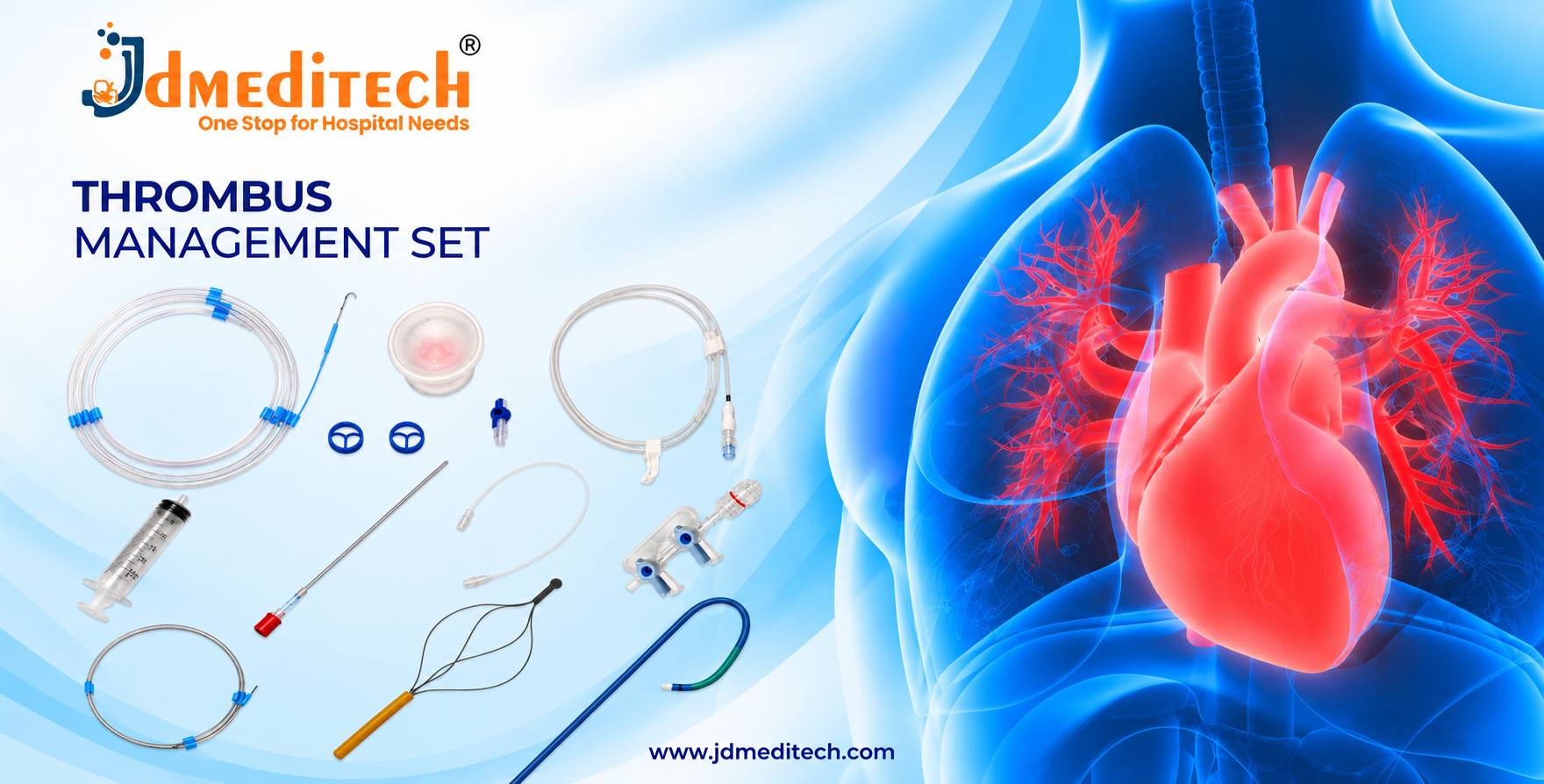
A thrombus is a blood clot that forms within the circulatory system. Although clotting helps prevent excessive bleeding after injury, abnormal clot formation can obstruct blood flow and cause serious complications.
Consequently, timely diagnosis and appropriate treatment are essential. In selected situations, interventional specialists may use catheter-based equipment to remove or treat a thrombus.
JDMeditech provides information about selected interventional cardiology and vascular accessories for hospitals, healthcare institutions, and international medical distributors. This guide explains common thrombus management equipment, clinical applications, potential benefits, risks, and device selection considerations.
What Is a Thrombus Management Set?
A Thrombus Management Set is a collection of selected devices associated with catheter-based thrombus treatment.
Depending on its intended use, a configuration may include an aspiration catheter, compatible tubing, a syringe, guide wires, and other vascular access accessories.
However, not every thrombus management set contains the same components. Furthermore, devices intended for coronary arteries may differ significantly from those designed for peripheral arteries or veins.
Therefore, clinicians and purchasing teams must confirm the approved intended use and actual packing list before selecting equipment.
Understanding Thrombus Formation
A thrombus is a blood clot that develops inside a blood vessel or within the heart.
For example, clot formation may occur in association with atherosclerotic plaque disruption, reduced blood flow, vascular injury, or certain medical conditions.
Moreover, thrombi can affect arteries and veins. Their clinical consequences depend on the affected location and degree of obstruction.
In some cases, a clot may break away and travel through the circulation. This traveling clot is known as an embolus.
Consequently, thrombosis and embolism can lead to serious conditions that require urgent medical evaluation.
What Is the Purpose of Thrombus Management?
Thrombus management aims to prevent or reduce complications associated with abnormal blood clot formation.
Treatment may involve anticoagulant medicines, antiplatelet medicines, thrombolytic drugs, catheter-based interventions, or surgery.
For selected patients, catheter-based treatment may help remove thrombotic material or restore blood flow.
However, device-based thrombus removal is not appropriate for every clot. Therefore, specialists must consider the patient’s diagnosis, anatomy, bleeding risk, and treatment alternatives.
Common Components of a Thrombus Management Set
Different manufacturers offer different equipment configurations. The following components are commonly associated with selected thrombus management procedures, but they are not a confirmed list of the instruments shown in the JDMeditech product image.
1. Aspiration Catheter
An aspiration catheter is designed to support the removal of selected thrombotic material using an approved aspiration system.
Moreover, aspiration catheters are available in different dimensions and designs for specific vascular applications.
However, the catheter must be used only within its approved intended use and compatibility requirements.
2. Aspiration Syringe
Selected manual aspiration systems use a compatible syringe to generate negative pressure.
Consequently, the syringe may form part of the clot aspiration equipment configuration.
Nevertheless, the required syringe type and connection method depend on the specific system.
3. Guide Wire
A suitable guide wire may provide a pathway for compatible catheter-based devices.
Furthermore, guide wire diameter, length, and design must match the intended equipment.
4. Introducer Sheath
An introducer sheath provides vascular access for compatible catheters and other devices.
In addition, selected sheaths incorporate valves or sidearms to support specific procedural requirements.
5. Connection Tubing
Compatible tubing may connect an aspiration catheter with an approved syringe or aspiration system.
Therefore, secure connections and manufacturer-approved compatibility are important.
6. Hemostatic Valve
A hemostatic valve may help manage blood loss during selected catheter-based procedures.
Moreover, the valve configuration depends on the access system.
7. Thrombectomy Device
Some thrombus management procedures use specialized mechanical thrombectomy devices.
These devices may remove or fragment thrombotic material using their approved mechanisms.
However, mechanical thrombectomy equipment is not necessarily included in a basic aspiration kit.
8. Catheter-Directed Thrombolysis Equipment
Selected procedures use specialized infusion catheters to deliver thrombolytic medication into or near a thrombus.
Importantly, thrombolysis is different from mechanical clot removal and carries significant bleeding risks.
Furthermore, these catheters and medications are not automatically included in a thrombus management set.
Thrombus Management Set Components and Functions
| Component | Primary Function |
|---|---|
| Aspiration Catheter | Supports selected thrombus aspiration procedures |
| Aspiration Syringe | Provides negative pressure in compatible manual systems |
| Guide Wire | Supports compatible catheter access |
| Introducer Sheath | Provides vascular access |
| Connection Tubing | Connects compatible aspiration components |
| Hemostatic Valve | Helps manage blood loss during catheter access |
| Mechanical Thrombectomy Device | Supports selected mechanical clot removal procedures |
| Infusion Catheter | Supports approved catheter-directed medication delivery |
Importantly, this table is educational. It does not confirm the actual contents of a particular JDMeditech Thrombus Management Set.
Types of Catheter-Based Thrombus Management
Several catheter-based treatment approaches are available for selected thrombotic conditions.
1. Aspiration Thrombectomy
Aspiration thrombectomy uses an approved catheter and aspiration system to remove selected thrombotic material.
For example, certain vascular interventions may use manual or powered aspiration equipment.
However, clinical evidence and recommendations vary by vascular territory and patient condition.
2. Mechanical Thrombectomy
Mechanical thrombectomy uses specialized devices to remove or disrupt a thrombus.
Moreover, different technologies have different mechanisms, indications, and compatibility requirements.
Therefore, equipment must be selected according to the specific vascular procedure.
3. Catheter-Directed Thrombolysis
Catheter-directed thrombolysis delivers clot-dissolving medication through a specialized catheter.
In selected patients, this approach may help reduce thrombotic obstruction.
However, thrombolytic medication can cause major bleeding. Consequently, patient selection and monitoring are essential.
4. Combined Thrombus Management
Some procedures combine mechanical treatment with medication-based approaches.
Nevertheless, the appropriate strategy depends on the clinical indication and the patient’s risk profile.
Clinical Applications of Thrombus Management Devices
Catheter-based thrombus management devices may support selected interventions in different vascular territories.
1. Selected Coronary Thrombus Management
Coronary thrombus may occur during an acute coronary syndrome.
In certain cases, interventional cardiologists may consider thrombus aspiration as an additional treatment during percutaneous coronary intervention.
However, routine manual aspiration thrombectomy before primary PCI for ST-elevation myocardial infarction is not recommended because clinical trials have not demonstrated an overall benefit.
Therefore, aspiration may be considered only in selected circumstances according to clinical judgment and current guidelines.
2. Acute Limb Ischemia
Acute limb ischemia occurs when blood flow to an extremity suddenly becomes severely reduced.
Depending on the cause and severity, clinicians may consider surgery, catheter-based thrombus removal, or thrombolysis.
However, acute limb ischemia is a time-sensitive medical emergency requiring prompt specialist assessment.
3. Selected Deep Vein Thrombosis
Deep vein thrombosis develops when a blood clot forms within a deep vein.
Anticoagulation is the main treatment for most patients.
Nevertheless, selected patients with extensive symptomatic thrombosis may be evaluated for catheter-based intervention.
4. Selected Pulmonary Embolism Interventions
Pulmonary embolism occurs when a blood clot obstructs part of the pulmonary arterial circulation.
For certain high-risk or deteriorating patients, specialist teams may consider catheter-based treatments.
However, these procedures require devices specifically approved for pulmonary vascular applications.
5. Selected Vascular Graft or Access Thrombosis
Thrombosis may affect certain vascular grafts or access circuits.
Consequently, specialists may consider suitable mechanical or catheter-based interventions.
However, device selection depends on the affected structure and approved indication.
Key Features of Thrombus Management Equipment
1. Catheter-Based Access
Suitable thrombus management systems use compatible catheters for selected vascular interventions.
As a result, specialists may treat certain thrombotic conditions without conventional open surgery.
2. Different Catheter Configurations
Aspiration and thrombectomy devices are available in different designs and dimensions.
Moreover, device selection depends on vessel size, anatomy, and the intended procedure.
3. Compatible Aspiration Systems
Selected aspiration catheters work with specified syringes, tubing, or powered aspiration equipment.
Therefore, hospitals must verify compatibility before use.
4. Guide Wire Compatibility
Some catheter-based systems are designed for use with compatible guide wires.
Furthermore, the manufacturer’s instructions identify applicable guide wire requirements.
5. Different Clinical Applications
Specialized thrombus management technologies may support coronary, peripheral, venous, or other vascular interventions.
However, no single device should be assumed suitable for every vascular territory.
How Is Catheter-Based Thrombus Management Performed?
A qualified interventional specialist performs catheter-based thrombus treatment in an appropriately equipped medical setting.
First, the clinical team evaluates the patient’s symptoms, vascular anatomy, and diagnostic imaging.
Next, specialists determine whether medication, catheter-based intervention, surgery, or a combination is appropriate.
During an intervention, the operator uses approved vascular access and imaging equipment to assess the affected region.
When indicated, compatible devices may support aspiration, mechanical thrombus removal, or catheter-directed medication delivery.
Afterward, the specialist evaluates the treatment result and monitors for potential complications.
Finally, the healthcare team establishes an individualized plan for anticoagulation, follow-up, and management of the underlying condition.
However, the exact technique depends on the diagnosis and selected equipment. This overview is not a procedural training guide.
Potential Benefits of Selected Thrombus Management Procedures
1. Restoration of Blood Flow
Successful treatment of a suitable thrombotic obstruction may improve blood flow through the affected vessel.
However, the degree of improvement depends on the condition and treatment outcome.
2. Catheter-Based Treatment Options
Selected patients may benefit from catheter-based interventions.
Consequently, certain conditions can be treated without open vascular surgery.
3. Support for Emergency Vascular Care
Some thrombotic conditions require urgent intervention to prevent tissue injury.
In suitable cases, catheter-based equipment may form part of emergency treatment.
4. Different Device Technologies
Modern vascular intervention includes aspiration, mechanical thrombectomy, and infusion-based technologies.
Therefore, specialists can evaluate options according to the clinical indication.
5. Integration With Other Treatments
Catheter-based procedures may be combined with appropriate medical therapy or other interventions.
Nevertheless, combined treatment must account for bleeding and other procedural risks.
Aspiration Thrombectomy vs Mechanical Thrombectomy vs Thrombolysis
| Feature | Aspiration | Mechanical Thrombectomy | Thrombolysis |
|---|---|---|---|
| Primary Approach | Suction-based clot removal | Device-based clot removal or disruption | Medication-based clot dissolution |
| Equipment | Aspiration catheter and compatible system | Specialized thrombectomy device | Infusion catheter and medication |
| Major Concerns | Bleeding, embolization, vessel injury | Vessel injury, embolization, bleeding | Major bleeding, including intracranial hemorrhage |
| Clinical Selection | Depends on indication | Depends on indication | Depends on indication and bleeding risk |
Importantly, these approaches are not interchangeable. Therefore, specialists must select treatment according to the affected vascular territory and clinical guidelines.
Why Is Routine Coronary Thrombus Aspiration Not Recommended?
Although removing a coronary clot may appear beneficial, large clinical trials have not demonstrated improved outcomes from routine manual aspiration before primary PCI in patients with ST-elevation myocardial infarction.
Furthermore, some studies raised concerns about stroke risk.
Consequently, the 2025 ACC/AHA acute coronary syndrome guideline recommends against routine manual aspiration thrombectomy before primary PCI.
However, selected bailout aspiration may still be considered when persistent thrombus creates a specific procedural problem.
Therefore, a thrombus aspiration catheter should not be marketed as a routine requirement for every coronary stenting procedure.
Risks and Safety Considerations
Catheter-based thrombus management is an invasive treatment that can cause serious complications.
Potential risks include bleeding, vascular injury, vessel perforation, thrombosis, and embolization of clot fragments.
In addition, some procedures may cause injury to the affected organ or surrounding tissues.
Furthermore, thrombolytic medication can increase the risk of major bleeding, including intracranial hemorrhage.
Consequently, clinicians must evaluate the patient’s bleeding risk, vascular anatomy, and treatment alternatives.
Moreover, device compatibility, imaging guidance, and appropriate monitoring are essential for patient safety.
Recovery and Follow-Up After Thrombus Treatment
Recovery depends on the underlying condition, procedure type, and patient health.
After treatment, the healthcare team monitors the vascular access site and evaluates the patient’s circulation.
In addition, clinicians may prescribe anticoagulant or antiplatelet medication when appropriate.
However, medication selection and duration depend on the diagnosis and individual risk factors.
Furthermore, follow-up care may include imaging, symptom assessment, and treatment of the underlying cause of thrombosis.
Patients should seek urgent medical attention for severe bleeding, sudden chest pain, breathing difficulty, stroke symptoms, or new signs of limb ischemia.
How to Choose a Thrombus Management Set
Hospitals and medical distributors should confirm the intended vascular application before purchasing thrombus management equipment.
First, identify whether the requirement involves coronary aspiration, peripheral thrombectomy, venous intervention, or another approved application.
Next, review the device specifications and compatibility requirements.
Important Equipment Selection Factors
- Approved intended use
- Target vascular territory
- Aspiration catheter diameter and length
- Catheter lumen dimensions
- Guide wire compatibility
- Introducer sheath compatibility
- Aspiration syringe or pump requirements
- Connection tubing configuration
- Hemostatic valve compatibility
- Radiopaque marker availability
- Device flexibility and construction
- Single-use classification
- Sterile packaging and shelf life
- Actual number of components
- Manufacturer instructions for use
- Applicable regulatory documentation
Moreover, purchasing teams should request the exact product packing list and technical datasheet before ordering.
Thrombus Management Equipment and Cardiology Accessories by JDMeditech
JDMeditech supplies information about selected cardiology and catheter-based medical devices for hospitals, healthcare institutions, and international medical distributors.
Customers can contact JDMeditech to inquire about thrombus management equipment, aspiration catheters, vascular access accessories, and compatible product configurations.
Furthermore, the team can confirm available models, technical specifications, and applicable documentation for a specific inquiry.
For more information, visit www.jdmeditech.com.
Frequently Asked Questions About Thrombus Management Set
1. What is a Thrombus Management Set?
A Thrombus Management Set refers to selected devices used during compatible catheter-based clot management procedures. Exact contents vary by manufacturer.
2. What is a thrombus?
A thrombus is a blood clot that forms within a blood vessel or the heart.
3. What is an aspiration catheter?
An aspiration catheter is a medical device designed to support suction-based removal of selected material, including thrombus, within its approved intended use.
4. What is the difference between a thrombus and an embolus?
A thrombus forms at a particular location. An embolus is material that travels through the bloodstream and may obstruct another vessel.
5. Is thrombus aspiration used during coronary angioplasty?
It may be considered in selected situations. However, routine manual aspiration before primary PCI for STEMI is not recommended.
6. Is thrombectomy the same as thrombolysis?
No. Thrombectomy involves device-based clot removal, while thrombolysis uses medication to dissolve thrombotic material.
7. Can the same thrombectomy device be used in arteries and veins?
Not necessarily. Each device must be used according to its approved intended use and compatibility specifications.
8. Does every thrombus management kit include an aspiration syringe?
No. Product configurations vary, and some systems use powered aspiration equipment instead.
9. What are the main risks of catheter-based thrombus management?
Potential complications include bleeding, vascular injury, embolization, and other serious adverse events.
10. Where can hospitals inquire about JDMeditech thrombus management equipment?
Hospitals and medical distributors can visit JDMeditech to request product information and quotations.
Conclusion
A Thrombus Management Set may support selected catheter-based procedures used to manage blood clots in the circulatory system.
Moreover, suitable aspiration catheters, guide wires, tubing, and vascular access accessories can form part of specialized intervention systems.
However, treatment selection depends on the patient’s diagnosis, the affected vascular territory, and the approved intended use of the equipment.
Therefore, hospitals should choose appropriate devices according to clinical requirements, professional guidelines, and manufacturer specifications.
Contact JDMeditech for interventional cardiology accessories, catheter-based devices, and international medical device inquiries.
Medical Disclaimer: This article provides general educational information and is not a procedural training guide. Qualified healthcare professionals must make treatment and device-selection decisions according to clinical judgment, applicable guidelines, and approved manufacturer instructions.




