



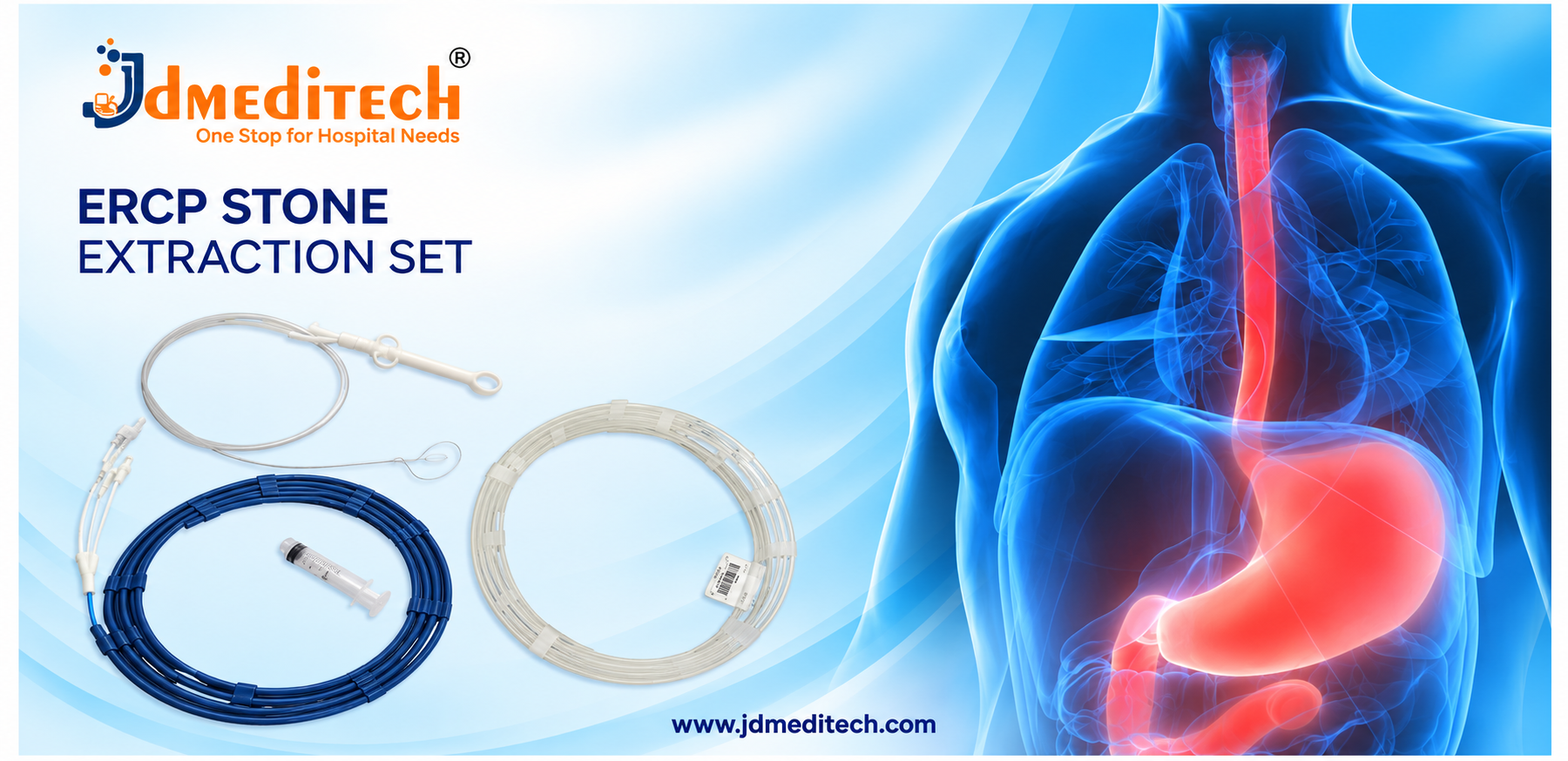
In suitable cases, ERCP provides a minimally invasive method for treating biliary obstruction and removing stones. However, the procedure requires specialized expertise and appropriate equipment.
JDMeditech provides information about gastroenterology instruments and endoscopy accessories for hospitals, endoscopy centers, and international medical distributors. This guide explains ERCP stone extraction equipment, its components, clinical applications, potential benefits, and important safety considerations.
What Is an ERCP Stone Extraction Set?
An ERCP Stone Extraction Set refers to selected endoscopic devices used during procedures involving the removal of bile duct stones.
Depending on the configuration, a set may contain a stone extraction balloon catheter, a stone retrieval basket, compatible guide wires, or selected connection accessories.
Moreover, additional instruments may be required for biliary cannulation, sphincterotomy, stone fragmentation, or drainage.
However, not every commercial set includes all these devices. Therefore, healthcare facilities must verify the actual packing list and intended use before ordering.
Understanding ERCP
ERCP stands for Endoscopic Retrograde Cholangiopancreatography. It combines gastrointestinal endoscopy with fluoroscopic imaging to diagnose and treat selected conditions involving the bile ducts and pancreatic ducts.
During ERCP, a specially designed side-viewing endoscope called a duodenoscope allows access to the major duodenal papilla.
Through compatible accessories, specialists can evaluate the biliary system and perform appropriate interventions.
For example, ERCP may support bile duct stone extraction, biliary stent placement, and treatment of selected biliary obstructions.
Nevertheless, ERCP is primarily a therapeutic procedure in modern practice. Noninvasive tests such as magnetic resonance cholangiopancreatography (MRCP) or endoscopic ultrasound (EUS) may be used first when diagnostic confirmation is required.
What Are Common Bile Duct Stones?
Common bile duct stones are also called choledocholithiasis.
These stones may originate in the gallbladder and migrate into the common bile duct. Alternatively, some stones form within the bile ducts.
When a stone obstructs bile flow, the patient may develop abdominal pain, jaundice, or abnormal liver tests.
Furthermore, untreated obstruction can contribute to cholangitis or pancreatitis.
Consequently, appropriate diagnosis and timely treatment are essential.
Why Is ERCP Stone Extraction Performed?
ERCP stone extraction aims to remove selected stones obstructing the biliary system.
For example, specialists may recommend therapeutic ERCP for confirmed common bile duct stones.
In addition, ERCP may help relieve biliary obstruction when associated with infection or other complications.
However, the urgency and treatment strategy depend on the patient’s condition, imaging findings, and clinical risks.
Therefore, qualified specialists must evaluate each case individually.
Common Components of an ERCP Stone Extraction Set
Different manufacturers offer different ERCP stone extraction configurations. The following instruments are commonly associated with biliary stone removal, but they are not a verified packing list for the pictured product.
1. ERCP Stone Extraction Balloon Catheter
A stone extraction balloon catheter is used to support the removal of selected stones or biliary debris.
Depending on the device design, the balloon may be available in specified diameters and catheter lengths.
Moreover, some designs include radiopaque markers or multiple lumens.
However, exact features and compatible inflation systems vary by manufacturer.
2. CBD Stone Retrieval Basket
A common bile duct stone retrieval basket is designed to capture and retrieve selected biliary stones.
For example, some baskets use multiple wires arranged in a retrieval configuration.
Furthermore, specialized baskets may support mechanical lithotripsy when used with approved compatible equipment.
Nevertheless, ordinary retrieval baskets must not be assumed suitable for stone crushing.
3. ERCP Guide Wire
A compatible guide wire supports selected biliary access and catheter exchange tasks.
Moreover, guide wires are available in different diameters, lengths, tip designs, and surface coatings.
Therefore, clinicians must verify compatibility with the selected ERCP accessories.
4. ERCP Cannula
An ERCP cannula may support selected biliary access and contrast administration requirements.
However, its design and use depend on the clinical procedure and device specifications.
5. Sphincterotome
A sphincterotome is a specialized accessory used during selected endoscopic biliary sphincterotomy procedures.
In suitable cases, sphincterotomy facilitates access for stone extraction.
Nevertheless, sphincterotomy carries important bleeding and perforation risks.
6. Balloon Inflation Accessories
Selected stone extraction balloons require compatible syringes or inflation accessories.
Consequently, the clinical team must follow the manufacturer’s specified inflation medium and limits.
7. Mechanical Lithotripsy Equipment
Large or difficult bile duct stones may require fragmentation before removal.
For example, selected mechanical lithotripsy systems can help fragment stones using compatible baskets and accessories.
However, these systems are not necessarily included in a basic extraction set.
8. Biliary Stent and Drainage Accessories
When complete stone clearance is not possible during a procedure, specialists may use appropriate biliary drainage strategies.
In selected cases, a temporary biliary stent may be placed.
However, stents and associated accessories are generally separate items unless specifically listed.
ERCP Stone Extraction Set Components and Functions
| Component | Primary Function |
|---|---|
| Stone Extraction Balloon | Supports retrieval of selected bile duct stones and debris |
| CBD Stone Retrieval Basket | Captures and retrieves selected biliary stones |
| ERCP Guide Wire | Supports compatible biliary access and device exchange |
| ERCP Cannula | Supports selected duct access and contrast administration |
| Sphincterotome | Supports selected biliary sphincterotomy procedures |
| Inflation Accessories | Support compatible balloon inflation |
| Mechanical Lithotripsy Equipment | Supports fragmentation of selected difficult stones |
| Biliary Stent | Supports selected biliary drainage requirements |
Importantly, this table is educational. Customers should confirm which instruments are actually supplied in the JDMeditech ERCP Stone Extraction Set.
Types of ERCP Stone Extraction Devices
1. Stone Extraction Balloon
Stone extraction balloons are used for selected biliary stone removal procedures.
Moreover, they may be suitable for clearing certain small stones or debris, depending on the clinical situation.
2. Stone Retrieval Basket
Retrieval baskets help capture selected bile duct stones.
However, basket selection depends on stone characteristics, duct anatomy, and the device’s intended use.
3. Mechanical Lithotripsy Basket
Specialized lithotripsy baskets can support fragmentation of certain difficult stones.
Consequently, they may be considered when conventional extraction is unsuccessful or unsuitable.
4. Cholangioscopy-Guided Lithotripsy Devices
Selected difficult stones may be managed using cholangioscopy-guided electrohydraulic or laser lithotripsy.
However, these approaches require specialized equipment and expertise beyond a standard extraction kit.
Clinical Applications of ERCP Stone Extraction
1. Common Bile Duct Stones
Confirmed common bile duct stones are a major indication for therapeutic ERCP.
In suitable patients, endoscopic extraction may restore bile drainage and relieve obstruction.
2. Biliary Obstruction
Stones may block the common bile duct and interfere with bile flow.
Consequently, selected patients require endoscopic stone removal or drainage.
3. Acute Cholangitis Associated With Stones
Cholangitis is an infection of the biliary system that may develop when bile flow becomes obstructed.
In these cases, urgent assessment and appropriate biliary drainage may be required.
However, the timing and method depend on disease severity and the patient’s clinical condition.
4. Selected Gallstone-Related Pancreatitis
Gallstones can trigger acute pancreatitis when they obstruct the pancreaticobiliary outflow.
Nevertheless, ERCP is not routinely required for every patient with gallstone pancreatitis.
It is generally reserved for selected patients with cholangitis or evidence of persistent biliary obstruction.
5. Difficult Bile Duct Stones
Large, impacted, or anatomically difficult stones may require advanced extraction techniques.
For example, specialists may consider lithotripsy or other established approaches.
Key Features of ERCP Stone Extraction Equipment
1. Endoscopic Compatibility
Suitable ERCP accessories are designed for use with specified endoscope working channels.
Therefore, hospitals must confirm device dimensions and endoscope compatibility.
2. Different Catheter Configurations
Extraction balloons and retrieval baskets are available in different designs.
Moreover, the appropriate configuration depends on the intended clinical application.
3. Guide Wire Compatibility
Selected accessories support wire-guided techniques.
Consequently, guide wire diameter and catheter compatibility must be verified.
4. Fluoroscopic Visibility
Some devices incorporate radiopaque markers that support visualization during fluoroscopy.
However, marker configuration varies by product model.
5. Different Stone Retrieval Options
Balloon and basket systems provide different approaches to selected biliary stones.
Nevertheless, no single extraction method is suitable for every stone.
How Is ERCP Stone Extraction Performed?
A qualified gastroenterologist performs ERCP in an appropriately equipped endoscopy facility.
First, the clinical team evaluates symptoms, blood tests, and relevant imaging findings.
Next, specialists determine whether therapeutic ERCP is indicated and select compatible equipment.
During the procedure, a duodenoscope provides access to the region where the bile duct opens into the small intestine.
Afterward, the endoscopist evaluates the biliary system using appropriate accessories and imaging.
When indicated, compatible extraction balloons, baskets, or other devices may be used to treat the selected stones.
Subsequently, the specialist assesses whether adequate stone clearance or biliary drainage has been achieved.
Finally, the healthcare team monitors the patient and provides follow-up instructions.
However, the exact approach depends on stone size, duct anatomy, patient condition, and available expertise. This overview is not intended as procedural training.
Potential Benefits of ERCP Stone Extraction
1. Removal of Bile Duct Stones
Successful ERCP can remove selected stones from the common bile duct.
As a result, biliary obstruction may improve.
2. Minimally Invasive Treatment
ERCP provides an endoscopic treatment option for suitable biliary conditions.
Therefore, selected patients may avoid more invasive bile duct exploration.
3. Support for Biliary Drainage
Stone extraction or appropriate drainage may help relieve selected biliary obstructions.
Moreover, timely treatment is particularly important in patients with cholangitis.
4. Different Retrieval Techniques
Balloon and basket extraction offer established treatment options.
Furthermore, advanced techniques are available for selected difficult stones.
5. Integration With Other ERCP Procedures
Stone extraction may be combined with appropriate sphincterotomy, dilation, or drainage procedures.
However, each additional intervention requires an individualized assessment of benefits and risks.
ERCP Stone Extraction Balloon vs Retrieval Basket
| Feature | Extraction Balloon | Retrieval Basket |
|---|---|---|
| Device Design | Inflatable catheter | Expandable wire basket |
| Primary Function | Supports stone and debris extraction | Captures selected stones |
| Stone Interaction | Uses balloon expansion | Uses mechanical capture |
| Common Accessories | Compatible inflation equipment | Compatible handle or control mechanism |
| Clinical Selection | Based on stone and duct characteristics | Based on stone and duct characteristics |
Importantly, balloon and basket extraction techniques are not universally interchangeable. Therefore, clinicians must choose the method according to the individual case.
What Happens When a Bile Duct Stone Is Difficult to Remove?
Some bile duct stones are too large or complex for conventional extraction.
In selected cases, specialists may use limited sphincterotomy with large-balloon dilation, mechanical lithotripsy, or cholangioscopy-guided lithotripsy.
Moreover, temporary biliary drainage may be appropriate when complete stone clearance cannot be achieved immediately.
However, advanced procedures require suitable expertise and equipment.
Risks and Safety Considerations
ERCP is an invasive procedure with potentially serious complications.
For example, adverse events may include post-ERCP pancreatitis, bleeding, infection, and gastrointestinal perforation.
Furthermore, sedation-related complications and device-related problems may occur.
Consequently, clinicians must assess the patient’s condition, procedural indication, and potential risks.
In addition, the clinical team should follow appropriate infection-prevention and endoscope-reprocessing procedures.
Current professional guidelines recommend preventive measures against post-ERCP pancreatitis, including suitable medication strategies and selected pancreatic stent placement when clinically indicated.
However, preventive treatment must account for contraindications and patient-specific risks.
Recovery After ERCP Stone Extraction
Recovery depends on the patient’s condition, the complexity of ERCP, and the treatment performed.
After the procedure, the healthcare team monitors the patient for pain, bleeding, infection, and other complications.
Moreover, clinicians provide individualized instructions about eating, medication, activity, and follow-up.
Some patients require additional treatment if stones remain or biliary obstruction recurs.
However, severe abdominal pain, fever, persistent vomiting, black stools, or worsening jaundice require urgent medical assessment.
How to Choose an ERCP Stone Extraction Set
Hospitals and medical distributors should confirm the intended biliary procedure before purchasing ERCP stone extraction equipment.
First, determine whether the requirement involves an extraction balloon, a retrieval basket, or a combined accessory configuration.
Next, review the compatibility of each device with the available endoscopy equipment.
Important Equipment Selection Factors
- Approved intended use
- Stone extraction balloon diameter options
- Catheter working length
- Catheter outer diameter
- Endoscope working channel compatibility
- Guide wire compatibility
- Basket wire configuration
- Basket opening dimensions
- Balloon inflation requirements
- Radiopaque marker availability
- Handle and connector design
- Mechanical lithotripsy compatibility, if applicable
- Sterile packaging and shelf life
- Single-use or reusable classification
- Actual number of supplied components
- Manufacturer instructions for use
- Applicable regulatory documentation
Furthermore, purchasing teams should request the exact product datasheet and packing list before ordering.
ERCP Stone Extraction Instruments by JDMeditech
JDMeditech provides information about selected gastroenterology instruments and endoscopy accessories for hospitals, healthcare institutions, and international medical distributors.
Customers can contact JDMeditech to inquire about ERCP stone extraction devices, compatible guide wires, biliary accessories, and available product configurations.
Moreover, the team can help confirm specifications, supplied components, and applicable documentation for individual product inquiries.
For additional information, visit www.jdmeditech.com.
Frequently Asked Questions About ERCP Stone Extraction Set
1. What is an ERCP Stone Extraction Set?
An ERCP Stone Extraction Set refers to selected devices used to support the endoscopic removal of bile duct stones. Exact contents vary by manufacturer.
2. What does ERCP stand for?
ERCP stands for Endoscopic Retrograde Cholangiopancreatography.
3. What is the purpose of an ERCP stone extraction balloon?
An extraction balloon helps remove selected stones or debris from the biliary system during compatible procedures.
4. What is a CBD stone retrieval basket?
A CBD stone retrieval basket is a specialized endoscopic instrument used to capture and retrieve selected common bile duct stones.
5. Are ERCP stone extraction balloons and baskets the same?
No. A balloon uses controlled expansion, while a retrieval basket captures selected stones mechanically.
6. Does every ERCP stone extraction kit include a guide wire?
No. Product configurations vary, so customers must verify the actual packing list.
7. Can ERCP remove large bile duct stones?
Many large or difficult stones can be treated endoscopically using suitable advanced techniques. However, treatment depends on the clinical circumstances.
8. Is ERCP required for every gallstone?
No. ERCP is generally used for selected biliary or pancreatic duct conditions rather than routine removal of stones located only in the gallbladder.
9. What are the main risks of ERCP?
Potential complications include pancreatitis, bleeding, infection, perforation, and sedation-related adverse events.
10. Where can hospitals inquire about JDMeditech ERCP accessories?
Hospitals and medical distributors can visit JDMeditech to request available product details and quotations.
Conclusion
An ERCP Stone Extraction Set supports selected endoscopic procedures for removing stones from the biliary system.
Moreover, compatible extraction balloons, retrieval baskets, guide wires, and related accessories are important instruments in modern therapeutic ERCP.
However, ERCP carries significant risks and requires specialist expertise, appropriate equipment, and careful patient monitoring.
Therefore, hospitals should select devices according to clinical requirements, professional guidelines, and approved manufacturer specifications.
Contact JDMeditech for ERCP accessories, gastroenterology instruments, and international medical device inquiries.
Medical Disclaimer: This article provides general educational information and is not a procedural training guide. Qualified healthcare professionals must make all treatment and device-selection decisions according to clinical judgment, applicable guidelines, and approved manufacturer instructions.




