



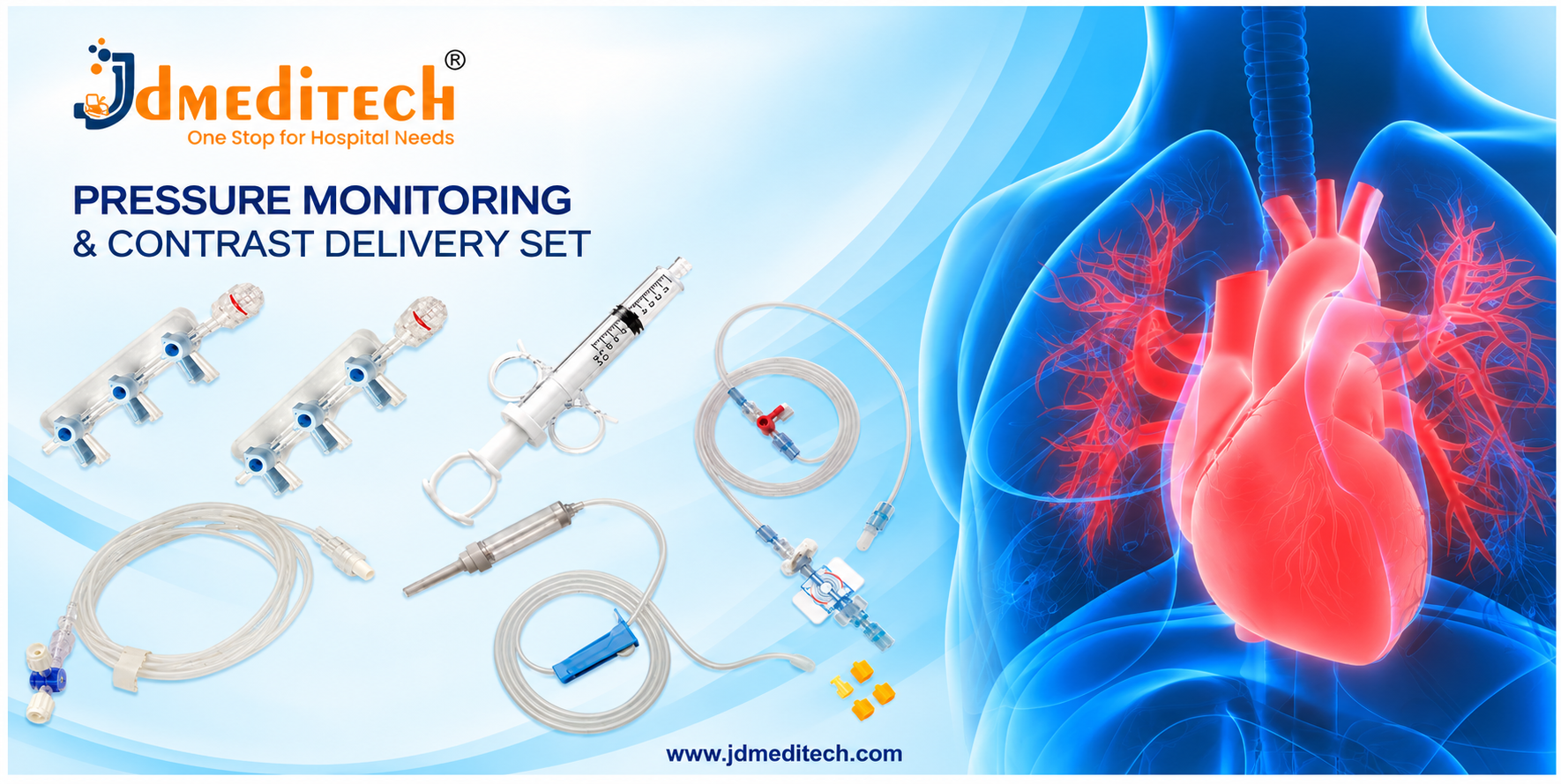
A Pressure Monitoring and Contrast Delivery Set is a collection of medical devices and accessories that may support pressure measurement and contrast media administration during selected catheter-based procedures. These systems are commonly associated with cardiac catheterization laboratories, angiography, and interventional cardiology.
During cardiovascular procedures, healthcare professionals may need to measure intravascular pressure while also obtaining images of blood vessels. Consequently, compatible pressure monitoring and contrast delivery equipment plays an important role in diagnostic and interventional workflows.
Moreover, suitable syringes, pressure tubing, stopcocks, manifolds, and monitoring accessories help connect different components of a catheterization system. However, each device must be selected according to its approved intended use and compatibility requirements.
JDMeditech provides information about selected cardiology devices and catheterization accessories for hospitals, cardiac centers, and international medical distributors. This article explains the components, applications, features, potential benefits, and safety considerations of pressure monitoring and contrast delivery equipment.
What Is a Pressure Monitoring and Contrast Delivery Set?
A Pressure Monitoring and Contrast Delivery Set refers to a selected combination of devices used to support compatible hemodynamic monitoring and contrast administration activities.
Depending on the product configuration, the set may include control syringes, connecting tubes, manifolds, stopcocks, pressure monitoring lines, and other accessories.
In addition, some systems use an electronic pressure transducer connected to a compatible monitoring system.
However, pressure monitoring and high-pressure contrast injection are distinct functions. Therefore, not every component is suitable for both applications.
Understanding Hemodynamic Pressure Monitoring
Hemodynamic pressure monitoring involves measuring pressure within selected parts of the cardiovascular system.
For example, cardiac catheterization may involve assessment of arterial pressure or pressures within the heart.
Moreover, pressure measurements can help specialists evaluate selected cardiovascular conditions and guide clinical decisions.
Depending on the system, a pressure transducer converts fluid pressure into an electrical signal for display on a compatible monitor.
Nevertheless, accurate measurement depends on appropriate equipment setup, calibration or zeroing, and clinical technique.
Understanding Contrast Media Delivery
Contrast media are substances used to improve the visibility of selected anatomical structures during medical imaging.
In angiography, compatible iodinated contrast media help clinicians visualize blood vessels under X-ray imaging.
For example, coronary angiography may use contrast administration to evaluate narrowing or blockage within coronary arteries.
Furthermore, selected catheter-based interventions require repeated imaging to assess device position and treatment results.
However, contrast administration carries risks, including allergic-like reactions and kidney-related complications in susceptible patients.
Why Are Pressure Monitoring and Contrast Delivery Devices Used?
These devices support different but related activities during selected cardiovascular procedures.
First, pressure monitoring equipment may provide information about cardiovascular pressure.
Meanwhile, contrast delivery accessories support administration of suitable contrast media through compatible catheter systems.
Consequently, these devices may form part of a broader diagnostic or interventional workflow.
However, their actual use depends on the procedure, the patient’s condition, and the manufacturer’s specifications.
Common Components of a Pressure Monitoring and Contrast Delivery Set
Different manufacturers offer different equipment configurations. Therefore, the following components represent commonly associated devices rather than a confirmed packing list for the pictured JDMeditech product.
1. Angiographic Control Syringe
An angiographic control syringe may support manual administration of contrast media through a compatible catheter system.
Moreover, specialized control syringes may include different handle or connector configurations.
However, syringe capacity, pressure capability, and intended use vary by product.
2. High-Pressure Extension Line
A high-pressure extension line connects compatible components of a contrast delivery system.
For example, selected lines are designed to transfer contrast media between an angiographic syringe and catheter.
Furthermore, the tubing must be rated for the intended injection conditions.
Importantly, ordinary monitoring tubing must not be assumed suitable for power injection.
3. Angiography Manifold
An angiography manifold is a multiport fluid-control accessory used in selected catheterization procedures.
Depending on its design, it may help manage connections between syringes, fluid lines, and monitoring equipment.
Moreover, manifold configurations may vary in their number of ports and stopcock arrangements.
4. Pressure Transducer
A pressure transducer converts pressure into a signal that a compatible monitoring system can display.
In selected cardiac catheterization procedures, this equipment supports hemodynamic assessment.
However, the transducer may be supplied separately from the disposable fluid delivery accessories.
5. Pressure Monitoring Tubing
Compatible pressure monitoring tubing provides a fluid pathway between a catheter and selected pressure monitoring components.
Furthermore, tubing properties can influence the quality of the measured pressure waveform.
Therefore, clinicians must use the appropriate tubing for the monitoring system.
6. Three-Way Stopcock
A three-way stopcock is a fluid-control accessory that helps manage compatible connections.
For example, selected stopcocks support different fluid pathways during catheterization procedures.
However, the stopcock’s pressure rating and approved application must match the intended system.
7. Contrast Transfer Accessories
Some contrast delivery systems include transfer tubing, spikes, or other accessories for handling contrast media.
Nevertheless, the actual accessories depend on the manufacturer’s configuration.
8. Connecting Tubes and Luer Connectors
Suitable connecting tubes and connectors support compatible fluid pathways.
Moreover, secure connections help reduce the risk of leakage or disconnection.
However, hospitals must confirm connector compatibility and pressure ratings before use.
Pressure Monitoring and Contrast Delivery Set Components and Functions
| Component | Primary Function |
|---|---|
| Angiographic Control Syringe | Supports compatible manual contrast administration |
| High-Pressure Extension Line | Connects approved contrast delivery components |
| Angiography Manifold | Supports management of selected fluid pathways |
| Pressure Transducer | Converts pressure into a monitoring signal |
| Pressure Monitoring Tubing | Connects compatible pressure monitoring components |
| Three-Way Stopcock | Supports control of selected fluid pathways |
| Contrast Transfer Accessories | Support compatible contrast media transfer |
| Luer Connectors | Connect compatible fluid delivery components |
Importantly, this table is educational. The actual JDMeditech set contents must be verified against the product datasheet and packing list.
Key Features of Pressure Monitoring and Contrast Delivery Equipment
1. Compatible Pressure Monitoring
Suitable transducers and monitoring lines support selected hemodynamic measurements.
Consequently, clinicians can evaluate pressure information when clinically indicated.
2. Contrast Administration Support
Compatible syringes and connecting lines support contrast delivery during selected angiographic procedures.
However, injection conditions must remain within the approved specifications of every component.
3. Multiple Connection Options
Manifolds and stopcocks may provide multiple fluid connections.
Furthermore, their configurations depend on the intended application.
4. Different Tubing Configurations
Pressure monitoring and contrast delivery tubing are available in different lengths, materials, and designs.
Therefore, purchasing teams should confirm the required dimensions and pressure ratings.
5. Integration With Catheterization Equipment
Selected accessories can connect with compatible angiographic catheters and monitoring systems.
Nevertheless, compatibility must be confirmed rather than assumed.
Clinical Applications of Pressure Monitoring and Contrast Delivery Systems
1. Coronary Angiography
Coronary angiography uses contrast media and X-ray imaging to visualize coronary arteries.
During the procedure, compatible contrast delivery accessories may support administration of the selected contrast agent.
In addition, pressure monitoring may be performed when clinically appropriate.
2. Cardiac Catheterization
Cardiac catheterization involves catheter-based evaluation of selected cardiovascular conditions.
For example, clinicians may assess pressure within different parts of the heart or circulation.
Moreover, contrast imaging may support anatomical evaluation when indicated.
3. Percutaneous Coronary Intervention
Percutaneous coronary intervention, or PCI, is a catheter-based treatment for selected coronary artery narrowings.
During PCI, contrast imaging helps specialists assess coronary anatomy and treatment results.
Furthermore, compatible monitoring accessories may support the overall catheterization workflow.
4. Peripheral Angiography
Peripheral angiography may be used to evaluate selected blood vessels outside the heart.
Depending on the procedure, compatible contrast delivery accessories may support vascular imaging.
However, devices must be approved for the intended application.
5. Selected Hemodynamic Studies
Hemodynamic studies may involve measurement of pressure within selected cardiovascular structures.
Consequently, compatible transducers, monitoring lines, and related accessories can be important parts of the equipment setup.
6. Selected Interventional Radiology Procedures
Some interventional radiology procedures use contrast media and catheter-based devices.
Nevertheless, the suitability of any particular accessory depends on its intended use and pressure rating.
How Are Pressure Monitoring and Contrast Delivery Systems Used?
Qualified healthcare professionals use these systems in appropriately equipped clinical environments.
First, the clinical team evaluates the patient’s condition and determines which measurements or imaging procedures are required.
Next, specialists select compatible catheters, pressure monitoring components, and contrast delivery accessories.
During the procedure, the team uses the approved equipment to obtain selected pressure measurements or administer contrast media.
Afterward, clinicians interpret the resulting hemodynamic data and imaging findings.
Finally, the healthcare team documents the procedure and monitors the patient for potential complications.
However, the exact workflow depends on the clinical indication and equipment configuration. This overview is not intended as procedural training.
Potential Benefits of Suitable Pressure Monitoring and Contrast Delivery Equipment
1. Support for Hemodynamic Assessment
Compatible pressure monitoring systems can provide useful information during selected cardiovascular investigations.
As a result, clinicians may gain additional data to support diagnosis and treatment planning.
2. Support for Vascular Imaging
Appropriate contrast delivery equipment helps administer contrast media during selected angiographic procedures.
Consequently, imaging can provide information about blood vessel anatomy.
3. Integration With Catheterization Workflows
Compatible accessories may support fluid connections and monitoring activities within a catheterization laboratory.
Moreover, suitable configurations can help teams organize procedure-specific equipment.
4. Different Equipment Options
Manufacturers offer different syringes, tubing, manifolds, and monitoring accessories.
Therefore, hospitals can select devices that match their equipment and clinical requirements.
5. Support for Diagnostic and Interventional Procedures
Selected systems may be used during both diagnostic catheterization and interventional procedures.
However, each component must be suitable for the intended application.
Pressure Monitoring vs Contrast Delivery
Although these functions may occur during the same catheterization procedure, they serve different purposes.
| Feature | Pressure Monitoring | Contrast Delivery |
|---|---|---|
| Primary Purpose | Measure cardiovascular pressure | Administer contrast media for imaging |
| Common Equipment | Transducer and monitoring tubing | Syringe, injector, and rated tubing |
| Output | Pressure values or waveforms | Contrast-enhanced imaging |
| Compatibility | Monitoring system requirements | Injection pressure and flow requirements |
| Key Consideration | Accurate pressure measurement | Safe contrast administration |
Importantly, a device intended only for pressure monitoring must not be used for high-pressure contrast injection unless the manufacturer specifically approves that application.
Manual Contrast Injection vs Power Injection
Contrast media may be administered manually or through a compatible powered injection system.
Manual injection uses suitable syringes and catheter connections according to the intended procedure.
In contrast, power injection uses specialized equipment to deliver contrast media under controlled settings.
Moreover, power injection can generate substantial pressure within the fluid delivery system.
Therefore, every component must be rated for the intended pressure and flow conditions.
However, a product described as an angiographic syringe or extension line should not automatically be considered power-injector compatible.
Risks and Safety Considerations
Pressure monitoring and contrast delivery procedures carry important risks.
For example, potential equipment-related complications include fluid leakage, disconnection, inaccurate pressure readings, and air entering the vascular system.
Furthermore, inappropriate injection pressure may damage equipment or contribute to vascular injury.
Contrast media may also cause allergic-like or physiological reactions.
In addition, some patients face an increased risk of kidney-related complications following iodinated contrast administration.
Consequently, clinicians must assess patient-specific risks and follow appropriate contrast administration protocols.
Moreover, compatible equipment, correct pressure ratings, aseptic handling, and appropriate clinical monitoring are essential.
Why Are Pressure Ratings Important?
Pressure ratings indicate the conditions under which a device is designed to operate.
For example, high-pressure contrast injection tubing must withstand its specified operating conditions.
However, the maximum permitted pressure varies between devices and manufacturers.
Therefore, the lowest applicable pressure limit among connected components must be respected according to the system instructions.
Importantly, pressure ratings should never be estimated from product appearance or tubing thickness.
Why Is Pressure Transducer Accuracy Important?
Accurate hemodynamic pressure monitoring depends on suitable equipment and appropriate clinical setup.
For example, transducer positioning and calibration can influence the displayed measurements.
Furthermore, air bubbles or other problems within a fluid-filled monitoring system may affect waveform quality.
Consequently, clinicians must follow the approved monitoring system instructions.
How to Choose a Pressure Monitoring and Contrast Delivery Set
Hospitals and medical distributors should confirm the intended procedure before purchasing equipment.
First, determine whether the requirement involves pressure monitoring, manual contrast delivery, power injection, or a combination of approved functions.
Next, review the specifications of each component and its compatibility with existing equipment.
Important Equipment Selection Factors
- Approved intended use
- Pressure transducer type, if included
- Pressure monitoring system compatibility
- Control syringe capacity
- Manual or power injection compatibility
- Maximum rated operating pressure
- Maximum supported flow rate, where applicable
- Extension tubing length and diameter
- Manifold port configuration
- Stopcock design and pressure rating
- Luer connector compatibility
- Contrast media compatibility
- Single-use or reusable classification
- Sterile packaging and shelf life
- Actual number of supplied components
- Manufacturer instructions for use
- Applicable regulatory documentation
Furthermore, purchasing teams should request the exact product datasheet and packing list before placing an order.
Pressure Monitoring and Contrast Delivery Accessories by JDMeditech
JDMeditech provides information about selected interventional cardiology devices and catheterization accessories for hospitals, cardiac centers, and international medical distributors.
Customers can contact JDMeditech to inquire about pressure monitoring accessories, angiographic syringes, contrast delivery tubing, and compatible product configurations.
Moreover, the team can confirm available models, technical specifications, and applicable documentation for individual product inquiries.
For additional information, visit www.jdmeditech.com.
Frequently Asked Questions About Pressure Monitoring and Contrast Delivery Set
1. What is a Pressure Monitoring and Contrast Delivery Set?
It refers to selected medical devices and accessories that support compatible pressure measurement and contrast administration during catheter-based procedures.
2. What is the purpose of hemodynamic pressure monitoring?
Hemodynamic monitoring provides information about pressure within selected parts of the cardiovascular system.
3. What is an angiographic control syringe?
An angiographic control syringe is a specialized syringe used for compatible contrast administration during selected angiographic procedures.
4. What is a pressure transducer?
A pressure transducer converts pressure into an electrical signal that can be displayed by a compatible monitoring system.
5. What is a high-pressure extension line?
A high-pressure extension line is a connecting tube designed for specified injection conditions within an approved contrast delivery system.
6. Can ordinary pressure monitoring tubing be used for power injection?
Not unless the manufacturer specifically approves it for the intended injection pressure and flow conditions.
7. What is the function of an angiography manifold?
A manifold helps manage selected fluid pathways and connections during compatible catheterization procedures.
8. Does every set include a pressure transducer?
No. Product configurations vary, and pressure transducers may be supplied separately.
9. What are the main risks of contrast administration?
Potential risks include allergic-like reactions, extravasation, air embolism, and kidney-related complications in susceptible patients.
10. Where can hospitals inquire about JDMeditech catheterization accessories?
Hospitals and medical distributors can visit JDMeditech to request available product details and quotations.
Conclusion
A Pressure Monitoring and Contrast Delivery Set may support selected diagnostic and interventional procedures involving cardiovascular pressure measurement and contrast administration.
Moreover, compatible syringes, tubing, manifolds, stopcocks, and monitoring accessories are important components of modern catheterization workflows.
However, accurate monitoring and safe contrast delivery require appropriately selected equipment, correct compatibility, and professional clinical supervision.
Therefore, hospitals should choose devices according to clinical requirements, manufacturer specifications, and applicable safety standards.
Contact JDMeditech for interventional cardiology accessories, angiography equipment inquiries, and international medical device requirements.
Medical Disclaimer: This article provides general educational information and is not a procedural training guide. Qualified healthcare professionals must make all treatment and device-selection decisions according to clinical judgment, applicable guidelines, and approved manufacturer instructions.




