



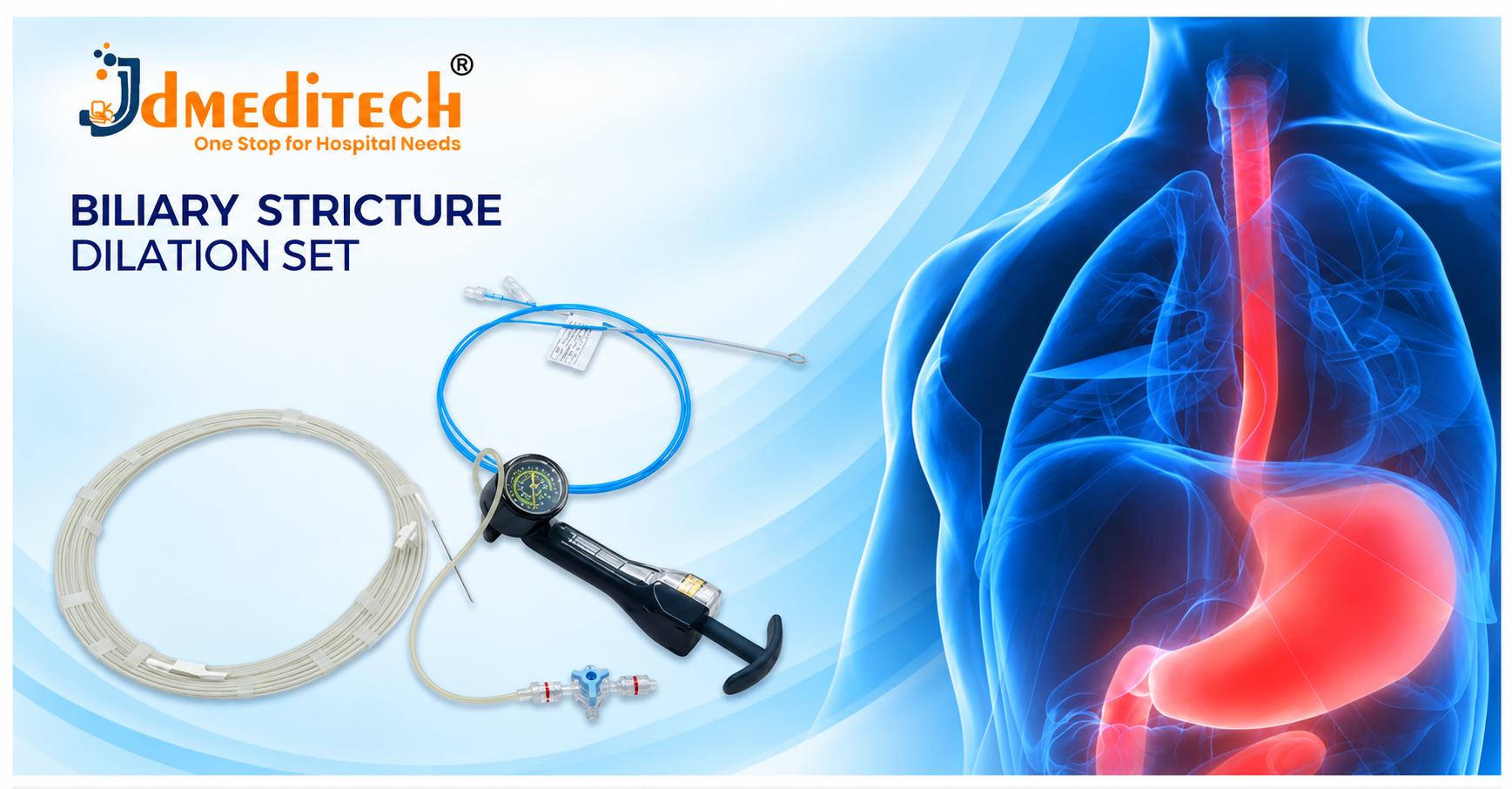
A Biliary Stricture Dilation Set contains specialized medical devices that may support the treatment of selected narrowed areas within the bile ducts. Gastroenterologists and other appropriately trained specialists use compatible balloon dilation catheters, guide wires, and inflation accessories during selected biliary interventions.
The biliary system carries bile from the liver toward the small intestine. However, inflammation, scarring, surgery, or certain diseases can narrow the bile ducts and interfere with normal bile drainage.
Consequently, patients may develop jaundice, itching, abdominal discomfort, or infection. In suitable cases, endoscopic balloon dilation may help widen the affected area and support further treatment.
This article from JDMeditech explains the common components, clinical applications, potential benefits, equipment requirements, and safety considerations associated with biliary stricture dilation.
What Is a Biliary Stricture Dilation Set?
A Biliary Stricture Dilation Set refers to a selected combination of instruments used during compatible procedures for widening narrowed segments of the biliary system.
Depending on the product configuration, a set may contain a biliary balloon dilation catheter, guide wire, inflation device, and related connectors.
Moreover, some procedures require additional endoscopic accessories, imaging equipment, or biliary stents.
However, not every commercial set contains all these components. Therefore, hospitals should confirm the exact packing list before ordering.
What Is a Biliary Stricture?
A biliary stricture is an abnormal narrowing within a bile duct. It may affect the intrahepatic or extrahepatic biliary system.
When the passage becomes narrowed, bile may not drain normally. As a result, pressure can increase within the biliary system.
Furthermore, persistent obstruction may contribute to cholangitis, liver injury, and other complications.
Importantly, a biliary stricture can be benign or malignant. Consequently, clinicians must investigate its cause before choosing treatment.
Common Causes of Biliary Strictures
Several conditions can cause narrowing of the bile ducts.
- Previous gallbladder or bile duct surgery
- Liver transplantation and biliary anastomotic scarring
- Chronic pancreatitis
- Primary sclerosing cholangitis
- Inflammatory or ischemic bile duct injury
- Selected infections
- Cholangiocarcinoma and other malignancies
- Compression from nearby tumors or structures
However, these conditions require different treatment approaches. Therefore, dilation alone is not suitable for every biliary stricture.
Symptoms of Biliary Stricture
The symptoms depend on the location, severity, and underlying cause of the narrowing.
For example, patients may experience yellowing of the skin or eyes, itching, dark urine, pale stools, or abdominal discomfort.
In addition, biliary obstruction may lead to fever and chills when infection develops.
Nevertheless, some strictures cause few symptoms initially and are identified through laboratory tests or imaging.
Because fever, jaundice, and abdominal pain may indicate cholangitis, these symptoms require urgent medical assessment.
Why Is Biliary Stricture Dilation Performed?
Biliary stricture dilation aims to widen a selected narrowed segment of the bile duct.
In suitable cases, this may help improve drainage or facilitate the placement of additional therapeutic devices.
Moreover, dilation can form part of a broader treatment strategy involving temporary biliary stenting.
However, the appropriate approach depends on the stricture’s cause and location.
For example, current European Society of Gastrointestinal Endoscopy guidance recommends different strategies for postoperative strictures, transplant-related strictures, chronic pancreatitis, and primary sclerosing cholangitis.
Common Components of a Biliary Stricture Dilation Set
The following instruments are commonly associated with selected biliary dilation procedures. However, they do not represent a confirmed packing list for the pictured JDMeditech set.
1. Biliary Balloon Dilation Catheter
A biliary balloon dilation catheter is designed to expand a selected narrowed duct segment within its approved intended use.
Moreover, different catheter models offer different balloon dimensions and working lengths.
Therefore, clinicians must select the appropriate device according to duct anatomy and product specifications.
2. Balloon Inflation Device
A compatible inflation device supports controlled inflation and deflation of selected dilation balloons.
Some inflation devices include a pressure gauge to display inflation pressure.
However, the permitted pressure range depends on the balloon catheter and the manufacturer’s instructions.
3. ERCP Guide Wire
A compatible guide wire may support access to the intended biliary treatment area.
Furthermore, it may provide a pathway for compatible balloon catheters and other endoscopic accessories.
Nevertheless, guide wire diameter and length must match the selected system.
4. Connecting Tubing
Suitable connecting tubing may form part of a compatible inflation system.
Consequently, the tubing and connectors must meet the manufacturer’s requirements.
5. ERCP Cannula
An ERCP cannula may support selected biliary access and contrast administration activities.
However, this accessory may be supplied separately from the dilation set.
6. Biliary Stent
Selected strictures require temporary biliary stenting to support longer-term treatment.
Depending on the indication, clinicians may use suitable plastic stents or covered self-expandable metal stents.
Importantly, a biliary stent is a separate therapeutic device and should not be assumed to be included in the set.
7. Endoscopic and Fluoroscopic Equipment
ERCP commonly uses a duodenoscope and fluoroscopic imaging.
These systems support visualization and assessment during appropriate biliary interventions.
However, endoscopes and imaging systems are not normally part of a disposable balloon dilation kit.
Biliary Stricture Dilation Set Components and Functions
| Component | Primary Function |
|---|---|
| Biliary Balloon Dilation Catheter | Supports widening of selected biliary strictures |
| Inflation Device | Supports controlled inflation of compatible balloons |
| Pressure Gauge | Displays pressure in compatible inflation systems |
| ERCP Guide Wire | Supports compatible biliary access and device exchange |
| Connecting Tubing | Connects approved inflation components |
| ERCP Cannula | Supports selected biliary access activities |
| Biliary Stent | Supports selected biliary drainage strategies |
| Duodenoscope and Imaging | Support visualization and procedural assessment |
Before purchasing, confirm which components are supplied together and which require separate ordering.
Types of Biliary Dilation Devices
1. Biliary Balloon Dilators
Biliary balloon dilators are designed for selected balloon dilation procedures.
Moreover, different devices have different balloon profiles, working lengths, and compatibility requirements.
2. Biliary Catheter Dilators
Some biliary interventions use specialized tapered or catheter-based dilators.
However, their construction and intended use differ from balloon dilation devices.
3. Specialized Biliary Dilation Systems
Additional devices may be used in complex endoscopic or percutaneous biliary interventions.
Therefore, clinicians should select equipment according to the specific anatomy and approved indication.
Clinical Applications of Biliary Stricture Dilation
1. Postoperative Benign Biliary Strictures
Some patients develop bile duct narrowing after gallbladder or biliary surgery.
Depending on the location and severity, endoscopic treatment may involve dilation and temporary stenting.
2. Post-Liver Transplant Biliary Strictures
Biliary anastomotic strictures can occur after liver transplantation.
In selected cases, ERCP-based treatment may involve dilation and suitable temporary stent placement.
However, treatment depends on the patient’s anatomy and clinical condition.
3. Chronic Pancreatitis-Related Biliary Strictures
Chronic pancreatitis may cause inflammation or fibrosis that narrows the distal common bile duct.
Consequently, selected patients require endoscopic biliary treatment.
However, current guidelines often favor temporary covered metal stenting for suitable chronic pancreatitis-related benign strictures rather than balloon dilation alone.
4. Primary Sclerosing Cholangitis
Primary sclerosing cholangitis is a chronic disease involving inflammation and scarring of the bile ducts.
Selected high-grade strictures may require therapeutic intervention.
Importantly, contemporary ESGE guidance suggests balloon dilation alone for suitable high-grade strictures associated with primary sclerosing cholangitis because routine additional stenting may increase adverse events.
5. Selected Malignant Biliary Obstructions
Malignant strictures may result from bile duct cancer, pancreatic cancer, or other tumors.
In these cases, biliary drainage and oncological management are central treatment considerations.
However, balloon dilation is not a substitute for appropriate cancer diagnosis or treatment.
6. Selected Percutaneous Biliary Interventions
Some biliary strictures require image-guided percutaneous treatment when endoscopic access is difficult or unsuitable.
Nevertheless, percutaneous devices and access systems may differ from those used during ERCP.
Key Features of Biliary Stricture Dilation Equipment
1. Balloon-Based Dilation
Compatible balloon catheters support controlled expansion during selected biliary procedures.
However, balloon characteristics depend on the specific product.
2. Different Balloon Dimensions
Manufacturers offer different balloon diameters and lengths for specific applications.
Therefore, clinicians must select the appropriate dimensions for the intended anatomy.
3. Guide Wire Compatibility
Selected dilation systems work with specified guide wire sizes.
Moreover, compatibility helps determine whether the catheter can be used with the intended equipment.
4. Pressure Monitoring During Inflation
Some inflation devices include a pressure gauge.
Consequently, the operator can observe the pressure indicated by the compatible inflation system.
Nevertheless, the manufacturer’s approved balloon pressure limits must always be followed.
5. Endoscopic Compatibility
ERCP balloon catheters must be compatible with the intended endoscope and accessories.
Therefore, hospitals should confirm the catheter dimensions and endoscope working channel requirements.
How Is Biliary Stricture Dilation Performed?
A qualified gastroenterologist or interventional specialist performs biliary stricture dilation in an appropriately equipped clinical setting.
First, the clinical team evaluates the patient’s symptoms, liver function tests, and diagnostic imaging.
Next, specialists determine the cause, location, and severity of the biliary narrowing.
When appropriate, an endoscopic or image-guided intervention may be selected.
During the procedure, the operator uses compatible equipment to assess the stricture and perform the planned treatment.
In selected cases, balloon dilation forms part of a treatment strategy that also includes temporary biliary stenting or drainage.
Afterward, the specialist evaluates the result and monitors for potential complications.
Finally, the healthcare team establishes an individualized follow-up plan.
However, the exact procedure depends on the stricture type and patient condition. This overview is not intended as procedural training.
Potential Benefits of Biliary Stricture Dilation
1. Widening of Selected Biliary Narrowings
Successful dilation may increase the opening of a narrowed bile duct segment.
As a result, selected patients may experience improved bile drainage.
2. Endoscopic Treatment Option
Some biliary strictures can be treated through endoscopic techniques.
Consequently, suitable patients may avoid more invasive procedures.
3. Support for Additional Therapy
In selected cases, dilation may facilitate further treatment, including compatible biliary stent placement.
However, the need for stenting depends on the clinical indication.
4. Different Equipment Configurations
Different balloon and catheter designs are available for specific procedures.
Therefore, hospitals can select suitable devices according to their equipment requirements.
5. Part of Long-Term Stricture Management
Some benign biliary strictures require repeated endoscopic assessment or treatment.
Moreover, appropriate follow-up helps identify persistent or recurrent obstruction.
Biliary Balloon Dilation vs Biliary Stenting
Balloon dilation and biliary stenting are different treatment approaches that may be used separately or together.
| Feature | Balloon Dilation | Biliary Stenting |
|---|---|---|
| Primary Purpose | Widens a selected narrowed segment | Supports biliary drainage or stricture treatment |
| Device | Inflatable balloon catheter | Plastic or metal stent |
| Device Position | Balloon is removed after treatment | Stent remains for a planned period or according to its indication |
| Follow-Up | Depends on the underlying condition | May require planned exchange or removal |
| Selection | Depends on stricture characteristics | Depends on stricture characteristics and drainage needs |
Importantly, balloon dilation alone is not universally sufficient for benign biliary strictures. Current professional guidelines recommend different approaches according to the cause of narrowing.
What Is the Difference Between Benign and Malignant Biliary Strictures?
Benign biliary strictures develop from noncancerous causes such as inflammation, surgical injury, or chronic pancreatitis.
In contrast, malignant biliary strictures arise from cancer or cancer-related compression.
Moreover, the diagnosis determines the appropriate treatment pathway.
Therefore, unexplained biliary narrowing requires suitable clinical investigation before definitive treatment.
Risks and Safety Considerations
Biliary dilation and ERCP are invasive procedures with potentially serious complications.
For example, adverse events may include post-ERCP pancreatitis, bleeding, infection, and bile duct injury.
Furthermore, perforation and sedation-related complications may occur.
In addition, incomplete drainage can contribute to cholangitis or persistent obstruction.
Consequently, specialists must assess patient-specific risks and select appropriate devices.
Moreover, the inflation pressure and balloon dimensions must remain within the approved manufacturer specifications.
Recovery After Biliary Stricture Dilation
Recovery depends on the patient’s condition and the type of intervention performed.
After treatment, the healthcare team monitors the patient for pain, infection, bleeding, and other complications.
Furthermore, follow-up may involve blood tests, imaging, or repeat endoscopic assessment.
Patients with temporary biliary stents may require scheduled stent exchange or removal.
However, fever, worsening jaundice, severe abdominal pain, or persistent vomiting require urgent medical assessment.
How to Choose a Biliary Stricture Dilation Set
Hospitals and medical distributors should confirm the intended procedure before purchasing biliary dilation equipment.
First, determine whether the requirement involves an ERCP balloon catheter, a percutaneous biliary dilation system, or another specialized device.
Next, verify the product specifications and compatibility requirements.
Important Equipment Selection Factors
- Approved intended use
- Balloon diameter options
- Balloon working length
- Catheter outer diameter
- Catheter working length
- Endoscope channel compatibility
- Guide wire compatibility
- Balloon rated burst pressure
- Recommended inflation medium
- Inflation device compatibility
- Pressure gauge specifications
- Radiopaque marker availability
- Connector and tubing configuration
- Sterile packaging and shelf life
- Single-use classification
- Actual number of supplied components
- Manufacturer instructions for use
- Applicable regulatory documentation
Furthermore, purchasing teams should request the technical datasheet and exact packing list before ordering.
Biliary Stricture Dilation Equipment by JDMeditech
JDMeditech welcomes inquiries from hospitals, gastroenterology departments, endoscopy centers, and international medical distributors regarding biliary dilation equipment and related accessories.
Customers can request information about available configurations, balloon catheter dimensions, compatible guide wires, and inflation devices.
Moreover, the JDMeditech team can confirm product availability, technical specifications, and applicable documentation for a specific inquiry.
For additional information, visit www.jdmeditech.com.
Frequently Asked Questions About Biliary Stricture Dilation Set
1. What is a Biliary Stricture Dilation Set?
A Biliary Stricture Dilation Set refers to selected medical devices used to support widening of narrowed bile duct segments. Exact contents vary by manufacturer.
2. What is a biliary stricture?
A biliary stricture is an abnormal narrowing of a bile duct that may interfere with bile drainage.
3. What is a biliary balloon dilator?
A biliary balloon dilator is a specialized catheter designed for selected dilation procedures within its approved intended use.
4. Is biliary stricture dilation performed during ERCP?
Yes. Selected biliary strictures may be treated endoscopically during ERCP. However, other approaches may be required in certain patients.
5. Does every biliary stricture require balloon dilation?
No. Treatment depends on the cause, location, severity, and clinical significance of the narrowing.
6. Is biliary balloon dilation the same as biliary stenting?
No. Balloon dilation widens a selected narrowed segment, while a biliary stent supports drainage or ongoing stricture treatment.
7. Can a biliary stricture return after treatment?
Yes. Some strictures recur and require additional treatment or follow-up.
8. Does every dilation set include a pressure gauge?
No. Some systems include a compatible inflation device with a pressure gauge, while other configurations require separate equipment.
9. What are the risks of biliary dilation?
Potential complications include pancreatitis, bleeding, infection, perforation, and bile duct injury.
10. Where can hospitals inquire about JDMeditech biliary dilation equipment?
Hospitals and medical distributors can visit JDMeditech to request available product details and quotations.
Conclusion
A Biliary Stricture Dilation Set may support selected procedures used to widen narrowed sections of the biliary system.
Moreover, compatible balloon catheters, guide wires, inflation devices, and related accessories are important components of certain endoscopic biliary interventions.
However, treatment depends on the underlying cause of the stricture, the patient’s condition, and the approved intended use of the equipment.
Therefore, hospitals should select devices according to clinical requirements, current professional guidelines, and manufacturer specifications.
Contact JDMeditech for biliary dilation equipment inquiries, gastroenterology accessories, and international medical device requirements.
Medical Disclaimer: This article provides general educational information and is not a procedural training guide or individual treatment recommendation. Qualified healthcare professionals must make treatment and device-selection decisions according to clinical judgment, applicable guidelines, and approved manufacturer instructions.




