



Urology Disposables – Types, Features, Uses and Applications
Urology Disposables include medical devices used during selected diagnostic, therapeutic and surgical procedures involving the urinary system. Hospitals and urology departments use different disposable products for urinary drainage, catheterization, ureteric access and dilation.
Furthermore, single-use devices can support clinical workflows when healthcare professionals follow appropriate handling and infection prevention practices. However, each product has specific indications, dimensions and safety requirements.
JDMeditech supplies urology medical devices and surgical consumables for hospitals, healthcare facilities and medical distributors. Additionally, our team can assist customers with available configurations, technical information and quotation requests.
What Are Urology Disposables?
Urology disposables are medical devices intended for one-time use when designated as single-use by the manufacturer.
For example, certain urinary drainage catheters help remove urine from the urinary tract. Meanwhile, ureteric catheters support selected procedures involving the ureter.
Additionally, compatible dilators may help clinicians establish or enlarge access during approved procedures.
Therefore, healthcare facilities should select each product according to its intended use and manufacturer specifications.
Importance of Disposable Urology Products
Disposable medical devices play an important role in modern urology care.
For instance, properly selected sterile single-use products can help avoid risks associated with inadequate reprocessing of reusable devices.
Furthermore, standardized packaging may support inventory management and clinical preparation.
However, disposable products still require correct storage, handling and aseptic technique.
Types of Urology Disposables
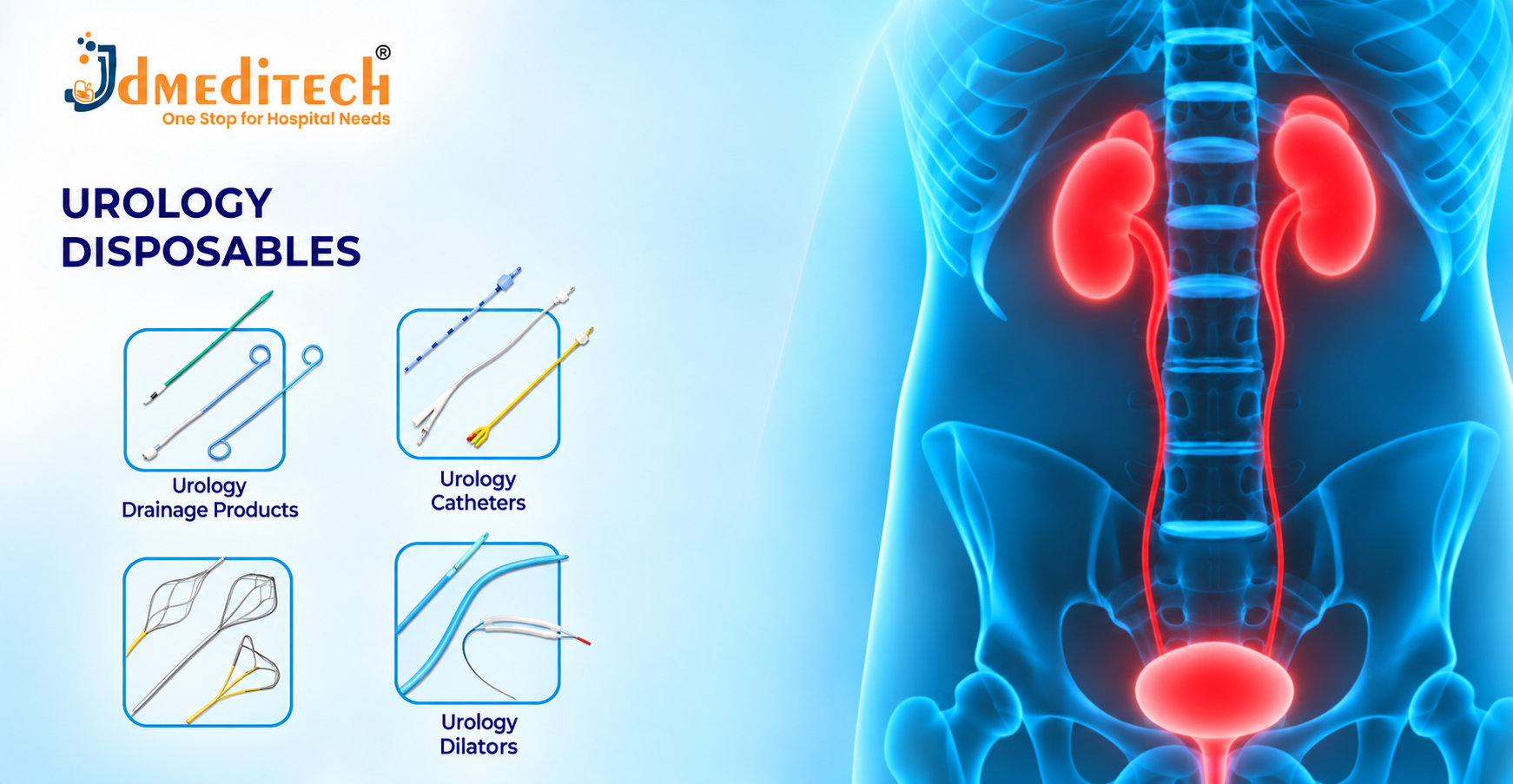
The reference image highlights several product groups.
- Urology Drainage Products
- Ureteric Catheters
- Urology Dilators
- Other Compatible Urology Accessories
Each product category serves a different clinical purpose. Consequently, hospitals should verify the required dimensions and device configuration.
1. Urology Drainage Products
Urology drainage products help clinicians manage urinary drainage in selected clinical situations.
For example, a urinary catheter may provide temporary bladder drainage when medically indicated.
Additionally, specialized drainage devices may support selected upper urinary tract procedures.
However, each drainage system requires appropriate clinical assessment and device selection.
Types of Urology Drainage Products
Common product categories may include:
- Foley Catheter
- Nelaton Catheter
- Suprapubic Catheter
- Nephrostomy Drainage Catheter
- Ureteric Drainage Catheter
- Urine Collection Accessories
- Other Manufacturer-Specified Drainage Devices
However, the reference image does not confirm that every listed product is included in the illustrated collection.
Foley Catheter
A Foley catheter provides bladder drainage through a flexible tube with a retention balloon.
For example, clinicians may use it when continuous bladder drainage is medically necessary.
Additionally, the balloon helps retain the catheter in its intended position.
However, catheter size, balloon capacity and material vary by model.
Nelaton Catheter
A Nelaton catheter is a straight urinary catheter used for selected intermittent catheterization applications.
Furthermore, its design differs from balloon-retained catheters.
Therefore, clinicians must select the correct catheter type for the intended purpose.
Suprapubic Catheter
A suprapubic catheter provides bladder drainage through a surgically established route in the lower abdomen.
Additionally, specialists may select this approach in certain clinical situations.
However, insertion and management require appropriate training and clinical oversight.
Nephrostomy Drainage Catheter
A nephrostomy catheter supports urinary drainage from the kidney collecting system through an established percutaneous route.
For example, specialists may use nephrostomy drainage when upper urinary tract decompression is indicated.
However, the clinical team must assess the patient and choose a suitable catheter configuration.
Features of Urology Drainage Devices
Depending on the product, drainage devices may offer the following characteristics.
- Flexible catheter construction
- Model-specific drainage openings
- Different catheter sizes
- Compatible drainage connectors
- Manufacturer-specified material
- Defined drainage length
- Sterile packaging where indicated
- Single-use labeling where applicable
Furthermore, buyers should verify every feature against the official product datasheet.
2. Ureteric Catheters
Ureteric catheters are specialized medical devices used during selected procedures involving the ureter and upper urinary tract.
For example, clinicians may use a compatible catheter during retrograde evaluation or other approved endourology procedures.
Additionally, certain designs may support controlled fluid delivery or drainage.
However, the exact function depends on the catheter model.
What Is a Ureteric Catheter?
A ureteric catheter is a narrow tubular device designed for selected applications within the ureter.
Furthermore, different tip configurations may support different clinical requirements.
Therefore, healthcare professionals should confirm the intended use before selection.
Types of Ureteric Catheters
Depending on the manufacturer, available designs may include:
- Open-End Ureteric Catheter
- Closed-End Ureteric Catheter
- Straight-Tip Ureteric Catheter
- Angled-Tip Ureteric Catheter
- Other Specialized Ureteric Catheter Designs
However, not every manufacturer supplies every configuration.
Features of Ureteric Catheters
- Model-specific catheter diameter
- Defined working length
- Different tip designs
- Compatible connector configuration
- Manufacturer-specified material
- Radiopaque characteristics where specified
- Guidewire compatibility where approved
- Single-use sterile options
Additionally, customers should confirm catheter compatibility with the selected instruments.
Applications of Ureteric Catheters
Qualified specialists may use compatible ureteric catheters during selected procedures.
- Retrograde Pyelography
- Selected Ureteric Access Procedures
- Selected Upper Urinary Tract Evaluation
- Approved Fluid Delivery Applications
- Other Manufacturer-Approved Endourology Procedures
However, clinical suitability depends on patient assessment and the device’s intended use.
Benefits of Ureteric Catheter Systems
Ureteric catheters provide a dedicated device option for selected upper urinary tract procedures.
Furthermore, different configurations allow clinicians to choose a suitable catheter design.
Nevertheless, ureteric injury, infection and other complications remain possible.
3. Urology Dilators
Urology dilators are specialized instruments used to enlarge or establish access through selected anatomical passages.
For example, clinicians may use an approved dilator during a designated urological procedure.
Additionally, different dilator systems serve different anatomical applications.
However, inappropriate dilation may cause tissue injury.
What Is a Urology Dilator?
A urology dilator is a medical device designed for controlled dilation during an approved procedure.
Depending on the product, the device may have a tapered or other specialized configuration.
Furthermore, some dilators are compatible with designated guidewires.
Therefore, clinicians should verify device compatibility and procedural indications.
Types of Urology Dilators
Common urology dilator categories may include:
- Urethral Dilators
- Ureteral Dilators
- Fascial Dilators
- Nephrostomy Tract Dilators
- Other Manufacturer-Approved Dilator Systems
However, these products differ in design and intended use.
Urethral Dilators
Urethral dilators may support selected procedures involving urethral narrowing.
However, repeated dilation is not appropriate for every patient or stricture type.
Therefore, specialists should consider the underlying condition and available treatment alternatives.
Ureteral Dilators
Ureteral dilators may support selected endourology access procedures.
Additionally, compatible designs may be used with designated guidewires.
However, ureteral dilation carries risks, including perforation and other injury.
Fascial Dilators
Fascial dilators may help establish an access tract during selected percutaneous procedures.
Furthermore, different sizes may be available within a compatible system.
However, specialists must follow the approved procedural technique.
Nephrostomy Tract Dilators
Nephrostomy tract dilators support selected percutaneous kidney access procedures.
For example, compatible systems may be used during preparation for nephroscopy.
However, these devices require specialist training and appropriate imaging guidance.
Features of Urology Dilators
- Manufacturer-defined dilator sizes
- Model-specific tapered design
- Defined working length
- Compatible guidewire lumen where provided
- Manufacturer-specified material
- Individual or set configurations
- Sterile single-use options
- Product identification and labeling
Furthermore, the available features depend on the selected product.
4. Other Urology Disposable Accessories
Urology departments may require additional disposable accessories for selected procedures.
For example, guidewires and access devices may support certain endoscopic workflows.
Additionally, compatible connectors and drainage accessories may form part of a clinical setup.
However, each accessory requires separate compatibility verification.
Common Urology Disposable Product Categories
Depending on the supplier, a broader urology disposable range may include:
- Double J Ureteral Stents
- Ureteric Catheters
- Hydrophilic Guidewires
- PTFE Guidewires
- Ureteral Access Sheaths
- Stone Retrieval Baskets
- Nephrostomy Catheters
- Foley Catheters
- Suprapubic Catheters
- Urethral Dilators
- Fascial Dilators
- Urinary Drainage Accessories
However, product availability and specifications require confirmation.
Technical Specifications of Urology Disposables
Exact technical specifications vary by product and manufacturer. Therefore, buyers should review the official datasheet before ordering.
| Parameter | Details to Verify |
|---|---|
| Product Category | Disposable Urology Medical Devices |
| Product Type | Drainage Catheter, Ureteric Catheter or Dilator |
| Size | Confirm manufacturer specifications |
| Working Length | Confirm product datasheet |
| Material | Confirm manufacturer specifications |
| Tip Design | Confirm selected model |
| Guidewire Compatibility | Verify where applicable |
| Connector Type | Confirm product configuration |
| Radiopacity | Verify where specified |
| Sterility | Confirm device labeling |
| Single-Use Status | Confirm instructions for use |
| Packaging | Confirm official packing list |
| Shelf Life | Confirm manufacturer labeling |
| Regulatory Documentation | Verify for destination market |
Comparison of Urology Disposable Categories
Different product groups serve different clinical purposes.
| Product Category | Main Purpose | Common Clinical Area |
|---|---|---|
| Drainage Products | Urinary Drainage | Bladder or Upper Urinary Tract |
| Ureteric Catheters | Selected Ureteric Procedures | Ureter and Upper Urinary Tract |
| Urology Dilators | Controlled Dilation | Selected Urological Access Procedures |
| Other Disposable Accessories | Procedure-Specific Support | Endourology and Related Procedures |
Importance of Correct Product Sizing
Correct sizing supports appropriate device selection.
For example, catheter diameter and working length must match the clinical requirement.
Similarly, a dilator must suit the approved procedure and access route.
Therefore, clinicians should verify dimensions before use.
Importance of Material Selection
Medical device materials differ by product design.
For example, catheter materials may include silicone or other medical-grade polymers.
Additionally, material properties can influence flexibility and handling.
However, buyers must confirm the exact composition from the manufacturer.
Importance of Sterile Packaging
Sterile packaging helps maintain the specified sterile condition until use when the package remains intact and storage requirements are met.
Furthermore, labeling provides important product identification information.
However, damaged or expired sterile packaging may compromise device suitability.
Therefore, staff should inspect each package before opening.
Single-Use Device Considerations
Single-use devices are intended for one use according to their labeling.
Additionally, reuse may introduce contamination, mechanical failure or other hazards.
Therefore, healthcare facilities must follow manufacturer instructions and applicable regulations.
Infection Prevention
Infection prevention remains important during urinary catheterization and other urological procedures.
For example, staff should follow appropriate aseptic practices.
Additionally, clinicians should avoid unnecessary catheter use and reassess continued need.
Consequently, proper clinical protocols help reduce preventable risks.
Handling and Storage Requirements
Disposable devices require appropriate storage and handling.
For example, staff should protect packaging from moisture, damage and unsuitable environmental conditions.
Additionally, hospitals should monitor expiry dates and inventory rotation.
Therefore, storage procedures should follow manufacturer recommendations.
Safety Precautions
Qualified healthcare professionals should use urology disposables only for approved indications.
Furthermore, the clinical team should verify size, compatibility and packaging integrity.
Therefore, users must follow the product instructions and institutional safety protocols.
Potential Risks and Complications
Urology procedures and disposable devices may involve several risks.
- Urinary Tract Infection
- Bleeding
- Tissue Irritation
- Urethral or Ureteric Injury
- Perforation
- Catheter Blockage
- Device Displacement
- Allergic or Material-Related Reactions
However, the risk profile depends on the device, procedure and patient condition.
Applications in Hospitals
Hospitals use disposable urology devices in multiple clinical departments.
For example, urinary drainage products may support selected inpatient care.
Additionally, ureteric catheters and dilators may support designated endourology procedures.
Therefore, hospitals should maintain appropriate product inventories.
Applications in Urology Departments
Urology departments use different disposable devices according to clinical requirements.
Furthermore, compatible accessories support procedure preparation.
However, clinicians must confirm the intended use of each product.
Applications in Surgical Centers
Surgical centers may require sterile disposable accessories for selected procedures.
Additionally, proper preparation helps support clinical workflows.
Therefore, staff should verify product availability and packaging integrity before surgery.
Applications for Medical Distributors
Medical distributors should confirm product specifications before supplying healthcare facilities.
For example, buyers may require particular catheter sizes or dilator configurations.
Additionally, destination-market regulations may affect product selection.
Consequently, distributors should request the relevant technical and regulatory documentation.
How to Choose Urology Disposable Products
Hospitals and procurement teams should review several factors before purchasing.
- Manufacturer’s intended use
- Product category
- Size and working length
- Material specifications
- Tip configuration
- Guidewire compatibility
- Connector compatibility
- Sterility
- Single-use labeling
- Packaging integrity
- Shelf life
- Regulatory documentation
- Manufacturer instructions
Furthermore, clinical staff should confirm product suitability for the intended procedure.
Why Choose JDMeditech?
JDMeditech supplies urology medical devices and surgical consumables for hospitals, healthcare facilities and medical distributors.
Furthermore, our team can assist customers with product information, available configurations and quotation inquiries.
- Urology Drainage Product Inquiries
- Ureteric Catheter Information
- Urology Dilator Product Requests
- Technical Specification Support
- Available Product Configuration Information
- Medical Distributor Inquiries
- International Export Inquiries
However, exact product specifications, availability and regulatory documentation require confirmation.
Frequently Asked Questions
1. What Are Urology Disposables?
They are medical devices intended for one-time use when designated as single-use by the manufacturer.
2. What Are Urology Drainage Products?
They include devices used for selected urinary drainage applications.
3. What Is a Ureteric Catheter?
A ureteric catheter is a specialized tubular device used during selected procedures involving the ureter.
4. What Are Urology Dilators?
They are devices used for controlled dilation during approved urological procedures.
5. Are All Urology Disposables Sterile?
Not necessarily. Therefore, buyers should verify sterility from the product labeling.
6. Are Disposable Urology Devices Reusable?
Single-use devices should not be reused contrary to their labeling and applicable regulations.
7. What Sizes Are Available?
Available sizes depend on the product and manufacturer. Therefore, customers should request the official datasheet.
8. What Materials Are Used?
Materials vary by device. Consequently, buyers should verify the manufacturer’s specifications.
9. Can Ureteric Catheters Be Used With Guidewires?
Some designs support compatible guidewires. However, the intended use and product specifications determine compatibility.
10. What Is the Purpose of a Foley Catheter?
A Foley catheter provides bladder drainage and uses a retention balloon to help maintain its position.
11. What Is the Purpose of a Nephrostomy Catheter?
It supports drainage from the kidney collecting system through an established percutaneous route.
12. Can Urology Dilators Cause Injury?
Yes. Incorrect or unsuitable dilation may cause tissue injury. Therefore, qualified specialists must follow appropriate protocols.
13. How Should Disposable Products Be Stored?
Facilities should follow manufacturer storage instructions and protect packaging integrity.
14. What Should Hospitals Verify Before Ordering?
Hospitals should confirm product dimensions, intended use, material, sterility and regulatory documentation.
15. Where Can Customers Request Product Information?
Hospitals and medical distributors can contact JDMeditech for available product information and quotations.
Conclusion
In conclusion, Urology Disposables support a wide range of urinary drainage and selected endourology procedures.
For example, drainage products help manage urinary drainage, while ureteric catheters support designated upper urinary tract applications.
Additionally, compatible dilators assist with selected access procedures.
Therefore, hospitals should choose disposable devices based on clinical requirements, manufacturer specifications and appropriate safety standards.
JDMeditech – One Stop for Hospital Needs
Website:
www.jdmeditech.com
Related Urology Products
- Foley Catheter
- Nelaton Catheter
- Suprapubic Catheter
- Nephrostomy Catheter
- Ureteric Catheter
- Urethral Dilator
- Ureteral Dilator
- Fascial Dilator
- Double J Ureteral Stent
- Hydrophilic Guidewire
- Ureteral Access Sheath
- Stone Retrieval Basket
Medical Disclaimer
This article provides general educational and product information only. It does not replace professional medical advice, clinical training or manufacturer instructions. Qualified healthcare professionals must select and use devices according to approved indications, product specifications and applicable safety requirements.




