



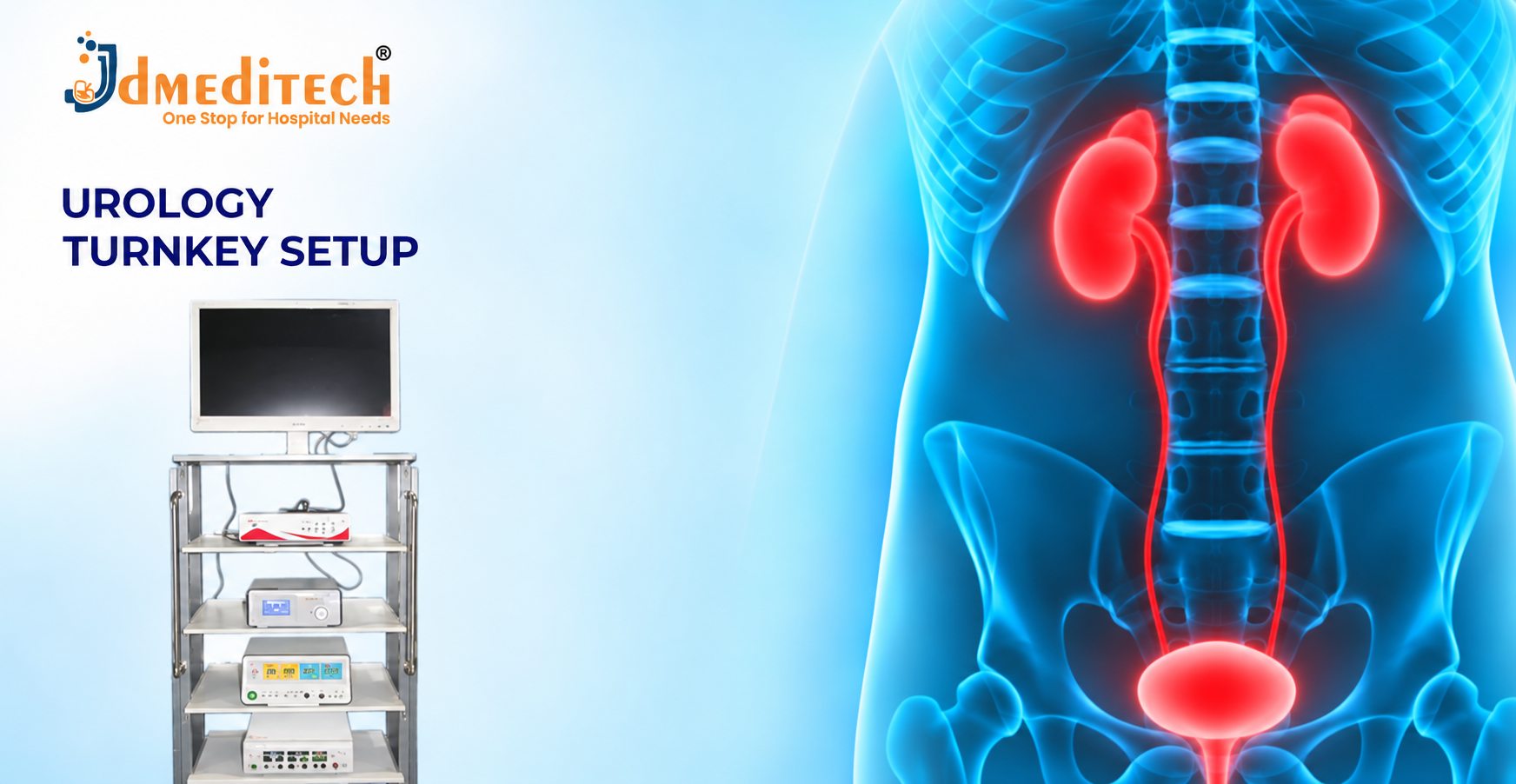
Urology Turnkey Setup – Complete Equipment Guide
A Urology Turnkey Setup brings together compatible medical equipment, instruments and accessories for selected urological procedures. Hospitals use integrated workstations to organize imaging devices, surgical systems and supporting components within a clinical environment.
Furthermore, a well-planned equipment arrangement can support efficient preparation and clinical workflows. However, the exact configuration depends on the intended procedures, available equipment and hospital requirements.
JDMeditech supplies medical devices and surgical instruments for urology departments, hospitals and medical distributors. Additionally, our team can assist customers with equipment inquiries, available configurations and technical information.
What Is a Urology Turnkey Setup?
A turnkey urology system is a planned combination of compatible equipment intended to support defined clinical services.
For example, an endoscopy workstation may include a medical monitor, camera system, light source and equipment trolley.
Meanwhile, selected surgical procedures may require additional irrigation, energy or imaging equipment.
Therefore, buyers should confirm the complete equipment list before purchasing.
Importance of an Integrated Urology Workstation
Urology procedures may require several devices to operate together.
For instance, an endoscopic imaging system needs compatible visualization components.
Additionally, certain procedures require irrigation equipment and designated surgical accessories.
Consequently, proper equipment planning can support an organized clinical environment.
Main Components of a Urology Turnkey System
The exact components vary by configuration. However, a urology workstation may include the following equipment.
- Medical Display Monitor
- Endoscopy Camera System
- Compatible Light Source
- Medical Equipment Trolley
- Irrigation Pump, where required
- Electrosurgical Generator, where required
- Endoscopic Instruments
- Compatible Cables and Connectors
- Procedure-Specific Accessories
However, not every system includes every component. Therefore, customers should request the official packing list.
1. Medical Display Monitor
A medical display monitor presents images from a compatible endoscopic camera system.
For example, surgeons may use the monitor to view anatomical structures during an endoscopic procedure.
Furthermore, image quality depends on the camera, display and signal configuration.
Features of a Medical Monitor
- Model-specific display resolution
- Compatible video inputs
- Screen size options
- Brightness and contrast controls
- Mounting compatibility
- Manufacturer-defined electrical requirements
Additionally, buyers should verify medical-use suitability and compatibility.
2. Endoscopy Camera System
An endoscopy camera system captures images through a compatible optical instrument.
For instance, a camera head may connect to a designated telescope.
Additionally, a compatible camera control unit processes the image signal.
However, the exact image quality and functions depend on the selected model.
Features of an Endoscopy Camera System
- Camera Control Unit
- Compatible Camera Head
- Model-Specific Image Resolution
- Compatible Video Output
- Image Adjustment Functions
- Approved Telescope Connections
- Manufacturer-Defined Accessories
Therefore, customers should verify the complete camera configuration.
3. Endoscopy Light Source
A light source provides illumination for compatible endoscopic instruments.
For example, an approved light cable transfers illumination to the optical system.
Furthermore, suitable lighting helps clinicians visualize anatomical structures.
However, light source compatibility and operating requirements vary by model.
Features of an Endoscopy Light Source
- Model-Specific Illumination Technology
- Adjustable Light Output, where supported
- Compatible Light Cable Connection
- Electrical Safety Features
- Manufacturer-Defined Power Requirements
- Cooling and Ventilation Requirements
Additionally, users must follow the manufacturer’s thermal safety precautions.
4. Medical Equipment Trolley
A medical equipment trolley supports the arrangement of compatible devices.
For example, different shelves may hold a camera control unit, light source and other equipment.
Furthermore, cable organization can help reduce clutter around the workstation.
However, the trolley must support the equipment’s weight and mounting requirements.
Features of an Equipment Trolley
- Multiple Equipment Shelves
- Monitor Mounting Options
- Compatible Cable Management
- Mobility Features
- Locking Wheels, where provided
- Manufacturer-Defined Load Capacity
- Equipment Mounting Compatibility
Therefore, hospitals should verify the trolley dimensions and load rating.
5. Irrigation Pump
Selected urology procedures require irrigation to support visualization and fluid management.
For example, a compatible irrigation pump may provide controlled fluid delivery during an approved endoscopic procedure.
However, not every urology procedure requires a pump.
Therefore, clinicians should confirm the intended application.
Features of an Irrigation Pump
- Model-Specific Fluid Delivery Controls
- Compatible Irrigation Tubing
- Operating Display
- Manufacturer-Defined Flow Settings
- Applicable Safety Monitoring Functions
- Approved Fluid Compatibility
Additionally, the clinical team must follow the manufacturer’s instructions.
6. Electrosurgical Generator
An electrosurgical generator provides controlled electrical energy for compatible surgical applications.
For example, selected urology procedures may require designated cutting or coagulation functions.
Furthermore, the generator must match the approved electrode and instrument configuration.
However, not every turnkey workstation includes an electrosurgical unit.
Features of an Electrosurgical Generator
- Model-Specific Output Modes
- Compatible Cutting Functions
- Compatible Coagulation Functions
- Operator Control Interface
- Approved Accessory Connections
- Electrical Safety Monitoring, where provided
- Manufacturer-Defined Output Ratings
Therefore, buyers should request the official technical datasheet.
7. Endoscopic Urology Instruments
Endoscopic instruments provide access and visualization during selected urology procedures.
For example, cystoscopes support lower urinary tract examination.
Meanwhile, ureteroscopes support selected procedures involving the ureter.
Additionally, nephroscopes support designated kidney procedures.
Common Instruments Used With Urology Workstations
- Cystoscope
- Rigid Ureteroscope
- Flexible Ureteroscope
- Nephroscope
- Resectoscope
- Compatible Endoscopic Forceps
- Compatible Surgical Electrodes
- Procedure-Specific Accessories
However, these instruments are not necessarily included in the standard workstation package.
Clinical Applications of Urology Turnkey Systems
Integrated urology equipment may support selected diagnostic and surgical procedures.
For example, the imaging components may support cystoscopy or ureteroscopy.
Additionally, suitable configurations may support selected endoscopic prostate or kidney procedures.
However, each procedure requires its own approved instrument and equipment combination.
Application in Cystoscopy
Cystoscopy allows clinicians to examine the urethra and bladder using a compatible cystoscope.
Furthermore, an endoscopic camera and monitor may support visualization.
Therefore, suitable imaging components form part of the clinical setup.
Application in Ureteroscopy
Ureteroscopy supports selected diagnostic and treatment procedures involving the ureter.
For example, a compatible imaging system may display the endoscopic view.
Additionally, designated instruments may support selected interventions.
However, equipment requirements depend on the procedure.
Application in RIRS
Retrograde intrarenal surgery involves endoscopic access to the kidney collecting system through the urinary tract.
Furthermore, suitable visualization equipment supports the procedure.
However, RIRS also requires specialized instruments and may require additional stone treatment equipment.
Application in TURP
Transurethral resection of the prostate is a surgical technique used for selected patients with urinary obstruction associated with benign prostatic enlargement.
For example, compatible resectoscope and energy systems may support the procedure.
Additionally, appropriate irrigation equipment is required.
Therefore, hospitals must verify the complete TURP configuration.
Application in PCNL
Percutaneous nephrolithotomy is a procedure used to treat selected kidney stones through a percutaneous access route.
Furthermore, the procedure requires specialized imaging, access and stone treatment equipment.
However, a basic endoscopy trolley does not represent a complete PCNL system.
Technical Specifications of Urology Turnkey Equipment
Technical specifications depend on the selected devices and configuration. Consequently, buyers should request an itemized technical proposal.
| Component | Specifications to Verify |
|---|---|
| Medical Monitor | Screen size, resolution, video inputs and mounting compatibility |
| Camera System | Resolution, camera head, outputs and telescope compatibility |
| Light Source | Illumination technology, light output and cable compatibility |
| Equipment Trolley | Dimensions, shelf capacity, wheel design and cable management |
| Irrigation Pump | Flow settings, tubing compatibility and approved applications |
| Electrosurgical Generator | Output modes, ratings, electrode compatibility and safety features |
| Endoscopic Instruments | Diameter, length, optical configuration and intended use |
| Electrical Requirements | Supply voltage, frequency, grounding and power consumption |
| Packaging | Official packing list and transport requirements |
| Regulatory Documentation | Documentation applicable to the selected models and destination market |
Benefits of a Planned Urology Workstation
A planned workstation can help hospitals organize compatible equipment.
For example, a dedicated trolley provides designated space for the imaging components.
Additionally, suitable cable management may improve equipment organization.
Furthermore, an itemized configuration helps procurement teams identify required accessories.
However, actual clinical performance depends on the selected devices and trained users.
Turnkey Setup Versus Individual Equipment Purchase
Hospitals may purchase equipment individually or request a coordinated configuration.
For example, an individual purchase may address a specific replacement need.
In contrast, a turnkey proposal can combine multiple compatible products in one equipment plan.
Therefore, procurement teams should compare the complete scope rather than only the quoted price.
How to Select a Urology Workstation
Hospitals should identify the intended procedures before selecting equipment.
- Define the clinical applications
- Confirm the required imaging quality
- Verify instrument compatibility
- Identify required surgical energy systems
- Review irrigation requirements
- Check equipment trolley capacity
- Confirm electrical compatibility
- Request an itemized packing list
- Verify warranty and service terms
- Review applicable regulatory documentation
Furthermore, biomedical engineering teams should review the proposed configuration.
Importance of Equipment Compatibility
Different devices must work together within the approved configuration.
For example, the camera head must connect to the compatible camera control unit.
Similarly, the light source must support the designated light cable and endoscope.
Therefore, buyers should verify every connection before installation.
Importance of Electrical Safety
Medical equipment requires appropriate electrical installation.
Furthermore, hospitals should follow manufacturer requirements for grounding and power connections.
However, improper connections may create electrical hazards.
Therefore, qualified personnel should inspect the equipment before clinical use.
Installation and Commissioning
Installation should follow the manufacturer’s instructions and hospital procedures.
For example, technical personnel may verify equipment connections and operating functions.
Additionally, commissioning may include documented safety checks.
Therefore, the facility should confirm the installation scope with the supplier.
Operator Training
Clinical personnel require appropriate training before using specialized equipment.
For example, staff should understand the imaging controls and applicable safety warnings.
Additionally, users should know how to identify equipment faults.
Consequently, training supports proper operation and maintenance.
Cleaning and Infection Prevention
Different workstation components have different cleaning requirements.
For example, external equipment surfaces may require approved surface cleaning methods.
Meanwhile, reusable endoscopic instruments require validated reprocessing procedures.
Therefore, staff should follow the instructions for each component.
Routine Maintenance
Preventive maintenance helps identify equipment problems.
For example, technical personnel may inspect cables, connectors and mechanical components.
Additionally, hospitals should follow the recommended service schedule.
Therefore, defective devices should remain out of clinical service until appropriately evaluated.
Pre-Use Equipment Checklist
Clinical teams should inspect the workstation before use.
- Check the equipment trolley
- Inspect electrical connections
- Verify monitor operation
- Confirm camera and light source functions
- Inspect compatible cables
- Review instrument condition
- Verify cleaning and reprocessing status
- Check device warnings
- Confirm procedure-specific accessories
Furthermore, staff should follow the manufacturer’s official checklist.
Applications in Hospitals
Hospitals may use integrated workstations for selected urology procedures.
For example, an endoscopy tower can support visualization during cystoscopy.
Additionally, compatible equipment may support other approved endourology procedures.
Therefore, the system configuration should match departmental needs.
Applications in Urology Departments
Urology departments may require a dedicated equipment arrangement for endoscopic procedures.
Furthermore, an organized workstation can support preparation and equipment management.
However, each clinical procedure requires its own approved configuration.
Applications in Surgical Centers
Surgical centers may use compatible imaging workstations during selected endoscopic operations.
Additionally, suitable equipment organization supports clinical preparation.
Therefore, facilities should confirm the full equipment scope before purchasing.
Applications for Medical Distributors
Medical distributors should request complete technical documentation for turnkey proposals.
For example, buyers may require specific monitor, camera or light source configurations.
Additionally, destination-market regulations may affect equipment selection.
Consequently, distributors should verify specifications and documentation before supply.
Why Choose JDMeditech?
JDMeditech supplies medical devices and surgical instruments for urology departments, hospitals and medical distributors.
Furthermore, our team can assist with equipment inquiries, product configurations and technical specification requests.
- Urology Workstation Inquiries
- Endoscopy Camera System Information
- Medical Monitor Product Requests
- Endoscopy Light Source Inquiries
- Medical Equipment Trolley Information
- Compatible Urology Instrument Requests
- Technical Specification Support
- International Distributor Inquiries
However, the complete supply scope, installation services, product availability and regulatory documentation require confirmation in the quotation.
Frequently Asked Questions
1. What Is a Urology Turnkey Setup?
It is a planned combination of compatible medical equipment and accessories for selected urology services.
2. What Equipment Does a Urology Workstation Include?
A configuration may include a monitor, camera system, light source and equipment trolley. Additional devices depend on the intended procedures.
3. Is Every Turnkey System the Same?
No. Equipment configurations vary according to clinical requirements and manufacturer specifications.
4. Does a Turnkey Setup Include Endoscopic Instruments?
Not necessarily. Therefore, customers should confirm the official packing list.
5. Can a Urology Workstation Support Cystoscopy?
Yes, when the workstation includes compatible imaging equipment and the required cystoscopy instruments.
6. Can It Support Ureteroscopy?
A suitable configuration may support ureteroscopy. However, additional procedure-specific equipment may be necessary.
7. Can the System Support TURP?
Selected configurations may support TURP when they include the required resectoscope, energy system and other compatible equipment.
8. Does the Workstation Include an Irrigation Pump?
Not always. Buyers should confirm whether the selected package includes an irrigation system.
9. Does It Include an Electrosurgical Generator?
Some configurations may include one. However, the exact supply scope must be confirmed.
10. What Monitor Size Is Available?
Available monitor sizes depend on the selected product. Therefore, customers should request the technical datasheet.
11. Is Installation Included?
Installation arrangements depend on the supplier’s quotation and service terms.
12. Does the Equipment Require Maintenance?
Yes. Facilities should follow manufacturer-recommended inspection and maintenance schedules.
13. Who Can Operate the Equipment?
Appropriately trained healthcare professionals should operate specialized clinical devices.
14. What Should Hospitals Check Before Ordering?
Hospitals should verify the complete configuration, compatibility, specifications, warranty and regulatory documentation.
15. Where Can Customers Request a Quotation?
Hospitals and medical distributors can contact JDMeditech to request product information and available equipment quotations.
Conclusion
In conclusion, a Urology Turnkey Setup can help hospitals organize compatible imaging and surgical equipment for selected urology procedures.
For example, a workstation may combine a medical monitor, camera system, light source and equipment trolley.
Additionally, suitable configurations may include procedure-specific devices and instruments.
Therefore, hospitals should verify the complete equipment list, clinical compatibility and manufacturer specifications before purchasing.
JDMeditech – One Stop for Hospital Needs
Website:
www.jdmeditech.com
Related Urology Equipment
- Endoscopy Camera System
- Medical Display Monitor
- Endoscopy Light Source
- Medical Equipment Trolley
- Urology Irrigation Pump
- Electrosurgical Unit
- Cystoscope
- Ureteroscope
- Nephroscope
- Resectoscope
- Urology Surgical Instruments
Medical Disclaimer
This article provides general educational and product information only. It does not replace professional medical advice, clinical training or manufacturer instructions. Qualified healthcare professionals must select and operate medical equipment according to approved indications, device specifications and applicable safety requirements.




