



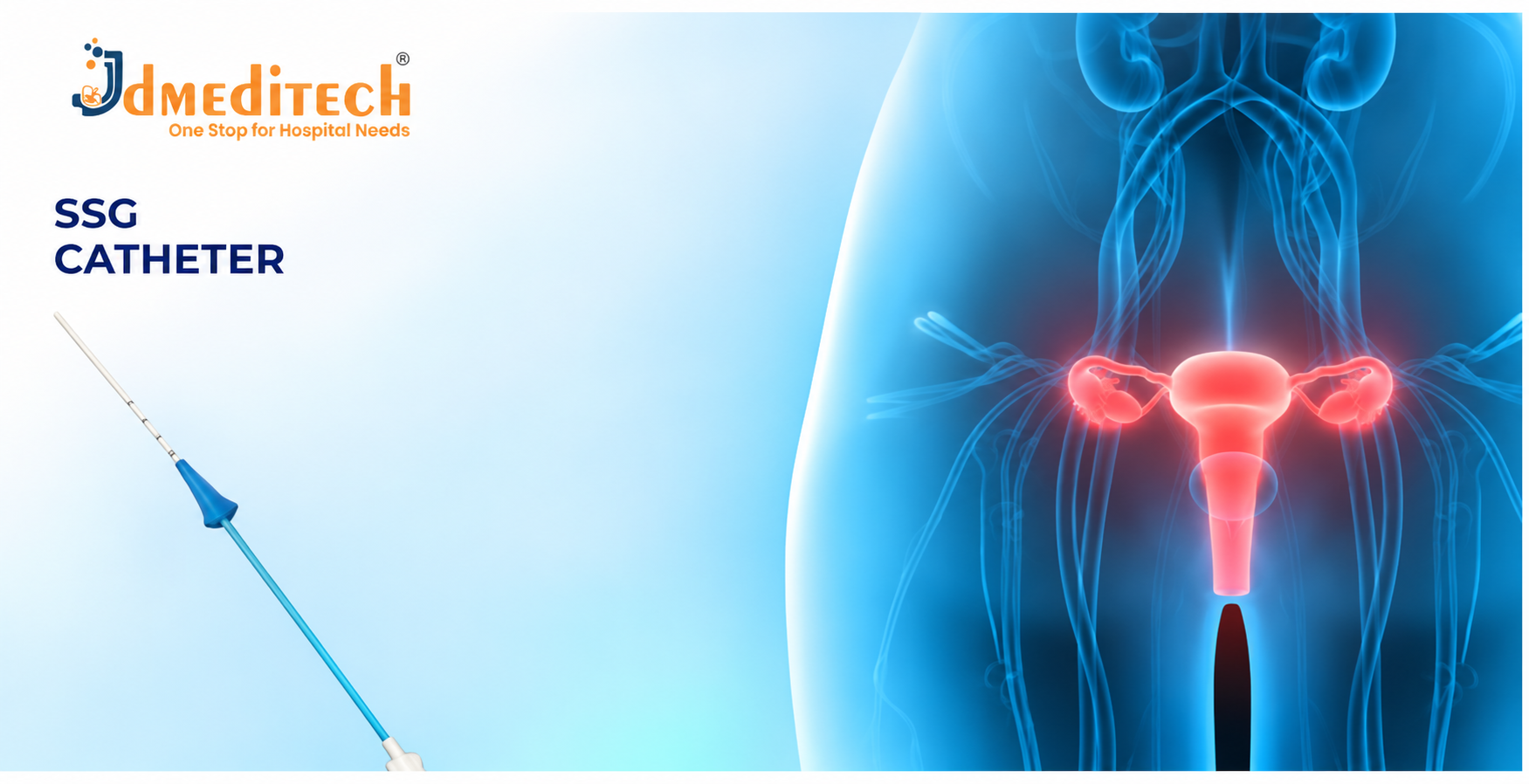
Embryo Transfer Catheter – Features, Types, Uses and Benefits
An Embryo Transfer Catheter is a specialized medical device used during in vitro fertilization (IVF) treatment. Fertility specialists use this catheter to place selected embryos into the uterine cavity as part of an assisted reproductive technology procedure.
Furthermore, the catheter’s design supports controlled handling during embryo transfer. However, the choice of device depends on clinical requirements, uterine anatomy and the fertility specialist’s assessment.
JDMeditech supplies gynecology instruments and medical consumables for hospitals, fertility clinics and medical distributors. Additionally, customers can contact our team for available product configurations, technical information and quotation inquiries.
What Is an Embryo Transfer Catheter?
An embryo transfer catheter is a narrow medical tube designed to deliver an embryo-containing fluid into the uterine cavity during an IVF procedure.
Typically, the fertility team uses a compatible transfer catheter after the laboratory prepares the embryo for transfer.
Additionally, some systems include an outer guiding catheter and an inner transfer catheter.
Therefore, clinicians should select the appropriate design according to the patient’s anatomy and the manufacturer’s intended use.
Importance of Embryo Transfer in IVF
Embryo transfer is an important stage of assisted reproductive treatment.
During IVF, an embryology laboratory develops embryos under controlled conditions. Subsequently, the clinical team selects an embryo for transfer according to the treatment plan.
Furthermore, the procedure requires coordination between the fertility specialist and embryologist.
However, pregnancy outcomes depend on many factors beyond the catheter, including embryo characteristics, uterine conditions and patient-specific circumstances.
Purpose of an IVF Transfer Catheter
The primary purpose of the catheter is to support the delivery of embryos into the uterine cavity.
For example, a compatible device provides a narrow channel for the transfer medium.
Additionally, suitable catheter handling may help reduce unnecessary manipulation during the procedure.
Nevertheless, no catheter design can guarantee implantation or pregnancy.
Types of Embryo Transfer Catheters
Manufacturers offer different catheter configurations for assisted reproductive procedures.
- Soft Embryo Transfer Catheter
- Firm or Semi-Rigid Transfer Catheter
- Single-Lumen Transfer Catheter
- Coaxial Embryo Transfer Catheter System
- Catheter With Outer Guiding Sheath
- Other Manufacturer-Specified IVF Transfer Devices
However, available designs vary by manufacturer. Therefore, buyers should review the official product catalogue.
1. Soft Embryo Transfer Catheter
A soft transfer catheter uses a flexible insertion section designed for embryo transfer.
For example, fertility specialists may prefer flexible catheters in suitable clinical situations.
Furthermore, clinical guidance generally supports soft catheters for routine embryo transfer.
However, device choice must account for individual anatomical requirements.
2. Firm or Semi-Rigid Transfer Catheter
A firmer catheter may offer different handling characteristics during selected procedures.
For instance, a clinician may consider a particular design when navigating challenging cervical anatomy.
However, increased rigidity can introduce additional considerations for tissue contact.
Therefore, the fertility specialist must assess the most appropriate option.
3. Coaxial Embryo Transfer Catheter
A coaxial system typically includes an outer guiding component and an inner transfer catheter.
Furthermore, the guiding component may support placement of the inner catheter in selected situations.
However, the exact arrangement depends on the product design.
4. Single-Lumen Embryo Transfer Catheter
A single-lumen catheter contains one internal channel for the intended transfer application.
Additionally, the manufacturer defines its dimensions, connection design and handling characteristics.
Therefore, customers should verify the catheter specifications before ordering.
Main Components of an Embryo Transfer Catheter
Depending on the selected model, a catheter system may include:
- Flexible Transfer Catheter
- Distal Catheter Tip
- Proximal Connector or Hub
- Outer Guiding Catheter, where supplied
- Depth Markings, where provided
- Compatible Handling Components
- Protective Packaging
However, the image alone does not confirm every component. Therefore, buyers should request the manufacturer’s packing list.
Flexible Catheter Shaft
The catheter shaft provides a narrow passage for the transfer medium.
Furthermore, its flexibility influences device handling.
However, shaft diameter, length and material vary by model.
Distal Catheter Tip
The distal tip forms the end of the catheter that enters the intended anatomical passage.
For example, some models use a rounded or atraumatic tip design.
However, customers should confirm the actual tip geometry from the official datasheet.
Catheter Hub and Connector
The proximal hub provides a connection point for compatible handling or transfer equipment.
Additionally, the connector design varies between manufacturers.
Therefore, the clinical team should verify compatibility with the intended transfer setup.
Outer Guiding Catheter
Some embryo transfer systems include an outer guiding catheter.
Furthermore, this component may assist with catheter positioning in selected clinical situations.
However, the outer component must match the inner catheter system.
Features of an Embryo Transfer Catheter
Product features depend on the selected design and manufacturer.
- Specialized IVF Transfer Application
- Model-Specific Flexible Shaft
- Defined Catheter Diameter
- Defined Working Length
- Manufacturer-Specified Tip Design
- Compatible Connector
- Optional Guiding Catheter Configuration
- Sterile Packaging, where specified
- Single-Use Design, where labeled
- Manufacturer-Defined Material
Additionally, fertility clinics should confirm the actual features before clinical use.
Clinical Applications of Embryo Transfer Catheters
Fertility specialists use approved catheters during embryo transfer procedures.
- Fresh Embryo Transfer in IVF
- Frozen Embryo Transfer
- Selected Assisted Reproductive Treatment Cycles
- Other Manufacturer-Approved Embryo Transfer Applications
However, the treatment protocol and device selection depend on specialist assessment.
Fresh Embryo Transfer
Fresh embryo transfer involves transferring an embryo during the treatment cycle in which the embryo was created.
Furthermore, the fertility team determines the appropriate timing based on clinical and laboratory considerations.
However, not every IVF cycle includes a fresh transfer.
Frozen Embryo Transfer
Frozen embryo transfer involves the use of an embryo that was previously cryopreserved and subsequently thawed or warmed.
Additionally, the clinical team prepares the patient according to the selected treatment protocol.
However, catheter selection still depends on individual requirements.
Overview of the Embryo Transfer Procedure
Embryo transfer takes place in a clinical environment under the care of trained fertility professionals.
First, the team confirms the patient’s identity and treatment plan. Next, the embryology laboratory prepares the selected embryo for transfer.
During the procedure, the clinician uses an appropriate catheter to place the embryo-containing medium into the uterine cavity.
Afterward, the clinical team completes the required checks and provides follow-up instructions.
However, the exact workflow varies according to the clinic’s protocol.
Role of Ultrasound Guidance
Ultrasound guidance can help clinicians visualize relevant anatomy during embryo transfer.
Furthermore, professional guidance supports ultrasound-guided embryo transfer in many clinical settings.
However, the technique depends on the clinical situation and facility protocol.
Importance of Catheter Selection
Catheter selection influences procedural handling.
For example, a flexible catheter may suit routine transfer in many patients.
Meanwhile, challenging anatomy may require additional clinical planning.
Therefore, specialists should choose the device based on patient needs and approved indications.
Importance of Atraumatic Handling
Careful catheter handling helps minimize unnecessary tissue contact.
Furthermore, fertility specialists aim to avoid difficult or traumatic transfer when possible.
However, anatomy and other patient-specific factors can influence procedural difficulty.
Potential Benefits of Embryo Transfer Catheters
Suitable transfer catheters support the clinical delivery of embryos during IVF treatment.
Additionally, different catheter designs allow specialists to select an appropriate configuration.
Furthermore, compatible guiding components may assist in selected clinical situations.
However, no device eliminates all procedural risks or guarantees successful implantation.
Technical Specifications of Embryo Transfer Catheters
Exact technical specifications vary by manufacturer. Therefore, the following table identifies details that customers should verify before ordering.
| Parameter | Details to Verify |
|---|---|
| Product Name | Embryo Transfer Catheter |
| Medical Specialty | Gynecology and Assisted Reproductive Technology |
| Intended Application | Embryo Transfer During Approved IVF Procedures |
| Catheter Type | Confirm selected model |
| Catheter Diameter | Confirm manufacturer datasheet |
| Working Length | Confirm manufacturer datasheet |
| Tip Design | Confirm manufacturer specifications |
| Catheter Material | Confirm manufacturer specifications |
| Outer Guiding Catheter | Verify whether supplied |
| Hub or Connector | Confirm compatibility |
| Depth Markings | Verify where provided |
| Sterility | Confirm product labeling |
| Single-Use Status | Confirm instructions for use |
| Packaging | Confirm official packing list |
| Shelf Life | Confirm manufacturer labeling |
| Regulatory Documentation | Verify for the destination market |
Soft Versus Firm Transfer Catheters
Different catheter designs provide different handling characteristics.
| Feature | Soft Catheter | Firm Catheter |
|---|---|---|
| Shaft Flexibility | Generally More Flexible | Generally Less Flexible |
| Clinical Selection | Commonly Preferred for Routine Transfers | May Be Considered in Selected Situations |
| Handling | Flexible Design | Different Support Characteristics |
| Patient Suitability | Depends on Clinical Assessment | Depends on Clinical Assessment |
| Device Compatibility | Manufacturer-Specific | Manufacturer-Specific |
Single Catheter Versus Coaxial System
A single catheter design uses one primary transfer component.
In contrast, a coaxial system includes an inner catheter and compatible outer guiding component.
Furthermore, the two configurations may offer different handling options.
Therefore, clinicians should select the approved system that suits the intended procedure.
Importance of Catheter Dimensions
Catheter diameter and length are important product specifications.
For example, the selected dimensions must match the intended clinical application.
Additionally, compatible components must fit together correctly.
Therefore, buyers should review the manufacturer’s technical documentation.
Importance of Material Compatibility
Catheter materials influence flexibility and handling characteristics.
Furthermore, manufacturers select materials according to the intended medical application.
However, exact material composition varies by product.
Therefore, clinics should request the official material specifications when required.
Sterile Packaging and Product Integrity
Embryo transfer devices require appropriate packaging and handling.
For example, staff should inspect the packaging before opening a sterile device.
Additionally, clinics should verify the expiry date and product identification.
Therefore, damaged or expired sterile products should not enter clinical use.
Single-Use Device Considerations
Many embryo transfer catheters are designed for single use.
Furthermore, reuse contrary to the device labeling may introduce contamination or performance risks.
Therefore, clinics must follow manufacturer instructions and applicable regulations.
Storage and Handling
Proper storage helps protect the catheter and its packaging.
For example, facilities should avoid conditions that could damage the device.
Additionally, staff should follow the manufacturer’s temperature and environmental requirements.
Consequently, correct inventory management supports product traceability.
Safety Precautions
Qualified fertility professionals must use embryo transfer catheters according to their approved indications.
Furthermore, the clinical team should verify device integrity, compatibility and sterile status.
However, unsuitable catheter handling may cause tissue irritation or injury.
Therefore, clinics should follow the manufacturer’s instructions and institutional protocols.
Potential Risks and Complications
Embryo transfer procedures may involve several clinical considerations.
- Temporary Discomfort
- Cervical or Uterine Irritation
- Minor Bleeding
- Difficult Catheter Passage
- Infection, although uncommon
- Other Procedure-Related Complications
However, individual risks depend on the patient’s condition and the clinical procedure.
Factors Affecting IVF Outcomes
Successful embryo transfer depends on several clinical and biological factors.
- Embryo Characteristics
- Patient Age and Medical History
- Uterine Conditions
- Endometrial Preparation
- Embryology Laboratory Practices
- Transfer Technique
- Individual Fertility Factors
Therefore, the catheter represents only one part of the overall IVF treatment process.
Applications in Fertility Clinics
Fertility clinics use transfer catheters during selected assisted reproductive procedures.
Furthermore, different catheter configurations may suit different clinical requirements.
However, the clinic should confirm the approved device specifications before use.
Applications in IVF Centers
IVF centers require specialized instruments and consumables for embryo transfer procedures.
For example, compatible catheters form part of the transfer equipment preparation.
Additionally, suitable inventory practices support clinical scheduling.
Therefore, procurement teams should maintain appropriate product records.
Applications in Hospitals
Hospitals with assisted reproductive services may require embryo transfer catheters.
Furthermore, qualified clinical teams should evaluate the available device options.
However, each hospital must follow its approved treatment protocols.
Applications for Medical Distributors
Medical distributors should verify the exact product configuration before supplying fertility centers.
For example, buyers may request particular catheter dimensions or guiding systems.
Additionally, destination-market regulations may affect product selection.
Consequently, distributors should request the relevant technical and regulatory documentation.
How to Choose an Embryo Transfer Catheter
Fertility clinics should review several factors before purchasing.
- Manufacturer’s Intended Use
- Catheter Type
- Shaft Flexibility
- Catheter Diameter
- Working Length
- Tip Design
- Guiding Catheter Configuration
- Connector Compatibility
- Material Specifications
- Sterility
- Single-Use Labeling
- Packaging Integrity
- Shelf Life
- Regulatory Documentation
Furthermore, the fertility specialist should confirm suitability for the intended procedure.
Why Choose JDMeditech?
JDMeditech supplies gynecology medical devices and surgical consumables for hospitals, fertility clinics and medical distributors.
Furthermore, our team can assist customers with available product information, configuration requests and quotation inquiries.
- Embryo Transfer Catheter Inquiries
- IVF Consumable Product Information
- Gynecology Instrument Requests
- Technical Specification Support
- Available Product Configuration Information
- Medical Distributor Inquiries
- International Export Inquiries
However, exact product availability, technical specifications and regulatory documentation require confirmation.
Frequently Asked Questions
1. What Is an Embryo Transfer Catheter?
It is a specialized medical device used to deliver embryos into the uterine cavity during selected IVF procedures.
2. What Is the Main Purpose of the Catheter?
Its primary purpose is to support the clinical placement of embryo-containing transfer medium into the uterus.
3. Is an Embryo Transfer Catheter Used in IVF?
Yes. Fertility specialists use compatible catheters during embryo transfer procedures.
4. What Is a Soft Embryo Transfer Catheter?
It is a flexible catheter design commonly used for routine embryo transfer in suitable patients.
5. What Is a Coaxial Embryo Transfer System?
It is a system that typically includes an inner transfer catheter and a compatible outer guiding catheter.
6. Are All Embryo Transfer Catheters the Same?
No. Catheters vary in flexibility, dimensions, tip design and configuration.
7. Are These Catheters Sterile?
Many are supplied sterile. However, buyers should confirm sterility from the product labeling.
8. Are Embryo Transfer Catheters Reusable?
Many are single-use devices. Therefore, users must follow the manufacturer’s labeling.
9. What Sizes Are Available?
Available dimensions depend on the selected manufacturer and model.
10. Can the Same Catheter Be Used for Fresh and Frozen Embryo Transfer?
A compatible device may support either application when its intended use and the clinic’s protocol allow it.
11. Does Catheter Type Guarantee IVF Success?
No. IVF outcomes depend on multiple clinical and biological factors.
12. Is Ultrasound Guidance Used During Embryo Transfer?
Many fertility clinics use ultrasound guidance during embryo transfer according to clinical protocols.
13. Who Can Use an Embryo Transfer Catheter?
Appropriately trained fertility healthcare professionals should perform embryo transfer procedures.
14. What Should Clinics Verify Before Ordering?
Clinics should confirm catheter dimensions, design, sterility, compatibility and regulatory documentation.
15. Where Can Customers Request Product Information?
Hospitals, fertility clinics and medical distributors can contact JDMeditech for available product information and quotations.
Conclusion
In conclusion, an Embryo Transfer Catheter is an important device used during assisted reproductive treatment.
For example, soft and coaxial catheter systems provide different handling options for selected clinical situations.
Additionally, appropriate device selection supports the embryo transfer workflow.
Therefore, fertility clinics should choose catheters according to clinical requirements, manufacturer specifications and established safety protocols.
JDMeditech – One Stop for Hospital Needs
Website:
www.jdmeditech.com
Related Gynecology Products
- Embryo Transfer Catheter
- Gynecology Aspiration Kit
- Hysteroscope
- Hysteroscopy Sheath
- Hysteroscopy Forceps
- Uterine Manipulator
- Gynecology Surgical Instruments
- Other Assisted Reproductive Consumables
Medical Disclaimer
This article provides general educational and product information only. It does not replace professional medical advice, fertility counseling, clinical training or manufacturer instructions. Qualified healthcare professionals must select and use devices according to approved indications, product specifications and applicable safety requirements.




