



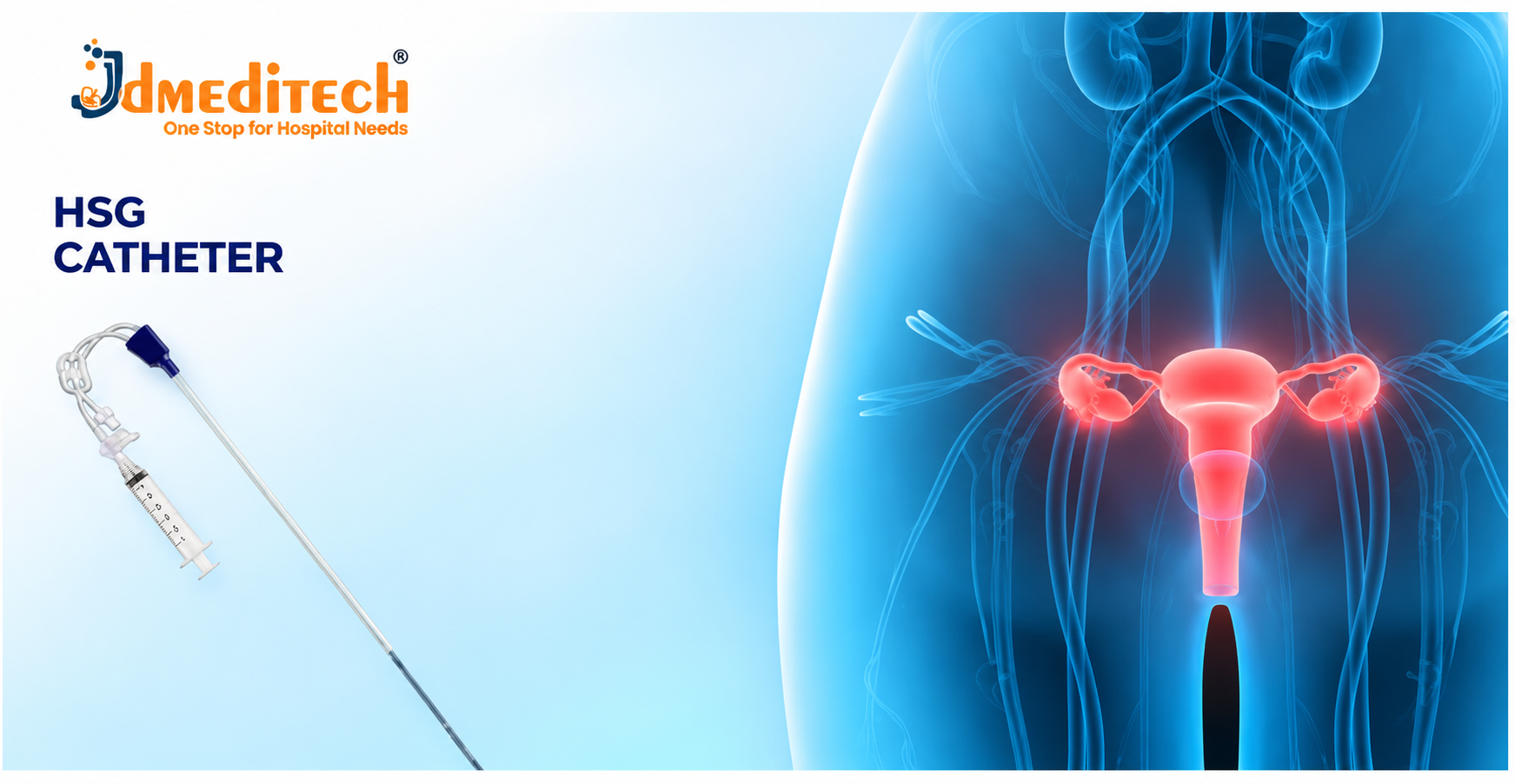
HSG Catheter – Features, Types, Uses and Benefits
An HSG Catheter, also known as a hysterosalpingography catheter, is a medical device used during diagnostic imaging of the uterus and fallopian tubes. Healthcare professionals use compatible catheters to introduce contrast medium into the uterine cavity during an HSG examination.
Furthermore, hysterosalpingography helps clinicians evaluate the shape of the uterine cavity and assess whether contrast passes through the fallopian tubes. Therefore, specialists may recommend this examination during selected fertility investigations.
JDMeditech supplies gynecology medical devices and diagnostic consumables for hospitals, fertility clinics and medical distributors. Additionally, customers can contact our team for available configurations, technical details and quotation requests.
What Is an HSG Catheter?
A hysterosalpingography catheter is a specialized device designed to support the controlled introduction of suitable contrast medium into the uterine cavity.
During an HSG examination, clinicians use imaging to observe the distribution of contrast within the uterus and fallopian tubes.
Additionally, some catheter models include a balloon or other retention mechanism.
However, the exact configuration depends on the manufacturer and intended use.
What Is Hysterosalpingography?
Hysterosalpingography is a diagnostic imaging examination that evaluates the uterine cavity and fallopian tube patency.
For example, clinicians may recommend HSG during the investigation of infertility or suspected tubal obstruction.
During conventional HSG, fluoroscopic imaging records the movement of radiographic contrast medium.
Consequently, the examination can provide useful information about selected structural abnormalities.
Purpose of an HSG Catheter
The primary purpose of the catheter is to provide a suitable route for introducing contrast medium during the examination.
Furthermore, a compatible catheter helps the clinical team manage the contrast delivery process.
However, device selection depends on anatomy, clinical requirements and manufacturer instructions.
Importance of HSG in Fertility Evaluation
Fallopian tube patency is an important consideration during selected fertility assessments.
For example, blocked tubes may prevent sperm and egg from meeting naturally.
Additionally, certain uterine cavity abnormalities may affect reproductive health.
Therefore, clinicians may include HSG as one part of a broader fertility evaluation.
Types of HSG Catheters
Manufacturers offer different catheter configurations for diagnostic gynecology procedures.
- Balloon HSG Catheter
- Non-Balloon HSG Catheter
- Single-Lumen HSG Catheter
- Dual-Lumen HSG Catheter
- Other Manufacturer-Specified Hysterosalpingography Devices
However, product designs and available configurations vary by manufacturer.
1. Balloon HSG Catheter
A balloon HSG catheter includes an inflatable component designed for its specified clinical application.
For example, certain designs use the balloon to help retain the catheter during contrast delivery.
Additionally, the balloon configuration may influence device positioning.
However, balloon use requires careful adherence to the manufacturer’s instructions.
2. Non-Balloon HSG Catheter
A non-balloon catheter uses a different design for contrast administration.
Furthermore, the clinician selects the device according to the intended examination and patient requirements.
However, the absence of a balloon does not eliminate the need for careful positioning.
3. Single-Lumen HSG Catheter
A single-lumen catheter contains one internal channel for its intended application.
Additionally, the manufacturer defines its dimensions and connector design.
Therefore, buyers should verify the product specifications before ordering.
4. Dual-Lumen HSG Catheter
A dual-lumen catheter includes two internal channels.
For example, some balloon catheter designs use separate channels for balloon inflation and contrast delivery.
However, the exact arrangement depends on the selected model.
Main Components of an HSG Catheter
Depending on the model, a catheter system may include:
- Catheter Shaft
- Distal Catheter Tip
- Contrast Delivery Lumen
- Balloon, where provided
- Balloon Inflation Channel, where applicable
- Proximal Connector
- Inflation Port, where applicable
- Manufacturer-Specified Accessories
- Protective Packaging
However, the reference image does not confirm every component. Therefore, customers should request the official packing list.
Catheter Shaft
The catheter shaft provides the main structure of the device.
Furthermore, its material and dimensions influence handling characteristics.
However, exact specifications vary by manufacturer.
Distal Catheter Tip
The distal tip forms the end of the catheter intended for placement during the procedure.
For example, some designs use a rounded or specially shaped tip.
However, the actual tip configuration requires confirmation from the datasheet.
Contrast Delivery Lumen
The contrast delivery lumen provides a channel for the designated contrast medium.
Additionally, the catheter must support the intended diagnostic application.
Therefore, clinicians should verify fluid compatibility and product instructions.
Balloon Component
Some catheter models include an inflatable balloon.
Furthermore, this component may help maintain catheter positioning during the examination.
However, excessive inflation or unsuitable use may cause discomfort or injury.
Inflation Port
Balloon-equipped models may include a dedicated inflation port.
Additionally, the port connects to compatible inflation equipment.
Therefore, the clinical team must follow the manufacturer’s specified inflation requirements.
Features of HSG Catheters
Available features depend on the selected product model.
- Specialized Hysterosalpingography Application
- Model-Specific Flexible Catheter Shaft
- Defined Catheter Diameter
- Defined Working Length
- Manufacturer-Specified Tip Design
- Contrast Delivery Channel
- Optional Balloon Retention Design
- Compatible Proximal Connector
- Sterile Packaging, where specified
- Single-Use Labeling, where applicable
Furthermore, customers should verify every feature against the official technical documentation.
Clinical Applications of HSG Catheters
Healthcare professionals use suitable catheters during selected diagnostic gynecology procedures.
- Hysterosalpingography
- Fallopian Tube Patency Evaluation
- Uterine Cavity Assessment
- Selected Infertility Investigations
- Other Manufacturer-Approved Diagnostic Applications
However, each application requires clinical assessment and an appropriate device.
Application in Fallopian Tube Evaluation
HSG can help assess whether contrast medium passes through the fallopian tubes.
For example, imaging may show contrast movement through the tubes and into the surrounding pelvic cavity.
However, apparent obstruction may occasionally reflect temporary tubal spasm or technical factors.
Therefore, clinicians interpret the findings alongside the patient’s history and other investigations.
Application in Uterine Cavity Assessment
HSG can provide information about the outline of the uterine cavity.
Furthermore, certain abnormalities may affect the appearance of the contrast-filled cavity.
However, additional imaging or direct evaluation may be necessary to clarify findings.
Application in Infertility Investigation
Clinicians may recommend hysterosalpingography during selected infertility evaluations.
For example, the examination can provide information about tubal patency.
Additionally, it may reveal findings that require further assessment.
Nevertheless, HSG does not evaluate every possible cause of infertility.
Overview of the HSG Procedure
A trained clinical team performs hysterosalpingography in an appropriate medical setting.
First, the team reviews the patient’s clinical history and confirms the examination plan.
Next, the clinician positions a suitable catheter according to the approved procedure.
During the examination, the team introduces an appropriate contrast medium and obtains the required images.
Afterward, the clinician reviews the findings and provides relevant follow-up advice.
However, the exact procedure varies according to clinical protocols and device instructions.
Importance of Imaging Guidance
Conventional hysterosalpingography uses fluoroscopic imaging.
Furthermore, imaging helps clinicians observe contrast distribution.
However, appropriate radiation protection and imaging protocols remain essential.
Importance of Catheter Selection
Correct catheter selection supports the diagnostic workflow.
For example, clinicians should consider catheter design and patient anatomy.
Additionally, the selected device must support the intended contrast medium and examination.
Therefore, healthcare professionals should verify compatibility before use.
Technical Specifications of HSG Catheters
Exact technical specifications vary by manufacturer. Consequently, buyers should confirm the following details before ordering.
| Parameter | Details to Verify |
|---|---|
| Product Name | HSG Catheter |
| Full Name | Hysterosalpingography Catheter |
| Medical Specialty | Gynecology and Diagnostic Imaging |
| Intended Application | Hysterosalpingography |
| Catheter Type | Confirm selected model |
| Catheter Diameter | Confirm manufacturer datasheet |
| Working Length | Confirm manufacturer datasheet |
| Material | Confirm manufacturer specifications |
| Tip Design | Confirm selected configuration |
| Number of Lumens | Confirm selected model |
| Balloon | Verify whether included |
| Balloon Capacity | Confirm manufacturer instructions, if applicable |
| Connector Type | Confirm compatibility |
| Contrast Compatibility | Verify approved contrast medium |
| Sterility | Confirm product labeling |
| Single-Use Status | Confirm instructions for use |
| Packaging | Confirm official packing list |
| Shelf Life | Confirm manufacturer labeling |
| Regulatory Documentation | Verify for the destination market |
Balloon Versus Non-Balloon HSG Catheters
Different catheter configurations provide different handling options.
| Feature | Balloon Catheter | Non-Balloon Catheter |
|---|---|---|
| Balloon Component | Included | Not Included |
| Retention Method | May Use Balloon Retention | Depends on Device Design |
| Inflation Port | Usually Provided | Not Required for Balloon Inflation |
| Clinical Selection | Based on Patient and Procedure | Based on Patient and Procedure |
| Compatibility | Manufacturer-Specific | Manufacturer-Specific |
Potential Benefits of an HSG Catheter
A suitable catheter provides a designated route for contrast administration during hysterosalpingography.
Furthermore, different designs allow clinicians to select an appropriate configuration.
Additionally, compatible retention mechanisms may support selected examinations.
However, the device does not eliminate procedural risks or guarantee diagnostic accuracy.
Importance of Correct Catheter Sizing
Catheter dimensions influence device selection.
For example, clinicians should consider the intended anatomical application.
Additionally, the catheter must match the approved diagnostic procedure.
Therefore, buyers should verify diameter and length before ordering.
Importance of Material Selection
Medical catheter materials differ by product design.
Furthermore, material properties may influence flexibility and handling.
However, exact material composition varies by manufacturer.
Therefore, customers should request the official material specifications when necessary.
Sterile Packaging
Sterile packaging helps maintain the specified sterile condition until use when the package remains intact and storage requirements are met.
Additionally, the product label provides important identification information.
Therefore, staff should inspect the package and expiry date before opening.
Single-Use Device Considerations
Many diagnostic catheters are intended for single use.
Furthermore, reuse contrary to the manufacturer’s labeling may introduce contamination or performance risks.
Therefore, healthcare facilities must follow the instructions for use and applicable regulations.
Storage and Handling
Proper storage helps protect catheter packaging and device integrity.
For example, facilities should avoid unsuitable environmental conditions.
Additionally, inventory teams should monitor expiry dates and packaging condition.
Consequently, correct storage practices support product traceability.
Safety Precautions During HSG
Qualified healthcare professionals must perform hysterosalpingography according to established clinical protocols.
Furthermore, clinicians should assess relevant contraindications before the examination.
For example, suspected pregnancy and active pelvic infection require particular attention.
Additionally, the clinical team should review the patient’s contrast reaction history and other relevant medical factors.
Therefore, proper screening and informed consent are essential.
Potential Risks and Complications
Hysterosalpingography may involve several risks and temporary effects.
- Pelvic Cramping
- Temporary Discomfort
- Light Vaginal Spotting
- Infection
- Contrast-Related Reactions
- Vasovagal Symptoms
- Rare Uterine or Cervical Injury
- Radiation Exposure During Conventional HSG
However, individual risk depends on the patient’s condition and clinical circumstances.
When Is HSG Generally Avoided?
Clinicians generally avoid HSG during pregnancy or when pregnancy is suspected.
Additionally, active pelvic infection is an important contraindication.
Furthermore, significant unexplained uterine bleeding or relevant contrast-related concerns may require additional assessment.
Therefore, the clinical team must review contraindications before scheduling the examination.
HSG Versus Ultrasound-Based Tubal Assessment
Conventional HSG uses radiographic contrast and fluoroscopic imaging.
In contrast, ultrasound-based tubal patency examinations use ultrasound with suitable contrast or fluid techniques.
Furthermore, the two methods differ in equipment requirements and imaging approach.
Therefore, the clinician should choose the appropriate examination for the patient.
Applications in Fertility Clinics
Fertility clinics may use HSG as part of selected infertility investigations.
Furthermore, catheter selection depends on the planned diagnostic procedure.
However, the examination should form part of a broader clinical assessment.
Applications in Hospitals
Hospitals may use compatible catheters in gynecology and diagnostic imaging departments.
For example, clinicians may request HSG when tubal patency assessment is indicated.
Additionally, suitable imaging facilities must support the examination.
Applications in Diagnostic Centers
Diagnostic imaging centers may perform hysterosalpingography when appropriately equipped and staffed.
Furthermore, the clinical team must follow radiation safety and infection prevention protocols.
Therefore, centers should verify device compatibility and procedural requirements.
Applications for Medical Distributors
Medical distributors should confirm catheter specifications before supplying healthcare facilities.
For example, buyers may request particular catheter diameters or balloon configurations.
Additionally, destination-market regulations may affect product selection.
Consequently, distributors should request the relevant technical and regulatory documentation.
How to Choose an HSG Catheter
Hospitals and fertility clinics should review several factors before purchasing.
- Manufacturer’s Intended Use
- Catheter Type
- Catheter Diameter
- Working Length
- Tip Design
- Balloon or Non-Balloon Configuration
- Number of Lumens
- Balloon Inflation Specifications
- Contrast Medium Compatibility
- Connector Compatibility
- Sterility
- Single-Use Labeling
- Packaging Integrity
- Shelf Life
- Regulatory Documentation
Furthermore, the clinician should confirm suitability for the intended examination.
Why Choose JDMeditech?
JDMeditech supplies gynecology medical devices and diagnostic consumables for hospitals, fertility clinics and medical distributors.
Furthermore, our team can assist customers with available product configurations, technical information and quotation requests.
- HSG Catheter Inquiries
- Gynecology Diagnostic Catheter Information
- Product Configuration Requests
- Technical Specification Support
- Medical Distributor Inquiries
- International Export Inquiries
However, exact availability, specifications and regulatory documentation require confirmation.
Frequently Asked Questions
1. What Is an HSG Catheter?
It is a specialized catheter used to introduce suitable contrast medium during hysterosalpingography.
2. What Does HSG Stand For?
HSG stands for hysterosalpingography.
3. What Is the Main Purpose of HSG?
The examination helps evaluate the uterine cavity and fallopian tube patency.
4. Is HSG Used During Fertility Evaluation?
Yes. Clinicians may recommend it during selected infertility investigations.
5. What Is a Balloon HSG Catheter?
It is a catheter with an inflatable component designed for its specified clinical application.
6. What Is a Non-Balloon HSG Catheter?
It is a catheter design that does not use an inflatable retention balloon.
7. Are All HSG Catheters the Same?
No. Catheters differ in dimensions, materials, tip designs and configurations.
8. Are HSG Catheters Sterile?
Many are supplied sterile. However, buyers should verify the product labeling.
9. Are HSG Catheters Reusable?
Many models are single-use devices. Therefore, users must follow manufacturer instructions.
10. What Sizes Are Available?
Available dimensions depend on the manufacturer and selected model.
11. Does HSG Confirm Every Cause of Infertility?
No. HSG evaluates selected structural and tubal factors, but infertility may involve many other causes.
12. Can HSG Cause Discomfort?
Yes. Some patients experience temporary cramping or discomfort during the examination.
13. Is HSG Performed During Pregnancy?
No. Known or suspected pregnancy is generally a contraindication to conventional HSG.
14. Who Can Perform an HSG Examination?
Appropriately trained healthcare professionals should perform the examination in a suitable clinical setting.
15. Where Can Customers Request Product Information?
Hospitals, fertility clinics and medical distributors can contact JDMeditech for available product information and quotations.
Conclusion
In conclusion, an HSG Catheter is an important device used during diagnostic evaluation of the uterus and fallopian tubes.
For example, balloon and non-balloon catheter designs provide different options for selected clinical requirements.
Additionally, correct device selection supports the hysterosalpingography workflow.
Therefore, hospitals and fertility clinics should verify product specifications, compatibility and safety requirements before use.
JDMeditech – One Stop for Hospital Needs
Website:
www.jdmeditech.com
Related Gynecology Products
- Embryo Transfer Catheter
- Gynecology Aspiration Kit
- Hysteroscope
- Hysteroscopy Diagnostic Sheath
- Hysteroscopy Operative Sheath
- Hysteroscopy Forceps
- Uterine Manipulator
- Gynecology Surgical Instruments
Medical Disclaimer
This article provides general educational and product information only. It does not replace professional medical advice, clinical training or manufacturer instructions. Qualified healthcare professionals must select and use medical devices according to approved indications, product specifications and applicable safety requirements.




