



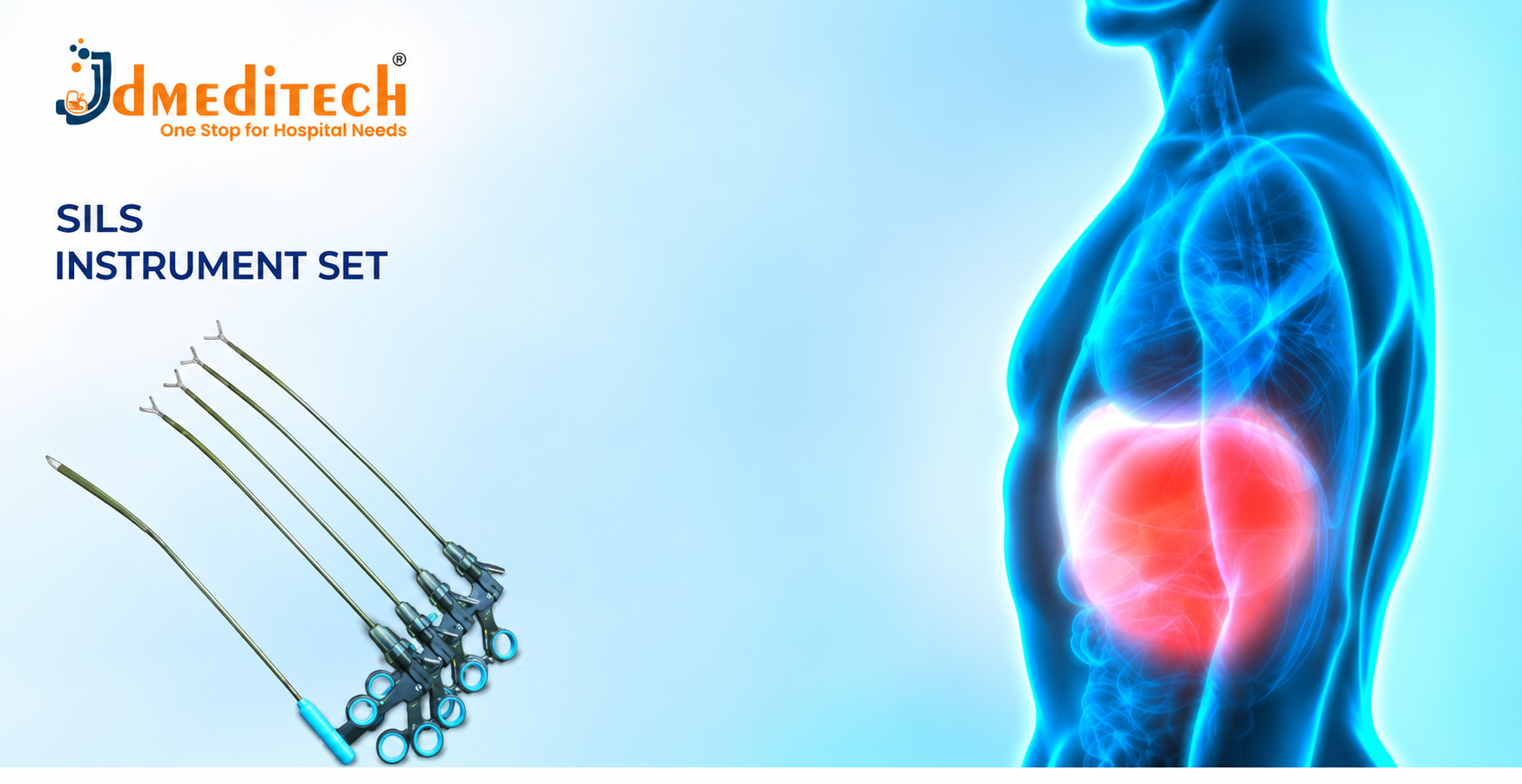
SILS Instrument Set – Complete Guide to Single Incision Laparoscopic Surgery Instruments
A SILS Instrument Set contains specialized surgical instruments for selected single incision laparoscopic procedures. SILS stands for Single Incision Laparoscopic Surgery, a minimally invasive approach that uses one primary access site, commonly near the umbilicus.
Furthermore, single incision procedures require instruments that support controlled movement within a limited access area. Therefore, suitable shaft designs, instrument lengths and handle configurations are important considerations.
JDMeditech supplies surgical instruments and medical equipment for hospitals, surgical centers and medical distributors. Additionally, our team can assist customers with available instrument configurations, technical information and quotation requests.
What Is a SILS Instrument Set?
A SILS surgical instrument set is a collection of specialized instruments used during selected single port laparoscopic procedures.
Unlike conventional multiport laparoscopy, single incision surgery typically introduces several instruments through one access site using a suitable access platform.
Consequently, the surgeon must manage instrument positioning and movement within a restricted working area.
However, the exact instrument requirements depend on the planned operation.
What Is Single Incision Laparoscopic Surgery?
Single incision laparoscopic surgery is a minimally invasive technique that uses one primary surgical access site.
For example, surgeons may use a specialized access port placed through an incision near the navel.
Furthermore, suitable laparoscopic instruments and visualization equipment allow the surgical team to perform selected operative tasks.
However, single incision surgery is not suitable for every patient or procedure.
Purpose of Single Port Laparoscopic Instruments
The primary purpose of SILS instruments is to support surgical manipulation through a shared access site.
For example, surgeons may require instruments for grasping, dissection, cutting and tissue handling.
Additionally, certain instrument designs help address limited working space and instrument crowding.
Therefore, the operating team should select an appropriate configuration.
Why Are Specialized SILS Instruments Important?
Single incision surgery presents different instrument positioning challenges compared with conventional laparoscopy.
For example, multiple instruments may enter through closely positioned access channels.
Furthermore, instrument handles and shafts may interfere with each other.
Consequently, specialized curved or articulating designs can support selected surgical tasks.
Main Components of a SILS Instrument Set
Depending on the manufacturer and selected configuration, a SILS instrument set may include:
- SILS Grasping Forceps
- SILS Dissecting Forceps
- Curved Laparoscopic Instruments
- Articulating Instruments, Where Available
- SILS Scissors
- SILS Needle Holder
- Specialized Laparoscopic Handles
- Optional Single Port Access Accessories
- Instrument Tray, Where Included
However, not every set contains all these instruments. Therefore, buyers should verify the official instrument list.
1. SILS Grasping Forceps
SILS grasping forceps support selected tissue handling tasks during minimally invasive surgery.
Furthermore, certain designs feature curved shafts or specialized handles.
However, the exact jaw pattern depends on the selected model.
2. SILS Dissecting Forceps
Dissecting forceps support controlled tissue manipulation during selected procedures.
Additionally, specialized instrument geometry may help surgeons work within a limited access area.
However, instrument suitability depends on the intended surgical task.
3. Curved Laparoscopic Instruments
Curved instruments feature a shaft geometry that differs from conventional straight laparoscopic designs.
For example, certain curved configurations help separate proximal instrument handles.
Furthermore, the distal working ends may approach the operative field from different angles.
However, the benefits depend on the specific instrument and surgical technique.
4. Articulating Instruments
Some single port instrument systems include articulating working ends.
Furthermore, articulation may provide additional movement options within the operative field.
However, not every SILS set includes articulating instruments.
5. SILS Scissors
SILS scissors support selected surgical cutting tasks.
Additionally, certain designs use specialized shafts or handles for single incision access.
However, the appropriate blade configuration depends on the procedure.
6. SILS Needle Holder
A SILS needle holder supports selected laparoscopic suturing tasks.
Furthermore, specialized instrument geometry may help the surgeon manage needle positioning.
However, suturing technique and instrument selection require appropriate surgical training.
7. Specialized Instrument Handles
Instrument handles allow surgeons to control the distal working ends.
Additionally, different handle designs may help accommodate closely positioned access channels.
However, handle construction varies by manufacturer.
8. Single Port Access Accessories
Some surgical setups use specialized access ports that accommodate multiple instruments.
Furthermore, the access platform must support the intended surgical technique.
However, a single port device may be supplied separately from the instrument set.
Key Features of SILS Surgical Instruments
Depending on the model, SILS instruments may offer the following characteristics:
- Specialized Designs for Single Incision Surgery
- Curved Instrument Shaft Options
- Selected Articulating Configurations
- Different Available Working Lengths
- Model-Specific Grasping and Dissecting Jaws
- Specialized Handle Configurations
- Compatibility With Selected Access Systems
- Reusable or Single-Use Options, Where Available
- Different Instrument Set Configurations
However, customers should verify the actual features through the official product datasheet.
Clinical Applications of SILS Instrument Sets
Qualified surgeons may use suitable single incision instruments during selected minimally invasive procedures.
Potential applications include:
- Selected Laparoscopic Cholecystectomy Procedures
- Selected Appendectomy Procedures
- Selected Gynecological Procedures
- Selected Abdominal Surgical Procedures
- Other Clinically Appropriate Single Port Operations
However, not every procedure or patient is suitable for single incision surgery.
Application in Laparoscopic Cholecystectomy
Selected gallbladder operations may use a single incision laparoscopic approach.
For example, the surgeon may introduce compatible instruments through a specialized access platform.
Furthermore, curved instruments may help manage working angles.
However, the surgical approach depends on patient anatomy and clinical judgment.
Application in Appendectomy
Selected appendectomy procedures may use a single incision technique.
Additionally, suitable instruments support tissue handling and dissection.
However, the surgeon must assess whether the approach is appropriate for the patient.
Application in Gynecological Surgery
Some gynecological operations may use single port laparoscopic techniques.
Furthermore, specialized instruments can support selected pelvic surgical tasks.
However, the required equipment depends on the planned procedure.
Application in General Surgery
Selected general surgical procedures may use single incision access.
Additionally, suitable instrument configurations can support minimally invasive operative tasks.
However, clinical suitability varies between procedures.
How Does a SILS Instrument Set Work?
A SILS instrument set provides tools for selected surgical tasks performed through a shared access site.
First, the operating team confirms the planned instrument configuration and access system.
During surgery, the surgeon uses suitable instruments under laparoscopic visualization.
Furthermore, the team manages instrument positioning according to the operative technique.
Afterward, staff handle the instruments according to their reusable or single-use labeling.
However, the exact surgical workflow depends on the operation.
Importance of Instrument Triangulation
Conventional laparoscopy often uses instruments entering through separate ports.
In contrast, single incision surgery places instruments close together.
Therefore, maintaining suitable working angles can be more challenging.
Furthermore, specialized instrument geometry may help address these limitations.
Importance of Instrument Ergonomics
Instrument ergonomics influence surgical handling.
For example, closely positioned handles may restrict movement.
Additionally, curved or specialized handle designs may provide alternative working positions.
However, the surgeon must become familiar with the selected instruments.
Technical Specifications of a SILS Instrument Set
Exact specifications vary by manufacturer and instrument configuration. Therefore, customers should request the official product datasheet.
| Parameter | Product Information |
|---|---|
| Product Name | SILS Instrument Set |
| Full Form | Single Incision Laparoscopic Surgery Instrument Set |
| Product Category | Laparoscopy Surgical Instruments |
| Primary Application | Selected Single Incision Laparoscopic Procedures |
| Instrument Configuration | Confirm Official Instrument List |
| Instrument Quantity | Confirm Selected Set |
| Shaft Design | Model-Specific |
| Working Length | Confirm Manufacturer Datasheet |
| Shaft Diameter | Confirm Available Dimensions |
| Jaw Configuration | Confirm Selected Instruments |
| Instrument Material | Confirm Manufacturer Specifications |
| Access Port Compatibility | Verify Manufacturer Instructions |
| Reusable Status | Confirm Product Labeling |
| Sterilization Method | Follow Validated Manufacturer Instructions |
| Packaging | Confirm Supplied Configuration |
| Regulatory Documentation | Verify for Destination Market |
Common SILS Instruments and Their Functions
| Instrument | General Function |
|---|---|
| Grasping Forceps | Selected Tissue Grasping |
| Dissecting Forceps | Selected Tissue Dissection |
| Curved Instrument | Supports Specialized Working Angles |
| Articulating Instrument | Provides Model-Specific Distal Movement |
| SILS Scissors | Selected Tissue Cutting |
| Needle Holder | Supports Surgical Suturing |
| Instrument Handle | Controls the Distal Working End |
| Access Port | Provides a Shared Access Platform When Included |
Potential Benefits of SILS Instruments
Suitable single incision instruments may support selected minimally invasive procedures.
- Specialized Instrument Design for Single Port Access
- Different Working Angle Options
- Compatibility With Selected Surgical Techniques
- Availability of Curved Instrument Configurations
- Support for Selected Tissue Handling Tasks
- Integration With Appropriate Access Platforms
Furthermore, specialized instruments may help address the handling challenges of single incision surgery.
However, these characteristics do not guarantee improved clinical outcomes.
SILS Surgery Versus Conventional Laparoscopy
Conventional laparoscopy typically uses multiple access ports.
In contrast, single incision laparoscopy uses one primary access site.
Furthermore, the two approaches differ in instrument positioning and ergonomic requirements.
However, the best surgical approach depends on the patient and planned procedure.
SILS Instruments Versus Standard Laparoscopic Instruments
Standard laparoscopic instruments often feature straight shafts.
Meanwhile, some SILS instruments use curved or articulating designs.
Additionally, specialized handles may help address instrument crowding.
However, not every single incision procedure requires a completely specialized instrument set.
Potential Challenges of Single Incision Surgery
Single incision surgery can create technical challenges.
- Instrument Crowding
- Limited Working Angles
- Reduced Instrument Triangulation
- Handle Interference
- Restricted Movement
- Procedure-Specific Learning Requirements
Therefore, appropriate surgical training and instrument selection remain important.
Potential Risks and Safety Considerations
Single incision laparoscopic procedures involve risks associated with surgery and instrument use.
Potential complications include:
- Bleeding
- Infection
- Injury to Adjacent Structures
- Access Site Complications
- Instrument-Related Tissue Injury
- Need for Additional Access Ports
- Conversion to Open Surgery
However, actual risks depend on patient factors, procedure selection and clinical circumstances.
Important Safety Precautions
Only qualified surgical healthcare professionals should use SILS instruments.
Furthermore, the operating team must verify instrument compatibility and integrity.
Additionally, clinicians should follow the approved surgical technique and manufacturer instructions.
Therefore, hospitals must maintain appropriate surgical safety procedures.
Inspection Before Surgical Use
Operating room personnel should inspect the instruments before use.
- Confirm Instrument Identification
- Check the Required Quantity
- Inspect Distal Jaws
- Examine Shaft Integrity
- Check Handle Movement
- Inspect Articulating Mechanisms, Where Applicable
- Verify Access Port Compatibility
- Confirm Sterile Status
- Remove Damaged Instruments From Use
Additionally, staff should follow the manufacturer’s inspection requirements.
Cleaning and Decontamination
Reusable SILS instruments require validated cleaning and decontamination.
Furthermore, curved shafts, joints and other complex structures may require particular attention.
However, cleaning methods vary by instrument design.
Therefore, facilities must follow the manufacturer’s instructions for use.
Sterilization Requirements
Reusable instruments intended for sterile surgery require validated sterilization.
For example, some compatible metal instruments may support specified steam sterilization cycles.
However, articulated mechanisms and other components can affect reprocessing requirements.
Consequently, staff should verify the approved method for each instrument.
Storage and Handling
Proper storage helps protect specialized instruments from avoidable damage.
For example, suitable trays can support organized instrument transport.
Additionally, staff should protect delicate jaws, curved shafts and articulating mechanisms.
Therefore, healthcare facilities should follow established storage procedures.
How to Choose a SILS Instrument Set
Hospitals and procurement teams should review several factors before purchasing.
- Intended Surgical Procedure
- Required Instrument Types
- Instrument Quantity
- Curved or Straight Shaft Configuration
- Articulating Features
- Working Length
- Shaft Diameter
- Jaw Design
- Handle Configuration
- Access Port Compatibility
- Instrument Material
- Reusable Status
- Cleaning and Sterilization Requirements
- Packaging Configuration
- Regulatory Documentation
Furthermore, the operating surgeon should confirm the final instrument selection.
Applications in Hospitals
Hospitals offering selected minimally invasive procedures may maintain specialized single incision instruments.
Additionally, surgical departments may use different instrument configurations for different operations.
However, equipment requirements depend on the hospital’s clinical services.
Applications in Surgical Centers
Appropriately equipped surgical centers may use compatible SILS instruments during selected operations.
Furthermore, standardized instrument configurations can support operating room preparation.
However, facilities must verify staff training, access system compatibility and reprocessing capabilities.
Applications for Medical Distributors
Medical distributors should confirm the complete instrument list before preparing quotations.
For example, customers may request particular shaft designs, working lengths or jaw configurations.
Additionally, destination-market regulations may affect documentation requirements.
Therefore, distributors should request an official technical proposal.
Why Choose JDMeditech?
JDMeditech supplies surgical instruments and medical equipment for hospitals, surgical centers and medical distributors.
Furthermore, our team can assist customers with available instrument configurations, technical information and quotation requests.
Customers can contact JDMeditech regarding:
- SILS Surgical Instrument Set Inquiries
- Single Port Laparoscopy Instrument Requirements
- Specialized Laparoscopic Instrument Configurations
- Available Technical Specifications
- Product Configuration Requests
- Medical Distributor Inquiries
- International Export Requests
However, exact product availability, dimensions and regulatory documentation require confirmation.
Frequently Asked Questions About SILS Instrument Sets
1. What Is a SILS Instrument Set?
It is a collection of instruments intended for selected single incision laparoscopic procedures.
2. What Does SILS Stand For?
SILS stands for Single Incision Laparoscopic Surgery.
3. What Is the Main Purpose of SILS Instruments?
They support selected surgical tasks through a shared minimally invasive access site.
4. Are SILS Instruments Different From Standard Laparoscopic Instruments?
Some SILS instruments use specialized curved or articulating designs. However, the exact differences depend on the model.
5. Are SILS Instruments Used in Gallbladder Surgery?
Compatible instruments may support selected single incision cholecystectomy procedures.
6. Can They Be Used in Appendectomy?
Suitable instruments may support selected single incision appendectomy procedures.
7. Are They Used in Gynecological Surgery?
Some single incision techniques apply to selected gynecological procedures. However, suitability depends on clinical judgment.
8. Do SILS Instruments Have Curved Shafts?
Some models feature curved shafts. However, not every SILS instrument uses the same geometry.
9. Are Articulating Instruments Available?
Articulating configurations may be available in certain product ranges. Therefore, customers should confirm the options.
10. Does the Set Include a Single Port Access Device?
Not necessarily. Access devices may be supplied separately.
11. Are SILS Instruments Reusable?
Reusable status depends on the selected model. Consequently, buyers should verify the product labeling.
12. Can the Instruments Be Steam Sterilized?
Some reusable instruments may support validated steam sterilization. However, the approved method must be confirmed.
13. What Are the Main Challenges of Single Incision Surgery?
Common challenges include instrument crowding, limited triangulation and handle interference.
14. Who Should Use These Instruments?
Appropriately trained surgical healthcare professionals should use them according to the approved intended purpose.
15. What Should Buyers Confirm Before Ordering?
Buyers should confirm the instrument list, shaft dimensions, handle designs, access compatibility, reprocessing requirements and regulatory documentation.
Conclusion
In conclusion, a SILS Instrument Set provides specialized tools for selected single incision laparoscopic procedures.
Furthermore, curved and articulating instrument designs may help address the handling challenges of single port access.
Additionally, different configurations support different surgical requirements.
However, safe use requires appropriate clinical selection, instrument compatibility and professional training.
Therefore, healthcare facilities should verify the complete technical specifications before purchasing.
JDMeditech – One Stop for Hospital Needs
Website:
www.jdmeditech.com
Related Laparoscopy Products
- Single Port Access System
- Laparoscopic Grasping Forceps
- Laparoscopic Dissecting Forceps
- Laparoscopic Scissors
- Laparoscopic Needle Holder
- Laparoscopic Trocar
- Laparoscopic Instrument Set
Medical Disclaimer
This article provides general educational and product information only. It does not replace professional medical advice, surgical training or manufacturer instructions. Qualified healthcare professionals must select and use surgical instruments according to approved indications, technical specifications and applicable safety requirements.




