



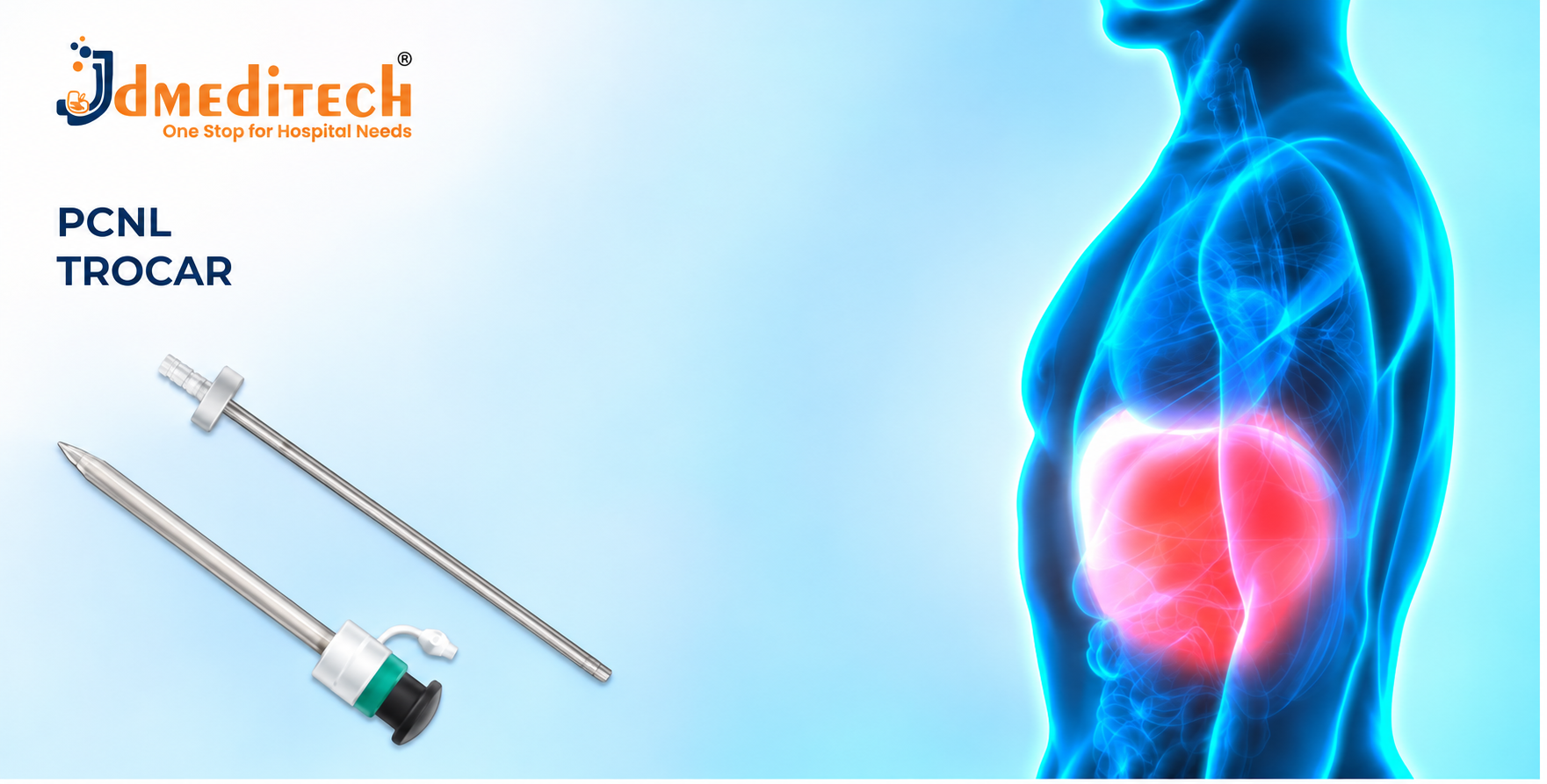
PCNL Trocar – Complete Guide to Features, Uses, Components and Specifications
A PCNL Trocar is a specialized urological instrument used in selected percutaneous renal access techniques during kidney stone surgery. Percutaneous nephrolithotomy, commonly called PCNL, allows urologists to remove certain kidney stones through a small access tract.
Furthermore, suitable access instruments help the surgical team establish or maintain a pathway toward the renal collecting system. The exact role of a trocar depends on its design and the surgical technique.
JDMeditech supplies urology instruments and medical equipment for hospitals, surgical centers and medical distributors. Additionally, customers can contact our team for available product configurations, technical specifications and quotation requests.
What Is a PCNL Trocar?
A PCNL trocar is an access instrument intended for selected percutaneous urological procedures.
Depending on the model, a trocar system may include an obturator and an outer cannula or sheath.
Moreover, different designs support different access requirements. Therefore, clinicians must verify the selected instrument’s approved intended use.
What Is Percutaneous Nephrolithotomy?
Percutaneous nephrolithotomy is a minimally invasive surgical procedure for treating selected kidney stones.
During PCNL, the urologist establishes a controlled access tract into the kidney under appropriate imaging guidance.
Next, the surgeon uses suitable instruments to visualize and treat the stone.
However, not every patient or kidney stone requires PCNL. Treatment selection depends on clinical assessment.
Purpose of a PCNL Access Trocar
The purpose of a renal access trocar is to support a particular stage of percutaneous access when its design and approved instructions permit that use.
For example, certain trocar systems provide a rigid access assembly with a penetrating obturator and surrounding cannula.
However, other PCNL access techniques use needles, guidewires and sequential or balloon dilation systems instead.
Therefore, a trocar should not be assumed to replace every component of a PCNL access set.
Main Components of a PCNL Trocar System
Depending on the manufacturer and model, a PCNL trocar assembly may contain:
- Outer Cannula or Access Sheath
- Inner Obturator or Trocar Stylet
- Proximal Handle or Hub
- Model-Specific Locking Mechanism
- Optional Connector or Valve Components
However, the supplied configuration may differ. Consequently, buyers should verify the manufacturer’s packing list.
1. Outer Cannula
The outer cannula forms part of the access assembly.
Depending on the design, it may provide a passage after removal of the inner obturator.
Furthermore, cannula diameter and length influence compatibility with other instruments.
Therefore, hospitals should confirm the exact dimensions.
2. Inner Obturator
The inner obturator is a component of certain trocar systems.
Its distal tip and construction depend on the intended access technique.
Additionally, the obturator must match the corresponding outer cannula.
However, improper use can cause serious tissue or vascular injury.
3. Proximal Handle or Hub
The proximal section supports handling and connection between instrument components.
Furthermore, certain models include a mechanism that secures the obturator and cannula together.
However, handle and hub configurations vary by manufacturer.
4. Locking Mechanism
Some trocar systems include a locking or retention mechanism.
For example, the mechanism may help maintain the intended relationship between compatible components.
Nevertheless, not every model includes the same design.
5. Optional Accessories
Some access assemblies may include additional connectors or accessories.
However, accessory availability depends on the supplied configuration.
Therefore, buyers should request a complete product list before ordering.
Key Features of PCNL Trocar Instruments
Depending on the selected model, renal access trocars may offer the following characteristics:
- Rigid Access Instrument Design
- Model-Specific Cannula and Obturator Assembly
- Different Available Instrument Dimensions
- Proximal Handling Features
- Compatibility With Selected Urological Techniques
- Manufacturer-Specified Materials
- Reusable or Single-Use Configurations, Where Available
- Optional Accessories Depending on the Model
However, customers must confirm the actual product features through the official technical datasheet.
Clinical Applications of PCNL Access Instruments
Qualified urologists use appropriate access instruments during selected percutaneous renal procedures.
Potential applications, subject to the specific device’s approved indications, include:
- Selected Percutaneous Nephrolithotomy Procedures
- Selected Percutaneous Renal Access Techniques
- Other Manufacturer-Approved Urological Applications
However, not every trocar model suits every renal access procedure.
Application in Kidney Stone Surgery
PCNL is an established treatment option for selected large or complex kidney stones.
For example, urologists may recommend PCNL when stone size, anatomy or other clinical factors make alternative treatments less suitable.
Furthermore, the procedure requires careful planning of the renal access route.
Therefore, clinicians select access instruments according to the operative technique.
Application in Percutaneous Renal Access
Percutaneous renal access involves establishing a controlled pathway into the kidney.
Additionally, imaging guidance helps the surgical team plan and assess access.
However, the exact instruments and sequence depend on the selected technique.
Consequently, only appropriately trained professionals should perform these procedures.
How Does a PCNL Trocar Work?
A PCNL trocar system may use an obturator and cannula assembly to support a specific access technique.
First, the surgical team verifies the device’s intended use, dimensions and compatibility.
During the procedure, the urologist uses appropriate imaging and the approved surgical technique to manage renal access.
Afterward, the surgeon uses the necessary instruments for the planned stone treatment.
However, the exact operative sequence varies between procedures and devices.
Importance of Imaging Guidance
Imaging guidance plays an important role in percutaneous renal access.
For example, clinicians may use ultrasound, fluoroscopy or a combination of techniques.
Furthermore, imaging supports anatomical assessment and access planning.
However, the choice of imaging technique depends on clinical circumstances and available expertise.
Technical Specifications of a PCNL Trocar
Exact specifications depend on the manufacturer and selected model. Therefore, customers should request the official product datasheet.
| Parameter | Product Information |
|---|---|
| Product Name | PCNL Trocar |
| Product Category | Percutaneous Urology Access Instrument |
| Primary Application | Selected Renal Access Procedures |
| Instrument Configuration | Confirm Manufacturer Packing List |
| Outer Cannula | Confirm Selected Model |
| Inner Obturator | Confirm Selected Model |
| Diameter | Confirm Available Size |
| Working Length | Confirm Manufacturer Datasheet |
| Tip Design | Model-Specific |
| Instrument Material | Confirm Manufacturer Specifications |
| Hub or Handle | Model-Specific |
| Compatible Accessories | Verify Manufacturer Instructions |
| Reusable Status | Confirm Product Labeling |
| Sterilization Method | Follow Validated Manufacturer Instructions |
| Packaging | Confirm Supplied Configuration |
| Regulatory Documentation | Verify for Destination Market |
PCNL Trocar Components and Functions
| Component | General Function |
|---|---|
| Outer Cannula | Forms Part of the Access Pathway |
| Inner Obturator | Supports the Intended Access Mechanism |
| Proximal Hub | Supports Instrument Handling |
| Locking Mechanism | Secures Compatible Components Where Provided |
| Optional Accessories | Support Model-Specific Functions |
Potential Benefits of a PCNL Trocar
A suitable access instrument may support selected percutaneous renal procedures.
- Specialized Access Instrument Configuration
- Compatibility With Selected Urological Techniques
- Different Available Instrument Dimensions
- Integration With Appropriate Renal Access Equipment
- Model-Specific Handling Features
Furthermore, the correct instrument configuration can support procedural planning.
However, these characteristics do not guarantee improved clinical outcomes.
PCNL Trocar Versus PCNL Access Needle
A PCNL access needle is used for selected renal puncture techniques.
In contrast, a trocar system may include a larger cannula and obturator assembly for its approved access function.
Furthermore, the two instruments may serve different stages or approaches.
Therefore, surgeons should not treat them as universally interchangeable.
PCNL Trocar Versus Amplatz Sheath
An Amplatz sheath commonly provides an access channel during PCNL after appropriate tract preparation.
Meanwhile, a trocar system has its own design and intended use.
Additionally, the instruments differ in configuration and function.
Therefore, buyers should verify the precise equipment requirements.
PCNL Trocar Versus Fascial Dilator
Fascial dilators support enlargement of an established access tract in selected procedures.
By comparison, a trocar may support a different access mechanism.
However, the choice depends on the operative technique and the manufacturer’s instructions.
Importance of Instrument Size Selection
PCNL access instruments are available in different dimensions across product ranges.
Furthermore, instrument diameter influences compatibility with other access equipment.
However, the clinically appropriate size depends on patient anatomy and the planned procedure.
Therefore, the urologist should confirm the required configuration.
Importance of Instrument Compatibility
Renal access procedures may involve several instruments and accessories.
For example, a selected trocar assembly must match its compatible cannula or obturator components.
Additionally, the surgical team should verify compatibility with other planned equipment.
Therefore, procurement teams should request detailed technical information.
Potential Risks of Percutaneous Renal Access
Percutaneous renal procedures involve important clinical risks.
Potential complications include:
- Bleeding
- Injury to Renal Blood Vessels
- Injury to Adjacent Organs
- Urinary Leakage
- Infection
- Sepsis
- Renal Tissue Injury
- Need for Additional Treatment
However, individual risks depend on patient factors, anatomy and the selected technique.
Important Safety Precautions
Only qualified urologists should use renal access instruments for their approved clinical purposes.
Furthermore, the operating team must confirm the instrument’s integrity and compatibility.
Additionally, appropriate imaging and surgical planning remain essential.
Therefore, healthcare facilities must follow established clinical protocols and manufacturer instructions.
Inspection Before Use
Operating room personnel should inspect the instrument before clinical use.
- Confirm Product Identification
- Inspect the Distal Tip
- Check Cannula Integrity
- Examine the Obturator
- Verify Component Compatibility
- Check the Handle or Hub
- Confirm Sterile Status
- Remove Damaged Instruments From Use
Additionally, staff should follow the manufacturer’s inspection requirements.
Cleaning and Decontamination
Reusable renal access instruments require validated cleaning and decontamination.
Furthermore, narrow lumens and connection points may require particular attention.
However, approved cleaning methods vary by instrument design.
Therefore, facilities should follow the manufacturer’s instructions for use.
Sterilization Requirements
Reusable instruments intended for sterile procedures require appropriate validated sterilization.
For example, some compatible metal instruments may support specified steam sterilization cycles.
However, not every product supports the same method.
Consequently, staff must confirm the approved sterilization process.
Storage and Handling
Proper storage helps protect access instruments from avoidable damage.
For example, facilities should protect the distal tip and cannula during transport.
Additionally, suitable trays can support organized instrument handling.
Therefore, hospitals should follow established storage procedures.
How to Choose a PCNL Trocar
Hospitals and procurement teams should review several factors before purchasing.
- Approved Intended Use
- Trocar Configuration
- Outer Cannula Diameter
- Working Length
- Tip Design
- Instrument Material
- Handle or Hub Configuration
- Compatible Accessories
- Reusable or Single-Use Status
- Cleaning Requirements
- Sterilization Compatibility
- Packaging Configuration
- Regulatory Documentation
Furthermore, the operating urologist should confirm the final instrument selection.
Applications in Hospitals
Hospitals offering percutaneous kidney stone treatment may require specialized access instruments.
Additionally, urology departments may maintain different instrument configurations.
However, the required equipment depends on the available procedures and clinical techniques.
Applications in Urology Centers
Specialized urology centers may use compatible access instruments during selected renal procedures.
Furthermore, standardized equipment lists can support procedural preparation.
However, facilities must verify training, imaging capabilities and reprocessing requirements.
Applications for Medical Distributors
Medical distributors should confirm the complete product specifications before preparing quotations.
For example, customers may require particular diameters, lengths or cannula configurations.
Additionally, destination-market regulations may affect documentation requirements.
Therefore, distributors should request an official technical proposal.
Why Choose JDMeditech?
JDMeditech supplies urology instruments and medical equipment for hospitals, surgical centers and medical distributors.
Furthermore, our team can assist customers with available product information, technical specifications and quotation requests.
Customers can contact JDMeditech regarding:
- PCNL Access Instrument Inquiries
- Urology Surgical Instrument Requirements
- Renal Access Equipment
- Available Technical Specifications
- Product Configuration Requests
- Medical Distributor Inquiries
- International Export Requests
However, exact product availability, dimensions and regulatory documentation require confirmation.
Frequently Asked Questions About PCNL Trocars
1. What Is a PCNL Trocar?
It is a specialized instrument used in selected percutaneous renal access techniques.
2. What Does PCNL Stand For?
PCNL stands for Percutaneous Nephrolithotomy, a procedure used to treat selected kidney stones.
3. What Is the Main Purpose of a Renal Access Trocar?
Its purpose is to support a particular access function according to the device’s approved intended use.
4. Is It Used During Kidney Stone Surgery?
Compatible models may be used during selected PCNL procedures. However, suitability depends on the surgical technique.
5. Does Every PCNL Procedure Require a Trocar?
No. Different access techniques use different instruments.
6. Does a Trocar Include an Obturator?
Some trocar systems include an obturator and outer cannula. However, customers should verify the supplied components.
7. Are Different Diameters Available?
Different product models may offer different dimensions. Therefore, buyers should request the available size list.
8. Is a PCNL Trocar the Same as an Access Needle?
No. These instruments may differ in construction and intended function.
9. Is It the Same as an Amplatz Sheath?
No. An Amplatz sheath and a trocar system have different designs and clinical functions.
10. Is the Instrument Reusable?
Reusable status depends on the selected product. Consequently, customers should verify the labeling.
11. Can the Instrument Be Steam Sterilized?
Some reusable models may support validated steam sterilization. However, the approved method must be confirmed.
12. What Are the Main Safety Concerns?
Potential concerns include bleeding, tissue injury, infection and injury to adjacent organs.
13. Who Should Use the Instrument?
Appropriately trained urologists should use it according to the approved intended purpose.
14. What Should Buyers Confirm Before Ordering?
Buyers should confirm the dimensions, components, compatibility, reprocessing requirements and regulatory documentation.
15. Where Can Customers Request Product Information?
Hospitals, urology centers and medical distributors can contact JDMeditech for available product information and quotations.
Conclusion
In conclusion, a PCNL Trocar is a specialized instrument for selected percutaneous renal access techniques.
Furthermore, its design and configuration determine its role in the procedure.
Additionally, appropriate instrument selection supports compatibility with the planned surgical approach.
However, safe use requires qualified clinical judgment, suitable imaging and adherence to manufacturer instructions.
Therefore, healthcare facilities should verify all technical specifications before purchasing.
JDMeditech – One Stop for Hospital Needs
Website:
www.jdmeditech.com
Related Urology Products
- PCNL Instrument Set
- PCNL Access Needle
- Amplatz Sheath
- Fascial Dilator Set
- Nephroscope
- Urology Guide Wire
- Stone Retrieval Instruments
Medical Disclaimer
This article provides general educational and product information only. It does not replace professional medical advice, surgical training or manufacturer instructions. Qualified healthcare professionals must select and use renal access instruments according to approved indications, technical specifications and applicable safety requirements.




