



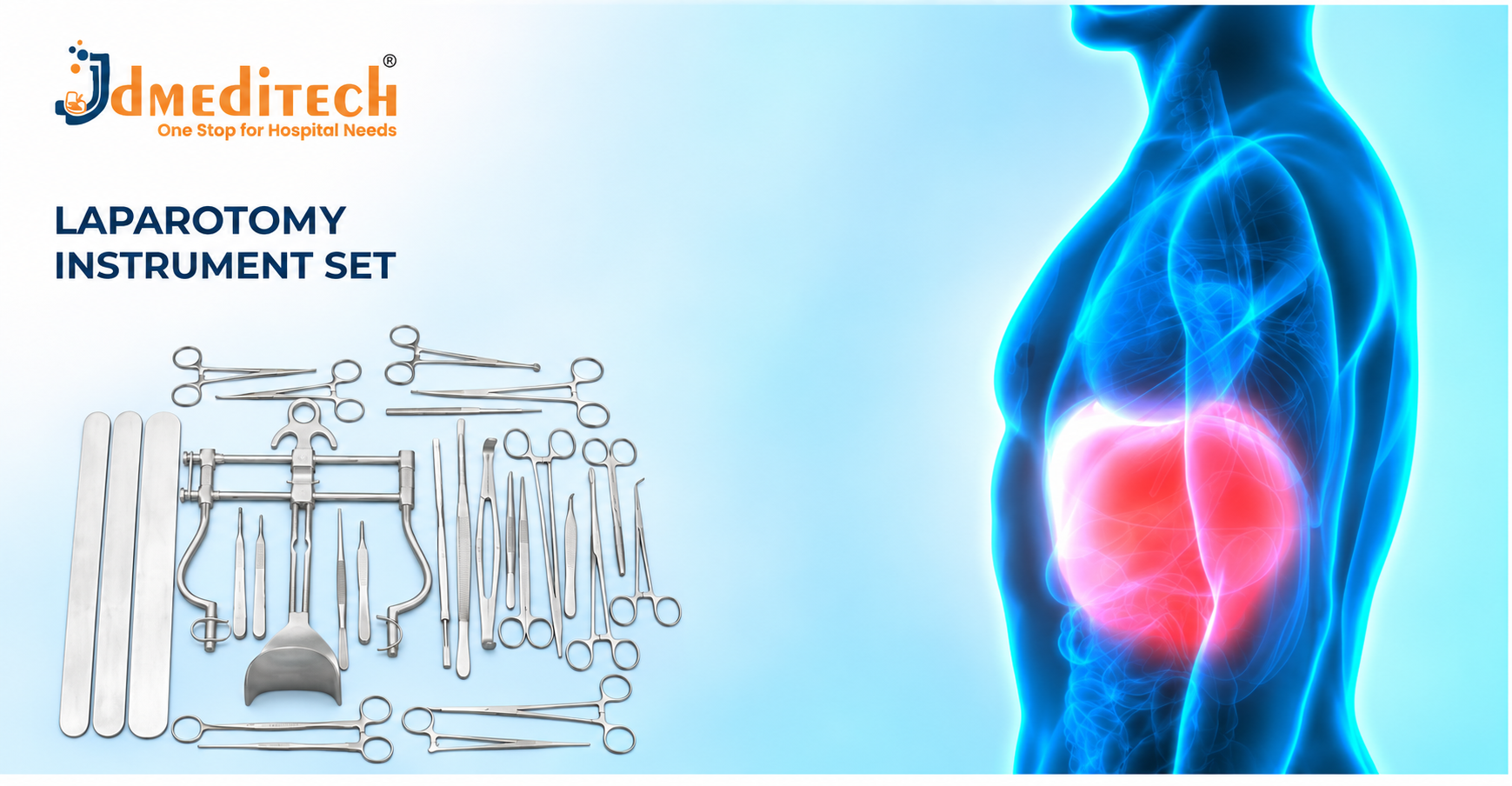
Laparotomy Instrument Set – Complete Guide to Surgical Instruments for Open Abdominal Surgery
A Laparotomy Instrument Set contains surgical instruments that support open abdominal procedures. Surgeons use different instruments for cutting, grasping, clamping, retracting, dissecting and suturing tissues.
Furthermore, a well-organized instrument set helps operating room teams prepare for different stages of surgery. Each instrument performs a particular function. Therefore, hospitals should select the appropriate set according to the planned operation.
JDMeditech supplies surgical instruments and medical equipment for hospitals, surgical centers and medical distributors. Additionally, our team can assist customers with available configurations, product information and quotation requests.
What Is a Laparotomy Instrument Set?
A laparotomy surgical set is a collection of instruments designed for selected open abdominal operations.
Unlike laparoscopic procedures, laparotomy involves a surgical incision that provides direct access to the abdominal cavity.
Consequently, the surgeon uses suitable instruments to handle tissues and perform the planned operation.
However, the exact instrument list varies according to the procedure and hospital requirements.
Purpose of a Laparotomy Surgical Instrument Set
The primary purpose of this surgical set is to provide instruments required for selected open abdominal procedures.
For example, surgeons may need instruments for tissue dissection, hemostasis, exposure and suturing.
Additionally, organized instrument preparation supports efficient operating room workflows.
Therefore, surgical teams should confirm the instrument inventory before each operation.
Importance of Proper Surgical Instrument Selection
Different abdominal operations require different instruments.
For example, certain procedures require specialized retractors, while others need additional intestinal or vascular instruments.
Furthermore, instrument size and design influence suitability for the intended surgical task.
Therefore, surgeons and operating room personnel should review the set configuration before use.
Main Components of a Laparotomy Instrument Set
A typical open abdominal surgery set may contain instruments from several categories.
- Scalpel Handles
- Surgical Scissors
- Artery Forceps
- Dissecting Forceps
- Tissue Forceps
- Needle Holders
- Surgical Retractors
- Sponge Holding Forceps
- Towel Clamps
- Hemostatic Clamps
- Selected Intestinal Instruments
- Instrument Trays
However, the actual quantity and instrument models depend on the selected configuration.
1. Scalpel Handles
Scalpel handles support compatible surgical blades.
Surgeons use them for selected tissue incisions during open operations.
Additionally, different handle designs accommodate different blade configurations.
Therefore, the surgical team should verify blade compatibility.
2. Surgical Scissors
Surgical scissors support selected cutting and dissection tasks.
For example, a set may include Mayo scissors or Metzenbaum scissors.
Furthermore, different blade designs suit different tissue characteristics.
However, the exact scissors included depend on the instrument list.
3. Artery Forceps
Artery forceps help surgeons clamp selected tissues or blood vessels.
For example, mosquito forceps and other hemostatic clamps may support bleeding control.
Additionally, straight and curved patterns serve different handling requirements.
Therefore, hospitals should verify the available types and sizes.
4. Dissecting Forceps
Dissecting forceps support tissue handling during surgical procedures.
Furthermore, different tip designs provide different grasping characteristics.
However, the surgeon must choose the appropriate pattern for the intended tissue.
5. Tissue Forceps
Tissue forceps help surgeons hold selected tissues during an operation.
For example, toothed and non-toothed patterns serve different surgical requirements.
Additionally, appropriate instrument selection can support controlled tissue handling.
6. Needle Holders
Needle holders secure suitable surgical needles during suturing.
Furthermore, different jaw designs accommodate different needle types and sizes.
Therefore, surgeons should select the appropriate needle holder for the planned closure technique.
7. Surgical Retractors
Surgical retractors help maintain access to the operative field.
For example, handheld retractors may support exposure during selected abdominal procedures.
Additionally, self-retaining retractors may maintain a selected position without continuous manual holding.
However, the type and size depend on the surgical approach.
8. Sponge Holding Forceps
Sponge holding forceps help surgical teams handle appropriate swabs or sponges.
Furthermore, certain designs support selected preparation or operative tasks.
However, staff must follow the approved surgical technique and instrument count procedures.
9. Towel Clamps
Towel clamps help secure selected surgical drapes or materials.
Additionally, different clamp designs suit different operating room requirements.
Therefore, hospitals should confirm the included patterns.
10. Hemostatic Clamps
Hemostatic clamps support temporary control of selected tissues or vessels.
Furthermore, different jaw patterns provide different clamping characteristics.
However, excessive pressure can damage tissue. Therefore, surgeons must select and use these instruments appropriately.
11. Intestinal Instruments
Some abdominal surgery sets include specialized instruments for intestinal procedures.
For example, selected bowel clamps may support appropriate tissue handling.
However, not every laparotomy set contains intestinal instruments.
Therefore, customers should verify the supplied configuration.
12. Surgical Instrument Tray
An instrument tray helps organize and transport surgical instruments.
Furthermore, suitable trays may support instrument handling during validated reprocessing workflows.
However, tray design and sterilization compatibility vary by product.
Common Instruments and Their Functions
| Instrument | General Function |
|---|---|
| Scalpel Handle | Supports Compatible Surgical Blades |
| Mayo Scissors | Selected Tissue or Material Cutting Tasks |
| Metzenbaum Scissors | Selected Soft Tissue Dissection |
| Artery Forceps | Clamping Selected Tissues or Vessels |
| Mosquito Forceps | Fine Hemostatic Clamping Tasks |
| Dissecting Forceps | Tissue Handling |
| Tissue Forceps | Grasping Selected Tissues |
| Needle Holder | Holding Surgical Needles |
| Surgical Retractor | Maintaining Operative Exposure |
| Sponge Holding Forceps | Handling Suitable Surgical Sponges |
| Towel Clamp | Securing Selected Drapes or Materials |
| Instrument Tray | Organizing Surgical Instruments |
Clinical Applications of Laparotomy Instruments
Qualified surgeons use open abdominal surgery instruments during selected procedures.
Potential applications include:
- Exploratory Laparotomy
- Selected Gastrointestinal Surgery
- Selected Abdominal Trauma Surgery
- Selected Bowel Procedures
- Selected Hepatobiliary Operations
- Other Appropriate Open Abdominal Procedures
However, the required instruments depend on the planned operation.
Application in Exploratory Laparotomy
Exploratory laparotomy allows surgeons to examine abdominal structures through an open incision.
Furthermore, the operation may require instruments for tissue handling, exposure and hemostasis.
Therefore, the surgical team prepares an appropriate instrument configuration.
Application in Gastrointestinal Surgery
Selected gastrointestinal procedures require open surgical access.
For example, surgeons may use appropriate instruments during certain stomach or intestinal operations.
Additionally, specialized tissue handling instruments may be necessary.
However, the exact configuration depends on the procedure.
Application in Abdominal Trauma Surgery
Some abdominal injuries require open surgical treatment.
Furthermore, the operating team may need instruments for rapid exposure, tissue handling and bleeding control.
However, emergency surgical requirements vary according to the patient’s condition.
Application in Bowel Surgery
Selected bowel operations require appropriate grasping, clamping, cutting and suturing instruments.
Additionally, specialized intestinal instruments may support particular surgical tasks.
Therefore, hospitals should verify that the set includes the required components.
Application in Hepatobiliary Surgery
Selected liver and biliary operations may require open abdominal access.
Furthermore, specialized retractors and hemostatic instruments may be necessary.
However, instrument selection depends on the planned surgical technique.
How Is a Laparotomy Instrument Set Used?
A laparotomy set provides instruments for different stages of an open abdominal procedure.
First, the surgical team confirms the planned instrument inventory.
Next, trained personnel prepare the instruments according to sterile operating room procedures.
During surgery, the surgeon selects suitable instruments for each clinical task.
Afterward, the team completes the required instrument counts and transfers reusable devices for validated reprocessing.
However, the precise surgical workflow depends on the operation.
Technical Specifications of a Laparotomy Instrument Set
Exact technical specifications vary by manufacturer and set configuration. Therefore, customers should request an official instrument list and product datasheet.
| Parameter | Product Information |
|---|---|
| Product Name | Laparotomy Instrument Set |
| Product Category | General Surgery Instrument Set |
| Primary Application | Selected Open Abdominal Procedures |
| Instrument Quantity | Confirm Selected Configuration |
| Instrument Types | As Per Approved Set List |
| Instrument Sizes | Confirm Manufacturer Specifications |
| Material | Confirm Manufacturer Datasheet |
| Surface Finish | Model-Specific |
| Reusable Status | Confirm Product Labeling |
| Sterilization Method | Follow Validated Manufacturer Instructions |
| Instrument Tray | Confirm Supplied Configuration |
| Packaging | Confirm Manufacturer Details |
| Regulatory Documentation | Verify for Destination Market |
Potential Benefits of a Complete Laparotomy Set
An appropriately configured instrument set can support operating room preparation.
- Organized Surgical Instrument Selection
- Availability of Instruments for Different Tasks
- Support for Open Abdominal Procedures
- Compatibility With Selected Surgical Workflows
- Different Configurations for Different Requirements
- Structured Instrument Inventory Management
Furthermore, a standardized instrument list can help hospitals review inventory requirements.
However, surgical outcomes depend on clinical factors, equipment suitability and professional technique.
Laparotomy Set Versus Laparoscopy Instrument Set
A laparotomy set supports open abdominal operations.
In contrast, a laparoscopy set contains instruments designed for minimally invasive access.
Furthermore, laparoscopic instruments often feature elongated shafts and specialized access components.
Therefore, hospitals should select the correct set for the planned surgical approach.
Laparotomy Set Versus General Surgery Set
A general surgery set may contain instruments for a broad range of operations.
Meanwhile, a laparotomy set focuses on the requirements of selected open abdominal procedures.
However, the two sets may share many common instruments.
Therefore, buyers should compare the actual instrument lists.
Importance of Surgical Instrument Quality
Surgical instruments must meet the technical requirements of their intended use.
Furthermore, appropriate manufacturing and inspection processes support consistent instrument performance.
However, material specifications and quality documentation vary between products.
Therefore, customers should request the relevant technical information.
Instrument Inspection Before Use
Operating room personnel should inspect surgical instruments before clinical use.
- Confirm Instrument Identification
- Check the Required Quantity
- Inspect Cutting Edges
- Examine Forceps Jaws
- Check Ratchets and Hinges
- Inspect Retractors
- Verify Needle Holder Function
- Confirm Sterilization Status
- Remove Damaged Instruments From Use
Additionally, the team should follow the manufacturer’s inspection instructions.
Cleaning and Decontamination
Reusable surgical instruments require appropriate cleaning after use.
Furthermore, hinged instruments and other complex surfaces may need special attention during validated cleaning.
However, approved cleaning methods depend on the instrument design.
Therefore, healthcare facilities must follow the manufacturer’s reprocessing instructions.
Sterilization Requirements
Reusable surgical instruments intended for sterile procedures require validated sterilization.
For example, certain compatible metal instruments may support specified steam sterilization cycles.
However, not every instrument or accessory supports the same method.
Consequently, staff must verify the approved sterilization process for each component.
Storage and Handling
Proper storage helps protect surgical instruments from avoidable damage.
For example, suitable instrument trays can support organized storage and transport.
Additionally, facilities should protect delicate tips and cutting edges.
Therefore, hospitals should follow established instrument handling procedures.
Potential Risks and Safety Considerations
Surgical instruments can cause complications when used incorrectly.
Potential concerns include:
- Unintended Tissue Injury
- Bleeding
- Instrument Breakage
- Contamination or Infection
- Sharps Injuries
- Incorrect Instrument Selection
- Retained Surgical Items
However, actual risks depend on the operation and clinical circumstances.
Therefore, qualified healthcare professionals must follow established surgical safety protocols.
Importance of Surgical Instrument Counts
Instrument counts form an important part of operating room safety.
Furthermore, surgical teams follow institutional procedures to account for instruments and other items.
Additionally, standardized set lists can support inventory verification.
Therefore, hospitals should maintain appropriate counting and documentation practices.
How to Select a Laparotomy Instrument Set
Hospitals and procurement teams should review several factors before purchasing.
- Intended Surgical Procedures
- Required Instrument Types
- Instrument Quantity
- Instrument Sizes
- Material Specifications
- Reusable Status
- Cleaning Requirements
- Sterilization Compatibility
- Instrument Tray Requirements
- Packaging Configuration
- Regulatory Documentation
- Replacement Instrument Availability
Furthermore, the operating surgeon should confirm the final instrument list.
Applications in Hospitals
Hospitals may use laparotomy sets during selected open abdominal procedures.
Additionally, operating departments may maintain different configurations for different surgical specialties.
However, instrument requirements depend on the hospital’s services.
Applications in Surgical Centers
Appropriately equipped surgical centers may maintain selected open surgery instrument sets.
Furthermore, standardized configurations can support operating room preparation.
However, facilities must verify staff training, reprocessing capabilities and clinical requirements.
Applications for Medical Distributors
Medical distributors should request a complete instrument list before preparing quotations.
For example, customers may require specific forceps, scissors, retractors or needle holders.
Additionally, destination-market regulations may affect documentation requirements.
Therefore, distributors should confirm the official product configuration.
Why Choose JDMeditech?
JDMeditech supplies surgical instruments and medical equipment for hospitals, surgical centers and medical distributors.
Furthermore, our team can assist with available instrument configurations, technical information and quotation requests.
Customers can contact JDMeditech regarding:
- Laparotomy Surgical Instrument Set Inquiries
- General Surgery Instrument Requirements
- Open Abdominal Surgery Instrument Lists
- Available Technical Specifications
- Instrument Configuration Requests
- Medical Distributor Inquiries
- International Export Requirements
However, exact availability, technical specifications and regulatory documentation require confirmation.
Frequently Asked Questions About Laparotomy Instrument Sets
1. What Is a Laparotomy Instrument Set?
It is a collection of surgical instruments used during selected open abdominal procedures.
2. What Is Its Main Purpose?
Its main purpose is to provide instruments for cutting, grasping, clamping, retracting and suturing during appropriate operations.
3. Which Instruments Are Commonly Included?
Common examples include scissors, forceps, retractors, needle holders, clamps and scalpel handles.
4. Is the Set Used in General Surgery?
Yes. Surgeons may use appropriately configured sets during selected general surgical procedures.
5. Is It Suitable for Abdominal Surgery?
Yes. Laparotomy sets are intended for selected open abdominal procedures.
6. Can It Be Used for Gastrointestinal Surgery?
Suitable configurations may support selected gastrointestinal operations. However, the required instruments depend on the procedure.
7. Is a Laparotomy Set the Same as a Laparoscopy Set?
No. Laparotomy uses open surgical access, while laparoscopy uses minimally invasive access techniques.
8. Are Different Instrument Configurations Available?
Configurations may vary by manufacturer and clinical requirement. Therefore, customers should confirm the available options.
9. Are the Instruments Reusable?
Reusable status depends on the supplied products. Consequently, buyers should verify the labeling of each component.
10. Can the Instruments Be Steam Sterilized?
Some reusable instruments may support validated steam sterilization. However, the approved method must be verified.
11. Does the Set Include an Instrument Tray?
Some configurations may include a tray. However, customers should confirm the supplied accessories.
12. Can Hospitals Request a Specific Instrument List?
Customers can inquire about available configurations. However, any requested changes require supplier confirmation.
13. Who Can Use These Instruments?
Appropriately trained surgical healthcare professionals should use them according to the approved intended purpose.
14. What Should Buyers Check Before Ordering?
Buyers should confirm the instrument list, quantity, sizes, material specifications, reprocessing requirements and regulatory documentation.
15. Where Can Customers Request Product Information?
Hospitals, surgical centers and medical distributors can contact JDMeditech for available product information and quotations.
Conclusion
In conclusion, a Laparotomy Instrument Set provides essential instruments for selected open abdominal procedures.
Furthermore, different instruments support cutting, grasping, clamping, dissection, retraction and suturing.
Additionally, organized instrument configurations can assist surgical preparation and inventory management.
However, hospitals must select the appropriate set according to clinical requirements and verified technical specifications.
Therefore, procurement teams should confirm the complete instrument list before purchasing.
JDMeditech – One Stop for Hospital Needs
Website:
www.jdmeditech.com
Related Surgical Instrument Products
- General Surgery Instrument Set
- Laparoscopy Instrument Set
- Surgical Scissors
- Artery Forceps
- Needle Holders
- Surgical Retractors
- Surgical Instrument Trays
Medical Disclaimer
This article provides general educational and product information only. It does not replace professional medical advice, surgical training or manufacturer instructions. Qualified healthcare professionals must select and use surgical instruments according to approved indications, technical specifications and applicable safety requirements.




