Endoscopic Retrograde Cholangiopancreatography (ERCP) has revolutionized the diagnosis and treatment of biliary and pancreatic disorders. During ERCP procedures, gastroenterologists frequently encounter biliary strictures that obstruct bile flow and cause complications such as jaundice, cholangitis, and abdominal pain.
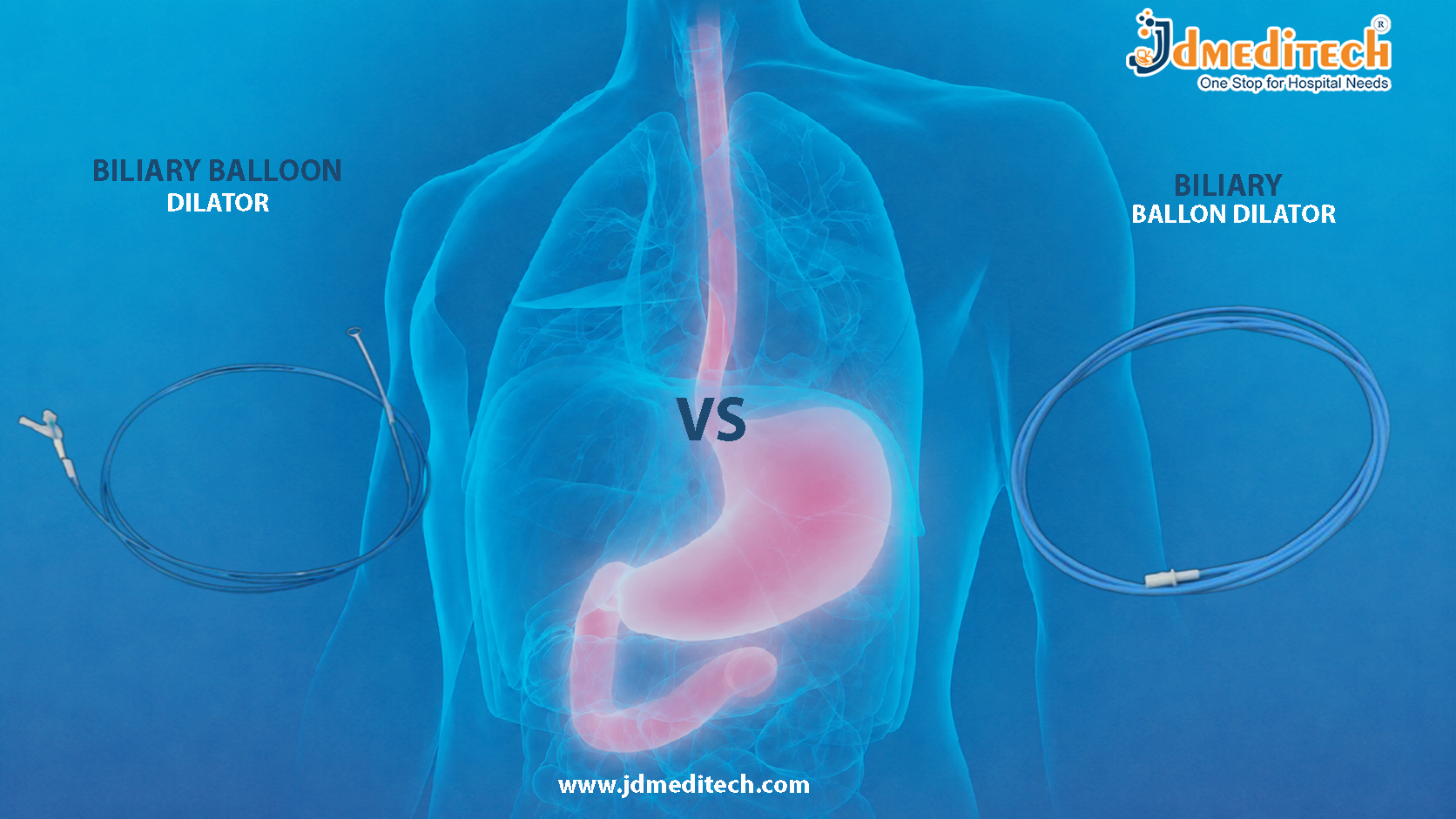
To manage these strictures effectively, physicians commonly use Biliary Dilators and Biliary Balloon Dilators. Although both devices aim to widen narrowed bile ducts, they differ significantly in their mechanism of action, procedural technique, and clinical applications.
Therefore, understanding the differences between these devices helps clinicians select the most appropriate instrument for successful ERCP stricture management.
What is a Biliary Dilator?
A Biliary Dilator is a tapered catheter-like device specifically designed to mechanically enlarge narrowed biliary strictures.
During ERCP, physicians advance the dilator over a guidewire and gently push it across the stricture. Consequently, the device gradually widens the narrowed segment through controlled mechanical force.
Because biliary dilators feature various diameters, clinicians can perform progressive dilation according to the severity of the stricture.
What is a Biliary Balloon Dilator?
A Biliary Balloon Dilator is an inflatable dilation device used to expand strictures within the biliary tree.
During the procedure, physicians position the balloon across the stricture under fluoroscopic guidance. They then inflate the balloon to a predetermined pressure, thereby exerting radial force on the narrowed segment.
As a result, the balloon uniformly expands the stricture while minimizing localized trauma.
Biliary Dilator vs Biliary Balloon Dilator: Key Differences
Mechanism of Action
Biliary Dilator: Uses axial pushing force to traverse and enlarge strictures.
Biliary Balloon Dilator: Uses radial expansion force to dilate the narrowed bile duct.
Therefore, physicians often describe the comparison as “Push vs Expand” in ERCP stricture management.
Dilation Technique
Physicians advance biliary dilators through the stricture using gradual mechanical pressure.
In contrast, clinicians position and inflate balloon dilators directly within the stricture. Consequently, balloon dilators provide controlled circumferential expansion.
Force Distribution
Traditional biliary dilators exert force primarily along the longitudinal axis.
However, biliary balloon dilators apply uniform radial pressure throughout the circumference of the stricture. As a result, balloon dilation often produces more symmetrical expansion.
Stricture Characteristics
Physicians frequently use biliary dilators to access tight, fibrotic, or highly resistant strictures.
Conversely, clinicians often select balloon dilators for controlled dilation of benign biliary strictures and anastomotic narrowing.
Procedural Precision
Although biliary dilators offer excellent trackability, balloon dilators provide superior control over dilation diameter and inflation pressure.
Therefore, balloon systems may improve procedural predictability in selected cases.
Advantages of Biliary Dilator
- Excellent pushability
- Superior guidewire tracking
- Effective crossing of tight strictures
- Gradual stepwise dilation
- Simple procedural technique
- Available in multiple French sizes
- Cost-effective solution
Advantages of Biliary Balloon Dilator
- Uniform radial expansion
- Controlled dilation pressure
- Predictable dilation diameter
- Reduced focal tissue trauma
- Enhanced procedural precision
- Effective management of benign strictures
- Excellent fluoroscopic visualization
Clinical Applications of Biliary Dilator
Healthcare professionals commonly use biliary dilators for:
- Tight biliary stricture traversal
- Initial stricture access
- Progressive ductal dilation
- Malignant biliary strictures
- Difficult ERCP procedures
- Pre-stenting duct preparation
Clinical Applications of Biliary Balloon Dilator
Gastroenterologists frequently use biliary balloon dilators for:
- Benign biliary stricture management
- Anastomotic stricture dilation
- Post-surgical biliary narrowing
- Sphincteroplasty procedures
- Controlled duct expansion
- Stone extraction preparation
Which Device is Better for ERCP Stricture Management?
Neither device is universally superior. Instead, physicians should choose the device according to the stricture characteristics, procedural objectives, and clinical scenario.
For example, clinicians often use biliary dilators to cross extremely tight strictures and establish initial access.
However, when controlled and uniform expansion is required, physicians frequently prefer biliary balloon dilators.
In many complex ERCP procedures, specialists combine both devices to optimize treatment outcomes.
Ultimately, successful biliary stricture management depends on appropriate device selection and operator expertise.
Why Choose JDMeditech Biliary Dilation Devices?
JDMeditech manufactures premium-quality biliary dilators and biliary balloon dilators designed to support safe and effective ERCP procedures.
Key Features
- Smooth and atraumatic design
- Excellent guidewire compatibility
- Superior trackability
- High-quality medical-grade materials
- Precision manufacturing
- Sterile and ready-to-use configuration
- Available in multiple sizes
Conclusion
Both Biliary Dilators and Biliary Balloon Dilators play essential roles in modern ERCP practice. While biliary dilators offer excellent pushability and stricture access, balloon dilators provide controlled radial expansion and procedural precision.
Therefore, healthcare professionals should evaluate stricture anatomy, treatment goals, and procedural complexity before selecting a dilation device.
By choosing high-quality ERCP accessories from JDMeditech, clinicians can improve procedural success, enhance patient safety, and achieve superior clinical outcomes.
Get Connected:
+91 79909 93062 | +91 63513 72032 | exports@jdmeditech.com