



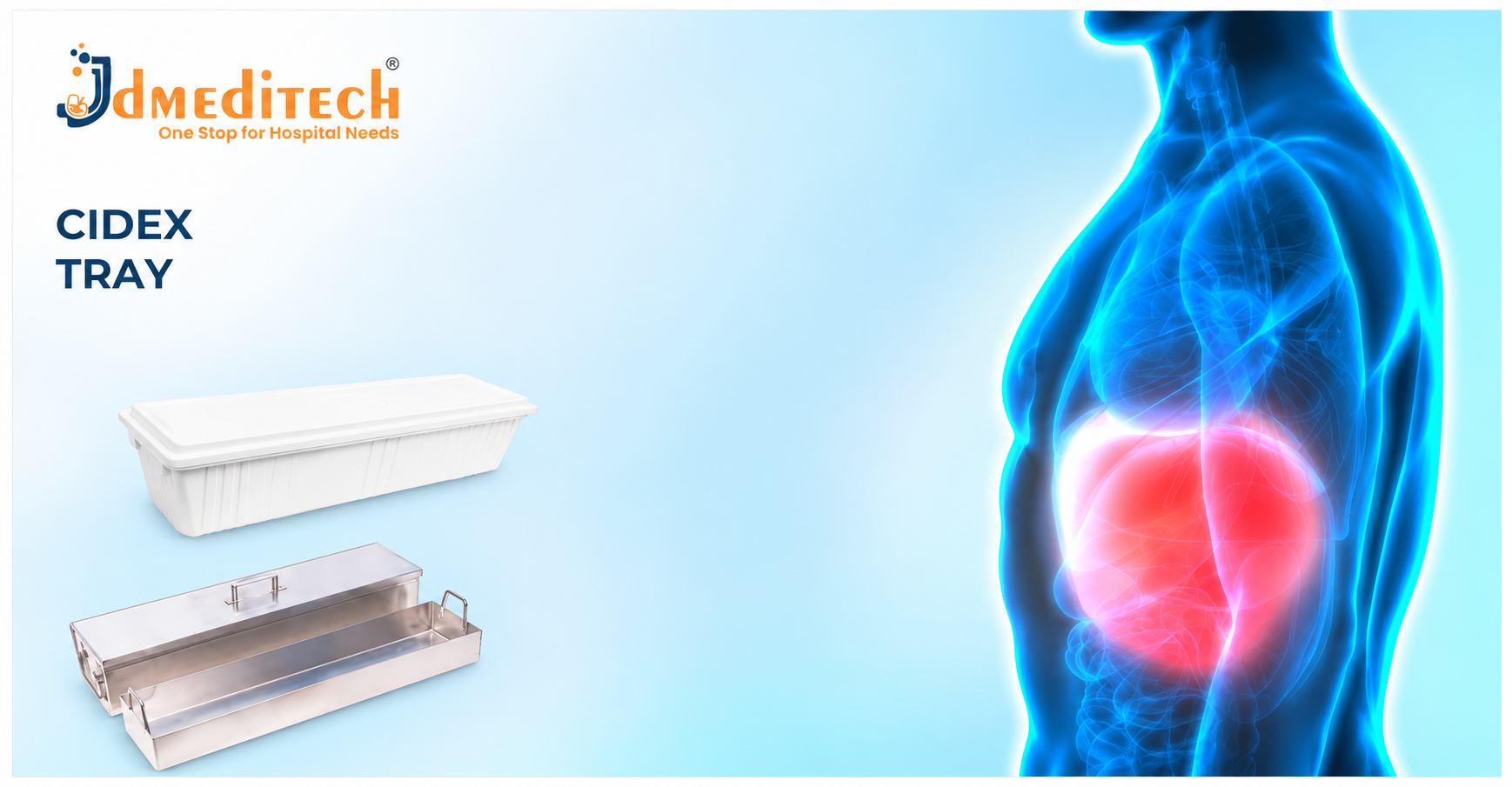
CIDEX Tray – Complete Guide to Uses, Features, Types and Medical Instrument Reprocessing
The CIDEX Tray is a medical instrument container commonly used in manual instrument soaking and chemical disinfection workflows. Healthcare facilities may use a compatible tray to hold selected reusable instruments during an approved reprocessing process.
Furthermore, an appropriately designed tray can help staff organize instruments and manage immersion in a suitable chemical solution. However, the tray itself does not disinfect or sterilize medical devices.
JDMeditech supplies surgical instruments, medical equipment and hospital accessories. Additionally, our team can assist hospitals, healthcare facilities and distributors with available product configurations and technical information.
What Is a CIDEX Tray?
A CIDEX Tray is a commonly used commercial description for an instrument soaking or disinfection container. Depending on the design, it may support selected manual chemical reprocessing activities.
For example, healthcare personnel may use a suitable container to immerse compatible reusable instruments in an approved high-level disinfectant.
However, the term does not establish compatibility with every CIDEX chemical formulation. Therefore, users must verify the tray material and the disinfectant manufacturer’s instructions.
Purpose of a Medical Instrument Disinfection Tray
The main purpose of a disinfection tray is to provide a suitable container for selected instrument reprocessing tasks.
Additionally, some trays include lids, internal holders or removable baskets to support instrument organization.
However, effective disinfection requires a validated process, compatible chemicals and appropriate staff training.
Importance of Instrument Reprocessing
Reusable medical instruments require appropriate reprocessing between patient uses.
First, healthcare personnel must follow the device manufacturer’s cleaning instructions.
Next, the required level of disinfection or sterilization depends on the instrument’s intended use.
Furthermore, staff must follow applicable infection prevention policies.
Therefore, a soaking tray forms only one possible part of the overall reprocessing workflow.
Main Components of a CIDEX Tray
Depending on the manufacturer and model, a tray system may include:
- Main Soaking Container
- Removable Lid
- Instrument Holding Area
- Optional Perforated Basket
- Optional Instrument Support
- Model-Specific Handles
- Optional Drainage Accessories
However, not every tray includes all these components. Therefore, buyers should confirm the supplied configuration.
1. Main Soaking Container
The main container holds the selected reprocessing solution when the manufacturer approves that use.
Furthermore, the container must provide adequate capacity for the intended instruments.
However, users must confirm chemical compatibility and the required solution volume.
2. Removable Lid
Some instrument soaking trays include a removable lid.
Additionally, a compatible lid may help reduce splashing and exposure during designated processing stages.
However, a lid does not eliminate chemical vapor hazards or replace required ventilation controls.
3. Instrument Holding Area
The internal area accommodates selected instruments during approved processing activities.
Furthermore, the tray should provide sufficient space to prevent unnecessary crowding.
However, instrument arrangement must follow the relevant reprocessing instructions.
4. Optional Perforated Basket
Some tray systems include a removable perforated basket.
For example, a basket may support handling of compatible instruments during a validated workflow.
However, users must verify whether the basket is included and whether it is compatible with the selected chemicals.
5. Optional Instrument Supports
Certain tray models provide supports for organizing instruments.
Additionally, these supports may help separate suitable devices during processing.
However, the supports must not prevent disinfectant contact with required instrument surfaces.
Key Features of CIDEX Trays
Depending on the selected model, medical soaking trays may offer the following characteristics:
- Instrument Soaking Container Design
- Different Available Sizes
- Model-Specific Chemical Compatibility
- Removable Lid Options
- Optional Instrument Baskets
- Optional Internal Instrument Holders
- Reusable Container Configurations
- Different Available Materials
- Compatibility With Selected Reprocessing Workflows
However, customers should verify all features against the official product datasheet.
Types of Medical Instrument Soaking Trays
Different tray designs may support different reprocessing requirements.
For example, manufacturers may offer polymer containers, metal trays or specialized instrument holding systems.
Additionally, some models include lids or removable baskets.
However, the material and construction must be suitable for the intended chemical and workflow.
Plastic Instrument Soaking Tray
Some instrument soaking containers use chemical-resistant polymer materials.
Furthermore, these containers may offer lightweight handling and different available capacities.
However, compatibility depends on the specific polymer and disinfectant formulation.
Metal Instrument Tray
Some medical instrument trays use metal construction.
Additionally, metal trays may provide a rigid instrument holding structure.
However, metal compatibility varies with the chemical formulation. Therefore, users should never assume that every metal tray is suitable for CIDEX solutions.
Tray With Removable Basket
A removable basket may support selected instrument handling tasks.
Furthermore, a suitable basket can help staff organize compatible devices.
However, the basket must allow the required disinfectant contact and must not interfere with validated processing.
Clinical and Hospital Applications
Compatible soaking trays may support selected manual instrument reprocessing activities in healthcare facilities.
Potential settings include:
- Hospital Instrument Reprocessing Departments
- Selected Endoscopy Reprocessing Areas
- Surgical Instrument Processing Areas
- Specialty Clinics
- Medical Equipment Reprocessing Facilities
- Other Approved Healthcare Processing Environments
However, each facility must confirm the approved workflow and applicable infection control requirements.
Application in Surgical Instrument Reprocessing
Some reusable surgical instruments require manual processing steps according to their instructions for use.
For example, a compatible tray may hold selected instruments during an approved soaking stage.
However, instruments that require sterilization cannot be made suitable for use merely through high-level disinfection.
Therefore, staff must determine the required processing level for each device.
Application in Endoscopy Departments
Selected reusable endoscopy accessories may require validated manual processing.
Furthermore, certain approved workflows may involve a compatible soaking container.
However, many flexible endoscopes require specific automated or manual reprocessing procedures, including channel processing.
Therefore, healthcare facilities must follow the endoscope manufacturer’s instructions and applicable reprocessing standards.
Application in Gynecology Departments
Gynecology departments use a variety of reusable instruments.
Additionally, some compatible devices may undergo approved manual chemical processing.
However, the required processing method depends on the device’s clinical use and manufacturer instructions.
Application in Urology Departments
Urology departments may use reusable instruments that require specialized cleaning and reprocessing.
Furthermore, some compatible accessories may undergo approved chemical processing.
However, critical surgical instruments generally require sterilization rather than high-level disinfection alone.
How Does a CIDEX Tray Work?
A soaking tray provides a container for a selected reprocessing solution and compatible medical instruments.
First, staff follow the instrument manufacturer’s validated cleaning requirements.
Next, trained personnel use the appropriate disinfectant and compatible container according to the approved instructions.
Furthermore, staff must follow the specified chemical concentration, temperature, contact time and rinsing requirements.
Finally, personnel complete the remaining approved processing, drying and storage steps.
However, the exact workflow depends on the disinfectant and medical device involved.
What Is High-Level Disinfection?
High-level disinfection is a reprocessing method that inactivates many microorganisms when staff follow a validated process.
However, it is not equivalent to sterilization and may not eliminate all bacterial spores.
Furthermore, high-level disinfection is generally associated with suitable semicritical medical devices.
Therefore, healthcare facilities must confirm whether the intended instrument requires high-level disinfection or sterilization.
Difference Between Cleaning and Disinfection
Cleaning removes soil and other contamination from medical devices.
In contrast, disinfection uses an appropriate process to inactivate specified microorganisms.
Furthermore, cleaning usually forms an essential prerequisite for effective disinfection.
Therefore, a chemical soaking stage should not replace required cleaning.
Difference Between High-Level Disinfection and Sterilization
High-level disinfection and sterilization serve different infection prevention purposes.
For example, sterilization uses a validated process intended to eliminate all forms of viable microbial life, including bacterial spores.
Meanwhile, high-level disinfection does not provide the same assurance.
Therefore, hospitals must select the appropriate process for the instrument’s intended use.
Technical Specifications of a CIDEX Tray
Exact specifications depend on the selected manufacturer and model. Therefore, buyers should request the official product datasheet.
| Parameter | Product Information |
|---|---|
| Product Name | CIDEX Tray |
| Generic Product Category | Medical Instrument Soaking Tray |
| Primary Application | Selected Manual Instrument Reprocessing Workflows |
| Material | Confirm Manufacturer Specifications |
| Available Dimensions | Confirm Official Size Chart |
| Internal Capacity | Confirm Selected Model |
| Lid | Model-Specific |
| Removable Basket | Confirm Supplied Configuration |
| Instrument Holder | Optional, Depending on Model |
| Chemical Compatibility | Verify With Tray and Disinfectant Manufacturers |
| Maximum Solution Capacity | Confirm Manufacturer Datasheet |
| Temperature Compatibility | Confirm Manufacturer Specifications |
| Reusable Status | Confirm Product Labeling |
| Cleaning Instructions | Follow Manufacturer Instructions |
| Packaging | Confirm Supplied Configuration |
| Regulatory Documentation | Verify for Destination Market |
CIDEX Tray Versus Surgical Instrument Tray
A medical soaking tray is intended for compatible liquid processing activities.
In contrast, a general surgical instrument tray may primarily support instrument organization, transport or sterilization workflows.
Furthermore, material requirements differ between applications.
Therefore, buyers should confirm the intended use before selecting a tray.
CIDEX Tray Versus Sterilization Tray
A sterilization tray supports instruments during an approved sterilization process.
Meanwhile, a chemical soaking tray may hold compatible devices during selected manual disinfection activities.
However, the two tray categories are not automatically interchangeable.
Therefore, healthcare personnel must follow the specific manufacturer’s instructions.
Potential Benefits of a CIDEX Tray
An appropriately selected medical soaking tray may provide several practical advantages.
- Dedicated Container for Selected Reprocessing Activities
- Different Available Size Options
- Organized Instrument Placement
- Optional Lid Configurations
- Optional Removable Baskets
- Compatibility With Selected Chemical Processing Workflows
- Reusable Container Options
Furthermore, a suitable tray may support standardized instrument handling procedures.
However, the tray does not independently guarantee effective disinfection.
Important Chemical Compatibility Considerations
Different disinfectants contain different active ingredients and chemical formulations.
For example, some high-level disinfectants use glutaraldehyde or other approved chemical agents.
Furthermore, certain chemicals may damage incompatible container materials.
Therefore, facilities must verify compatibility with the exact disinfectant formulation before use.
Importance of Correct Contact Time
High-level disinfectants require specific exposure conditions.
For example, the approved contact time may depend on the product formulation and processing temperature.
Additionally, some products require concentration monitoring.
Therefore, staff must follow the current disinfectant labeling rather than using a universal soaking time.
Importance of Proper Instrument Cleaning
Cleaning is essential before many disinfection and sterilization processes.
For example, organic soil may interfere with subsequent processing.
Furthermore, complex instruments may require specialized cleaning methods.
Therefore, healthcare facilities must follow validated cleaning instructions.
Importance of Complete Instrument Contact
A validated immersion process may require the solution to contact all specified device surfaces.
Furthermore, some devices contain channels, joints or other complex structures.
However, simply placing an instrument inside a tray may not achieve the required exposure.
Therefore, staff must follow the complete device and disinfectant instructions.
Safety Precautions During Chemical Disinfection
Chemical disinfectants may present health and occupational safety risks.
Therefore, trained personnel must follow the applicable safety instructions.
- Verify Chemical Compatibility
- Use Required Personal Protective Equipment
- Follow Appropriate Ventilation Requirements
- Prevent Chemical Splashes
- Observe Approved Contact Times
- Follow Concentration Monitoring Requirements
- Use Approved Rinsing Procedures
- Follow Chemical Disposal Requirements
- Review the Safety Data Sheet
- Follow Facility Infection Control Policies
Additionally, staff should avoid using damaged or incompatible containers.
Potential Risks of Incorrect Tray Use
Improper tray selection or chemical processing may create safety concerns.
Potential risks include:
- Inadequate Instrument Disinfection
- Chemical Exposure
- Container Material Damage
- Instrument Corrosion or Damage
- Incomplete Chemical Contact
- Incorrect Chemical Concentration
- Improper Contact Time
- Residual Disinfectant on Instruments
- Cross-Contamination
However, appropriate equipment selection and validated processing procedures help manage these risks.
Cleaning and Maintenance of the Tray
Reusable soaking containers require appropriate cleaning and maintenance.
Furthermore, staff should inspect the tray for cracks, corrosion or other damage.
Additionally, facilities should follow the manufacturer’s cleaning instructions after designated use.
However, cleaning requirements vary by tray material and chemical exposure.
Inspection Before Use
Healthcare personnel should inspect the tray before each intended processing activity.
- Confirm Product Identification
- Inspect Container Integrity
- Check Lid Condition
- Examine Optional Basket Components
- Verify Chemical Compatibility
- Confirm Suitable Capacity
- Inspect for Visible Damage
- Follow Manufacturer Instructions
Furthermore, staff should remove damaged containers from service.
Storage and Handling Guidelines
Proper storage helps protect reusable medical trays.
For example, facilities should keep clean containers in suitable designated storage areas.
Additionally, staff should avoid unnecessary mechanical damage and chemical exposure.
Therefore, healthcare facilities should follow the manufacturer’s storage recommendations.
How to Choose the Right CIDEX Tray
Hospitals and procurement teams should consider several factors before purchasing.
- Intended Reprocessing Application
- Container Material
- Approved Chemical Compatibility
- Internal Dimensions
- Solution Capacity
- Instrument Size Compatibility
- Lid Configuration
- Basket Availability
- Ease of Cleaning
- Temperature Compatibility
- Reusable Status
- Manufacturer Instructions
- Regulatory Requirements
Furthermore, the infection prevention and reprocessing teams should confirm the final selection.
Applications in Hospitals
Hospitals may use suitable soaking trays within approved manual reprocessing workflows.
Additionally, different departments may require different tray sizes and configurations.
However, each facility must confirm the intended use and chemical compatibility.
Applications in Instrument Reprocessing Departments
Instrument reprocessing departments manage reusable medical devices according to established protocols.
Furthermore, selected manual workflows may require compatible containers.
However, trays cannot replace validated automated reprocessing equipment when the device instructions require it.
Applications for Medical Distributors
Medical distributors should confirm the intended application and technical specifications before preparing quotations.
For example, customers may request particular dimensions, materials or basket configurations.
Additionally, chemical compatibility may influence the purchasing decision.
Therefore, distributors should request the official manufacturer documentation.
Why Choose JDMeditech?
JDMeditech supplies medical devices, surgical instruments and hospital accessories for healthcare facilities and medical distributors.
Furthermore, our team can assist customers with available tray configurations, technical information and quotation requests.
Customers can contact JDMeditech regarding:
- CIDEX Tray Product Inquiries
- Medical Instrument Soaking Tray Requirements
- Available Tray Sizes
- Material and Capacity Information
- Product Configuration Requests
- Hospital Procurement Inquiries
- Medical Distributor Requirements
- International Export Inquiries
However, exact product availability, specifications and chemical compatibility require confirmation.
Frequently Asked Questions About CIDEX Trays
1. What Is a CIDEX Tray?
It is a commonly used name for a medical instrument soaking or disinfection container.
2. What Is the Main Purpose of a CIDEX Tray?
Its purpose is to hold compatible instruments during selected approved manual reprocessing activities.
3. Does the Tray Disinfect Instruments by Itself?
No. Effective disinfection requires an appropriate disinfectant and a validated processing procedure.
4. Can the Tray Be Used With Every CIDEX Solution?
No. Users must verify compatibility with the exact chemical formulation.
5. Are Different Tray Sizes Available?
Different sizes may be available. Therefore, customers should request the official size chart.
6. Are CIDEX Trays Made From Plastic?
Some soaking trays use polymer materials. However, construction varies by model.
7. Are Metal Trays Available?
Metal instrument trays are available, but chemical compatibility must be confirmed before use.
8. Does Every Tray Include a Lid?
No. Lid availability depends on the selected model and supplied configuration.
9. Can a CIDEX Tray Include a Removable Basket?
Some tray systems include baskets. However, customers should verify the actual accessories.
10. Can the Tray Be Used for Endoscopy Instruments?
Only when the tray, instruments and reprocessing method are compatible with the applicable instructions.
11. Is High-Level Disinfection the Same as Sterilization?
No. High-level disinfection and sterilization provide different levels of microbial control.
12. Can Surgical Instruments Be Sterilized in a CIDEX Tray?
A soaking tray does not independently sterilize instruments. Sterilization requires an approved validated process.
13. How Long Should Instruments Remain in Disinfectant?
The required contact time depends on the exact disinfectant and device instructions. Therefore, staff must follow the approved labeling.
14. Is the Tray Reusable?
Many soaking containers are reusable. However, users should verify the manufacturer’s labeling and maintenance instructions.
15. What Should Buyers Confirm Before Ordering?
Buyers should verify the tray material, dimensions, capacity, chemical compatibility, lid configuration and regulatory documentation.
16. Where Can Customers Request Product Information?
Hospitals, healthcare facilities and medical distributors can contact JDMeditech for available product details and quotations.
Conclusion
In conclusion, the CIDEX Tray is a medical instrument container used in selected manual soaking and chemical disinfection workflows.
Furthermore, different tray designs may offer different materials, sizes and accessories.
Additionally, an appropriate container can support organized instrument handling during approved reprocessing activities.
However, effective infection prevention depends on validated cleaning, disinfection or sterilization procedures.
Therefore, healthcare facilities should verify the complete technical specifications and chemical compatibility before purchasing.
JDMeditech – One Stop for Hospital Needs
Website:
www.jdmeditech.com
Related Medical Products
- Surgical Instrument Tray
- Instrument Sterilization Tray
- Laparoscopic Instrument Tray
- Scope Tray With Holder
- Endoscopy Instrument Accessories
- Medical Instrument Cleaning Accessories
- Hospital Reprocessing Accessories
Medical and Safety Disclaimer
This article provides general educational and product information only. It does not replace manufacturer instructions, validated medical device reprocessing protocols or professional infection prevention guidance. Healthcare facilities must follow the medical device and disinfectant manufacturers’ current instructions, applicable regulations and occupational safety requirements.




