



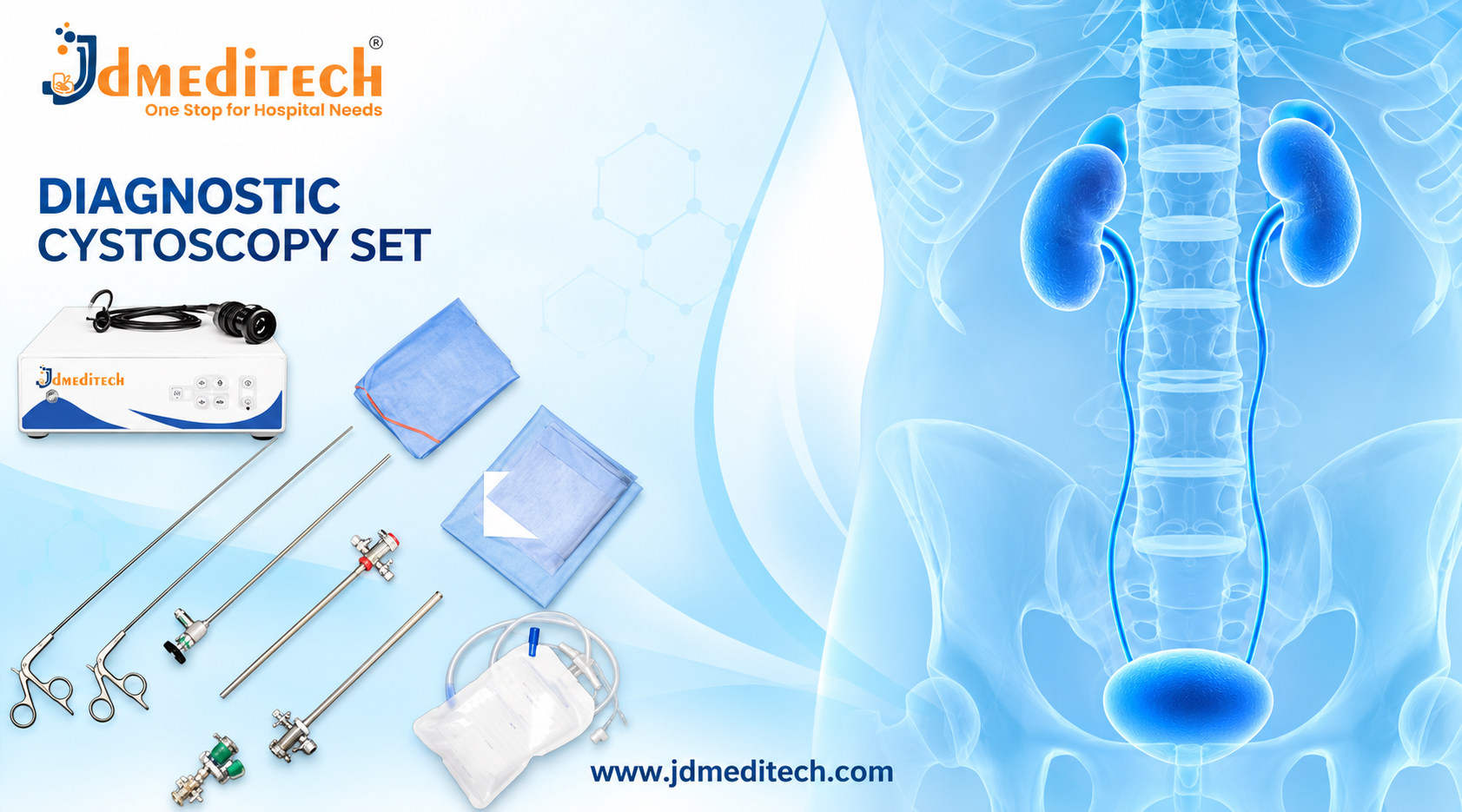
Diagnostic Cystoscopy Set: Uses, Instruments & Benefits
A Diagnostic Cystoscopy Set includes specialized instruments that help urologists examine the urethra and urinary bladder. This examination is called cystoscopy. It allows doctors to inspect the bladder lining and investigate selected urinary symptoms.
Moreover, cystoscopy plays an important role in modern urology. It helps healthcare professionals assess bladder conditions, investigate bleeding, and identify certain abnormalities.
JDMeditech offers urology instruments and accessories for hospitals, medical centers, and international distributors. In this article, we explain the uses, common instruments, features, and benefits of a diagnostic cystoscopy set.
What Is a Diagnostic Cystoscopy Set?
A Diagnostic Cystoscopy Set is a collection of compatible endoscopic instruments used to examine the lower urinary tract.
During cystoscopy, a doctor introduces a cystoscope through the urethra. The instrument provides a view of the urethra and inside the bladder.
As a result, the doctor can examine the bladder lining and investigate visible abnormalities.
Diagnostic cystoscopy may use either rigid or flexible instruments. However, the selected equipment depends on the procedure and clinical requirements.
Common Instruments in a Diagnostic Cystoscopy Set
The components of a cystoscopy set depend on the selected configuration. However, several instruments are commonly used during rigid diagnostic cystoscopy.
1. Cystoscope Sheath
The cystoscope sheath provides an access channel for compatible endoscopic instruments. In addition, suitable sheath designs support fluid flow during the examination.
2. Cystoscope Telescope
A rigid telescope helps the urologist view the urinary tract. Different telescope designs may offer different viewing angles.
Therefore, hospitals should confirm the telescope diameter and viewing angle before purchasing.
3. Obturator
A compatible obturator may support the introduction of a rigid cystoscope sheath. Its design must match the selected sheath system.
4. Irrigation Accessories
Irrigation equipment helps maintain bladder distension and visibility during cystoscopy.
Moreover, the healthcare team selects the appropriate irrigation arrangement according to the procedure and equipment instructions.
5. Light Source and Light Cable
A suitable light source illuminates the examination area. A compatible light cable transfers illumination to the endoscope.
Consequently, proper compatibility is important for effective visualization.
6. Endoscopic Camera System
A compatible camera system can display cystoscopic images on a monitor. In addition, certain systems may support image recording or documentation.
7. Diagnostic Accessories
Selected cystoscopy procedures may require additional accessories, such as compatible biopsy forceps.
However, these accessories are not included in every diagnostic cystoscopy set.
Diagnostic Cystoscopy Set Components and Functions
| Component | Function |
|---|---|
| Cystoscope Sheath | Provides endoscopic access |
| Telescope | Supports internal visualization |
| Obturator | Supports insertion of a compatible sheath |
| Irrigation Accessories | Support fluid flow and visibility |
| Light Source | Provides illumination |
| Light Cable | Connects compatible illumination equipment |
| Camera System | Displays endoscopic images |
| Optional Biopsy Forceps | Support tissue sampling when indicated |
In short, each instrument has a specific role. Therefore, the selected components must be compatible with the complete cystoscopy system.
Key Features of a Diagnostic Cystoscopy Set
1. Endoscopic Visualization
A diagnostic cystoscope allows healthcare professionals to inspect the urethra and bladder directly.
As a result, doctors can identify visible changes that may require further evaluation.
2. Transurethral Access
Cystoscopy is performed through the urethra. Therefore, a standard diagnostic examination does not require an external surgical incision.
3. Compatible Instrument Options
Different cystoscopy systems may offer various sheath sizes, telescope designs, and accessory options.
Consequently, hospitals should select instruments according to their clinical needs.
4. Irrigation Support
Suitable irrigation helps expand the bladder and maintain a clear view.
Moreover, the selected system should follow the manufacturer’s instructions for use.
5. Diagnostic Accessory Compatibility
Some cystoscopy systems support additional compatible accessories.
For example, selected instruments may help collect tissue samples when clinically indicated.
Applications of a Diagnostic Cystoscopy Set
A Diagnostic Cystoscopy Set supports the evaluation of various urinary tract conditions.
- Investigation of blood in the urine (hematuria)
- Evaluation of selected recurrent urinary symptoms
- Examination of suspected bladder abnormalities
- Assessment of certain urethral conditions
- Investigation of selected urinary tract obstructions
- Bladder tumor surveillance when clinically indicated
- Evaluation of selected bladder stones
- Further examination after abnormal diagnostic findings
However, cystoscopy is not necessary for every urinary symptom. The treating urologist determines whether the examination is appropriate.
How Is Diagnostic Cystoscopy Performed?
Diagnostic cystoscopy is performed by a trained healthcare professional.
First, the clinical team reviews the patient’s condition and prepares the required instruments.
Next, the healthcare professional introduces a suitable cystoscope through the urethra using the appropriate clinical technique.
During the examination, the doctor inspects the urethra and bladder lining. Irrigation may be used to support visibility.
Afterward, the doctor reviews the findings and recommends further tests or treatment when needed.
The examination method, anesthesia, and recovery requirements depend on the patient’s condition and the type of cystoscopy performed.
Benefits of Diagnostic Cystoscopy
1. Direct Examination
Cystoscopy allows direct visualization of the urethra and bladder lining.
Therefore, it can provide information that complements imaging and laboratory investigations.
2. Supports Clinical Diagnosis
The examination helps doctors investigate selected urinary tract conditions.
In addition, suspicious findings may guide further testing or tissue sampling.
3. No External Incision
Standard diagnostic cystoscopy uses transurethral access.
As a result, an external incision is generally unnecessary.
4. Supports Follow-Up Care
Cystoscopy may also help monitor certain previously diagnosed bladder conditions.
However, follow-up schedules depend on the individual clinical diagnosis.
Rigid vs Flexible Diagnostic Cystoscopy
| Feature | Rigid Cystoscopy | Flexible Cystoscopy |
|---|---|---|
| Instrument Design | Rigid metal endoscope | Flexible endoscope |
| Access | Through the urethra | Through the urethra |
| Visualization | Direct endoscopic viewing | Flexible endoscopic viewing |
| Common Setting | Clinical or operating-room setting | Frequently used in outpatient settings |
| Accessory Options | Depend on the selected system | Depend on the selected system |
Both methods allow examination of the lower urinary tract. Nevertheless, the choice depends on the patient’s condition, planned procedure, and available equipment.
How to Choose the Right Diagnostic Cystoscopy Set
Hospitals and distributors should review several factors before selecting a cystoscopy system.
Important Selection Factors
- Rigid or flexible cystoscopy requirements
- Cystoscope sheath diameter
- Telescope viewing angle
- Optical and camera compatibility
- Light source connection
- Irrigation system compatibility
- Required diagnostic accessories
- Instrument material and construction
- Cleaning and sterilization instructions
- Manufacturer documentation
- Availability of replacement components
Furthermore, the purchasing team should confirm the approved intended use of each instrument.
Therefore, selecting a compatible configuration is essential for appropriate clinical use.
Cleaning, Sterilization and Safety
Reusable cystoscopy instruments require appropriate reprocessing according to validated manufacturer instructions.
Before use, healthcare professionals should inspect instruments for damage and verify their compatibility.
In addition, the clinical team should follow infection prevention procedures and applicable facility protocols.
Potential cystoscopy-related complications include urinary discomfort, bleeding, and urinary tract infection. Serious complications are less common but may occur.
Therefore, patients should receive appropriate clinical advice before and after the procedure.
Diagnostic Cystoscopy Set by JDMeditech
JDMeditech provides urology surgical instruments and accessories for healthcare institutions and international medical distributors.
Our urology product range includes selected cystoscopy instruments, endoscopic accessories, and related medical equipment.
Moreover, customers can contact our team to request available configurations, technical information, and quotations.
For product inquiries, visit www.jdmeditech.com.
Frequently Asked Questions About Diagnostic Cystoscopy Sets
1. What is a Diagnostic Cystoscopy Set?
A Diagnostic Cystoscopy Set contains compatible instruments used to examine the urethra and urinary bladder.
2. What is diagnostic cystoscopy used for?
Doctors use diagnostic cystoscopy to investigate selected urinary symptoms, examine the bladder lining, and assess certain urinary tract abnormalities.
3. Which instruments are used in rigid cystoscopy?
Common instruments include a cystoscope sheath, telescope, obturator, light source, and suitable irrigation accessories.
4. Is cystoscopy a surgical procedure?
Cystoscopy is an endoscopic medical procedure. It may be performed for diagnostic examination or as part of selected therapeutic procedures.
5. Is diagnostic cystoscopy painful?
Patients may experience discomfort. However, the level of discomfort varies, and suitable anesthesia or pain-control methods may be used.
6. What is the difference between rigid and flexible cystoscopy?
Rigid cystoscopy uses a firm endoscope, while flexible cystoscopy uses a bendable instrument. Both provide views of the lower urinary tract.
7. Can cystoscopy detect bladder tumors?
Cystoscopy can reveal suspicious bladder lesions. However, tissue examination may be required to establish a diagnosis.
8. Where can I inquire about a JDMeditech Diagnostic Cystoscopy Set?
Visit JDMeditech to request product details, available configurations, and quotations.
Conclusion
A Diagnostic Cystoscopy Set supports the examination of the urethra and urinary bladder using specialized endoscopic instruments.
Moreover, cystoscopy helps healthcare professionals investigate selected urinary symptoms and identify visible abnormalities.
Choosing compatible instruments is important for safe and appropriate clinical use.
Contact JDMeditech for diagnostic cystoscopy instruments, urology equipment, and international supply inquiries.
Medical Disclaimer: This article is intended for general educational information. Medical procedures and device selection should follow professional clinical judgment and approved manufacturer instructions.




