



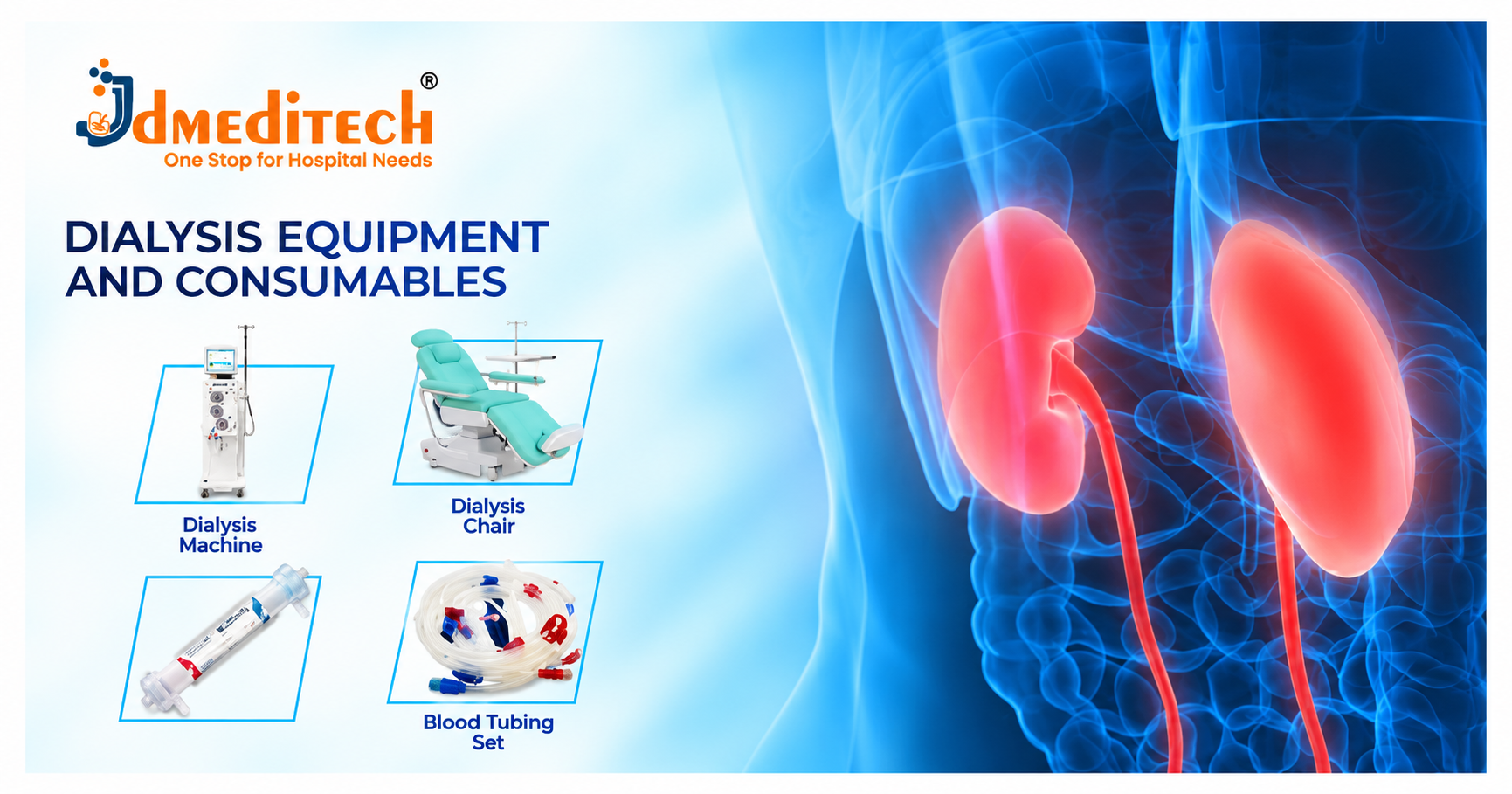
Dialysis Equipment and Consumables: Complete Guide to Machines, Chairs, Blood Tubing Sets and Accessories
Dialysis Equipment and Consumables play an important role in the treatment of patients with kidney failure. Hospitals and dialysis centers use specialized machines, patient-support furniture, and disposable medical products to deliver dialysis treatment.
For example, a dialysis machine controls key treatment functions during hemodialysis. Meanwhile, a dialysis chair supports patient positioning and comfort. In addition, a compatible blood tubing set carries blood between the patient and the extracorporeal circuit.
Therefore, selecting appropriate dialysis products is essential for treatment preparation and clinical workflows. Furthermore, healthcare facilities must verify equipment compatibility, safety requirements, and manufacturer instructions.
JDMeditech supplies medical equipment and consumables for hospitals, nephrology departments, dialysis centers, and medical distributors. Additionally, customers can inquire about available dialysis products and technical specifications.
What Are Dialysis Equipment and Consumables?
Dialysis equipment includes medical devices and supporting systems used during dialysis treatment. Meanwhile, dialysis consumables include products that healthcare teams replace according to their intended use and manufacturer instructions.
For example, hemodialysis machines support the treatment process. In contrast, blood tubing sets and dialyzers form parts of the extracorporeal blood circuit.
Consequently, healthcare facilities need both equipment and compatible consumables to prepare for hemodialysis.
What Is Dialysis?
Dialysis is a medical treatment that helps remove waste products and excess fluid when the kidneys cannot perform these functions adequately.
Additionally, dialysis helps manage certain electrolyte and fluid imbalances.
However, dialysis does not replace every function of healthy kidneys. Therefore, patients require ongoing care from qualified healthcare professionals.
Why Is Dialysis Important?
Healthy kidneys filter waste products and help regulate fluid and electrolyte balance.
However, severe kidney dysfunction can prevent the body from maintaining these functions.
As a result, dialysis may become necessary for selected patients with acute kidney injury or advanced kidney failure.
Furthermore, the treating nephrologist determines the appropriate treatment plan.
Types of Dialysis Treatment
Healthcare facilities provide different dialysis therapies. In particular, the treatment choice depends on the patient’s condition and clinical requirements.
- Hemodialysis
- Peritoneal Dialysis
- Continuous Kidney Replacement Therapy
- Other specialized dialysis modalities
Nevertheless, each treatment uses different equipment and consumables.
What Is Hemodialysis?
Hemodialysis uses an extracorporeal circuit and a dialyzer to remove selected waste products and excess fluid from the blood.
During treatment, blood travels through a compatible circuit and dialyzer before returning to the patient.
Meanwhile, the dialysis machine controls and monitors important treatment parameters.
What Is Peritoneal Dialysis?
Peritoneal dialysis uses the lining of the abdominal cavity as a membrane for fluid and solute exchange.
Additionally, the treatment requires specialized dialysis solutions, catheters, and compatible accessories.
However, peritoneal dialysis equipment differs from conventional hemodialysis equipment.
Main Types of Dialysis Equipment and Consumables
Dialysis facilities require different medical products. For example, equipment supports treatment delivery, while consumables form parts of the treatment circuit.
- Dialysis Machine
- Dialysis Chair
- Blood Tubing Set
- Dialyzer
- Hemodialysis Catheter
- AV Fistula Needle
- Dialysis Concentrates
- Dialysis Water Treatment Equipment
- Dialysis Disinfectant
- Transducer Protector
- Dialysis Accessories
- Other compatible dialysis consumables
However, product requirements vary by facility. Therefore, hospitals should prepare a detailed equipment and consumables list.
1. Dialysis Machine
A Dialysis Machine is a medical device that supports hemodialysis treatment.
For example, the machine manages selected blood circuit and dialysate functions. Additionally, monitoring systems help healthcare professionals observe important treatment parameters.
However, operating functions vary between models. Therefore, users must follow the manufacturer’s instructions.
What Is a Dialysis Machine?
A dialysis machine supports extracorporeal blood treatment through a compatible dialyzer and tubing circuit.
Furthermore, the machine helps control treatment parameters according to the prescribed therapy.
Consequently, trained healthcare professionals must verify the machine configuration before treatment.
Applications of Dialysis Machines
Dialysis machines support selected kidney replacement therapies.
- Maintenance Hemodialysis
- Selected Hospital Hemodialysis Treatments
- Kidney Failure Management
- Selected Acute Dialysis Treatments
- Other manufacturer-approved applications
However, the treating physician must determine the appropriate therapy.
Key Features of Dialysis Machines
Different dialysis machines provide different technical features.
- Blood pump system
- Dialysate preparation and delivery functions
- Ultrafiltration control
- Pressure monitoring
- Air detection and safety functions
- Conductivity monitoring
- Temperature monitoring
- Alarm systems
- Treatment display interface
- Disinfection functions, depending on model
Furthermore, customers should confirm each feature against the selected machine’s technical documentation.
How Does a Dialysis Machine Work?
A dialysis machine supports the movement of blood through a compatible extracorporeal circuit.
Meanwhile, the dialyzer allows controlled exchange of selected substances across a semipermeable membrane.
Additionally, the machine monitors important operating conditions.
However, the clinical team must supervise treatment and respond to any safety alarms.
Benefits of Dialysis Machines
Dialysis machines support essential treatment functions.
- Support prescribed hemodialysis therapy
- Provide selected treatment monitoring functions
- Help manage prescribed fluid removal
- Support compatible extracorporeal circuits
- Provide safety alarms and monitoring features
Nevertheless, performance and available functions depend on the machine model.
2. Dialysis Chair
A Dialysis Chair supports patient positioning during dialysis treatment.
Because hemodialysis sessions can last several hours, suitable seating and positioning are important considerations.
Furthermore, adjustable chair features may help healthcare staff position patients according to clinical needs.
What Is a Dialysis Chair?
A dialysis chair is specialized patient-support furniture used in dialysis centers.
Depending on the model, it may include adjustable sections and positioning accessories.
However, features and load capacity vary. Therefore, customers should review the manufacturer’s specifications.
Applications of Dialysis Chairs
- Hemodialysis Centers
- Nephrology Departments
- Hospital Dialysis Units
- Selected Outpatient Treatment Facilities
- Other compatible patient-care settings
Furthermore, facilities should consider patient accessibility and clinical monitoring needs.
Key Features of Dialysis Chairs
Different dialysis chairs offer different configurations.
- Adjustable backrest, depending on model
- Adjustable leg support
- Patient-support cushioning
- Arm support options
- Compatible positioning controls
- Easy-to-clean surfaces
- Selected safety and positioning features
However, hospitals must verify actual features and weight limits before purchasing.
Benefits of Dialysis Chairs
Suitable dialysis chairs support patient positioning during treatment.
- Provide dedicated patient seating
- Support selected positioning adjustments
- Help organize treatment areas
- Offer different configurations
- Support clinical access to the patient
Nevertheless, the facility should select chairs according to patient and staff requirements.
3. Blood Tubing Set
A Blood Tubing Set is a disposable extracorporeal circuit component used during compatible hemodialysis treatments.
For example, the tubing connects the patient’s vascular access circuit with the dialyzer and dialysis machine.
Therefore, tubing compatibility is essential for safe treatment preparation.
What Is a Blood Tubing Set?
A blood tubing set consists of medical-grade tubing and associated circuit components.
Depending on the design, it includes arterial and venous bloodline sections.
Additionally, the set may include chambers, connectors, and monitoring interfaces.
Applications of Blood Tubing Sets
Blood tubing sets support extracorporeal circulation during hemodialysis.
- Maintenance Hemodialysis
- Selected Hospital Hemodialysis Treatments
- Compatible Dialysis Machine Circuits
- Other manufacturer-approved extracorporeal applications
However, the set must match the dialysis machine and prescribed treatment configuration.
Components of a Blood Tubing Set
Different blood tubing sets contain different components.
- Arterial Bloodline
- Venous Bloodline
- Drip Chambers
- Compatible Connectors
- Pump Segment
- Injection or Sampling Ports, where applicable
- Pressure Monitoring Connections
- Other model-specific components
Therefore, customers should confirm the exact packing list and circuit design.
Arterial Bloodline
The arterial bloodline carries blood from the patient’s vascular access toward the dialyzer.
Additionally, the tubing configuration must match the machine’s blood pump system.
Consequently, healthcare professionals should verify compatibility before treatment.
Venous Bloodline
The venous bloodline returns blood from the extracorporeal circuit to the patient.
Furthermore, compatible venous chambers and monitoring connections support the intended circuit configuration.
However, staff must follow the machine and tubing manufacturer’s instructions.
Key Features of Blood Tubing Sets
Blood tubing sets vary by manufacturer and dialysis machine compatibility.
- Compatible arterial and venous bloodlines
- Medical-grade tubing construction
- Machine-specific pump segment
- Selected drip chamber designs
- Compatible connection ports
- Manufacturer-specified circuit configuration
- Single-use labeling, where applicable
Furthermore, buyers should confirm sterility and packaging details.
Benefits of Blood Tubing Sets
Compatible blood tubing sets support hemodialysis circuit preparation.
- Provide a defined extracorporeal blood pathway
- Connect compatible dialysis circuit components
- Offer machine-specific configurations
- Support prescribed hemodialysis workflows
However, correct setup and monitoring remain essential.
4. Dialyzer
A Dialyzer is a key component of the hemodialysis circuit.
It contains a semipermeable membrane that supports the exchange of selected substances between blood and dialysate.
As a result, the dialyzer helps remove waste products and excess fluid according to the treatment prescription.
What Is a Dialyzer?
A dialyzer is a medical device designed for extracorporeal blood purification.
Typically, hemodialysis dialyzers contain hollow-fiber membranes.
However, membrane characteristics and device dimensions vary by model.
Types of Dialyzers
Dialyzers differ in membrane properties and performance characteristics.
- Low-Flux Dialyzer
- High-Flux Dialyzer
- Other specialized dialyzer configurations
Therefore, the treating nephrologist must select a suitable dialyzer.
Key Features of Dialyzers
- Membrane material
- Membrane surface area
- Ultrafiltration characteristics
- Clearance performance
- Blood compartment volume
- Compatible connections
- Manufacturer-specified sterilization method
Furthermore, customers should verify technical performance data before ordering.
5. Hemodialysis Catheter
A Hemodialysis Catheter provides vascular access for selected dialysis treatments.
For example, clinicians may use suitable catheters when a patient requires catheter-based hemodialysis access.
However, catheter selection depends on the clinical situation and intended duration of use.
Types of Hemodialysis Catheters
- Temporary Hemodialysis Catheter
- Tunneled Hemodialysis Catheter
- Selected Double-Lumen Catheter Configurations
Nevertheless, clinicians must assess access requirements and potential complications.
6. AV Fistula Needle
An AV Fistula Needle supports vascular access through a suitable arteriovenous fistula or graft during hemodialysis.
Furthermore, different needle sizes and configurations suit different clinical requirements.
Therefore, trained healthcare professionals must select the appropriate needle.
Key Features of AV Fistula Needles
- Needle gauge
- Needle length
- Wing configuration
- Tubing length
- Needle tip design
- Safety features, where applicable
However, actual features depend on the selected model.
7. Dialysis Concentrates
Dialysis Concentrates are used to prepare dialysate for compatible hemodialysis systems.
For example, acid and bicarbonate concentrates form part of selected dialysate preparation systems.
However, concentrate composition and dilution requirements must match the machine and prescribed treatment.
Types of Dialysis Concentrates
- Acid Concentrate
- Bicarbonate Concentrate
- Other manufacturer-approved dialysate concentrate configurations
Therefore, facilities must verify chemical composition and machine compatibility.
8. Dialysis Water Treatment Equipment
Dialysis water treatment equipment prepares water that meets applicable dialysis quality requirements.
For example, reverse osmosis systems may form part of the water treatment process.
Additionally, facilities require appropriate monitoring and maintenance procedures.
However, the complete water treatment system must meet relevant dialysis standards.
Importance of Dialysis Water Quality
Water quality is critical during hemodialysis because dialysate preparation requires appropriately treated water.
Furthermore, facilities must monitor relevant chemical and microbiological parameters.
Therefore, dialysis centers should implement validated water quality procedures.
9. Dialysis Disinfectants
Dialysis disinfectants support cleaning and disinfection processes for compatible dialysis equipment.
However, the selected disinfectant must match the machine manufacturer’s instructions.
Additionally, facilities must follow appropriate handling and safety procedures.
10. Additional Dialysis Consumables
Dialysis departments may require additional disposable accessories.
- Transducer Protectors
- Compatible Dialysis Connectors
- Selected Dialysis Catheter Accessories
- Dialysis Circuit Accessories
- Compatible Treatment Tubing
- Other Manufacturer-Specified Consumables
Nevertheless, hospitals should verify the exact requirements for each dialysis system.
Dialysis Equipment and Consumables List
The following table summarizes common dialysis products and their primary applications.
| Product | Primary Application | Selection Requirement |
|---|---|---|
| Dialysis Machine | Hemodialysis treatment | Confirm model and treatment functions |
| Dialysis Chair | Patient positioning | Verify adjustments and load capacity |
| Blood Tubing Set | Extracorporeal blood circuit | Confirm machine compatibility |
| Dialyzer | Blood purification | Verify membrane specifications |
| Hemodialysis Catheter | Vascular access | Confirm catheter type and dimensions |
| AV Fistula Needle | Dialysis vascular access | Confirm gauge and configuration |
| Dialysis Concentrate | Dialysate preparation | Verify composition and dilution |
| Water Treatment Equipment | Dialysis water preparation | Confirm water quality requirements |
| Dialysis Disinfectant | Equipment disinfection | Confirm manufacturer compatibility |
| Transducer Protector | Pressure monitoring interface protection | Verify circuit compatibility |
Technical Specifications of Dialysis Equipment and Consumables
Technical specifications vary by product model. Therefore, customers should request verified manufacturer datasheets before purchasing.
| Product | Parameter | Specification |
|---|---|---|
| Dialysis Machine | Blood Flow Range | Confirm manufacturer datasheet |
| Dialysis Machine | Ultrafiltration Control | According to selected model |
| Dialysis Machine | Power Requirements | Model-dependent |
| Dialysis Chair | Load Capacity | Confirm manufacturer specifications |
| Dialysis Chair | Adjustment Functions | According to selected model |
| Blood Tubing Set | Machine Compatibility | Confirm compatible dialysis system |
| Blood Tubing Set | Material | According to product datasheet |
| Blood Tubing Set | Sterility | Confirm product labeling |
| Dialyzer | Membrane Surface Area | According to selected model |
| Dialyzer | Membrane Material | Confirm manufacturer specifications |
| Hemodialysis Catheter | French Size | According to selected model |
| AV Fistula Needle | Needle Gauge | According to selected model |
| Dialysis Concentrate | Composition | Confirm approved formulation |
| Dialysis Disinfectant | Compatibility | Confirm equipment instructions |
Benefits of Dialysis Equipment and Consumables
Dialysis equipment and consumables support essential treatment functions.
- Support prescribed dialysis treatments
- Provide compatible extracorporeal circuit components
- Help organize dialysis center workflows
- Offer different equipment configurations
- Support patient positioning
- Enable selection of appropriate consumables
- Support treatment monitoring functions
However, clinical outcomes depend on patient condition, treatment prescription, and proper equipment operation.
Importance of Dialysis Equipment Compatibility
Compatibility is essential when selecting dialysis products.
For example, blood tubing sets must match the dialysis machine. Similarly, dialyzers require compatible circuit connections.
Furthermore, dialysis concentrates must suit the machine and treatment prescription.
Therefore, hospitals should verify compatibility before purchasing.
Importance of Sterile Dialysis Consumables
Many invasive dialysis consumables are supplied sterile.
Additionally, intact packaging helps maintain sterility until use.
However, healthcare professionals must inspect packaging and follow aseptic procedures.
Single-Use Dialysis Consumables
Many dialysis circuit components are intended for single use.
Therefore, healthcare facilities must follow product labeling and applicable regulations.
Furthermore, staff should use appropriate disposal procedures after treatment.
How to Select Dialysis Equipment
Hospitals should evaluate equipment specifications and clinical requirements before purchasing.
- Intended dialysis modality
- Machine technical specifications
- Patient monitoring requirements
- Equipment compatibility
- Electrical requirements
- Water treatment requirements
- Installation requirements
- Staff training requirements
- Maintenance requirements
- Manufacturer documentation
Additionally, facilities should consider service availability and long-term operating requirements.
How to Select Dialysis Consumables
Consumable selection depends on the dialysis machine and prescribed treatment.
For example, buyers should verify tubing compatibility and dialyzer specifications.
Furthermore, hospitals should review sterility, packaging, and shelf-life information.
Consequently, procurement teams should coordinate with clinical and technical staff.
Dialysis Center Equipment Planning
Dialysis centers require coordinated planning for equipment, utilities, and clinical workflows.
First, the facility should define treatment capacity. Next, the team should identify the required equipment.
Additionally, planners must consider water treatment, electrical systems, patient monitoring, and infection prevention.
Dialysis Center Setup Requirements
Different facilities have different infrastructure needs.
- Suitable treatment space
- Dialysis machines
- Patient chairs or beds
- Dialysis water treatment system
- Compatible electrical infrastructure
- Appropriate infection prevention facilities
- Consumable storage areas
- Patient monitoring equipment
- Emergency equipment according to facility requirements
- Qualified clinical personnel
However, facilities must follow applicable healthcare regulations and standards.
Dialysis Equipment Maintenance
Regular maintenance supports equipment reliability.
For example, technical teams should follow manufacturer maintenance schedules.
Furthermore, dialysis centers should maintain service and inspection records.
Therefore, qualified personnel must perform required servicing.
Cleaning and Disinfection of Dialysis Equipment
Dialysis equipment requires appropriate cleaning and disinfection.
For example, facilities should follow validated manufacturer procedures for compatible machines.
Additionally, staff must handle disinfectants according to safety instructions.
However, cleaning requirements differ between products.
Storage and Handling of Dialysis Consumables
Proper storage helps maintain product integrity.
For example, facilities should protect packaged consumables from damage and unsuitable environmental conditions.
Furthermore, staff should check expiry dates and packaging condition.
Therefore, hospitals should follow manufacturer storage instructions.
Potential Risks During Dialysis Treatment
Dialysis treatment carries potential risks.
For example, patients may experience low blood pressure or vascular access complications.
- Hypotension
- Vascular access complications
- Infection
- Bleeding
- Electrolyte disturbances
- Fluid balance complications
- Other treatment-related complications
Consequently, trained healthcare professionals must monitor treatment according to established clinical protocols.
Applications of Dialysis Equipment and Consumables
Dialysis products support several healthcare settings.
- Dialysis Centers
- Nephrology Departments
- Hospitals
- Selected Intensive Care Units
- Specialized Kidney Care Facilities
- Other appropriately equipped treatment centers
However, each facility must maintain suitable equipment and qualified personnel.
Why Choose JDMeditech for Dialysis Equipment and Consumables?
JDMeditech supplies medical equipment and consumables for healthcare facilities and medical distributors.
Furthermore, customers can contact our team for information about available dialysis products.
- Dialysis Machine inquiries
- Dialysis Chair inquiries
- Blood Tubing Set inquiries
- Dialyzer inquiries
- Hemodialysis Catheter inquiries
- AV Fistula Needle inquiries
- Dialysis Concentrate inquiries
- Dialysis Disinfectant inquiries
- Technical Specification requests
- Quotation requests
- International Export inquiries
However, availability, specifications, and supply terms require confirmation. Therefore, customers should request a detailed quotation.
Frequently Asked Questions About Dialysis Equipment and Consumables
1. What Are Dialysis Equipment and Consumables?
Dialysis equipment includes treatment machines and supporting systems. Meanwhile, consumables include products such as tubing sets and dialyzers.
2. What Is a Dialysis Machine?
A dialysis machine supports hemodialysis treatment through compatible circuits. Additionally, it monitors important operating parameters.
3. What Is a Dialysis Chair?
A dialysis chair supports patient positioning during treatment. Furthermore, selected models provide adjustable features.
4. What Is a Blood Tubing Set?
A blood tubing set forms part of the extracorporeal blood circuit. Therefore, it must match the dialysis machine and prescribed treatment.
5. What Is a Dialyzer?
A dialyzer contains a semipermeable membrane that supports blood purification. As a result, selected waste products and fluid can move across the membrane during treatment.
6. What Is Hemodialysis?
Hemodialysis uses an extracorporeal circuit and dialyzer to support waste and fluid removal. However, treatment requires professional supervision.
7. What Is Peritoneal Dialysis?
Peritoneal dialysis uses the abdominal lining for fluid and solute exchange. Additionally, it requires specialized solutions and accessories.
8. What Is an AV Fistula Needle?
An AV fistula needle supports vascular access during selected hemodialysis treatments. However, clinicians must choose the appropriate configuration.
9. What Is a Hemodialysis Catheter?
A hemodialysis catheter provides vascular access for selected dialysis treatments. Therefore, clinicians must evaluate the patient’s access requirements.
10. What Are Dialysis Concentrates?
Dialysis concentrates help prepare dialysate for compatible hemodialysis machines. However, facilities must verify composition and dilution requirements.
11. What Is Dialysis Water Treatment?
Dialysis water treatment prepares water for dialysate production. Furthermore, facilities must monitor water quality according to applicable standards.
12. Are Blood Tubing Sets Disposable?
Many blood tubing sets are intended for single use. Therefore, healthcare facilities must follow manufacturer labeling.
13. Are Dialyzers Available in Different Types?
Yes. Different dialyzers offer different membrane properties and performance characteristics. However, clinicians must select suitable models.
14. What Is the Difference Between a Dialyzer and a Dialysis Machine?
A dialyzer provides the membrane used for blood purification. Meanwhile, the dialysis machine supports and monitors treatment functions.
15. What Are the Main Dialysis Consumables?
Common consumables include blood tubing sets, dialyzers, needles, catheters, and selected accessories. However, requirements vary by treatment.
16. How Should Dialysis Consumables Be Stored?
Hospitals should follow manufacturer storage instructions. Additionally, staff must inspect packaging and expiry information.
17. Why Is Machine Compatibility Important?
Compatibility helps ensure that selected circuit components suit the dialysis machine. Therefore, hospitals must verify specifications before use.
18. What Is the Purpose of a Dialysis Chair?
A dialysis chair supports patient positioning during treatment. Furthermore, suitable designs may offer different adjustment options.
19. How Should Dialysis Equipment Be Maintained?
Qualified personnel should follow manufacturer maintenance schedules. Additionally, facilities should document required servicing.
20. What Is the Role of a Dialysis Water Treatment System?
A water treatment system prepares water for dialysis applications. Consequently, appropriate monitoring and maintenance are essential.
21. What Are the Risks of Hemodialysis?
Potential risks include hypotension, bleeding, infection, and vascular access complications. Therefore, clinical monitoring is essential.
22. Can Dialysis Equipment Be Used in Hospitals?
Yes. Hospitals use appropriate dialysis systems in nephrology departments and other suitable clinical areas. However, treatment requirements vary.
23. What Should Buyers Check Before Purchasing Dialysis Machines?
Buyers should review machine specifications, utility requirements, maintenance needs, and service terms. Furthermore, they should confirm consumable compatibility.
24. What Information Is Required for a Dialysis Product Quotation?
Customers should provide the product name, model, specifications, quantity, and delivery destination. Additionally, they should mention any required configuration.
25. Where Can I Inquire About Dialysis Equipment and Consumables?
Hospitals and medical distributors can contact JDMeditech for information about available dialysis products and technical specifications.
Conclusion
In conclusion, Dialysis Equipment and Consumables support essential kidney replacement treatments.
Furthermore, dialysis machines manage important treatment functions, while dialysis chairs support patient positioning.
Meanwhile, blood tubing sets and dialyzers form key parts of compatible hemodialysis circuits.
Therefore, healthcare facilities should prioritize equipment compatibility, product specifications, staff training, and appropriate maintenance.
JDMeditech – One Stop for Hospital Needs
Website:
www.jdmeditech.com
Medical References
Medical Disclaimer
This article provides general educational and product information only. It does not replace professional medical advice, clinical training, or manufacturer instructions for use. Qualified healthcare professionals must select and operate dialysis equipment according to patient needs, applicable standards, and clinical safety requirements.




