



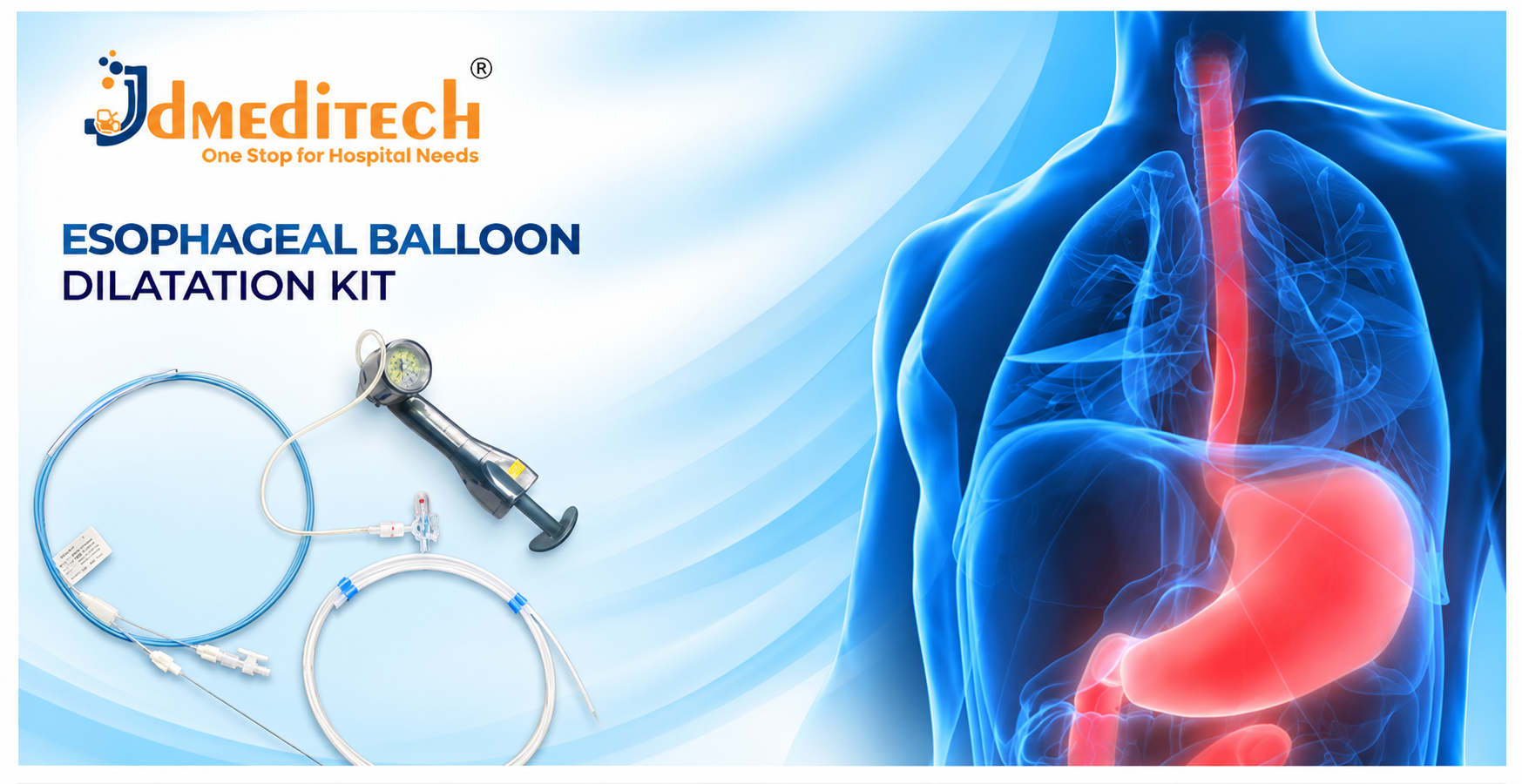
An Esophageal Balloon Dilatation Kit is a collection of medical devices used to support selected esophageal dilation procedures. Gastroenterologists use compatible balloon catheters to widen narrowed areas of the esophagus when clinically indicated.
Esophageal narrowing can make swallowing difficult and may affect a patient’s ability to eat comfortably. Therefore, specialists investigate the underlying cause before recommending treatment.
Moreover, suitable balloon catheters, inflation devices, and accessories support controlled dilation during selected endoscopic procedures. However, device selection depends on the patient’s condition and the manufacturer’s approved specifications.
JDMeditech offers selected gastroenterology instruments and endoscopy accessories for hospitals, clinics, and international medical distributors. This guide explains esophageal balloon dilation, commonly associated kit components, clinical applications, benefits, and safety considerations.
What Is an Esophageal Balloon Dilatation Kit?
An Esophageal Balloon Dilatation Kit refers to a selected collection of devices used during esophageal balloon dilation.
The procedure involves expanding a compatible balloon within a narrowed section of the esophagus. As a result, the treatment may improve the passage of food and liquids in suitable patients.
In addition, specialists may use endoscopic or fluoroscopic guidance according to the type and complexity of the narrowing.
Nevertheless, esophageal dilation is an invasive intervention. Therefore, qualified healthcare professionals must evaluate its benefits, limitations, and potential complications.
Understanding Esophageal Strictures
An esophageal stricture is an abnormal narrowing of the esophagus, the muscular tube connecting the throat to the stomach.
For example, chronic acid reflux may cause inflammation and scarring that narrow the esophageal passage.
Furthermore, other conditions can produce esophageal narrowing, including eosinophilic esophagitis, previous surgery, radiation injury, and corrosive injury.
Consequently, patients may experience difficulty swallowing, food sticking, or discomfort during meals.
However, swallowing difficulties can also result from motility disorders or malignancy. Therefore, clinicians must identify the cause before selecting a treatment.
Why Is Esophageal Balloon Dilatation Performed?
Esophageal balloon dilation is commonly used to manage selected symptomatic esophageal strictures.
During treatment, the specialist expands a suitable balloon within the narrowed region to increase the available passage.
As a result, some patients experience improved swallowing and reduced obstruction-related symptoms.
However, the treatment does not always correct the underlying cause. Consequently, additional medication, repeat dilation, or other management may be necessary.
Common Components of an Esophageal Balloon Dilatation Kit
Different manufacturers offer different balloon dilation configurations. Therefore, the following components represent commonly associated equipment rather than a confirmed JDMeditech packing list.
1. Esophageal Balloon Dilatation Catheter
The balloon dilation catheter is the primary instrument used to expand a selected narrowed section of the esophagus.
Moreover, balloon catheters are available in different diameters, lengths, and designs for specific applications.
However, clinicians must use each catheter only within its approved specifications.
2. Balloon Inflation Device
A compatible inflation device allows the operator to manage balloon inflation during selected dilation procedures.
In addition, some inflation devices incorporate a pressure gauge for monitoring inflation pressure.
Therefore, the device must be compatible with the selected balloon catheter and its rated pressure limits.
3. Pressure Gauge
A pressure gauge displays the inflation pressure when incorporated into a compatible inflation system.
Consequently, the clinical team can monitor pressure according to the manufacturer’s instructions.
However, pressure readings alone do not establish the balloon’s exact expanded diameter unless supported by the device specifications.
4. Connecting Tubing
Compatible tubing may connect the balloon catheter to an inflation device.
Furthermore, secure connections are important for proper system operation.
5. Guide Wire
Selected esophageal balloon catheters are designed for use with compatible guide wires.
Moreover, guide wire selection depends on the catheter design and procedural requirements.
Nevertheless, not every balloon catheter requires a separate guide wire.
6. Endoscopic Visualization Equipment
A suitable endoscope may provide direct visualization during balloon dilation.
In addition, fluoroscopic imaging may be appropriate for selected complex strictures.
Importantly, imaging equipment is generally supplied separately from disposable dilation kits.
7. Connection Accessories
Some configurations include compatible connectors, valves, or other accessories.
However, the actual supplied components depend on the manufacturer’s packing list.
Esophageal Balloon Dilatation Kit Components and Functions
The following table summarizes commonly associated equipment and its primary functions.
| Component | Primary Function |
|---|---|
| Balloon Dilatation Catheter | Expands a selected narrowed esophageal segment |
| Inflation Device | Supports controlled balloon inflation and deflation |
| Pressure Gauge | Displays inflation pressure |
| Connecting Tubing | Connects compatible inflation components |
| Guide Wire | Supports selected wire-guided dilation systems |
| Endoscope | Provides direct visualization during suitable procedures |
| Fluoroscopy Equipment | Supports imaging guidance when clinically indicated |
| Connection Accessories | Support specified system connections |
Importantly, this table is educational. Customers must confirm the exact JDMeditech product contents, available sizes, and compatibility information before ordering.
Key Features of Esophageal Balloon Dilatation Equipment
1. Controlled Balloon Expansion
Compatible dilation balloons expand within the selected esophageal narrowing.
Therefore, specialists can perform dilation according to the approved device characteristics and clinical requirements.
2. Different Balloon Configurations
Esophageal dilation balloons are available in different designs and dimensions.
Moreover, certain products provide multiple specified dilation diameters.
However, available sizes and pressure ratings vary by product.
3. Compatibility With Endoscopic Procedures
Selected balloon catheters are designed for use with compatible endoscopes.
Consequently, hospitals must confirm working channel requirements and catheter dimensions.
4. Pressure Monitoring
Suitable inflation systems may include pressure-monitoring capabilities.
Furthermore, clinicians must follow the approved pressure limits for the specific balloon catheter.
5. Different Clinical Applications
Esophageal balloon dilation supports selected treatment approaches for esophageal narrowing.
Nevertheless, the correct device depends on the underlying condition and procedural plan.
Clinical Applications of Esophageal Balloon Dilatation
Specialists may use esophageal balloon dilation in selected conditions involving narrowing of the esophagus.
1. Benign Esophageal Strictures
Benign strictures can develop because of inflammation, scarring, or previous treatment.
For suitable patients, balloon dilation may help widen the narrowed region.
2. Peptic Esophageal Strictures
Long-standing gastroesophageal reflux can contribute to peptic stricture formation.
Therefore, treatment may combine dilation with appropriate acid-suppressing medication.
3. Schatzki Ring
A Schatzki ring is a narrowing near the lower esophagus that can cause intermittent difficulty swallowing solid foods.
In selected symptomatic patients, dilation may help improve swallowing.
4. Eosinophilic Esophagitis-Related Narrowing
Eosinophilic esophagitis can produce inflammation and fibrotic narrowing.
Consequently, some patients require dilation in addition to treatment of the underlying inflammatory condition.
5. Postoperative Esophageal Strictures
Esophageal narrowing may develop after selected surgical procedures.
However, dilation requires careful evaluation of the patient’s surgical history and anatomy.
6. Radiation-Related or Caustic Strictures
Radiation injury and corrosive exposure can cause complex esophageal strictures.
Nevertheless, these cases may carry higher procedural risks and require specialized planning.
7. Selected Malignant Esophageal Narrowing
Some patients with malignant narrowing may undergo dilation as part of carefully planned management.
However, these cases require particular caution because perforation risk may be higher.
How Is Esophageal Balloon Dilatation Performed?
A qualified gastroenterologist performs esophageal balloon dilation in an appropriately equipped clinical setting.
First, the healthcare team evaluates the patient’s swallowing symptoms, medical history, and diagnostic findings.
Next, the specialist selects an appropriate dilation approach and compatible equipment.
During the procedure, the clinician identifies the narrowed esophageal region using suitable imaging or endoscopic visualization.
Afterward, a compatible balloon catheter is positioned for the planned treatment.
The specialist then performs dilation according to the patient’s condition and the approved device instructions.
Finally, the clinical team assesses the treatment area and monitors the patient during recovery.
However, the exact procedure depends on the cause, severity, and complexity of the narrowing.
Potential Benefits of Esophageal Balloon Dilatation
1. Improved Swallowing in Suitable Patients
Balloon dilation may increase the opening of a narrowed esophageal segment.
As a result, some patients experience improved swallowing and reduced food obstruction symptoms.
2. Endoscopic Treatment Option
Selected strictures can be treated using an endoscopic approach.
Therefore, suitable patients may avoid more invasive interventions for certain types of narrowing.
3. Compatibility With Different Balloon Sizes
Clinicians can select a balloon configuration according to the stricture and approved product dimensions.
Moreover, certain systems offer specified multiple-diameter options.
4. Support for Different Stricture Types
Balloon dilation may be used in several types of benign esophageal narrowing.
However, the treatment plan must account for the underlying cause and associated risks.
5. Repeat Treatment When Necessary
Some strictures recur or require more than one dilation session.
Consequently, clinicians may recommend further treatment according to symptoms and clinical findings.
Balloon Dilatation vs Bougie Dilatation
Balloon and bougie dilators are established options for selected esophageal strictures. However, their designs and mechanisms differ.
| Feature | Balloon Dilatation | Bougie Dilatation |
|---|---|---|
| Device Type | Expandable balloon catheter | Solid or semi-rigid dilator |
| Primary Mechanism | Radial expansion | Mechanical passage through the narrowing |
| Common Guidance | Endoscopic or selected fluoroscopic guidance | Often guide-wire assisted |
| Available Designs | Different balloon diameters and lengths | Different dilator diameters and configurations |
| Selection | Based on stricture and device requirements | Based on stricture and device requirements |
Importantly, clinical evidence supports both balloon and wire-guided bougie dilation for suitable benign strictures. Therefore, the choice depends on the patient’s condition and the specialist’s assessment.
Esophageal Balloon Dilatation vs Achalasia Pneumatic Dilatation
Although both treatments use balloons, conventional esophageal stricture dilation and pneumatic dilation for achalasia are not identical.
Esophageal stricture dilation aims to widen a narrowed segment of the esophagus.
In contrast, achalasia pneumatic dilation uses specialized equipment to disrupt the lower esophageal sphincter’s resistance to opening.
Moreover, achalasia treatment often requires different balloon dimensions and clinical protocols.
Therefore, an ordinary esophageal balloon dilation catheter must not be assumed suitable for achalasia pneumatic dilation.
Risks and Safety Considerations
Esophageal balloon dilation is an invasive procedure with potentially serious complications.
For example, adverse events may include esophageal perforation, bleeding, aspiration, and pain.
Furthermore, complex strictures and certain underlying diseases can increase procedural risk.
Consequently, specialists must evaluate the patient’s anatomy, clinical condition, and available treatment alternatives.
Active or incompletely healed esophageal perforation is a contraindication to dilation.
In addition, patients with recent esophageal surgery, previous perforation, or significant bleeding disorders require careful assessment.
After treatment, severe or persistent chest pain, fever, breathlessness, or rapid deterioration may indicate a complication and require urgent medical evaluation.
Recovery After Esophageal Balloon Dilatation
Recovery depends on the patient’s condition, sedation, and procedure complexity.
After dilation, the healthcare team monitors the patient and provides instructions about food, fluids, medications, and follow-up.
Some patients may experience temporary throat or chest discomfort.
However, persistent or worsening symptoms require prompt medical assessment.
Furthermore, repeat dilation or additional treatment may be necessary if narrowing returns.
How to Choose an Esophageal Balloon Dilatation Kit
Hospitals and medical distributors should confirm the intended clinical application before purchasing balloon dilation equipment.
First, identify whether the requirement involves a conventional esophageal stricture balloon or a specialized pneumatic dilation system.
Next, review the approved device dimensions and compatible inflation equipment.
Important Equipment Selection Factors
- Approved intended use
- Balloon diameter options
- Balloon working length
- Catheter working length
- Catheter outer diameter
- Endoscope working channel compatibility
- Guide wire compatibility
- Rated balloon pressure limits
- Inflation device compatibility
- Pressure gauge configuration
- Connection tubing specifications
- Radiopaque marker availability
- Sterile packaging requirements
- Single-use or reusable classification
- Manufacturer instructions for use
- Available technical documentation
Moreover, purchasing teams should verify the exact kit contents and available sizes before placing an order.
Esophageal Balloon Dilatation Instruments by JDMeditech
JDMeditech offers selected gastroenterology instruments and endoscopy accessories for hospitals, endoscopy centers, and international medical distributors.
Our gastroenterology product range includes selected balloon dilation devices, endoscopic catheters, guide wires, and related medical accessories.
Furthermore, customers can contact JDMeditech to discuss available product configurations, compatibility requirements, and technical specifications.
For additional information, visit www.jdmeditech.com.
Frequently Asked Questions About Esophageal Balloon Dilatation Kit
1. What is an Esophageal Balloon Dilatation Kit?
An Esophageal Balloon Dilatation Kit contains selected devices used to support esophageal balloon dilation. However, exact components vary by product configuration.
2. What is the purpose of esophageal balloon dilation?
The procedure aims to widen selected narrowed areas of the esophagus and improve swallowing in suitable patients.
3. Which instruments are commonly used?
Common equipment includes a balloon dilation catheter, compatible inflation device, and selected accessories.
4. What is an esophageal stricture?
An esophageal stricture is an abnormal narrowing that may cause difficulty swallowing.
5. Does every kit include an inflation device?
No. Inflation devices may be supplied separately. Therefore, customers should verify the packing list.
6. Is balloon dilation performed under endoscopic guidance?
Many procedures use endoscopic guidance. In addition, fluoroscopy may be appropriate for selected complex strictures.
7. Can esophageal strictures return after dilation?
Yes. Some strictures recur and require further treatment or repeat dilation.
8. Is esophageal balloon dilation the same as achalasia pneumatic dilation?
No. Achalasia pneumatic dilation may require specialized balloons and different clinical protocols.
9. What are the main risks of esophageal dilation?
Potential complications include esophageal perforation, bleeding, aspiration, and pain.
10. Where can hospitals inquire about JDMeditech gastroenterology devices?
Hospitals and medical distributors can visit JDMeditech to request information about available products and quotations.
Conclusion
An Esophageal Balloon Dilatation Kit supports selected procedures intended to widen narrowed sections of the esophagus.
Moreover, compatible balloon catheters and inflation devices help specialists perform dilation according to clinical requirements.
However, esophageal dilation carries important risks and does not always eliminate the underlying cause of narrowing.
Therefore, healthcare professionals must select suitable equipment and treatment approaches according to patient needs, clinical guidelines, and manufacturer specifications.
Contact JDMeditech for gastroenterology instruments, endoscopic balloon devices, and international medical device inquiries.
Medical Disclaimer: This article provides general educational information and is not a procedural training guide. Qualified healthcare professionals must make all treatment and device-selection decisions according to clinical judgment, applicable guidelines, and approved manufacturer instructions.




