



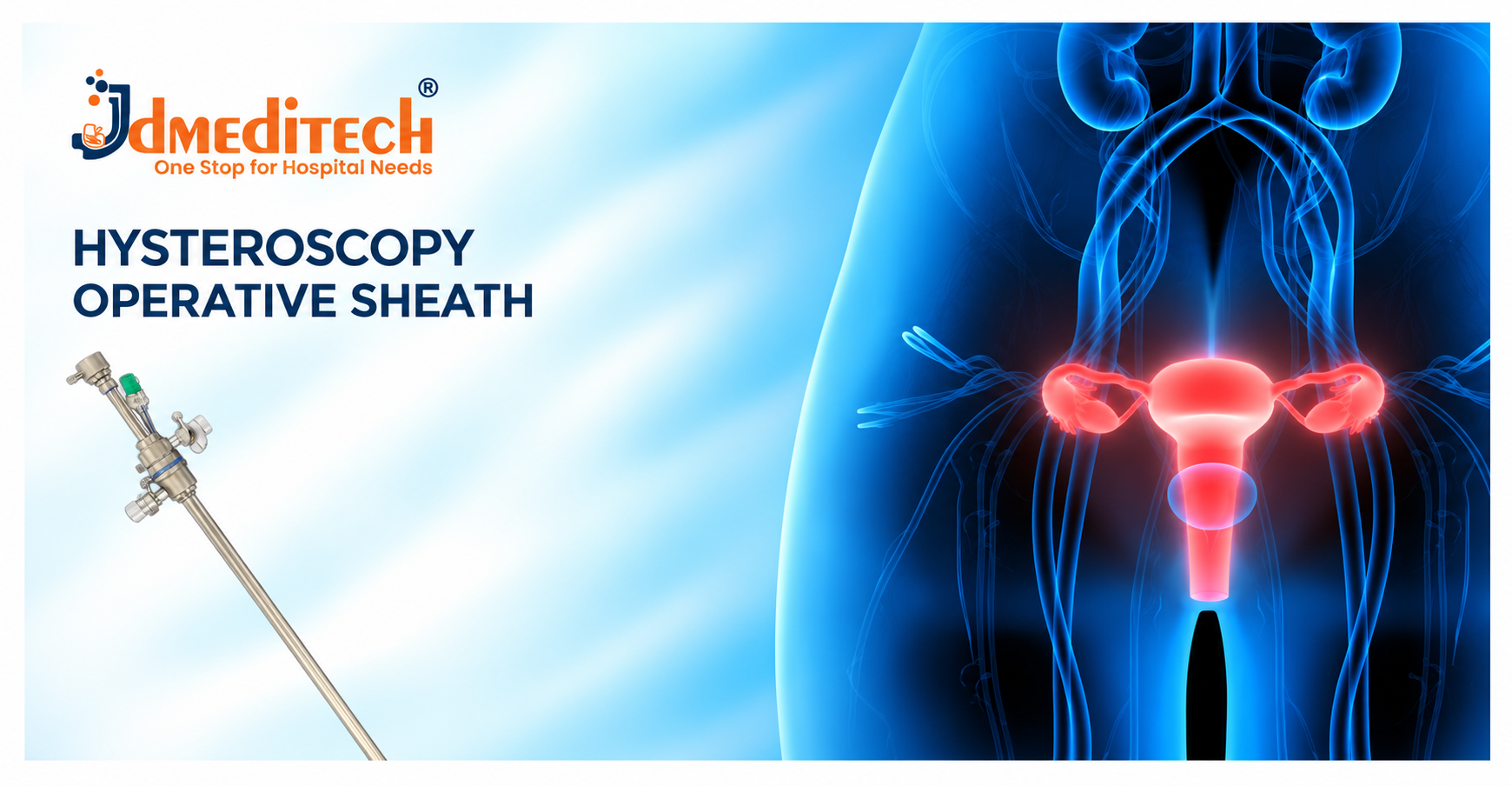
Hysteroscopy Operative Sheath: Uses, Features and Benefits
Hysteroscopy Operative Sheath is a specialized gynecology instrument that forms part of a compatible operative hysteroscopy system. It provides an outer access channel for the hysteroscope and may support fluid flow and instrument access, depending on its design.
Furthermore, operative hysteroscopy helps clinicians examine the uterine cavity and perform selected procedures under direct visualization. Therefore, an appropriate sheath plays an important role in system compatibility and clinical workflow.
JDMeditech supplies gynecology instruments and related medical equipment for hospitals, clinics and medical distributors. Additionally, customers can contact our team to discuss available sheath configurations, technical specifications and quotation requirements.
What Is a Hysteroscopy Operative Sheath?
An operative hysteroscopy sheath is an outer tubular component designed to work with a compatible hysteroscope.
Typically, it surrounds or accommodates the telescope and may provide channels for fluid management or working instruments.
However, the exact arrangement depends on the manufacturer and selected model.
Purpose of an Operative Hysteroscopy Sheath
The sheath supports the operation of a compatible hysteroscopy system.
For example, selected designs allow fluid to enter or leave the uterine cavity. Additionally, some models provide access for suitable working instruments.
Therefore, the sheath’s intended purpose depends on its channel configuration and clinical application.
Importance of the Sheath in Hysteroscopy
Hysteroscopy allows clinicians to inspect the inside of the uterus.
However, clear visualization and appropriate instrument access depend on the complete system.
Consequently, the sheath must match the telescope, fluid connections and selected operative instruments.
Key Features of an Operative Sheath
Different hysteroscopy systems offer different sheath configurations.
- Outer tubular instrument body
- Compatible telescope connection
- Model-specific fluid ports
- Selected inflow and outflow arrangements
- Optional working instrument channel
- Manufacturer-defined shaft dimensions
- Suitable connection and locking mechanisms
- Model-specific reusable or single-use design
Furthermore, buyers should verify the exact product features before ordering.
Outer Tubular Construction
The sheath has a tubular structure that accommodates compatible hysteroscopy components.
Additionally, its outer diameter affects the access requirements of the procedure.
Therefore, clinicians should select the appropriate size for the intended application.
Telescope Compatibility
Each operative sheath must work with a suitable hysteroscope.
For example, manufacturers may specify a particular telescope diameter or viewing configuration.
Consequently, users should not assume that different brands or models are interchangeable.
Fluid Management Connections
Many operative sheaths include ports that connect to compatible fluid tubing.
Furthermore, some designs provide separate inflow and outflow pathways.
However, the clinical team must follow the applicable fluid management protocol.
Working Instrument Access
Selected operative sheath designs allow compatible instruments to enter the uterine cavity.
For example, surgeons may use suitable biopsy forceps, grasping forceps or scissors when the system supports them.
However, instrument diameter and working length must match the sheath and hysteroscope.
Connection and Locking Mechanisms
Operative sheaths may include connection or locking components.
These features help secure compatible system parts during clinical use.
Therefore, users should confirm the connection type before purchasing.
Components of a Hysteroscopy Sheath
The exact components vary by manufacturer and product design.
- Outer Sheath Tube
- Proximal Connection Assembly
- Fluid Inflow Port, if provided
- Fluid Outflow Port, if provided
- Working Channel, if provided
- Locking or Coupling Mechanism
- Compatible Sealing Components
Additionally, some systems require separate accessories.
Outer Sheath Tube
The outer tube forms the main body of the sheath.
Furthermore, its dimensions determine compatibility with the selected system.
Therefore, buyers should verify the diameter and working length.
Proximal Connection Assembly
The proximal connection joins the sheath with compatible hysteroscopy components.
For example, certain designs use model-specific coupling mechanisms.
However, compatibility depends on the manufacturer.
Fluid Inflow and Outflow Ports
Fluid ports support the fluid pathway of the hysteroscopy system.
Additionally, suitable tubing connects the sheath with the selected fluid management equipment.
However, the clinical team must monitor fluid balance and patient safety.
Working Channel
Some operative sheaths include a working channel for compatible instruments.
For example, clinicians may use suitable grasping or biopsy tools during selected procedures.
Therefore, the channel dimensions must match the instrument specifications.
Technical Specifications
Technical specifications vary by model. Consequently, customers should confirm the manufacturer’s official datasheet.
| Parameter | Product Details |
|---|---|
| Product Name | Hysteroscopy Operative Sheath |
| Product Category | Gynecology Endoscopy Instruments |
| Primary Application | Compatible operative hysteroscopy systems |
| Outer Diameter | Confirm selected model |
| Working Length | Confirm selected model |
| Telescope Compatibility | Manufacturer-specified |
| Working Channel | Model-dependent |
| Fluid Ports | According to selected design |
| Connection Type | Manufacturer-specified |
| Material | Confirm product datasheet |
| Reusable or Single Use | According to product labeling |
| Sterility | According to product labeling |
| Reprocessing Requirements | Follow manufacturer instructions |
| Packaging | According to selected configuration |
Types of Hysteroscopy Sheaths
Hysteroscopy sheaths are available in different configurations.
- Diagnostic Sheath
- Operative Sheath
- Continuous-Flow Sheath
- Single-Flow Sheath
- Working-Channel Sheath
However, manufacturers may use different names for similar configurations.
Diagnostic Hysteroscopy Sheath
A diagnostic sheath supports compatible hysteroscopy examinations.
For example, clinicians may use it to inspect the uterine cavity.
However, not every diagnostic sheath supports operative instruments.
Operative Hysteroscopy Sheath
An operative sheath supports selected hysteroscopic procedures.
Additionally, some designs allow compatible working instruments to pass through the system.
Therefore, the intended procedure determines the required configuration.
Continuous-Flow Hysteroscopy Sheath
Continuous-flow systems provide designated pathways for fluid circulation.
For example, selected designs use separate inflow and outflow channels.
However, clinicians must follow appropriate fluid management practices.
Single-Flow Hysteroscopy Sheath
Single-flow designs use a different fluid pathway arrangement.
Furthermore, the configuration depends on the manufacturer.
Therefore, buyers should review the official system documentation.
Clinical Applications
Operative hysteroscopy sheaths support selected gynecological procedures when paired with compatible equipment.
- Diagnostic Hysteroscopy
- Targeted Endometrial Biopsy
- Selected Endometrial Polyp Procedures
- Selected Uterine Adhesion Procedures
- Appropriate Intrauterine Material Retrieval
- Other Compatible Operative Hysteroscopy Procedures
However, the sheath itself does not perform tissue cutting or removal.
Use in Diagnostic Hysteroscopy
Diagnostic hysteroscopy helps clinicians inspect the uterine cavity.
Additionally, a compatible sheath supports the telescope and fluid pathway.
However, the clinician must select the appropriate system for the examination.
Use in Endometrial Biopsy
Selected operative systems allow clinicians to collect targeted endometrial tissue samples.
For example, compatible biopsy forceps may pass through an appropriate working channel.
Furthermore, laboratory analysis may help evaluate the collected sample.
Use in Endometrial Polyp Procedures
Endometrial polyps are growths that develop from the uterine lining.
In selected cases, operative hysteroscopy supports polyp assessment or removal.
However, clinicians require suitable working instruments in addition to the sheath.
Use in Uterine Adhesion Procedures
Uterine adhesions may affect the uterine cavity.
For example, clinicians may consider hysteroscopic treatment in selected cases.
However, treatment requires appropriate surgical instruments and clinical expertise.
Use in Intrauterine Material Retrieval
Selected operative hysteroscopy systems support the retrieval of appropriate intrauterine material.
For example, a clinician may use compatible grasping instruments in certain cases.
Nevertheless, the clinical team must assess each patient’s situation.
General Procedure Overview
First, the healthcare team selects a suitable hysteroscopy system.
Next, clinicians confirm sheath compatibility with the telescope and accessories.
During the procedure, the sheath supports the selected endoscopic system.
Finally, the team follows the required cleaning, reprocessing or disposal instructions.
Importance of Fluid Management
Fluid management plays an important role in hysteroscopy.
For example, suitable distension media help clinicians visualize the uterine cavity.
However, fluid absorption and fluid balance require careful monitoring.
Therefore, the clinical team must follow established safety protocols.
Benefits of an Operative Sheath
A compatible sheath provides several practical functions.
- Supports the hysteroscope assembly
- Provides model-specific fluid pathways
- May allow compatible working instrument access
- Offers different system configurations
- Supports selected diagnostic procedures
- Supports selected operative procedures
- Works with manufacturer-specified accessories
However, the actual functions depend on the selected model.
Advantages of Compatible Working Channels
A working channel allows suitable instruments to operate through the hysteroscopy system.
For example, compatible forceps may support selected tissue sampling tasks.
However, the instrument must fit the channel dimensions.
Advantages of Continuous-Flow Designs
Continuous-flow designs provide separate fluid pathways in compatible systems.
Consequently, they can support fluid circulation during selected procedures.
However, the clinical team must monitor fluid use carefully.
Operative Sheath Versus Diagnostic Sheath
Diagnostic and operative sheaths serve different system requirements.
For example, diagnostic sheaths primarily support uterine cavity examination.
In contrast, operative designs may include access for suitable working instruments.
| Feature | Diagnostic Sheath | Operative Sheath |
|---|---|---|
| Primary Purpose | Diagnostic examination | Selected operative procedures |
| Instrument Channel | Not always available | Model-dependent |
| Fluid Pathway | System-dependent | System-dependent |
| Compatibility | Manufacturer-specified | Manufacturer-specified |
How to Select the Right Sheath
Hospitals should review several factors before purchasing an operative sheath.
- Intended clinical application
- Hysteroscope compatibility
- Telescope diameter
- Outer sheath diameter
- Working length
- Working channel dimensions
- Fluid port arrangement
- Connection mechanism
- Material specifications
- Reusable or single-use labeling
- Manufacturer documentation
Furthermore, procurement teams should consult the gynecology department.
Importance of Instrument Compatibility
Compatibility is essential for safe system assembly.
For example, the telescope must fit the selected sheath.
Additionally, working instruments must match the available channel dimensions.
Therefore, users should verify every component before use.
Safety Precautions
Healthcare professionals should follow appropriate hysteroscopy safety practices.
- Inspect the sheath before use
- Confirm telescope compatibility
- Check fluid connections
- Verify working instrument compatibility
- Follow infection prevention protocols
- Monitor fluid balance
- Follow manufacturer instructions
- Use appropriate clinical techniques
- Maintain patient safety
Furthermore, trained clinicians should perform hysteroscopic procedures.
Potential Procedure-Related Risks
Hysteroscopy carries potential risks.
For example, complications may include bleeding, infection or uterine injury.
Additionally, certain procedures carry fluid-related risks.
Therefore, clinicians must follow appropriate patient monitoring and safety protocols.
Cleaning and Reprocessing
Reusable sheaths require validated cleaning and reprocessing.
For example, healthcare facilities should follow the manufacturer’s instructions for cleaning, inspection and sterilization.
However, single-use devices should not undergo unauthorized reuse.
Inspection Before Use
Staff should inspect the sheath before each procedure.
For example, they should check the tube, connection assembly and fluid ports.
Additionally, they should confirm the instrument’s compatibility with the selected system.
Storage and Handling
Proper storage helps protect medical instruments from damage.
For example, facilities should use suitable protective storage systems.
Furthermore, staff should follow manufacturer handling instructions.
Applications in Hospitals
Hospitals use compatible hysteroscopy systems for selected gynecological procedures.
Additionally, operative sheaths support the assembly of appropriate endoscopic equipment.
Therefore, hospitals should choose products according to clinical requirements.
Applications in Gynecology Clinics
Gynecology clinics may use suitable hysteroscopy systems for selected examinations and procedures.
However, the required sheath configuration depends on the available equipment.
Consequently, buyers should confirm compatibility before ordering.
Applications for Medical Distributors
Medical distributors should review technical specifications before supplying hysteroscopy accessories.
For example, buyers may require a particular telescope connection or sheath diameter.
Therefore, distributors should confirm the exact product model.
Why Choose JDMeditech?
JDMeditech supplies gynecology instruments and medical equipment for hospitals, clinics and medical distributors.
Furthermore, customers can contact our team for product information, available configurations and quotation requests.
- Operative Sheath inquiries
- Diagnostic Hysteroscopy Sheath inquiries
- Hysteroscope inquiries
- Hysteroscopy Forceps inquiries
- Gynecology Equipment inquiries
- Technical Specification requests
- Product Compatibility inquiries
- International Export inquiries
However, product availability and technical specifications require confirmation.
Frequently Asked Questions
1. What Is a Hysteroscopy Operative Sheath?
It is an outer component of a compatible hysteroscopy system. Additionally, selected designs provide fluid pathways and instrument access.
2. What Is the Main Purpose of an Operative Sheath?
The sheath supports compatible hysteroscopy components. Furthermore, some models allow working instruments to enter the uterine cavity.
3. What Is the Difference Between Diagnostic and Operative Sheaths?
Diagnostic sheaths primarily support examination. In contrast, operative designs may support selected working instruments.
4. Does Every Operative Sheath Include a Working Channel?
Not necessarily. Channel arrangements vary by design. Therefore, buyers should verify the product specifications.
5. What Is a Continuous-Flow Sheath?
It is a sheath design with designated fluid pathways. For example, some systems provide separate inflow and outflow connections.
6. Why Is Fluid Management Important?
Fluid helps clinicians visualize the uterine cavity. However, the team must monitor fluid balance and patient safety.
7. Are Operative Sheaths Available in Different Sizes?
Yes. Manufacturers offer different configurations and dimensions. Therefore, customers should confirm the required model.
8. Do Operative Sheaths Fit Every Hysteroscope?
No. Compatibility depends on telescope dimensions and connection design. Consequently, buyers should verify the specifications.
9. Can a Sheath Support Biopsy Procedures?
Selected operative systems support compatible biopsy instruments. However, the sheath itself does not collect tissue.
10. Can a Sheath Support Polyp Procedures?
Yes, selected systems can support appropriate operative hysteroscopy procedures. Nevertheless, additional instruments are required.
11. What Is the Importance of Sheath Diameter?
Diameter affects the system’s access requirements. Therefore, clinicians should select an appropriate size.
12. What Is the Importance of Working Length?
Working length helps determine compatibility with the selected system. Additionally, users should verify the manufacturer specifications.
13. What Is the Purpose of Fluid Ports?
Fluid ports connect the sheath to compatible tubing. Furthermore, some designs support separate inflow and outflow pathways.
14. Are Operative Sheaths Reusable?
Some models are reusable, while others may be single use. However, the manufacturer labeling determines the correct handling.
15. Are Operative Sheaths Supplied Sterile?
Sterility depends on the selected product. Therefore, buyers should verify the packaging information.
16. How Are Reusable Sheaths Cleaned?
Healthcare facilities must follow validated manufacturer reprocessing instructions. Additionally, staff should inspect the instrument before reuse.
17. What Materials Are Used for Operative Sheaths?
Materials vary by manufacturer and model. Therefore, customers should request the official product datasheet.
18. Can Operative Sheaths Cause Injury?
Improper use may contribute to tissue injury. Consequently, trained clinicians must follow appropriate safety practices.
19. Can Operative Sheaths Be Used in Hospitals?
Yes. Hospitals use compatible hysteroscopy sheaths during selected diagnostic and operative procedures.
20. Can Operative Sheaths Be Used in Clinics?
Yes, when the clinical setting and equipment are appropriate. However, the clinician must determine suitability.
21. What Should Buyers Check Before Purchasing?
Buyers should confirm the diameter, working length, fluid ports, telescope connection and compatibility. Furthermore, they should review product documentation.
22. Can Operative Sheaths Be Used With Hysteroscopy Forceps?
Selected systems support compatible forceps. However, the working channel and instrument dimensions must match.
23. What Is the Role of the Connection Mechanism?
The connection mechanism joins compatible system components. Therefore, users should confirm the required coupling design.
24. How Should an Operative Sheath Be Stored?
Facilities should follow manufacturer storage instructions. Additionally, suitable protection helps prevent instrument damage.
25. Where Can I Inquire About Operative Sheaths?
Hospitals, gynecology clinics and medical distributors can contact JDMeditech for product information and quotation inquiries.
Conclusion
In conclusion, the Hysteroscopy Operative Sheath is an important component of selected gynecology endoscopy systems.
Furthermore, different designs support fluid management, telescope assembly and compatible instrument access.
However, correct product selection and system compatibility remain essential.
Therefore, healthcare facilities should verify technical specifications before purchasing.
JDMeditech – One Stop for Hospital Needs
Website: www.jdmeditech.com
Related Gynecology Instruments
Explore more gynecology instruments and related equipment through the JDMeditech website.
- Hysteroscope
- Hysteroscopy Forceps
- Hysteroscopy Scissors
- Hysteroscopy Irrigation Pump
- Gynecology Endoscopy Instruments
Medical References
- American College of Obstetricians and Gynecologists
- Royal College of Obstetricians and Gynaecologists
- National Health Service
- U.S. FDA – Medical Devices
Medical Disclaimer
This article provides general educational and product information only. It does not replace professional medical advice, clinical training, manufacturer instructions or established surgical protocols. Qualified healthcare professionals must select and use hysteroscopy instruments according to patient needs, equipment compatibility and applicable safety requirements.




