



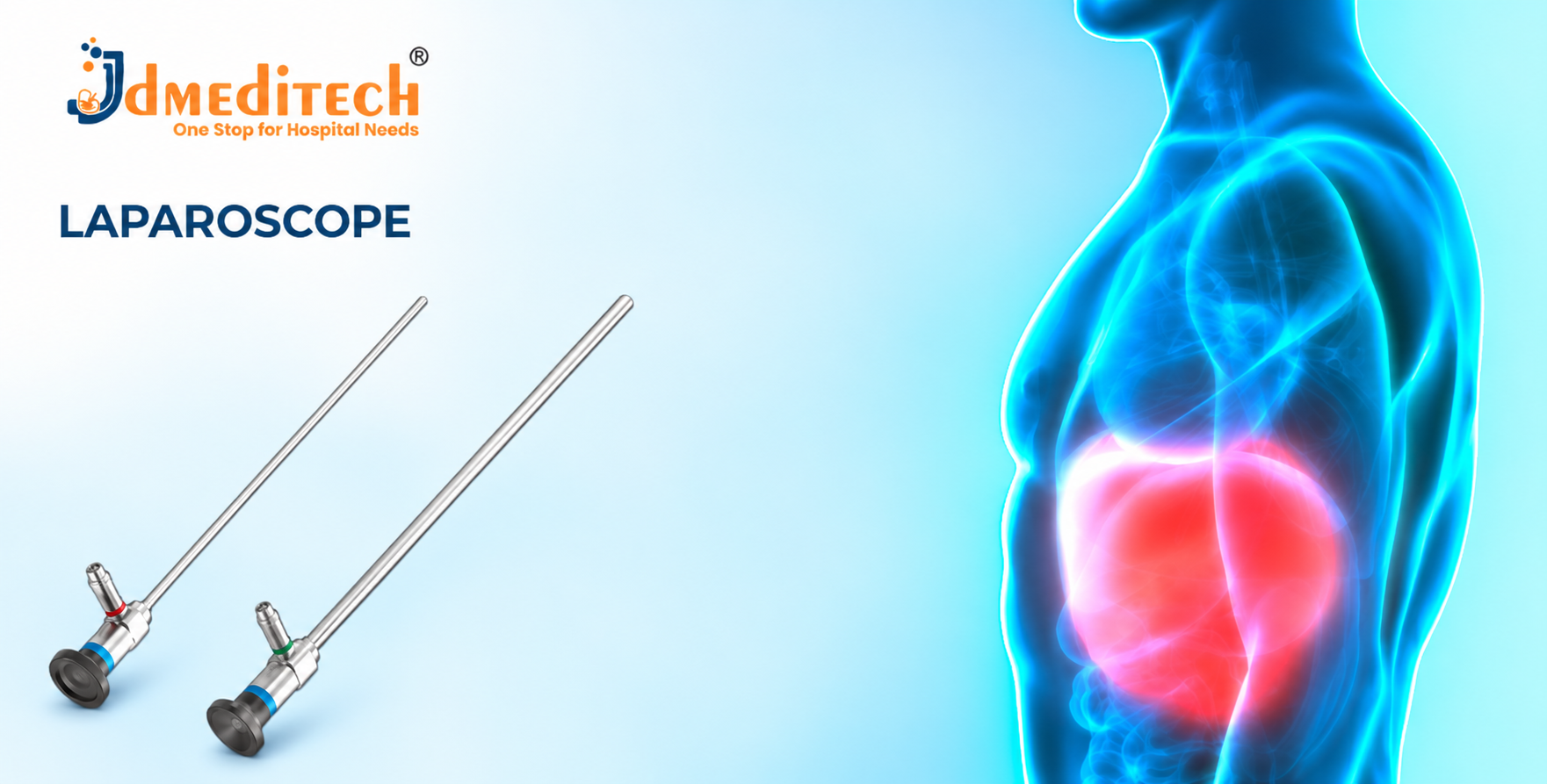
Laparoscope – Features, Types, Uses and Specifications
A Laparoscope is a specialized
endoscopic instrument used to
visualize internal structures
during minimally invasive surgery.
During laparoscopic procedures,
surgeons insert the optical
instrument through a compatible
surgical access port.
As a result, the surgical team
can observe the operative field
through a connected imaging system.
Furthermore, laparoscopic visualization
supports precise observation
and instrument coordination.
JDMeditech supplies laparoscopy
equipment, surgical instruments
and medical accessories for
hospitals, surgical centers
and medical distributors.
What Is a Laparoscope?
A laparoscope is an optical
medical instrument designed
for viewing structures
inside the abdominal
or pelvic cavity.
Typically, a rigid model
includes a long shaft,
an optical system,
an eyepiece connection
and a light connection.
Furthermore, compatible
camera equipment can
display the surgical
field on a monitor.
However, exact optical
and mechanical features
vary by model.
Purpose of a Laparoscopic Telescope
The primary purpose
of a surgical telescope
is to provide
endoscopic visualization
during approved procedures.
Furthermore, the instrument
helps surgeons inspect
designated anatomical
structures.
For example, a suitable
scope may support
visualization during
laparoscopic cholecystectomy.
However, the selected
instrument must match
the intended clinical
application.
How Does a Laparoscope Work?
A rigid surgical scope
uses an optical
system to transmit
images from its
distal viewing end.
Next, a compatible
camera system
captures the image
through the eyepiece.
The video system
then displays
the operative field
on a monitor.
Furthermore, an
external light source
provides illumination
through a compatible
light connection.
However, the optical
design depends
on the model.
Importance of Visualization in Laparoscopic Surgery
Minimally invasive
surgery requires
clear visualization
of the operative
field.
Therefore, the
surgeon uses
endoscopic imaging
to observe
anatomical structures.
Furthermore, the
camera system
supports coordination
between the surgeon
and operating
room team.
However, image
quality depends
on several factors,
including optics,
illumination and
camera compatibility.
Key Features of a Rigid Laparoscope
- Rigid Optical Shaft
- Endoscopic Viewing System
- Compatible Camera Connection
- Light Source Connection
- Designed for Minimally Invasive Visualization
- Available Viewing Angle Options
- Model-Specific Shaft Diameters
- Model-Specific Working Lengths
- Compatibility With Selected Access Ports
- Manufacturer-Defined Reprocessing Requirements
Furthermore, customers
should confirm
the exact optical
configuration before
purchasing.
Main Components of a Laparoscope
A typical rigid
optical instrument
may include
the following
components.
- Rigid Shaft
- Distal Objective Lens
- Internal Optical System
- Eyepiece Assembly
- Camera Coupling Interface
- Light Post
- Proximal Housing
- Protective Optical Components
1. Rigid Shaft
The rigid shaft
supports the
optical assembly
and allows
endoscopic access.
Furthermore, shaft
diameter and
length vary
between models.
2. Objective Lens
The distal objective
lens collects
light from
the operative
field.
Furthermore, it
forms part
of the scope’s
imaging system.
3. Internal Optical System
The internal optical
system transmits
the image
toward the
proximal eyepiece.
Additionally, optical
design influences
image transmission.
However, exact
lens arrangements
vary by model.
4. Eyepiece Assembly
The eyepiece
provides an
interface for
compatible camera
equipment.
Furthermore, the
connection must
match the selected
camera coupler.
5. Light Post
The light post
connects to
an approved
fiber-optic
light cable.
As a result,
the system
can illuminate
the surgical
field.
However, users
must confirm
connector compatibility.
Types of Laparoscopes
Different laparoscopic
procedures may
require different
optical configurations.
Therefore, surgeons
select the
viewing angle,
diameter and
working length
according to
clinical needs.
0-Degree Laparoscope
A 0-degree
scope provides
a forward-facing
view along
the instrument
axis.
Furthermore, it
supports selected
laparoscopic
visualization tasks.
30-Degree Laparoscope
A 30-degree
scope provides
an angled
viewing direction.
Furthermore, rotating
the instrument
can change
the observed
field.
However, appropriate
handling requires
clinical training.
Other Viewing Angle Options
Additional optical
angles may
be available
for specialized
applications.
However, availability
depends on
the manufacturer
and product
configuration.
Common Laparoscope Diameter Options
Rigid endoscopes
are available
in different
shaft diameters.
For example,
5 mm and
10 mm are
commonly encountered
laparoscopic
telescope sizes.
However, these
are general
industry examples
and do not
confirm the
sizes of
the pictured
product.
Clinical Applications of a Laparoscope
- Diagnostic Laparoscopy
- Laparoscopic Cholecystectomy
- Laparoscopic Appendectomy
- Selected Gynecological Procedures
- Selected Urological Procedures
- Selected Colorectal Procedures
- Other Approved Minimally Invasive Procedures
However, the
specific scope
must be
appropriate for
the intended
procedure.
Role in Laparoscopic Cholecystectomy
Laparoscopic cholecystectomy
involves removing
the gallbladder
through minimally
invasive access.
During surgery,
the optical
instrument provides
visualization of
the operative
field.
Furthermore, the
camera system
displays images
on the
surgical monitor.
Role in Gynecological Laparoscopy
Selected gynecological
procedures use
laparoscopic
visualization
to inspect
pelvic structures.
Furthermore, suitable
optics support
observation during
approved diagnostic
and therapeutic
procedures.
Role in Urological Laparoscopy
Selected urological
operations require
visualization of
internal anatomical
structures.
Therefore, compatible
laparoscopic optics
support the
surgical imaging
system.
However, instrument
selection depends
on the
operative approach.
Benefits of a Laparoscope
- Supports Internal Surgical Visualization
- Provides Endoscopic Optical Access
- Works With Compatible Camera Systems
- Supports Selected Minimally Invasive Procedures
- Offers Different Viewing Angle Options
- Allows Model-Specific Diameter Selection
- Supports Operative Field Observation
Furthermore, clinical
performance depends
on the complete
imaging system
and surgical
technique.
Rigid Laparoscope vs Flexible Endoscope
| Feature | Rigid Laparoscope | Flexible Endoscope |
|---|---|---|
| Shaft Design | Rigid | Flexible |
| Primary Application | Selected Laparoscopic Procedures | Various Endoscopic Procedures |
| Viewing Direction | Fixed Optical Angle | May Include Steerable Tip |
| Camera Arrangement | Often External Camera Coupling | Depends on Endoscope Design |
| Working Channel | Not Typically Integrated | Available on Many Models |
Technical Specifications of Laparoscope
The supplied
product image
shows rigid
optical instruments.
However, the
image alone
does not
confirm exact
diameter, length,
viewing angle
or optical
performance.
Therefore, buyers
should verify
the official
technical datasheet.
| Parameter | Product Information |
|---|---|
| Product Name | Laparoscope |
| Instrument Type | Rigid Optical Endoscope |
| Category | Laparoscopy Surgical Instruments |
| Primary Function | Endoscopic Visualization |
| Viewing Angle | Confirm Available Options |
| Outer Diameter | Confirm Manufacturer Specifications |
| Working Length | Confirm Manufacturer Specifications |
| Optical System | Confirm Manufacturer Specifications |
| Field of View | Confirm Manufacturer Specifications |
| Camera Compatibility | Confirm Approved Coupler Type |
| Light Cable Compatibility | Confirm Approved Connection Type |
| Material | Confirm Manufacturer Specifications |
| Reusability | Confirm Product Labeling |
| Sterilization Compatibility | Follow Validated Instructions |
| Packaging | Confirm Supplied Configuration |
| Regulatory Documentation | Verify for Destination Market |
Importance of Viewing Angle
Viewing angle
influences the
direction of
endoscopic
observation.
Furthermore, different
angles may
support different
surgical approaches.
Therefore, clinicians
should select
appropriate optics
for each
procedure.
Importance of Shaft Diameter
Shaft diameter
affects compatibility
with surgical
access ports.
Furthermore, the
selected diameter
must suit
the planned
operative approach.
However, larger
diameter does
not automatically
mean better
clinical performance.
Importance of Optical Quality
Optical quality
influences image
clarity and
light transmission.
Furthermore, clean
and undamaged
optical surfaces
support consistent
visualization.
Therefore, proper
handling and
inspection are
essential.
Camera and Light Source Compatibility
A rigid scope
usually works
with compatible
camera and
illumination
equipment.
Furthermore, the
camera coupler
must fit
the eyepiece.
Additionally, the
light cable
must match
the light
connection.
However, users
must verify
compatibility before
clinical use.
Safety Precautions
- Verify Approved Intended Use
- Inspect Optical Surfaces
- Check Shaft Integrity
- Confirm Camera Compatibility
- Verify Light Cable Connection
- Use Compatible Access Ports
- Avoid Excessive Mechanical Force
- Prevent Thermal Injury From Illumination
- Follow Validated Reprocessing Instructions
- Use Appropriately Trained Personnel
- Follow Manufacturer Instructions
Potential Risks and Complications
- Tissue Injury From Improper Handling
- Optical Instrument Damage
- Thermal Injury From Light Components
- Contamination From Improper Reprocessing
- Inadequate Visualization
- Mechanical Damage to the Shaft
- Camera Connection Failure
- Light Transmission Problems
Furthermore, risks
depend on the
procedure, equipment
and clinical
technique.
Inspection Before Use
- Confirm Instrument Identification
- Inspect the Distal Lens
- Inspect the Eyepiece
- Check Shaft Straightness
- Inspect the Light Post
- Verify Optical Clarity
- Confirm Camera Coupling
- Check Light Transmission
- Confirm Reprocessing Status
- Follow Manufacturer Pre-Use Checks
Cleaning and Sterilization Guidelines
Reusable laparoscopes
require validated
cleaning and
reprocessing before
clinical reuse.
Furthermore, personnel
must follow
the manufacturer’s
instructions for
detergents, cleaning
methods and
sterilization.
However, not
every rigid
endoscope supports
the same
sterilization cycle.
Therefore, users
must verify
the approved
reprocessing method
for the
specific model.
Storage and Handling Recommendations
- Store in an Approved Instrument Container
- Protect the Distal Lens
- Protect the Eyepiece
- Avoid Mechanical Impact
- Prevent Shaft Bending
- Keep Optical Surfaces Clean
- Follow Manufacturer Storage Instructions
- Inspect Before Each Use
How to Choose the Right Laparoscope
Hospitals and
procurement teams
should evaluate
several important
factors before
purchasing.
- Intended Surgical Application
- Viewing Angle
- Outer Diameter
- Working Length
- Optical Performance
- Camera Compatibility
- Light Source Compatibility
- Access Port Compatibility
- Reprocessing Requirements
- Regulatory Documentation
- Service and Technical Support
Why Choose JDMeditech?
JDMeditech supplies
laparoscopy equipment,
surgical instruments
and medical accessories
for hospitals,
surgical centers
and medical distributors.
Furthermore, our
team assists
customers with
product inquiries,
available configurations
and quotation
requests.
Customers can
contact JDMeditech
regarding:
- Laparoscope
- Laparoscopic Camera System
- Endoscopic Light Source
- Fiber Optic Light Cable
- CO2 Insufflator
- Laparoscopic Trocar
- Laparoscopic Hand Instruments
- Laparoscopy Trolley
- Hospital Equipment Procurement
Frequently Asked Questions
1. What Is a Laparoscope?
A laparoscope is an endoscopic optical instrument used to visualize internal structures during selected minimally invasive surgical procedures.
2. What Is the Main Purpose of a Laparoscope?
Its primary purpose is to provide internal surgical visualization through a compatible imaging system.
3. What Is a 0-Degree Laparoscope?
A 0-degree scope provides a forward-facing viewing direction along the instrument axis.
4. What Is a 30-Degree Laparoscope?
A 30-degree scope provides an angled viewing direction for selected surgical applications.
5. What Are Common Laparoscope Sizes?
Common industry examples include 5 mm and 10 mm scopes. However, customers should confirm the available product sizes.
6. Does a Laparoscope Require a Camera?
A rigid optical scope commonly connects to an external camera system for video display.
7. Does It Require a Light Source?
Yes. Conventional rigid optical laparoscopes require compatible illumination for visualization.
8. Can It Be Used for Laparoscopic Cholecystectomy?
Yes, when the scope is appropriate for the procedure and compatible with the surgical imaging system.
9. Can a Laparoscope Be Reused?
Reuse depends on the product labeling and validated cleaning and sterilization instructions.
10. Can Every Laparoscope Be Autoclaved?
No. Steam sterilization compatibility depends on the specific model and manufacturer’s validated instructions.
11. How Should the Instrument Be Stored?
Users should store the scope in an approved protective container according to the manufacturer’s instructions.
12. Where Can Customers Request Product Information?
Hospitals, surgical centers and medical distributors can contact JDMeditech for product information and quotations.
Conclusion
In conclusion,
the Laparoscope
is an essential
optical instrument
for selected
minimally invasive
surgical procedures.
Furthermore, its
optical system
supports internal
visualization when
connected to
compatible imaging
equipment.
However, safe
performance depends
on correct
instrument selection,
proper handling
and validated
reprocessing.
Therefore, hospitals
and medical
distributors should
verify complete
technical specifications
before purchasing.
JDMeditech – One Stop for Hospital Needs
Website:
www.jdmeditech.com
Related Laparoscopy Equipment
- Laparoscopic Camera System
- Endoscopic Light Source
- Fiber Optic Light Cable
- CO2 Insufflator
- Laparoscopic Trocar
- Laparoscopic Hand Instruments
Medical Equipment Reference
For general information
about medical device
safety, visit the
U.S. Food and Drug Administration –
Medical Devices
.
Medical Disclaimer
This article provides
general educational
and product information
only. It does not
replace professional
medical advice,
clinical judgment,
specialist training
or manufacturer
instructions.
Healthcare professionals
must verify approved
indications, optical
specifications, accessory
compatibility, cleaning
requirements and
sterilization methods
before use.




