



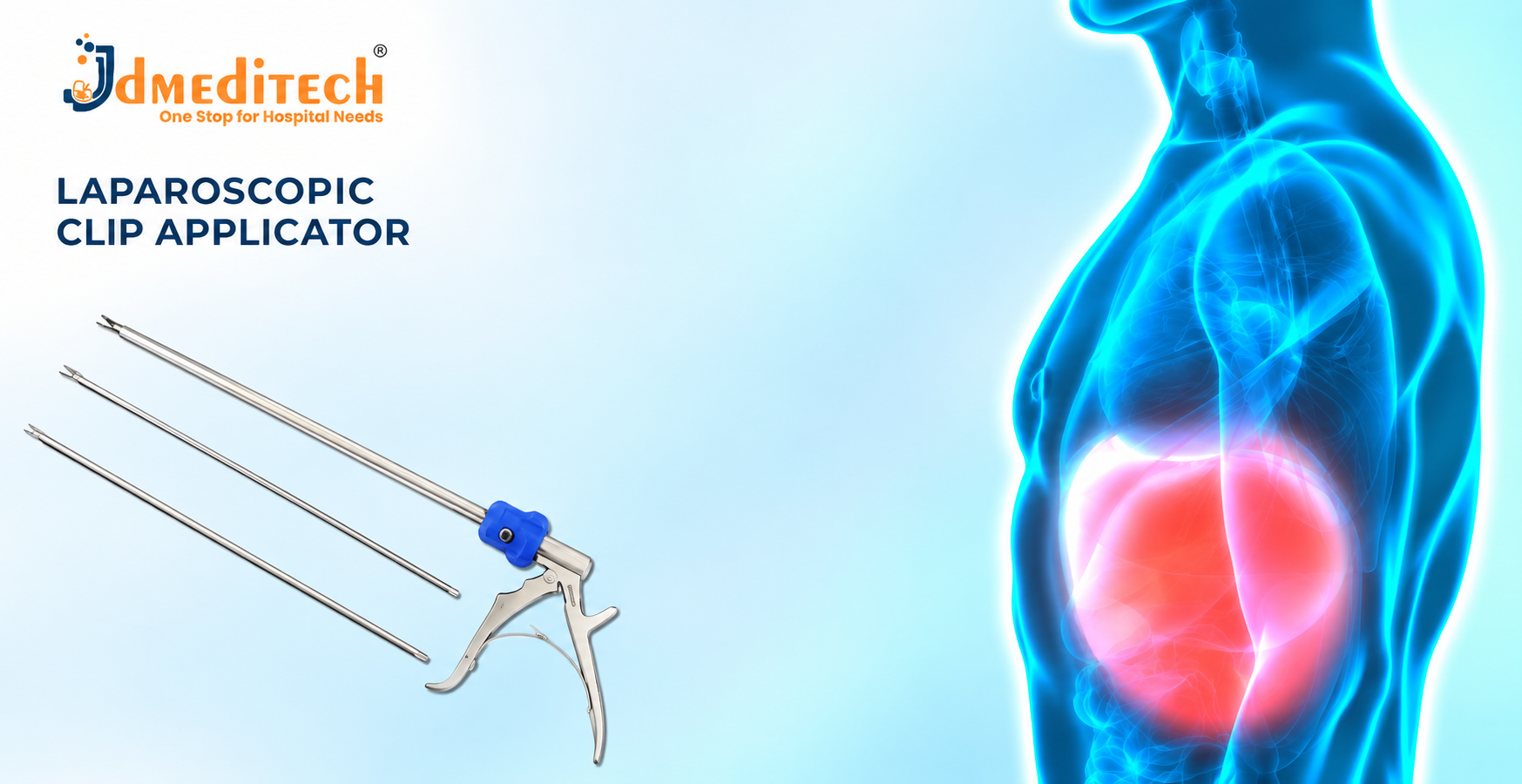
Laparoscopic Clip Applicator – Features, Uses, Benefits and Specifications
A Laparoscopic Clip Applicator is a specialized surgical instrument used to position and apply compatible surgical clips during minimally invasive procedures. Surgeons use clip applicators for selected ligation and occlusion tasks when the clip system’s approved indications permit such use.
Furthermore, laparoscopic clip applicators feature elongated shafts that allow surgeons to work through compatible access ports. Their distal jaws hold and close surgical clips according to the instrument’s mechanical design.
However, different clip applicators support different clip materials, sizes and closure mechanisms. Therefore, healthcare professionals must confirm compatibility before use.
JDMeditech supplies laparoscopic surgical instruments and accessories for hospitals, surgical centers and medical distributors. Additionally, customers can contact our team to inquire about available Laparoscopic Clip Applicator models and technical specifications.
What Is a Laparoscopic Clip Applicator?
A Laparoscopic Clip Applicator, also known as a laparoscopic clip applier, is a surgical instrument designed to apply compatible clips through a minimally invasive access route.
Typically, the instrument includes a handle, elongated shaft and distal clip-holding jaws.
Furthermore, some models incorporate rotation mechanisms or other handling features.
However, the exact configuration depends on the manufacturer and intended clip system.
Purpose of a Laparoscopic Clip Applicator
The primary purpose of a Laparoscopic Clip Applicator is to position and close compatible surgical clips on selected anatomical structures.
Additionally, appropriate clip systems may support mechanical vessel ligation or occlusion.
Therefore, surgeons select the clip and applicator combination according to the procedure and the manufacturer’s approved indications.
Importance of Clip Applicators in Laparoscopic Surgery
Laparoscopic procedures may require controlled management of selected vessels and tubular structures.
Furthermore, compatible surgical clips provide a mechanical ligation option for certain applications.
However, correct clip selection and placement remain essential for the intended function.
Therefore, surgeons must follow the manufacturer’s instructions and clinical protocols.
Main Components of a Laparoscopic Clip Applicator
Depending on the model, a Laparoscopic Clip Applicator may include:
- Instrument Handle
- Finger Rings or Operating Grip
- Long Laparoscopic Shaft
- Distal Clip-Holding Jaws
- Jaw Opening and Closing Mechanism
- Internal Actuation Assembly
- Optional Rotation Control
- Optional Locking Mechanism
- Product Identification Markings
However, exact components vary between models.
1. Instrument Handle
The handle allows the surgeon to control the clip applicator.
Furthermore, its operating mechanism transfers movement to the distal jaws.
However, handle design differs between manufacturers.
2. Finger Rings or Operating Grip
Some clip applicators feature finger rings, while others use alternative grips.
Additionally, the grip design influences instrument handling.
Therefore, surgeons should select an appropriate configuration for the procedure.
3. Long Laparoscopic Shaft
The elongated shaft allows the instrument to pass through compatible laparoscopic access ports.
Furthermore, shaft diameter and length influence instrument compatibility and reach.
Therefore, users must verify the required dimensions before use.
4. Distal Clip-Holding Jaws
The distal jaws hold a compatible surgical clip before application.
Furthermore, the jaw geometry helps position and close the selected clip.
However, different clip systems may require different jaw designs.
5. Jaw Opening and Closing Mechanism
The jaw mechanism controls the movement of the distal jaws.
Additionally, proper mechanical function supports the intended clip application process.
Therefore, users should inspect the mechanism before use.
6. Internal Actuation Assembly
The internal actuation assembly transfers movement from the handle to the distal working end.
Furthermore, its construction depends on the instrument design.
However, damaged components may affect instrument performance.
7. Optional Rotation Control
Some laparoscopic clip applicators include a rotation mechanism.
Furthermore, this feature may allow surgeons to adjust the orientation of the distal jaws.
However, customers should verify whether the selected model includes rotation control.
8. Optional Locking Mechanism
Selected applicators may include additional mechanisms that influence handle or jaw operation.
However, these features vary by manufacturer.
Therefore, users should follow the device-specific instructions.
9. Product Identification Markings
Manufacturers may include markings that identify the instrument model, dimensions or clip compatibility.
Additionally, these markings help healthcare teams select the appropriate instrument.
Therefore, users should verify product identification before use.
Key Features of a Laparoscopic Clip Applicator
Depending on the selected model, a Laparoscopic Clip Applicator may offer:
- Long-Shaft Laparoscopic Design
- Hand-Operated Clip Application
- Specialized Clip-Holding Jaws
- Compatibility With Selected Surgical Clips
- Different Shaft Diameters
- Different Shaft Lengths
- Optional Rotating Shaft
- Different Handle Configurations
- Reusable or Single-Use Options
- Model-Specific Clip Closure Mechanisms
However, the official product datasheet should confirm each feature.
How Does a Laparoscopic Clip Applicator Work?
A Laparoscopic Clip Applicator provides a mechanical method of positioning and closing compatible surgical clips.
First, the surgical team verifies the selected clip and applicator combination.
Next, the surgeon uses the instrument through an appropriate laparoscopic access port.
During the procedure, the applicator supports positioning and closure of the selected clip.
Furthermore, the surgeon assesses whether the clip meets the intended surgical requirement.
However, the precise technique depends on the clip system and clinical situation.
Importance of Clip Compatibility
Clip compatibility is essential for safe surgical application.
Furthermore, different clip systems may require different jaw geometries and closure mechanisms.
Therefore, users must follow the manufacturer’s compatibility instructions.
Importance of Clip Size Selection
Clip size selection depends on the target structure and the manufacturer’s approved sizing guidance.
Furthermore, an unsuitable clip may cause incomplete closure or tissue injury.
Therefore, surgeons must select the correct clip size for the intended application.
Importance of Jaw Alignment
Proper jaw alignment supports correct clip positioning and closure.
Furthermore, damaged or misaligned jaws may interfere with clip application.
Therefore, healthcare professionals should inspect the applicator before use.
Importance of Shaft Diameter
Shaft diameter determines compatibility with laparoscopic access ports.
Additionally, different procedures may require different instrument configurations.
Therefore, users must verify trocar compatibility before use.
Importance of Shaft Length
Shaft length influences instrument reach within the operative field.
Furthermore, patient anatomy and surgical approach affect instrument selection.
Therefore, surgeons should select an appropriate shaft length.
Types of Laparoscopic Clip Applicators
Manufacturers offer different clip applicator configurations for surgical applications.
- Metallic Clip Applicator
- Polymer Clip Applicator
- Reusable Laparoscopic Clip Applicator
- Single-Use Laparoscopic Clip Applicator
- Rotatable Clip Applicator
- Clip Size-Specific Applicator
- Different Shaft-Length Applicators
However, these categories describe possible configurations rather than confirmed specifications of the illustrated product.
1. Metallic Clip Applicator
Metallic clip applicators support selected metal ligation clip systems.
Furthermore, manufacturers may offer different jaw configurations for different clip sizes.
However, users must verify the approved clip compatibility.
2. Polymer Clip Applicator
Polymer clip applicators support compatible polymer ligation clips.
Additionally, certain polymer clip systems include locking mechanisms.
However, not all polymer clips are interchangeable.
3. Reusable Laparoscopic Clip Applicator
Reusable applicators support repeated use only when the manufacturer authorizes reprocessing.
Furthermore, hospitals must follow validated cleaning and sterilization instructions.
However, personnel should remove damaged instruments from service.
4. Single-Use Laparoscopic Clip Applicator
Single-use applicators are intended for one use according to product labeling.
Additionally, healthcare facilities must follow applicable disposal requirements.
Therefore, users should not reuse single-use devices contrary to labeling and regulations.
5. Rotatable Laparoscopic Clip Applicator
Some clip applicators feature a rotating shaft or jaw-orientation mechanism.
Furthermore, this feature may assist with instrument positioning.
However, the available rotation range depends on the model.
Applications of Laparoscopic Clip Applicators
Compatible laparoscopic clip applicators support selected surgical ligation tasks.
Potential applications of approved clip systems include:
- Selected Laparoscopic General Surgery Procedures
- Selected Abdominal Surgical Procedures
- Selected Urological Procedures
- Selected Gynecological Procedures
- Selected Gastrointestinal Procedures
- Other Manufacturer-Approved Ligation Applications
However, exact clinical indications depend on the selected clip system and applicator.
Application in Laparoscopic General Surgery
General laparoscopic procedures may require mechanical ligation of selected structures.
Furthermore, compatible clip applicators support the placement of approved surgical clips.
However, the surgeon must verify the clip system’s indications and limitations.
Application in Abdominal Surgery
Selected abdominal procedures may involve mechanical ligation techniques.
Additionally, compatible surgical clips may support the planned operative approach.
However, the surgeon must determine whether clip placement is appropriate.
Application in Urological Surgery
Selected urological procedures may use approved surgical clip systems.
Furthermore, different anatomical structures may require different ligation methods.
However, some applications have important restrictions or contraindications.
Therefore, surgeons must follow the clip manufacturer’s instructions.
Application in Gynecological Surgery
Selected gynecological procedures may require mechanical ligation.
Additionally, compatible clip applicators may support specific surgical tasks.
However, the surgeon must consider tissue characteristics and approved indications.
Technical Specifications of Laparoscopic Clip Applicators
Exact specifications vary by manufacturer and model. Therefore, customers should request the official product datasheet before ordering.
| Parameter | Product Information |
|---|---|
| Product Name | Laparoscopic Clip Applicator |
| Alternative Name | Laparoscopic Clip Applier |
| Product Category | Laparoscopy Instruments |
| Primary Function | Application of Compatible Surgical Clips |
| Instrument Type | Hand-Operated Surgical Applicator |
| Shaft Design | Elongated Laparoscopic Shaft |
| Shaft Diameter | Confirm Available Sizes |
| Shaft Length | Confirm Available Lengths |
| Jaw Configuration | Confirm Manufacturer Specifications |
| Compatible Clip Material | Confirm Approved Clip System |
| Compatible Clip Size | Confirm Manufacturer Specifications |
| Handle Design | Confirm Manufacturer Specifications |
| Rotation Mechanism | Model-Dependent |
| Instrument Material | Confirm Manufacturer Specifications |
| Trocar Compatibility | Confirm Manufacturer Specifications |
| Reusable or Single-Use | Confirm Product Labeling |
| Sterile Status | Confirm Product Labeling |
| Cleaning and Sterilization | Follow Manufacturer Instructions |
| Packaging | Confirm Supplied Configuration |
| Regulatory Documentation | Verify for Destination Market |
Potential Benefits of Laparoscopic Clip Applicators
When appropriately selected and used, laparoscopic clip applicators may offer several practical functions.
- Mechanical Application of Compatible Surgical Clips
- Access Through Compatible Laparoscopic Ports
- Hand-Operated Clip Positioning
- Specialized Clip-Holding Jaws
- Different Instrument Configurations
- Compatibility With Selected Surgical Procedures
However, these characteristics do not guarantee improved clinical outcomes or eliminate surgical risks.
Laparoscopic Clip Applicator vs Open Surgery Clip Applicator
| Feature | Laparoscopic Clip Applicator | Open Surgery Clip Applicator |
|---|---|---|
| Primary Application | Selected Minimally Invasive Procedures | Selected Open Surgical Procedures |
| Instrument Design | Long-Shaft Configuration | Typically Forceps-Like Configuration |
| Access Method | Compatible Laparoscopic Ports | Direct Open Surgical Access |
| Clip Compatibility | Model-Specific | Model-Specific |
| Clip Closure | Mechanical | Mechanical |
| Clinical Selection | Procedure-Dependent | Procedure-Dependent |
Important Safety Precautions
Only appropriately trained healthcare professionals should use surgical clip applicators.
Furthermore, users must follow the clip and applicator manufacturers’ instructions.
- Verify the Approved Intended Use
- Confirm Clip and Applicator Compatibility
- Select the Correct Clip Size
- Inspect the Applicator Jaws
- Check Handle Function
- Confirm Trocar Compatibility
- Verify Sterile Status
- Follow the Approved Loading Method
- Verify Clip Placement and Closure
- Avoid Excessive Force
- Observe All Contraindications
- Follow Approved Reprocessing Instructions
Additionally, surgeons must consider the anatomical structure and patient-specific risks.
Potential Risks and Complications
Improper clip selection, positioning or closure may cause complications.
Potential risks include:
- Bleeding
- Incomplete Vessel Occlusion
- Clip Dislodgement
- Clip Migration
- Tissue Injury
- Injury to Adjacent Structures
- Instrument Malfunction
- Infection
- Need for Additional Surgical Intervention
Therefore, appropriate training, clip compatibility and clinical judgment remain essential.
Inspection Before Use
Healthcare professionals should inspect the applicator according to the manufacturer’s instructions.
- Confirm Product Identification
- Verify Compatible Clip Type
- Check Compatible Clip Size
- Inspect the Distal Jaws
- Check Jaw Alignment
- Test Handle Movement
- Inspect the Shaft
- Check for Corrosion or Damage
- Verify Sterile Status
- Confirm Trocar Compatibility
Furthermore, personnel should remove damaged instruments from service.
Cleaning and Sterilization Guidelines
Reusable laparoscopic clip applicators require validated cleaning and sterilization according to the manufacturer’s instructions.
Furthermore, jaw mechanisms and internal components may require particular cleaning attention.
However, users must not assume that every applicator supports the same sterilization method.
Therefore, healthcare facilities should follow the device-specific instructions.
Storage and Handling Guidelines
Proper storage helps protect surgical clip applicators.
For example, healthcare facilities should protect the distal jaws from impact.
Additionally, staff should avoid conditions that could damage the shaft or sterile packaging.
Therefore, facilities should follow the manufacturer’s storage recommendations.
How to Choose the Right Laparoscopic Clip Applicator
Hospitals and procurement teams should consider several factors before purchasing.
- Approved Intended Use
- Compatible Clip Material
- Compatible Clip Size
- Jaw Configuration
- Shaft Diameter
- Shaft Length
- Handle Design
- Rotation Mechanism
- Reusable or Single-Use Classification
- Sterile Status
- Reprocessing Requirements
- Regulatory Documentation
Furthermore, surgeons should verify the applicator’s suitability for the planned procedure.
Applications in Hospitals and Surgical Centers
Hospitals and surgical centers require appropriate clip applicators for selected surgical procedures.
Furthermore, different departments may require different clip sizes and instrument configurations.
Therefore, procurement teams should coordinate with surgeons and operating room personnel.
Applications for Medical Distributors
Medical distributors should confirm clip compatibility, instrument dimensions and reusable status before preparing quotations.
Additionally, customers may request packaging details and regulatory documentation.
Therefore, distributors should verify the official product specifications.
Why Choose JDMeditech?
JDMeditech supplies laparoscopic instruments, surgical accessories and medical equipment for hospitals, surgical centers and medical distributors.
Furthermore, our team can assist customers with product inquiries, available configurations and technical information.
Customers can contact JDMeditech regarding:
- Laparoscopic Clip Applicator Inquiries
- Surgical Clip Applicator Requirements
- Clip Compatibility Information
- Instrument Size Requirements
- Hospital Procurement Requests
- Medical Distributor Inquiries
- International Export Requirements
However, exact product availability and technical specifications require confirmation.
Frequently Asked Questions About Laparoscopic Clip Applicators
1. What Is a Laparoscopic Clip Applicator?
It is a surgical instrument designed to apply compatible clips during selected laparoscopic procedures.
2. What Is Its Main Purpose?
Its primary purpose is to position and close compatible surgical clips on selected anatomical structures.
3. Is It Used for Hemostasis?
Compatible clip systems may support hemostasis through mechanical ligation when clinically appropriate.
4. Can It Apply Polymer Clips?
Some applicators support approved polymer clip systems. However, users must verify compatibility.
5. Can It Apply Metallic Clips?
Selected applicators support metallic clips. However, the clip type and size must match the instrument.
6. Are All Surgical Clips Interchangeable?
No. Different clip systems may require different applicators.
7. Is a Laparoscopic Clip Applicator Reusable?
Some models are reusable, while others are single-use. Users must follow product labeling.
8. Are Different Shaft Lengths Available?
Different lengths may be available depending on the manufacturer and model.
9. Can the Applicator Rotate?
Some models include rotation mechanisms. However, customers must verify the selected configuration.
10. Can It Be Autoclaved?
Only reusable models with validated steam sterilization instructions should undergo autoclaving.
11. Can It Pass Through Any Trocar?
No. Trocar compatibility depends on instrument diameter and access-port specifications.
12. What Should Buyers Confirm Before Ordering?
Buyers should verify clip type, clip size, jaw configuration, shaft dimensions and regulatory documentation.
13. Who Should Use a Laparoscopic Clip Applicator?
Only appropriately trained healthcare professionals should use surgical clip applicators.
14. Why Is Clip Compatibility Important?
Correct compatibility helps support proper clip positioning and closure.
15. Where Can Customers Request Product Information?
Hospitals, surgical centers and medical distributors can contact JDMeditech for product information and quotations.
Conclusion
In conclusion, a Laparoscopic Clip Applicator is an important surgical instrument for the mechanical application of compatible clips during selected minimally invasive procedures.
Furthermore, different instrument configurations support different clip systems and surgical requirements.
However, safe and appropriate use depends on correct clip selection, surgical expertise and adherence to manufacturer instructions.
Therefore, healthcare facilities should verify the product specifications before purchasing.
JDMeditech – One Stop for Hospital Needs
Website:
www.jdmeditech.com
Related Laparoscopy Instruments
- Hem O Lock Clip Applicator
- Open Surgery Clip Applicator
- Surgical Ligation Clips
- Laparoscopic Grasping Forceps
- Laparoscopic Bipolar Forceps
- Laparoscopic Trocar
Medical Disclaimer
This article provides general educational and product information only. It does not replace professional surgical training, manufacturer instructions or clinical judgment. Healthcare professionals must verify clip compatibility, intended use, sterile status, reprocessing requirements and contraindications before use.




