



Laparoscopic Endo Bag – Features, Uses and Surgical Applications
The Laparoscopic Endo Bag is a specialized surgical specimen retrieval device designed to contain and assist with removing excised tissue during selected minimally invasive procedures. Surgeons use compatible retrieval bags to collect surgical specimens before extracting them through an appropriate access site.
During laparoscopic surgery, the surgical team must handle removed tissue carefully. Therefore, an appropriately selected specimen retrieval bag can support controlled specimen containment and extraction.
Furthermore, certain retrieval systems include an introducer shaft, deployment mechanism and collection pouch. However, the exact design, material and operating characteristics depend on the product model.
JDMeditech supplies laparoscopic instruments, surgical accessories and medical equipment for hospitals, surgical centers and medical distributors.
What Is a Laparoscopic Endo Bag?
A Laparoscopic Endo Bag is a surgical collection pouch used to contain tissue or organs that surgeons remove during selected laparoscopic procedures.
Depending on its design, the bag may be introduced through a compatible trocar using a dedicated deployment instrument.
Additionally, some models include a support ring or closure mechanism to assist with specimen collection.
However, the manufacturer must confirm the exact device configuration and intended use.
Purpose of a Laparoscopic Endo Bag
The primary purpose of a specimen retrieval bag is to contain excised tissue during surgical extraction.
For example, surgeons may use a suitable bag to retrieve a gallbladder specimen after laparoscopic cholecystectomy.
Furthermore, containment may help limit direct contact between the specimen and surrounding tissues during removal.
However, a retrieval bag cannot guarantee prevention of contamination or specimen spillage.
Importance of Specimen Retrieval in Laparoscopic Surgery
Minimally invasive surgery uses relatively small access incisions.
Additionally, the surgical team may need to remove tissue specimens through these access sites.
Therefore, appropriate specimen retrieval devices can support controlled extraction.
However, the surgeon must consider specimen size, tissue characteristics and clinical requirements.
Main Components of a Laparoscopic Endo Bag
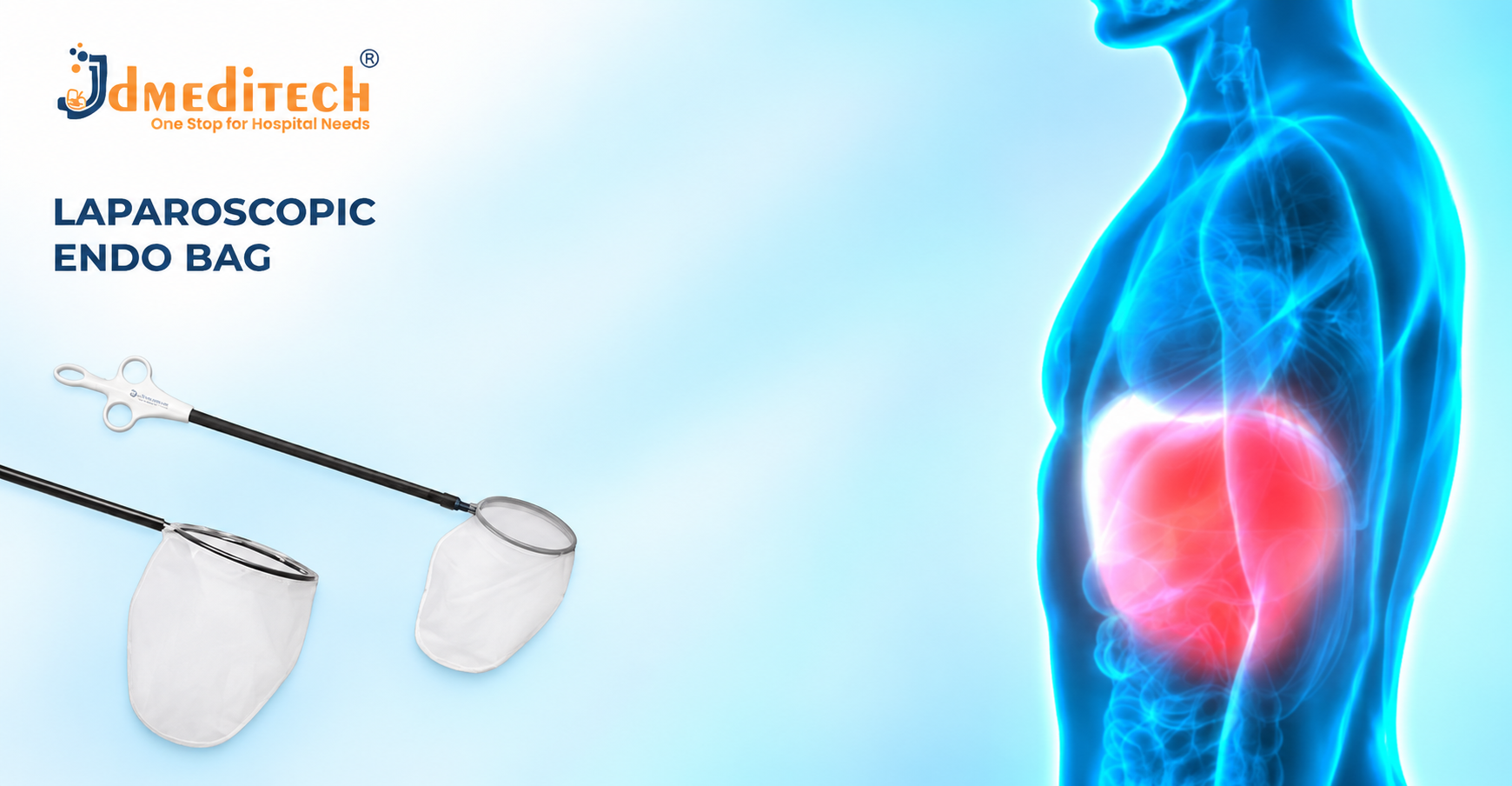
The illustrated product shows collection pouches attached to elongated deployment instruments. The exact construction and closure mechanism require confirmation from the manufacturer.
Depending on the model, a Laparoscopic Endo Bag may include:
- Specimen Collection Pouch
- Bag Opening or Support Ring
- Long Introducer Shaft
- Deployment Mechanism
- Proximal Control Handle
- Optional Closure System
- Optional Retrieval Cord
- Model-Specific Supporting Components
However, not every retrieval bag includes all these components.
1. Specimen Collection Pouch
The collection pouch holds suitable surgical specimens during the intended retrieval process.
Furthermore, pouch dimensions influence the amount and type of tissue it can accommodate.
However, the maximum specimen size depends on the product model.
2. Bag Opening or Support Ring
Some retrieval systems include a support ring that helps maintain the bag opening during specimen collection.
Additionally, selected designs use flexible opening structures.
However, the exact opening mechanism varies between manufacturers.
3. Long Introducer Shaft
The introducer shaft supports delivery of the collection pouch through a compatible laparoscopic access port.
Furthermore, shaft dimensions influence trocar compatibility.
Therefore, hospitals should verify the required dimensions before purchasing.
4. Deployment Mechanism
The deployment mechanism allows the surgeon to release or open the retrieval bag according to the manufacturer’s instructions.
Additionally, some models use a mechanical handle or sliding control.
However, the exact operating method depends on the device.
5. Proximal Control Handle
The proximal handle allows the surgeon to control the deployment instrument.
Furthermore, its design influences instrument handling.
However, not every retrieval bag includes a separate handle assembly.
6. Optional Closure System
Some specimen retrieval bags include a closure mechanism.
Additionally, selected designs use a drawstring or other closure arrangement.
However, the manufacturer must confirm the available closure system.
7. Optional Retrieval Cord
Certain retrieval systems include a cord or similar component that assists with bag closure or retrieval.
Furthermore, its configuration depends on the device design.
However, users must follow the approved operating instructions.
Key Features of a Laparoscopic Endo Bag
Depending on the selected model, these devices may offer the following features:
- Specialized Surgical Specimen Collection Pouch
- Minimally Invasive Surgical Application
- Compatible Laparoscopic Trocar Access
- Model-Specific Deployment Mechanism
- Optional Bag Support Ring
- Optional Closure Mechanism
- Different Pouch Size Options
- Different Introducer Dimensions
- Single-Use or Other Manufacturer-Approved Configurations
However, actual features and availability require confirmation from the official product specifications.
How Does a Laparoscopic Endo Bag Work?
A specimen retrieval bag provides a collection pouch for suitable excised tissue.
During an approved laparoscopic procedure, the surgeon introduces the compatible retrieval device through an appropriate access port.
After deploying the bag, the surgeon places the intended specimen inside the collection pouch.
Depending on the device, a closure mechanism may help contain the specimen before extraction.
Finally, the surgical team retrieves the bag according to the manufacturer’s instructions and the operative plan.
However, the exact technique depends on the product design and clinical requirements.
Understanding Laparoscopic Specimen Retrieval
Specimen retrieval involves removing excised tissue from the operative field.
Furthermore, surgeons must consider specimen size, tissue condition and the extraction route.
However, inappropriate handling may damage the collection pouch or specimen.
Therefore, the surgical team must select a suitable retrieval method.
Importance of Specimen Containment
Specimen containment may help reduce direct contact between excised tissue and surrounding structures.
Additionally, an appropriately selected bag may help manage selected specimens during removal.
However, retrieval bags do not eliminate all contamination or spillage risks.
Therefore, surgeons must follow appropriate surgical precautions.
Difference Between a Laparoscopic Endo Bag and a Surgical Grasper
A Laparoscopic Endo Bag provides a pouch for containing surgical specimens.
In contrast, a laparoscopic grasper uses a mechanical working tip to hold suitable tissue.
Furthermore, surgeons may use these devices together during selected procedures.
However, they perform different functions and are not interchangeable.
Difference Between an Endo Bag and a Gall Bladder Extractor
An Endo Bag is primarily a specimen containment device.
In contrast, a Gall Bladder Extractor is a mechanical instrument intended to assist with selected tissue-handling or extraction tasks.
Additionally, a retrieval bag may complement an appropriate extraction instrument.
However, the exact instrument combination depends on the surgical procedure.
Types of Laparoscopic Endo Bags
Manufacturers offer different specimen retrieval systems for minimally invasive surgery.
Common categories may include:
- Introducer-Based Specimen Retrieval Bag
- Manual Specimen Retrieval Pouch
- Drawstring Closure Retrieval Bag
- Support-Ring Retrieval Bag
- Different Capacity Retrieval Bags
- Specialized Surgical Specimen Collection Systems
However, each design has specific operating characteristics and intended applications.
Introducer-Based Retrieval Bag
An introducer-based system uses a dedicated instrument to deliver the pouch into the operative field.
Furthermore, some models include a controlled deployment mechanism.
However, the required trocar size depends on the device.
Manual Specimen Retrieval Pouch
A manual retrieval pouch is designed for specimen collection without a dedicated integrated deployment mechanism.
Additionally, its use depends on the approved surgical technique.
However, the manufacturer must confirm the intended application.
Drawstring Closure Retrieval Bag
A drawstring design includes a closure mechanism that helps gather the bag opening.
Furthermore, closure may support specimen containment during retrieval.
However, the bag must remain within its approved operating limits.
Support-Ring Retrieval Bag
A support-ring design uses a ring or similar structure to help maintain the pouch opening.
Additionally, the ring geometry may influence deployment and specimen placement.
However, the exact construction depends on the manufacturer.
Applications of a Laparoscopic Endo Bag
Approved specimen retrieval bags may support selected minimally invasive procedures.
Potential applications include:
- Laparoscopic Cholecystectomy
- Selected Laparoscopic Appendectomy Procedures
- Selected Gynecological Procedures
- Selected Laparoscopic Urological Procedures
- Selected General Surgical Procedures
- Other Manufacturer-Approved Specimen Retrieval Applications
However, the exact clinical indications depend on the device labeling.
Application in Laparoscopic Cholecystectomy
During laparoscopic cholecystectomy, surgeons remove the gallbladder after completing the required dissection.
Furthermore, a suitable retrieval bag may help contain the gallbladder specimen during extraction.
However, the surgeon must consider specimen size and the selected extraction method.
Application in Laparoscopic Appendectomy
Selected appendectomy procedures may require specimen containment.
Additionally, compatible retrieval bags may support controlled removal of the appendix specimen.
However, the surgeon must follow the approved surgical technique.
Application in Gynecological Surgery
Some minimally invasive gynecological procedures require removal of excised tissue.
Furthermore, suitable retrieval bags may support specimen containment.
However, clinical suitability depends on the tissue type and device specifications.
Application in Laparoscopic Urology
Selected urological procedures may require surgical specimen retrieval.
Additionally, compatible retrieval systems may support the intended operative technique.
However, the exact device selection depends on the procedure.
Technical Specifications of a Laparoscopic Endo Bag
Exact specifications vary by model. Therefore, customers should request the official manufacturer datasheet.
| Parameter | Product Information |
|---|---|
| Product Name | Laparoscopic Endo Bag |
| Alternative Name | Laparoscopic Specimen Retrieval Bag |
| Product Category | Laparoscopic Surgical Accessory |
| Primary Function | Surgical Specimen Containment and Retrieval |
| Bag Design | Model-Specific |
| Bag Material | Confirm Manufacturer Specifications |
| Bag Capacity | Confirm Product Datasheet |
| Bag Opening Diameter | Confirm Official Dimensions |
| Bag Dimensions | Model-Specific |
| Introducer Length | Confirm Product Datasheet |
| Introducer Diameter | Confirm Official Dimensions |
| Deployment Mechanism | Confirm Product Configuration |
| Closure Mechanism | Confirm Whether Included |
| Compatible Trocar Size | Confirm Official Specifications |
| Maximum Specimen Size | Confirm Validated Device Limits |
| Single-Use or Reusable | Confirm Product Labeling |
| Sterile Status | Confirm Product Labeling |
| Packaging | Confirm Supplied Configuration |
| Storage Requirements | Follow Manufacturer Instructions |
| Regulatory Documentation | Verify for Destination Market |
Importance of Retrieval Bag Size
Bag dimensions influence the type and size of specimens the device can accommodate.
Furthermore, oversized specimens may create retrieval difficulties.
However, the maximum specimen capacity varies between models.
Therefore, surgeons must select an appropriate bag size.
Importance of Bag Material
Material characteristics influence the bag’s mechanical performance.
Additionally, the pouch must meet the manufacturer’s requirements for its intended application.
However, users should not assume that every retrieval bag offers identical puncture or tear resistance.
Therefore, hospitals should verify the official product specifications.
Importance of Trocar Compatibility
Introducer-based retrieval bags require suitable laparoscopic access ports.
Furthermore, introducer dimensions determine the required trocar compatibility.
However, different models may require different access sizes.
Therefore, procurement teams should confirm compatibility before ordering.
Potential Benefits of a Laparoscopic Endo Bag
When appropriately selected, a specimen retrieval bag may provide several practical advantages.
- Support for Surgical Specimen Containment
- Assistance With Controlled Specimen Retrieval
- Compatibility With Selected Laparoscopic Procedures
- Different Pouch Capacity Options
- Model-Specific Deployment Systems
- Optional Closure Mechanisms
- Potential Reduction in Direct Specimen Contact
- Support for Minimally Invasive Surgical Workflows
Furthermore, appropriate device selection supports the intended retrieval technique.
However, these characteristics do not independently guarantee improved clinical outcomes.
Important Safety Precautions
Only appropriately trained surgical professionals should use laparoscopic specimen retrieval devices.
Furthermore, the surgical team must verify device integrity, intended use and trocar compatibility.
- Confirm Product Identification
- Inspect the Collection Pouch
- Check the Deployment Mechanism
- Verify the Bag Opening System
- Confirm Trocar Compatibility
- Check the Closure Mechanism, if Present
- Verify Specimen Size Compatibility
- Avoid Excessive Traction
- Confirm Sterile Status
- Follow Manufacturer Instructions
Additionally, damaged or incompatible devices should not be used.
Potential Risks of Incorrect Endo Bag Use
Improper device selection or operation may create clinical risks.
- Specimen Spillage
- Bag Rupture or Tearing
- Incomplete Specimen Containment
- Difficulty During Extraction
- Damage to Surrounding Tissue
- Contamination
- Mechanical Deployment Failure
- Retained Bag Components
Therefore, specimen retrieval requires appropriate training and clinical judgment.
Inspection Before Use
Healthcare personnel should inspect the device before surgery.
- Confirm the Correct Product Model
- Inspect the Packaging
- Verify Sterile Status
- Check the Introducer
- Inspect the Bag and Opening Structure
- Verify the Deployment Mechanism
- Confirm Trocar Compatibility
- Check the Expiry Date, if Applicable
- Review the Manufacturer Instructions
Furthermore, personnel should not use a device with damaged packaging or compromised integrity.
Single-Use and Reprocessing Considerations
Many laparoscopic specimen retrieval bags are intended for single use.
Furthermore, single-use devices must not be reused or reprocessed unless the applicable regulations and manufacturer instructions expressly permit it.
However, the exact intended use depends on the product model.
Therefore, healthcare facilities must follow the official product labeling.
Storage and Handling Guidelines
Proper storage helps protect specimen retrieval devices.
For example, facilities should protect the packaging from moisture, excessive heat and physical damage according to the manufacturer’s instructions.
Additionally, personnel should check the packaging before use.
Therefore, hospitals should follow the approved storage conditions.
How to Choose the Right Laparoscopic Endo Bag
Hospitals and procurement teams should review several factors before purchasing.
- Intended Surgical Application
- Specimen Type and Size
- Bag Capacity
- Bag Material
- Bag Opening Dimensions
- Deployment Mechanism
- Closure Mechanism
- Introducer Length
- Introducer Diameter
- Compatible Trocar Size
- Sterile Status
- Single-Use or Reusable Labeling
- Packaging Requirements
- Regulatory Documentation
Furthermore, the operating surgeon should confirm the final device selection.
Applications in Hospitals
Hospitals performing laparoscopic procedures may require specialized specimen retrieval bags.
Additionally, different surgical departments may use different pouch capacities and deployment configurations.
Therefore, procurement teams should coordinate with surgical professionals.
Applications in Surgical Centers
Surgical centers may use compatible retrieval bags during selected minimally invasive procedures.
Furthermore, suitable devices support the planned specimen retrieval technique.
However, the exact configuration depends on clinical requirements.
Applications for Medical Distributors
Medical distributors should confirm bag dimensions, capacity and trocar compatibility before preparing quotations.
For example, customers may request a particular bag size or deployment mechanism.
Additionally, destination-market regulations may affect documentation requirements.
Therefore, distributors should request the official product specifications.
Why Choose JDMeditech?
JDMeditech supplies laparoscopic instruments, surgical accessories and medical equipment for hospitals, surgical centers and medical distributors.
Furthermore, our team can assist customers with product inquiries, available configurations and technical information.
Customers can contact JDMeditech regarding:
- Laparoscopic Endo Bag Inquiries
- Specimen Retrieval Bag Requirements
- Available Bag Sizes and Configurations
- Hospital Procurement Inquiries
- Medical Distributor Requests
- International Export Inquiries
However, exact availability and technical specifications require confirmation.
Frequently Asked Questions About Laparoscopic Endo Bags
1. What Is a Laparoscopic Endo Bag?
It is a surgical collection pouch designed to contain and retrieve suitable specimens during selected minimally invasive procedures.
2. What Is Its Main Purpose?
Its main purpose is to support controlled surgical specimen containment and extraction.
3. How Does a Laparoscopic Endo Bag Work?
The surgeon deploys a compatible collection pouch, places the intended specimen inside and retrieves it according to the approved technique.
4. Is It Used in Laparoscopic Cholecystectomy?
Yes, compatible retrieval bags may be used to contain the gallbladder specimen during selected procedures.
5. Can It Be Used in Laparoscopic Appendectomy?
Selected retrieval bags may support appendix specimen removal when approved for the intended application.
6. Are Different Bag Sizes Available?
Different sizes may be available. However, customers should verify the official product range.
7. What Materials Are Used?
Materials vary by manufacturer. Therefore, buyers should request the official datasheet.
8. Is the Laparoscopic Endo Bag Reusable?
Many retrieval bags are single-use devices. However, users must confirm the specific product labeling.
9. Does It Include a Closure Mechanism?
Some models include a drawstring or other closure system. However, the exact design depends on the manufacturer.
10. Does It Require a Special Trocar?
Introducer-based retrieval bags require a compatible access port. Therefore, users must verify the specified trocar size.
11. Can an Endo Bag Prevent All Specimen Spillage?
No. Properly selected retrieval bags may support containment, but they cannot eliminate all spillage risks.
12. What Should Buyers Confirm Before Ordering?
Buyers should verify bag capacity, dimensions, deployment mechanism, trocar compatibility, sterile status and regulatory documentation.
13. Who Should Use This Device?
Only appropriately trained surgical professionals should use it during clinical procedures.
14. What Are the Main Risks of Incorrect Use?
Incorrect use may cause bag rupture, specimen spillage, extraction difficulty or tissue injury.
15. Where Can Customers Request Product Information?
Hospitals, surgical centers and medical distributors can contact JDMeditech for product information and quotations.
Conclusion
In conclusion, the Laparoscopic Endo Bag is a specialized surgical accessory designed to support controlled specimen containment and retrieval during selected minimally invasive procedures.
Furthermore, introducer-based systems may support deployment through compatible laparoscopic access ports.
Additionally, suitable retrieval bags may assist with specimen handling during laparoscopic cholecystectomy and other approved procedures.
However, safe use requires appropriate device selection, surgical training and compliance with manufacturer instructions.
Therefore, healthcare facilities should verify all technical specifications before purchasing.
JDMeditech – One Stop for Hospital Needs
Website:
www.jdmeditech.com
Related Laparoscopy Instruments
- Laparoscopic Gall Bladder Extractor
- Laparoscopic Grasping Forceps
- Laparoscopic Dissecting Forceps
- Laparoscopic Trocar
- Laparoscopic Instrument Set
- Laparoscopic Surgical Accessories
Medical Disclaimer
This article provides general educational and product information only. It does not replace surgical training, manufacturer instructions or clinical judgment. Healthcare professionals must verify device dimensions, intended use, specimen capacity, trocar compatibility, sterile status and applicable product labeling before use.




