



Laparoscopic Endo Trainer – Features, Uses and Benefits for Surgical Training
The Laparoscopic Endo Trainer is a specialized surgical training device that helps medical students, surgical residents and healthcare professionals develop fundamental laparoscopic skills. It provides a simulated working environment where trainees can practice instrument handling, hand-eye coordination and basic minimally invasive surgical techniques.
During laparoscopic surgery, surgeons operate through small access ports while observing the operative field on a monitor. Consequently, they must develop precise instrument control and spatial awareness.
Therefore, a laparoscopic training box offers an opportunity to practice essential skills outside the operating room.
Furthermore, structured simulation exercises can support repeated practice and skill assessment.
JDMeditech supplies laparoscopic instruments, surgical accessories and training equipment for hospitals, medical institutions and distributors.
What Is a Laparoscopic Endo Trainer?
A Laparoscopic Endo Trainer is a simulation device that recreates selected conditions of laparoscopic instrument handling.
Also known as a laparoscopic box trainer, it typically provides a working chamber with access ports for surgical instruments.
Additionally, compatible models may use a camera and monitor to display training exercises.
However, the exact construction and included accessories vary between models.
Purpose of a Laparoscopic Endo Trainer
The primary purpose of a laparoscopic endo trainer is to support the development of basic minimally invasive surgical skills.
First, trainees can practice handling laparoscopic instruments in a controlled environment.
Next, they can perform structured exercises that develop coordination and precision.
Furthermore, instructors can assess performance and provide feedback.
As a result, repeated training may help learners improve their technical proficiency.
Importance of Laparoscopic Simulation Training
Laparoscopic surgery requires skills that differ from conventional open surgery.
For example, surgeons often work with long instruments while viewing a two-dimensional video image.
Additionally, instrument movement at the abdominal wall can create a fulcrum effect, which changes how hand movements translate to the instrument tip.
Therefore, simulation training provides an opportunity to become familiar with these challenges.
Moreover, trainees can repeat exercises without exposing patients to training-related procedural risks.
Main Components of a Laparoscopic Endo Trainer
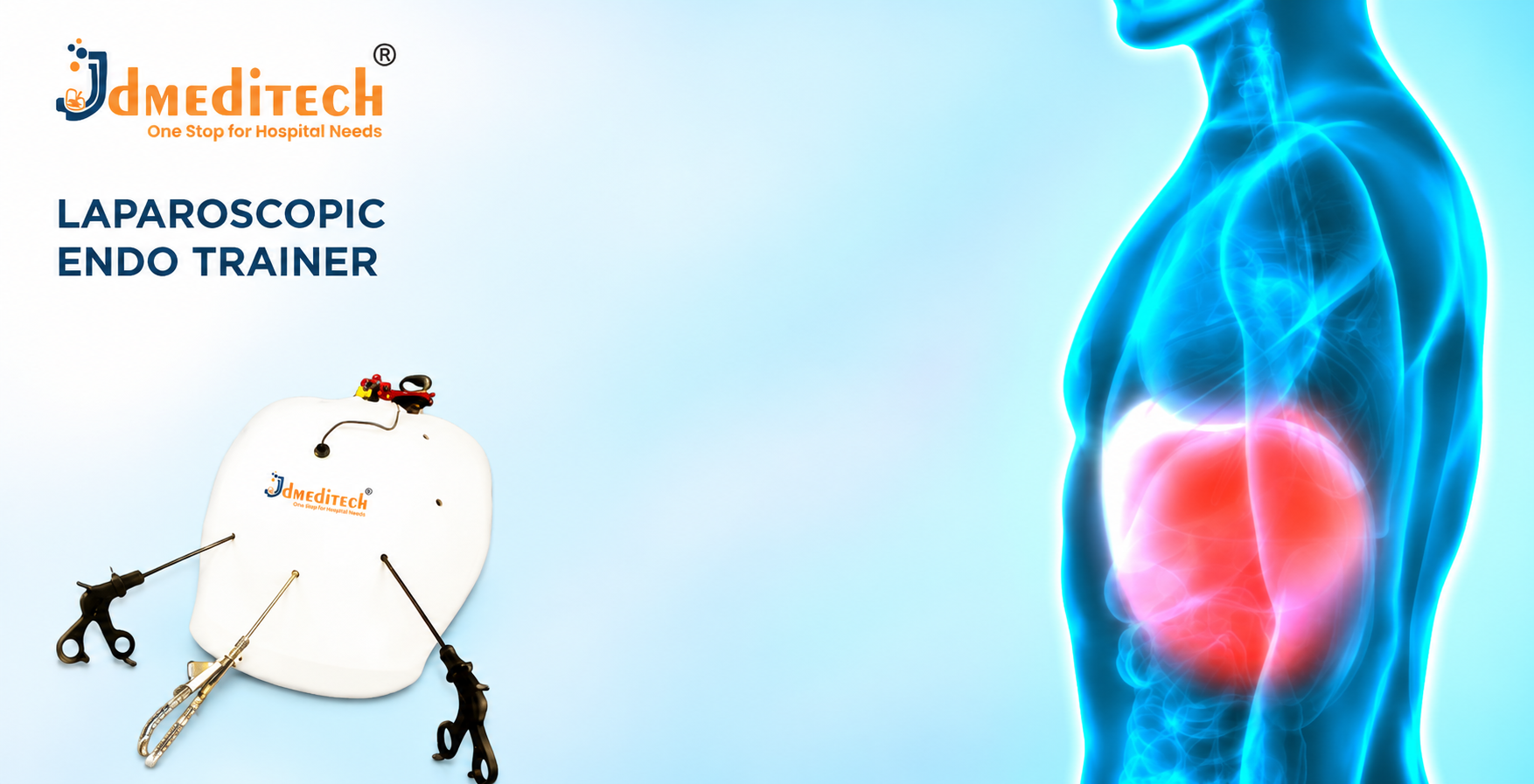
The illustrated product shows a training enclosure with access points and laparoscopic instruments. However, the exact supplied configuration requires confirmation.
Depending on the model, a laparoscopic endo trainer may include:
- Training Box or Enclosure
- Instrument Entry Ports
- Internal Working Platform
- Camera or Visualization System
- Lighting Arrangement
- Laparoscopic Training Instruments
- Practice Modules
- Connection Cables or Accessories
- Support or Mounting Components
However, some models require separate cameras, displays or instruments.
1. Training Box or Enclosure
The training enclosure provides a simulated working space.
Furthermore, it restricts direct access to the practice area, helping trainees become familiar with laparoscopic instrument handling.
Depending on the design, the enclosure may be rigid, portable or collapsible.
2. Instrument Entry Ports
Entry ports allow trainees to introduce compatible laparoscopic instruments into the training chamber.
Additionally, the position of these ports influences the working angles available during practice.
Therefore, trainees can use them to develop instrument coordination.
3. Internal Working Platform
The internal platform provides space for training exercises and compatible practice materials.
For example, users may place objects, suture pads or other training modules inside the enclosure.
However, the available working area depends on the model.
4. Camera or Visualization System
Some laparoscopic endo trainers use a camera to display the internal training area.
Consequently, trainees can practice coordinating their instrument movements with a video image.
However, camera resolution, connection type and monitor inclusion vary by configuration.
5. Lighting Arrangement
A lighting system may illuminate the training chamber.
Furthermore, suitable illumination can improve visibility during simulation exercises.
However, not every model includes an integrated light source.
6. Laparoscopic Training Instruments
Compatible laparoscopic instruments allow trainees to practice selected manual skills.
Depending on the training package, instruments may include graspers, dissectors, scissors or needle holders.
However, buyers should confirm which instruments are included in the supplied kit.
7. Practice Modules
Practice modules provide structured exercises for different laparoscopic skills.
For example, modules may support object transfer, precision movement, suturing or knot tying.
Additionally, instructors can select exercises according to the learner’s training level.
Key Features of a Laparoscopic Endo Trainer
Depending on the selected configuration, the device may offer the following features:
- Simulated Laparoscopic Working Environment
- Instrument Access Ports
- Practice Area for Surgical Skill Development
- Compatibility With Selected Laparoscopic Instruments
- Support for Hand-Eye Coordination Exercises
- Support for Instrument Manipulation Practice
- Compatibility With Selected Suturing Exercises
- Optional Camera and Visualization System
- Optional Training Modules
- Portable Configurations on Selected Models
- Repeatable Training Exercises
- Suitable Applications for Structured Surgical Education
However, actual features depend on the manufacturer’s specifications.
How Does a Laparoscopic Endo Trainer Work?
A laparoscopic endo trainer creates a controlled practice environment for minimally invasive surgical skills.
First, the instructor or trainee prepares the training enclosure and appropriate exercise materials.
Next, the trainee introduces compatible laparoscopic instruments through the designated access ports.
When a camera system is available, the trainee observes the working area through a connected display.
Then, the trainee performs structured exercises while coordinating hand movements with the visual feedback.
Finally, the instructor may review performance and identify areas for improvement.
However, setup procedures depend on the specific training system.
Understanding Hand-Eye Coordination in Laparoscopy
Hand-eye coordination is an important component of laparoscopic training.
During simulation exercises, trainees use visual feedback to guide instrument movements.
Furthermore, repeated practice helps learners become familiar with the relationship between hand movements and instrument-tip movement.
Therefore, box trainers commonly include coordination-based exercises.
Understanding the Laparoscopic Fulcrum Effect
The fulcrum effect occurs when a laparoscopic instrument pivots around an entry point.
As a result, movements at the handle can produce movements in a different direction at the instrument tip.
Therefore, trainees must learn to control their instruments within this movement pattern.
Additionally, simulation exercises provide opportunities to practice these movements repeatedly.
Importance of Depth Perception
Many conventional laparoscopic camera systems display a two-dimensional image.
Consequently, trainees must use visual cues and instrument movements to judge depth.
Furthermore, structured exercises can help learners improve their spatial awareness.
However, training outcomes depend on practice quality and instructional feedback.
Common Training Exercises Using a Laparoscopic Endo Trainer
A laparoscopic endo trainer may support several fundamental skills exercises.
- Peg Transfer
- Object Grasping and Relocation
- Instrument Coordination
- Precision Cutting
- Pattern Cutting
- Needle Handling
- Intracorporeal Suturing Practice
- Extracorporeal Knot-Tying Practice
- Instrument Navigation
- Bimanual Coordination
However, the available exercises depend on the trainer configuration and practice accessories.
1. Peg Transfer Training
Peg transfer exercises help trainees practice grasping and transferring objects between instruments.
Furthermore, these exercises encourage coordinated movement of both hands.
Therefore, instructors commonly use similar tasks during basic laparoscopic skills training.
2. Object Grasping and Relocation
Object relocation exercises help trainees practice controlled instrument movements.
Additionally, learners can improve their ability to manipulate small objects within a restricted working area.
3. Precision Cutting Practice
Precision cutting exercises help trainees develop control over laparoscopic scissors.
For example, instructors may use suitable training materials with predefined cutting patterns.
However, trainees should use only appropriate practice materials and compatible instruments.
4. Laparoscopic Suturing Practice
Suturing exercises allow trainees to practice needle handling and instrument coordination.
Furthermore, compatible training pads may simulate selected tissue-handling tasks.
However, simulation does not reproduce every characteristic of living tissue.
5. Knot-Tying Practice
Knot-tying exercises help learners become familiar with laparoscopic suture manipulation.
Additionally, structured practice may support the development of consistent instrument movements.
However, clinical knot security requires appropriate training and assessment.
6. Bimanual Coordination Training
Bimanual coordination involves using both hands to control separate instruments.
Furthermore, laparoscopic procedures frequently require coordinated instrument movement.
Therefore, training exercises may focus on simultaneous use of two instruments.
Applications of a Laparoscopic Endo Trainer
A laparoscopic endo trainer supports educational and simulation-based applications.
Common settings include:
- Medical Colleges
- Teaching Hospitals
- Surgical Residency Programs
- Laparoscopy Training Centers
- Simulation Laboratories
- Gynecology Training Programs
- Urology Training Programs
- General Surgery Training Programs
- Continuing Surgical Education
- Skills Assessment Workshops
Application in Medical Colleges
Medical colleges may use laparoscopic endo trainers to introduce students to minimally invasive surgical instruments.
Furthermore, instructors can demonstrate fundamental instrument movements.
Additionally, students can practice basic tasks under supervision.
Application in Surgical Residency Programs
Surgical residents often need repeated practice to develop laparoscopic skills.
Therefore, training centers may incorporate box trainer exercises into structured curricula.
Furthermore, instructors can use performance assessments to monitor progress.
Application in Gynecology Training
Gynecology training programs may include laparoscopic simulation exercises.
For example, trainees may practice instrument handling, object manipulation and suturing.
However, advanced clinical procedures require additional supervised training.
Application in Urology Training
Urology trainees may use laparoscopic box trainers to practice fundamental instrument control.
Additionally, compatible training modules may support suturing and coordination exercises.
Therefore, the trainer can form part of a broader surgical education program.
Application in General Surgery Training
General surgery training programs may use laparoscopic simulators to introduce basic minimally invasive techniques.
Furthermore, structured exercises allow trainees to practice repeatedly.
However, simulation training should complement supervised clinical education.
Technical Specifications of a Laparoscopic Endo Trainer
Exact specifications vary by model. Therefore, customers should request the official product datasheet before purchasing.
| Parameter | Product Information |
|---|---|
| Product Name | Laparoscopic Endo Trainer |
| Alternative Name | Laparoscopic Box Trainer |
| Product Category | Surgical Simulation and Training Equipment |
| Primary Application | Laparoscopic Skills Training |
| Training Type | Physical Box-Based Simulation |
| Enclosure Design | Model-Specific |
| Enclosure Material | Confirm Manufacturer Specifications |
| Overall Dimensions | Confirm Official Datasheet |
| Working Area | Confirm Official Datasheet |
| Instrument Entry Ports | Confirm Number and Size |
| Camera System | Confirm Whether Included |
| Camera Resolution | Confirm if Applicable |
| Lighting System | Confirm Whether Included |
| Monitor | Confirm Whether Included |
| Display Connection | Confirm if Applicable |
| Power Requirements | Confirm if Applicable |
| Included Instruments | Confirm Package Contents |
| Training Modules | Confirm Available Accessories |
| Portability | Model-Specific |
| Cleaning Requirements | Follow Manufacturer Instructions |
| Packaging | Confirm Supplied Configuration |
| Regulatory Status | Confirm Applicable Product Classification |
Importance of Training Box Design
The enclosure design influences the available working area and instrument entry angles.
Furthermore, a suitable layout helps trainees practice selected laparoscopic movements.
Therefore, training institutions should select a model that supports their curriculum.
Importance of Instrument Compatibility
Training exercises require compatible laparoscopic instruments.
Additionally, instrument length and diameter may affect usability within the enclosure.
Therefore, buyers should confirm instrument compatibility before ordering.
Importance of Camera and Visualization Quality
A suitable visualization system allows trainees to observe instrument movements inside the training chamber.
Furthermore, adequate lighting and image clarity can support training activities.
However, camera performance depends on the supplied equipment.
Importance of Repeated Practice
Repeated practice plays an important role in technical skill development.
For example, learners can repeat object transfer, cutting and suturing exercises.
Additionally, instructors can provide feedback after each session.
Therefore, structured repetition may support progressive skill development.
Potential Benefits of a Laparoscopic Endo Trainer
When used within a structured training program, a laparoscopic endo trainer may provide several educational benefits.
- Supports Fundamental Laparoscopic Skills Training
- Provides a Controlled Practice Environment
- Encourages Hand-Eye Coordination
- Supports Bimanual Instrument Control
- Allows Repeated Training Exercises
- Supports Basic Suturing Practice
- Provides Opportunities for Instructor Feedback
- Supports Simulation-Based Surgical Education
- May Reduce Reliance on Operating Room Time for Basic Skills Practice
- Allows Training With Compatible Practice Modules
However, training outcomes depend on curriculum quality, supervision and learner participation.
Difference Between a Laparoscopic Endo Trainer and a Virtual Reality Simulator
| Feature | Laparoscopic Endo Trainer | Virtual Reality Simulator |
|---|---|---|
| Training Environment | Physical Training Box | Computer-Generated Simulation |
| Instrument Handling | Physical Instruments | Simulator Controllers or Specialized Interfaces |
| Practice Materials | Physical Objects and Training Modules | Digital Exercises |
| Visual Feedback | Direct or Camera-Based | Computer-Generated Display |
| Performance Tracking | Instructor-Based or Optional Systems | Often Includes Digital Metrics |
| Equipment Requirements | Box and Compatible Accessories | Dedicated Simulator Hardware and Software |
Difference Between an Endo Trainer and a Clinical Laparoscopic System
A laparoscopic endo trainer supports simulation-based education.
In contrast, a clinical laparoscopic system supports approved diagnostic or surgical procedures.
Furthermore, training equipment may not meet the requirements for direct patient use.
Therefore, users must not treat a training box as a clinical surgical system.
How to Choose the Right Laparoscopic Endo Trainer
Medical institutions and procurement teams should review several factors before purchasing.
- Training Curriculum Requirements
- Enclosure Dimensions
- Instrument Entry Port Configuration
- Available Working Space
- Camera Inclusion and Compatibility
- Lighting Arrangement
- Monitor and Display Requirements
- Compatible Laparoscopic Instruments
- Available Training Modules
- Ease of Cleaning
- Portability
- Package Contents
- Availability of Replacement Accessories
- Technical Support Requirements
Furthermore, instructors should confirm that the selected trainer supports the intended educational objectives.
Safety Precautions During Laparoscopic Training
Although a laparoscopic endo trainer operates in a simulated environment, users must follow appropriate safety precautions.
- Inspect the Training Box Before Use
- Check Instrument Entry Ports
- Use Compatible Training Instruments
- Handle Sharp Instruments Carefully
- Secure the Trainer on a Stable Surface
- Protect Electrical Connections When Applicable
- Follow Camera and Lighting Instructions
- Use Appropriate Training Materials
- Supervise Beginners During Practice
- Follow Manufacturer Instructions
Additionally, users should not operate damaged training equipment.
Cleaning and Maintenance
Regular cleaning helps maintain the training environment.
Furthermore, trainees should remove practice materials after each session.
Additionally, instructors should inspect instrument ports, camera connections and other components.
However, cleaning requirements depend on the materials and equipment configuration.
Therefore, users should follow the manufacturer’s maintenance instructions.
Storage and Handling Guidelines
Proper storage helps protect training equipment from damage.
For example, institutions should store the trainer in a clean and dry location.
Additionally, users should protect cameras, cables and accessories from mechanical damage.
Therefore, training centers should follow the manufacturer’s storage recommendations.
Applications in Medical Colleges
Medical colleges may incorporate laparoscopic endo trainers into practical teaching sessions.
Furthermore, students can become familiar with instrument handling before participating in advanced surgical training.
Additionally, instructors can demonstrate common laparoscopic movement patterns.
Applications in Teaching Hospitals
Teaching hospitals may use box trainers for structured surgical skills programs.
Furthermore, trainees can repeat exercises and receive feedback from instructors.
Therefore, the device can complement supervised clinical training.
Applications in Surgical Training Centers
Dedicated training centers may use laparoscopic endo trainers during workshops and practical courses.
Additionally, compatible modules allow instructors to organize different training activities.
However, the available exercises depend on the equipment package.
Applications for Medical Distributors
Medical distributors should confirm trainer dimensions, camera options and included accessories before preparing quotations.
For example, customers may require a complete training package or only the basic enclosure.
Additionally, institutions may request compatible instruments and practice modules.
Therefore, distributors should request the official product configuration.
Why Choose JDMeditech?
JDMeditech supplies laparoscopic instruments, surgical accessories and medical equipment for hospitals, medical institutions and distributors.
Furthermore, our team can assist customers with product inquiries, available configurations and technical information.
Customers can contact JDMeditech regarding:
- Laparoscopic Endo Trainer Inquiries
- Available Training Equipment Configurations
- Laparoscopic Training Instruments
- Medical College Procurement Requirements
- Surgical Training Center Inquiries
- Medical Distributor Requests
- International Export Inquiries
However, exact availability and package contents require confirmation.
Frequently Asked Questions About Laparoscopic Endo Trainers
1. What Is a Laparoscopic Endo Trainer?
It is a simulation device designed to help trainees practice fundamental laparoscopic skills.
2. What Is Another Name for a Laparoscopic Endo Trainer?
It is also commonly called a laparoscopic box trainer or laparoscopy training box.
3. Who Can Use a Laparoscopic Endo Trainer?
Medical students, surgical residents and healthcare professionals may use it as part of supervised training programs.
4. What Skills Can Trainees Practice?
Depending on the available modules, trainees can practice instrument coordination, object transfer, precision cutting, suturing and knot tying.
5. Does the Trainer Include a Camera?
Some models include a camera, while others require a separate visualization system. Buyers should confirm the package contents.
6. Does It Include Laparoscopic Instruments?
Instrument inclusion varies by product configuration. Therefore, customers should request a detailed packing list.
7. Can It Support Suturing Practice?
Yes, when compatible suturing instruments and practice materials are available.
8. Is the Trainer Portable?
Some configurations are portable. However, dimensions and weight depend on the model.
9. Can Beginners Use It?
Yes. Instructors commonly use basic box-training exercises to introduce laparoscopic instrument handling.
10. Is It Suitable for Medical Colleges?
Yes. Medical colleges may use compatible trainers for simulation-based surgical education.
11. Does It Replace Clinical Surgical Training?
No. Simulation training complements but does not replace supervised clinical education and competency assessment.
12. Can It Be Used for Gynecology Training?
Yes. Compatible training exercises may support fundamental skills used in gynecological laparoscopy.
13. Can It Be Used for Urology Training?
Yes. Urology trainees may use suitable box trainers to practice basic laparoscopic instrument skills.
14. What Should Buyers Confirm Before Ordering?
Buyers should confirm enclosure dimensions, entry ports, camera availability, lighting, included instruments, practice modules and power requirements.
15. Where Can Customers Request Product Information?
Hospitals, medical colleges, training centers and distributors can contact JDMeditech for product information and quotations.
Conclusion
In conclusion, the Laparoscopic Endo Trainer is a valuable educational tool for developing fundamental laparoscopic skills in a simulated environment.
Furthermore, structured exercises allow trainees to practice hand-eye coordination, instrument handling, precision cutting and suturing techniques.
Additionally, repeated practice and instructor feedback can support progressive skill development.
However, simulation training must complement supervised clinical education rather than replace it.
Therefore, medical institutions should select a trainer that matches their curriculum and equipment requirements.
JDMeditech – One Stop for Hospital Needs
Website:
www.jdmeditech.com
Related Laparoscopy Training Equipment
- Laparoscopic Grasping Forceps
- Laparoscopic Needle Holder
- Laparoscopic Scissors
- Laparoscopic Knot Pusher
- Laparoscope
- Laparoscopic Camera System
- Laparoscopic Training Accessories
Educational Disclaimer
This article provides general educational and product information only. A laparoscopic endo trainer is intended for simulation-based training according to its manufacturer labeling. It does not replace supervised clinical training, surgical competency assessment or professional judgment. Customers should verify the actual product configuration, included accessories and technical specifications before purchasing.




