



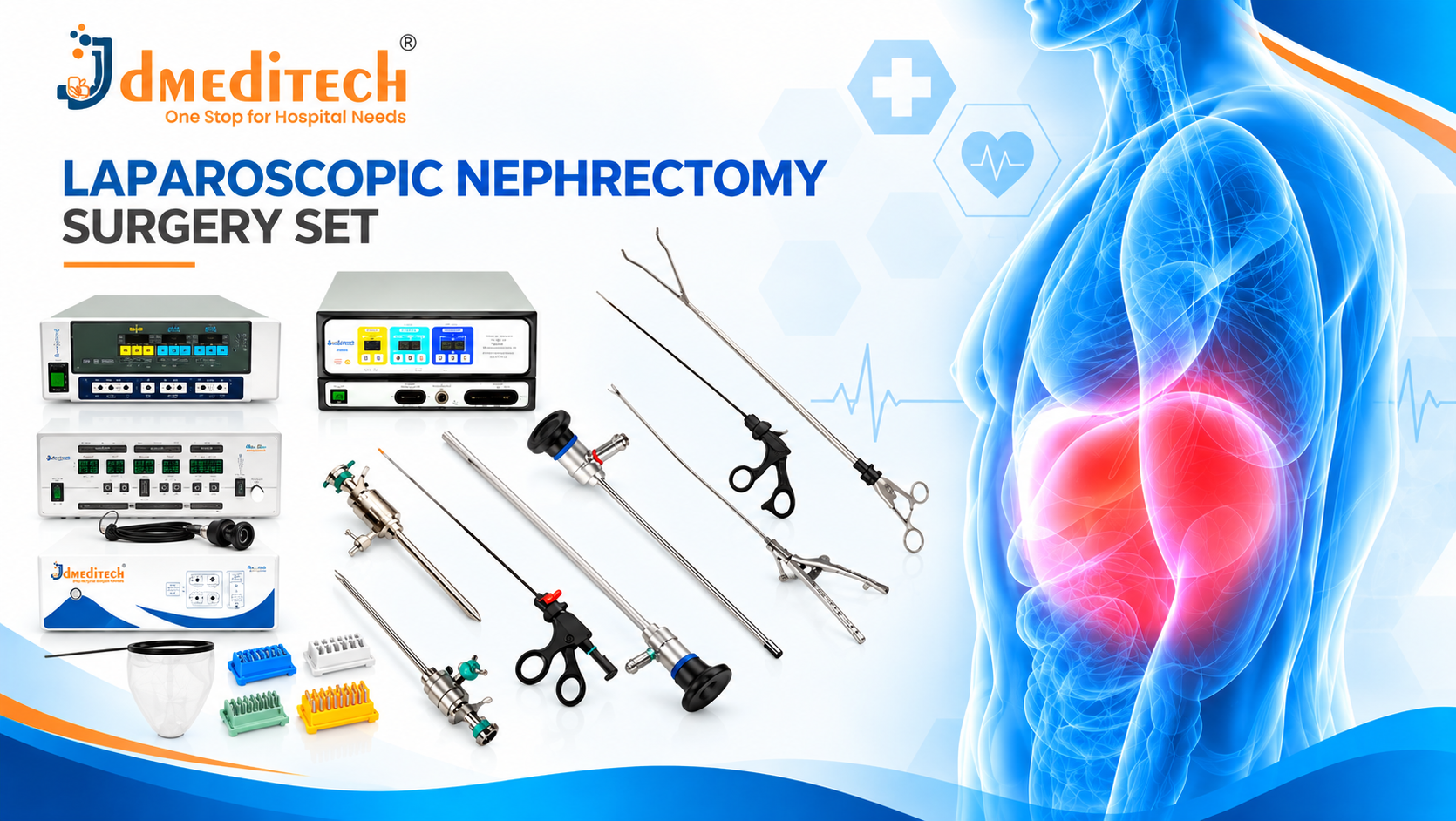
What Is a Laparoscopic Nephrectomy Surgery Set?
A Laparoscopic Nephrectomy Surgery Set brings together instruments that support laparoscopic kidney surgery. The exact configuration depends on the surgical technique, hospital requirements, and surgeon preferences.
A typical instrument selection may include laparoscopic graspers, scissors, dissectors, needle holders, trocars, and other accessories. In addition, the operating room may require a camera system, light source, insufflator, and electrosurgical equipment.
These instruments help surgeons perform different surgical tasks through small incisions. However, each procedure requires suitable instruments and compatible equipment.
What Is Laparoscopic Nephrectomy?
Laparoscopic nephrectomy is a minimally invasive surgical procedure that removes part or all of a kidney. Surgeons perform the operation using a laparoscope and specialized surgical instruments.
First, the surgeon creates access to the abdominal or retroperitoneal space. Next, the surgical team introduces compatible instruments and establishes visualization of the operative area.
The surgeon then performs the planned kidney procedure while protecting surrounding structures. Finally, the team removes the specimen and completes the operation according to the surgical plan.
However, the exact technique depends on the patient’s condition, surgical indication, and selected approach.
Essential Instruments in a Laparoscopic Nephrectomy Surgery Set
A Laparoscopic Nephrectomy Surgery Set may include several instruments for access, visualization, tissue handling, dissection, and suturing.
Hospitals should select each instrument according to the procedure and equipment requirements.
1. Laparoscope
A laparoscope allows surgeons to view the operative area through a camera system. It supports visualization during minimally invasive kidney surgery.
Different laparoscope diameters and viewing angles may suit different procedures. Therefore, surgeons should confirm compatibility with the camera, light source, and access system.
2. Trocar and Cannula
A trocar and cannula provide an access pathway for compatible laparoscopic instruments.
Surgeons select the trocar configuration according to the required instrument diameter, access technique, and surgical approach.
3. Veress Needle
A Veress needle supports abdominal insufflation during selected laparoscopic access techniques.
However, surgeons may use other access techniques depending on patient factors and procedural requirements.
4. Laparoscopic Grasper
A laparoscopic grasper helps surgeons hold, lift, and manipulate tissue during the procedure.
Different jaw designs support different tissue-handling requirements. Consequently, surgical teams should select suitable instruments for the intended task.
5. Maryland Dissector
A Maryland dissector supports precise tissue handling and dissection. Its curved jaw design helps surgeons work around selected anatomical structures.
Moreover, compatible models may offer different lengths, diameters, and handle configurations.
6. Laparoscopic Scissors
Laparoscopic scissors help surgeons cut tissue and other appropriate materials during surgery.
Manufacturers offer different blade designs and instrument configurations. Therefore, the surgical team should choose the appropriate scissors for the planned procedure.
7. Laparoscopic Needle Holder
A laparoscopic needle holder helps surgeons control surgical needles during intracorporeal suturing.
Its handle and jaw mechanism support needle handling in the limited working space of laparoscopic surgery.
8. Clip Applicator
A clip applicator allows surgeons to apply compatible surgical clips during selected procedural steps.
However, the surgeon must choose the correct clip system for the intended tissue or vessel. Device compatibility and manufacturer instructions remain essential.
9. Suction and Irrigation Instrument
A suction and irrigation instrument helps remove fluids and deliver irrigation when the procedure requires it.
As a result, the surgical team can support visibility and fluid management during the operation.
10. Electrosurgical Instruments
Compatible electrosurgical instruments support tissue cutting or coagulation according to their intended use.
Surgeons should select suitable energy devices and follow the manufacturer’s operating instructions.
Laparoscopic Nephrectomy Instruments and Their Functions
The following table summarizes common instruments and equipment that may support laparoscopic kidney surgery.
| Instrument or Equipment | Main Function |
|---|---|
| Laparoscope | Provides visualization of the surgical area |
| Trocar and Cannula | Provide access for compatible instruments |
| Veress Needle | Supports insufflation during selected access techniques |
| Laparoscopic Grasper | Holds and manipulates tissue |
| Maryland Dissector | Supports tissue dissection |
| Laparoscopic Scissors | Cut tissue during appropriate surgical steps |
| Laparoscopic Needle Holder | Supports surgical needle handling and suturing |
| Clip Applicator | Applies compatible surgical clips |
| Suction and Irrigation Instrument | Supports fluid management and visibility |
| Electrosurgical Instruments | Support cutting or coagulation according to intended use |
| Insufflator | Controls gas delivery and pressure for suitable laparoscopic procedures |
| Camera and Light Source | Support endoscopic imaging and illumination |
| Specimen Retrieval Bag | Supports containment and removal of the surgical specimen |
Note: This table describes common instruments and equipment. It does not represent a confirmed JDMeditech set packing list. Actual configurations may vary.
Types of Laparoscopic Nephrectomy
Surgeons may perform different types of nephrectomy according to the patient’s condition and treatment plan.
Partial Nephrectomy
During a partial nephrectomy, the surgeon removes part of the kidney while preserving the remaining kidney tissue when appropriate.
This approach may suit selected kidney tumors or other conditions. However, the clinical team must evaluate the patient’s anatomy and treatment requirements.
Radical Nephrectomy
During a radical nephrectomy, the surgeon removes the affected kidney and may also remove surrounding tissues according to the clinical indication.
The surgical approach and extent of tissue removal depend on the patient’s condition and treatment plan.
Simple Nephrectomy
A simple nephrectomy involves removing a kidney without the broader tissue removal that may accompany radical nephrectomy.
Surgeons may consider this approach for selected non-cancerous conditions when kidney removal becomes necessary.
Laparoscopic Equipment Used During Kidney Surgery
In addition to handheld instruments, laparoscopic nephrectomy requires suitable supporting equipment.
For example, the operating room may use a camera system, light source, insufflator, display monitor, and compatible energy devices.
These systems support visualization, access, and surgical instrument operation. Furthermore, equipment compatibility helps the surgical team prepare the operating room efficiently.
Key Features of Laparoscopic Nephrectomy Instruments
Hospitals and surgical teams should evaluate the design and specifications of each instrument before use.
Important features may include:
- Suitable instrument length and diameter
- Compatible trocar and cannula dimensions
- Appropriate jaw and tip configurations
- Ergonomic handle design
- Compatible optical and imaging systems
- Suitable instrument connection systems
- Appropriate cleaning and reprocessing requirements
- Clear technical specifications and instructions
Moreover, the clinical team should confirm each instrument’s intended use and compatibility with the planned procedure.
Benefits and Limitations of Laparoscopic Kidney Surgery
Laparoscopic nephrectomy offers a minimally invasive approach for suitable patients.
Compared with traditional open surgery, laparoscopic techniques may offer smaller incisions, reduced postoperative discomfort, and shorter hospital stays in selected cases.
However, these benefits depend on patient factors, procedure complexity, and surgical expertise.
Laparoscopic procedures also have limitations. For example, some patients may require open surgery because of anatomical, medical, or procedural factors.
Therefore, the surgical team should evaluate the appropriate treatment approach for each patient.
How to Choose a Laparoscopic Nephrectomy Surgery Set
Hospitals and medical-device buyers should review the intended procedure before selecting a Laparoscopic Nephrectomy Surgery Set.
First, confirm whether the surgical team requires instruments for partial, simple, or radical nephrectomy.
Next, check the required instrument sizes, lengths, tip designs, and compatible equipment.
Additionally, consider the following factors:
- Planned surgical approach
- Instrument type and configuration
- Required instrument quantity
- Trocar and cannula compatibility
- Camera and light-source compatibility
- Electrosurgical system compatibility
- Cleaning and sterilization requirements
- Applicable product documentation
- Packaging and supply requirements
Finally, confirm the exact instrument list with the supplier before placing an order.
JDMeditech Laparoscopic Nephrectomy Surgery Instruments
JDMeditech offers laparoscopic surgical instruments and accessories for hospitals, surgical centers, healthcare facilities, and international medical-device distributors.
Our product range includes instruments that may support different laparoscopic procedures, including selected kidney surgeries.
Customers can contact JDMeditech with their required instrument names, sizes, lengths, quantities, and technical specifications.
Our team can then discuss suitable available products, equipment configurations, and quotation requirements.
Explore our JDMeditech Laparoscopy Division for additional product information.
Why Choose JDMeditech for Laparoscopic Instruments?
JDMeditech provides medical devices and surgical instruments across different healthcare specialties, including urology and laparoscopy.
We support hospitals, medical-device distributors, and healthcare procurement teams with product information and export enquiries.
Moreover, customers can share their required instrument configurations with our team. As a result, we can discuss suitable available options and quotation details.
Frequently Asked Questions
What is a Laparoscopic Nephrectomy Surgery Set?
A Laparoscopic Nephrectomy Surgery Set includes instruments that support minimally invasive kidney surgery. The exact instrument list depends on the planned procedure and hospital requirements.
Which instruments are commonly used during laparoscopic nephrectomy?
Common instruments include a laparoscope, trocars, graspers, dissectors, scissors, needle holders, clip applicators, and suction-irrigation instruments.
What is the purpose of a laparoscope during nephrectomy?
A laparoscope allows the surgical team to view the operative area through a compatible imaging system.
What is the difference between partial and radical nephrectomy?
Partial nephrectomy removes part of the kidney. In contrast, radical nephrectomy removes the affected kidney and may include surrounding tissues according to the clinical indication.
Does laparoscopic nephrectomy require an insufflator?
Many laparoscopic approaches use an insufflator to maintain the required working space. However, equipment requirements depend on the surgical technique.
Can hospitals customize a laparoscopic instrument set?
Hospitals can discuss their required instrument list with the supplier. The available configuration depends on product specifications and supply options.
Does JDMeditech provide laparoscopic surgical instruments?
Yes. JDMeditech offers a range of laparoscopic instruments and accessories. Customers can contact our team to discuss available products, specifications, and quotation requirements.
Conclusion
Overall, the Laparoscopic Nephrectomy Surgery Set plays an important role in preparing for minimally invasive kidney surgery.
The appropriate selection of laparoscopes, trocars, graspers, dissectors, scissors, needle holders, and compatible equipment supports surgical preparation and workflow.
However, the exact instrument configuration depends on the procedure, surgical technique, patient requirements, and hospital preferences.
Therefore, healthcare procurement teams should review technical specifications and confirm the required instrument list before ordering.
For product information, available configurations, and quotations, contact JDMeditech.
Disclaimer: JDMeditech provides this article for general educational and product-information purposes only. Healthcare professionals should follow applicable clinical guidelines, institutional protocols, regulatory requirements, and the manufacturer’s Instructions for Use. Product configurations and availability may vary.




