



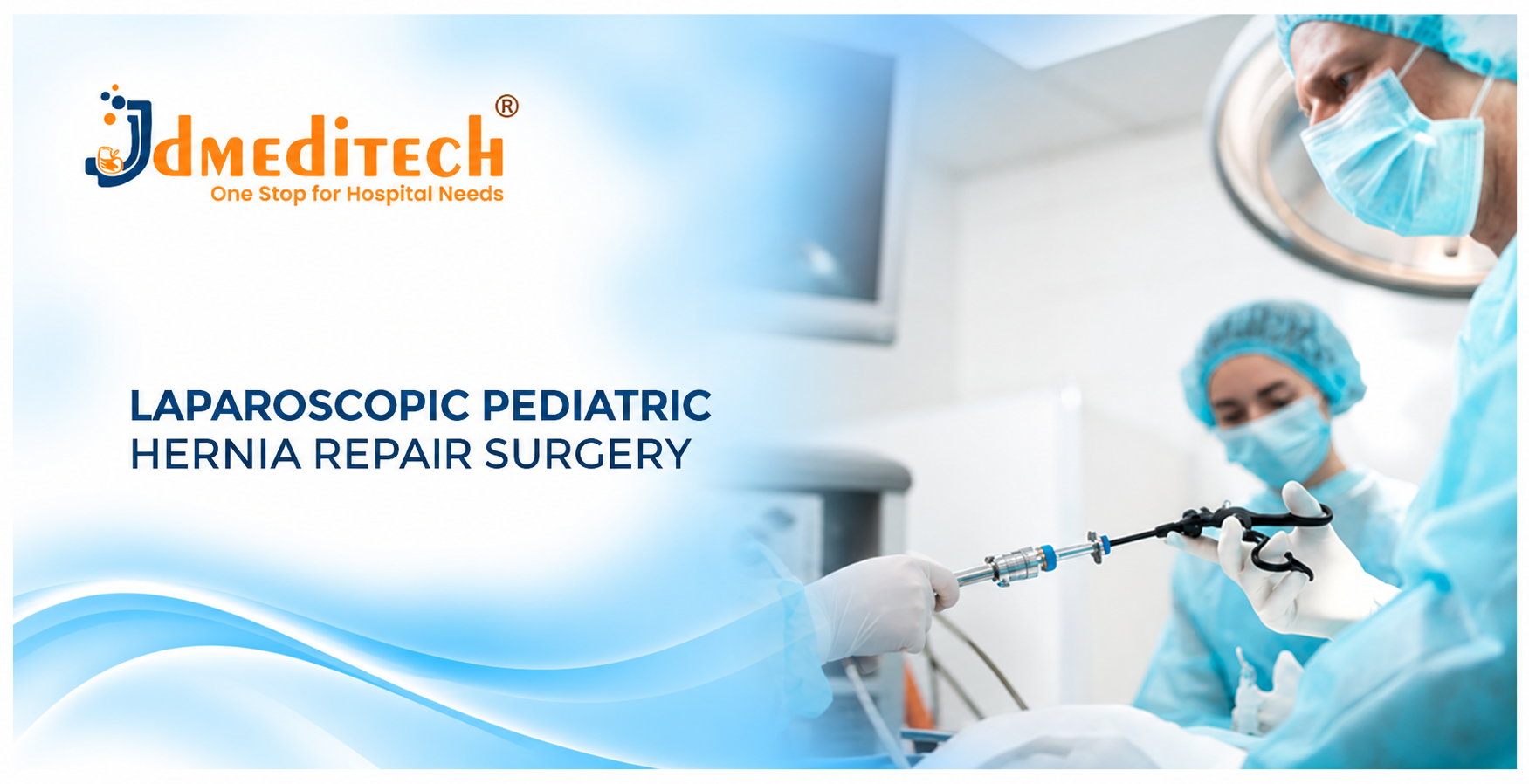
Laparoscopic Pediatric Hernia Repair Surgery: Procedure, Instruments, Benefits & Recovery
Laparoscopic Pediatric Hernia Repair Surgery is a minimally invasive procedure used to treat selected inguinal hernias in infants and children. It involves using a laparoscope and specialized pediatric surgical instruments to close an abnormal opening that allows abdominal contents to enter the groin.
Pediatric inguinal hernias usually develop when the processus vaginalis, a small passage formed during fetal development, remains open. Consequently, abdominal tissue or intestine may protrude into the inguinal canal.
Although pediatric hernias can occur at different ages, they are particularly important in infants because trapped hernia contents may lead to serious complications.
This JDMeditech guide explains laparoscopic pediatric hernia repair surgery, symptoms, diagnosis, surgical techniques, instruments, benefits, complications, recovery, and frequently asked questions.
What Is a Pediatric Inguinal Hernia?
A pediatric inguinal hernia occurs when abdominal contents protrude through an abnormal opening in the groin region.
In children, the condition is usually associated with a patent processus vaginalis.
This developmental passage normally closes around birth. However, when it remains open, abdominal contents may move into the inguinal canal.
In boys, a hernia may extend toward the scrotum. In girls, it may appear as a swelling in the groin or labial region.
Unlike many adult inguinal hernias, pediatric inguinal hernias generally result from a developmental opening rather than acquired weakness of the abdominal wall.
What Causes Pediatric Inguinal Hernia?
The main cause is incomplete closure of the processus vaginalis during development.
Several factors may be associated with an increased risk.
1. Premature Birth
Premature infants have an increased likelihood of developing inguinal hernias because normal developmental closure may be incomplete.
2. Patent Processus Vaginalis
A persistent processus vaginalis creates a pathway through which abdominal contents may protrude.
3. Family History
A family history of inguinal hernia may be associated with increased risk.
4. Developmental Conditions
Some congenital and connective tissue disorders may be associated with pediatric hernias.
5. Male Sex
Inguinal hernias occur more frequently in boys than in girls.
Common Symptoms of Pediatric Inguinal Hernia
- Visible swelling or bulge in the groin
- Scrotal swelling in boys
- Groin or labial swelling in girls
- Bulge that becomes more noticeable during crying or straining
- Intermittent swelling that reduces when the child relaxes
- Discomfort or irritability
- Occasional groin tenderness
Some hernias are painless and may only be noticed during bathing, changing clothes, or routine examination.
However, a painful or irreducible swelling may indicate incarceration.
Emergency Signs of Incarcerated or Strangulated Hernia
A hernia becomes incarcerated when its contents become trapped and cannot return to the abdominal cavity.
Strangulation occurs when the blood supply to trapped tissue is compromised.
Warning signs include:
- Persistent or severe groin pain
- A firm swelling that does not reduce
- Repeated vomiting
- Abdominal distension
- Marked irritability or inconsolable crying
- Redness or discoloration over the swelling
- Signs of significant illness
Medical Emergency: Suspected incarcerated or strangulated hernia requires immediate emergency medical assessment. Delayed treatment may cause bowel damage or other serious complications.
Types of Pediatric Hernia
1. Indirect Inguinal Hernia
Indirect inguinal hernia is the most common inguinal hernia in children and is associated with a patent processus vaginalis.
2. Direct Inguinal Hernia
Direct inguinal hernia is uncommon in young children and involves a different anatomical pathway through the abdominal wall.
3. Bilateral Inguinal Hernia
Bilateral inguinal hernia occurs when hernias are present on both sides of the groin.
4. Incarcerated Inguinal Hernia
An incarcerated hernia contains tissue that becomes trapped outside its normal position.
5. Strangulated Inguinal Hernia
A strangulated hernia occurs when the blood supply to trapped tissue is reduced or interrupted.
6. Umbilical Hernia
An umbilical hernia occurs around the navel. It differs from an inguinal hernia and often closes spontaneously in young children.
Therefore, the treatment recommendations for pediatric inguinal hernias should not automatically be applied to umbilical hernias.
How Is Pediatric Inguinal Hernia Diagnosed?
A pediatric surgeon or qualified healthcare professional usually diagnoses an inguinal hernia through medical history and physical examination.
The clinician examines the groin and scrotal or labial region for a swelling.
In some cases, the bulge becomes more noticeable when the child cries, coughs, or strains.
Ultrasound may be considered when the diagnosis is uncertain or another condition is suspected.
However, routine imaging is not necessary for every straightforward pediatric inguinal hernia.
What Is Laparoscopic Pediatric Hernia Repair Surgery?
Laparoscopic Pediatric Hernia Repair Surgery uses small abdominal incisions, a camera system, and suitable pediatric surgical instruments to repair an inguinal hernia.
The procedure generally involves closure of the internal inguinal ring or patent processus vaginalis using an appropriate suturing technique.
Unlike many adult inguinal hernia repairs, routine mesh implantation is usually unnecessary in children.
However, surgical planning depends on age, anatomy, hernia characteristics, and specialist expertise.
When Is Pediatric Hernia Surgery Recommended?
Once a pediatric inguinal hernia is diagnosed, surgical repair is generally recommended because the hernia does not usually close spontaneously.
The timing depends on the child’s age, clinical stability, symptoms, and risk of incarceration.
Infants and children with suspected strangulation require emergency treatment.
For premature infants, the optimal timing should balance the risk of incarceration against anesthesia-related and respiratory risks.
Therefore, the treating pediatric surgical team should determine the appropriate schedule.
Treatment Options for Pediatric Inguinal Hernia
1. Open Pediatric Herniotomy
Open herniotomy is a traditional surgical approach that uses a small groin incision to identify and close the hernia sac.
It remains a commonly used treatment for pediatric inguinal hernias.
2. Laparoscopic Pediatric Hernia Repair
Laparoscopic repair uses a camera and suitable instruments to close the abnormal opening through minimally invasive access.
This technique may also allow visualization of the opposite internal inguinal ring.
3. Emergency Hernia Repair
Emergency surgery may be required when the hernia becomes strangulated or cannot be safely managed through other appropriate emergency measures.
4. Bilateral Hernia Repair
When hernias are confirmed on both sides, the surgeon may repair both during the same operation.
5. Repair of an Incidentally Identified Patent Processus Vaginalis
During laparoscopy, the surgeon may identify an open processus vaginalis on the opposite side without a clinically apparent hernia.
However, whether to close this finding remains a matter of individualized decision-making.
Not every asymptomatic patent processus vaginalis will develop into a hernia.
Types of Laparoscopic Pediatric Inguinal Hernia Repair
1. Intracorporeal Suturing Technique
Intracorporeal repair involves placement and tying of sutures using laparoscopic instruments inside the abdominal cavity.
2. Extracorporeal Suturing Technique
Extracorporeal repair uses an appropriate percutaneous suturing approach to close the internal inguinal ring.
3. Percutaneous Internal Ring Suturing
Selected pediatric surgeons use percutaneous internal ring suturing techniques to close the hernia opening.
4. Single-Port Laparoscopic Repair
Some techniques use a single laparoscopic viewing port with compatible suturing accessories.
5. Multi-Port Laparoscopic Repair
Other techniques use multiple small ports for visualization and instrument access.
However, no single technique is appropriate for every child, and outcomes depend on surgeon experience and patient factors.
Open vs Laparoscopic Pediatric Hernia Repair
| Feature | Open Repair | Laparoscopic Repair |
|---|---|---|
| Access | Small groin incision | Small abdominal incisions |
| Visualization | Direct surgical exposure | Camera-assisted visualization |
| Closure | High ligation of hernia sac | Internal ring closure |
| Opposite Side Assessment | Not routinely visualized | Can be inspected |
| Mesh Requirement | Usually not required | Usually not required |
| Recovery | Generally rapid | Generally rapid |
| Recurrence | Low with appropriate repair | Comparable in experienced hands |
Common Instruments Used in Laparoscopic Pediatric Hernia Repair Surgery
Laparoscopic pediatric hernia repair requires equipment for visualization, abdominal access, suturing, and tissue handling.
Instrument requirements vary according to the selected surgical technique and the child’s size.
The following list describes general instrument categories rather than a verified JDMeditech pediatric hernia repair surgical set.
1. Pediatric Laparoscope Telescope
A suitable laparoscope provides magnified visualization of internal abdominal structures.
2. Laparoscopic Camera System
A compatible camera system transmits images from the laparoscope to a medical monitor.
3. Medical Light Source
A suitable light source provides illumination during laparoscopic surgery.
4. Fiber-Optic Light Cable
A compatible light cable transfers illumination to the laparoscope.
5. Pediatric Laparoscopic Trocar
A suitable trocar forms part of the abdominal access system.
6. Laparoscopic Cannula
A compatible cannula provides access for selected laparoscopic instruments.
7. CO2 Insufflator
A carbon dioxide insufflator helps maintain pneumoperitoneum during surgery.
Pediatric insufflation settings require careful selection and monitoring by the clinical team.
8. Veress Needle
A Veress needle may be used for selected abdominal entry techniques when clinically appropriate.
9. Pediatric Laparoscopic Grasper
A suitable grasper supports controlled tissue manipulation.
10. Atraumatic Grasping Forceps
Atraumatic graspers help handle delicate tissues when required.
11. Maryland Dissector
A Maryland dissector may support selected tissue separation tasks.
12. Laparoscopic Scissors
Suitable laparoscopic scissors support tissue cutting during selected techniques.
13. Laparoscopic Needle Holder
A laparoscopic needle holder supports intracorporeal suturing when required.
14. Percutaneous Suturing Needle
A compatible percutaneous suturing device may be used in selected extracorporeal closure techniques.
15. Surgical Sutures
Appropriate surgical sutures are used to close the hernia opening.
16. Bipolar Forceps
Bipolar forceps may support selected coagulation tasks when needed.
17. Suction and Irrigation Cannula
Suction and irrigation instruments may be used when fluid management is necessary.
18. Surgical Monitor
A medical-grade monitor displays laparoscopic images for the surgical team.
19. Endoscopy Trolley
A suitable trolley supports organized positioning of the visualization system.
20. Sterile Surgical Accessories
Compatible sterile drapes, tubing, dressings, and other procedure-specific accessories support the operation.
Pediatric Laparoscopic Hernia Repair Instruments and Functions
| Instrument | Primary Function |
|---|---|
| Pediatric Laparoscope | Provides surgical visualization |
| Camera System | Transmits surgical images |
| Light Source | Provides illumination |
| Trocar and Cannula | Provide abdominal access |
| CO2 Insufflator | Maintains pneumoperitoneum |
| Veress Needle | Supports selected abdominal entry techniques |
| Atraumatic Grasper | Supports delicate tissue handling |
| Maryland Dissector | Supports selected tissue dissection |
| Laparoscopic Scissors | Support tissue cutting |
| Needle Holder | Supports laparoscopic suturing |
| Percutaneous Suturing Needle | Supports selected ring closure techniques |
| Surgical Sutures | Support closure of the hernia opening |
| Bipolar Forceps | Support coagulation when required |
How Is Laparoscopic Pediatric Hernia Repair Surgery Performed?
A qualified pediatric surgeon performs the procedure in an appropriately equipped hospital.
First, the healthcare team reviews the child’s symptoms, examination findings, and medical history.
Next, the anesthesia team evaluates the child’s suitability for surgery.
During the operation, the surgeon establishes suitable laparoscopic access and examines the internal inguinal ring.
Depending on the selected technique, the surgeon closes the abnormal opening using appropriate suturing instruments.
The surgical team may also assess the opposite inguinal region when clinically indicated.
Finally, the surgeon completes the repair and arranges postoperative monitoring.
However, the exact technique varies and requires specialized pediatric surgical training.
Potential Benefits of Laparoscopic Pediatric Hernia Repair
1. Minimally Invasive Access
Laparoscopic surgery generally uses small abdominal incisions.
2. Direct Visualization
A camera system allows visualization of the internal inguinal ring and surrounding anatomy.
3. Assessment of the Opposite Side
Laparoscopy can identify a patent processus vaginalis on the opposite side.
4. Treatment of Bilateral Hernias
Confirmed bilateral hernias may be repaired during the same operation.
5. Small Surgical Scars
Minimally invasive access may produce small abdominal scars.
6. Rapid Recovery
Many children recover relatively quickly after uncomplicated hernia repair.
7. Effective Hernia Repair
Both open and laparoscopic approaches have favorable outcomes when performed by appropriately trained surgeons.
However, laparoscopy is not necessarily superior for every patient, and the chosen technique should reflect clinical needs.
Risks and Complications of Pediatric Hernia Repair
Laparoscopic pediatric hernia repair is an invasive procedure with potential complications.
- Bleeding
- Infection
- Postoperative swelling
- Hernia recurrence
- Injury to the vas deferens
- Injury to testicular blood vessels
- Injury to nearby abdominal organs
- Hydrocele formation
- Temporary urinary difficulties
- Anesthesia-related complications
- Need for additional surgery
Premature infants may have additional anesthesia-related respiratory risks.
Therefore, treatment planning and postoperative monitoring should be individualized.
Recovery After Laparoscopic Pediatric Hernia Repair Surgery
Recovery depends on the child’s age, medical condition, surgical technique, and any complications.
Many uncomplicated pediatric inguinal hernia repairs are performed as day-case procedures.
However, some infants, particularly those born prematurely, may require overnight or longer observation.
Temporary discomfort, mild swelling, or bruising may occur around the surgical area.
Many children gradually resume normal daily activities within a few days.
However, the surgical team may recommend restrictions on sports, strenuous activity, or pressure on the operative area.
Caregivers should follow the surgeon’s instructions regarding wound care, bathing, medication, and follow-up.
When Should Parents Seek Medical Attention After Surgery?
Parents or caregivers should contact the healthcare team for concerning postoperative symptoms.
- Persistent fever
- Increasing abdominal or groin pain
- Significant swelling or redness
- Persistent vomiting
- Difficulty passing urine
- Bleeding from the wound
- Unusual lethargy or breathing difficulties
Severe symptoms or breathing problems require urgent medical assessment.
Can a Pediatric Inguinal Hernia Return After Surgery?
Yes. Hernia recurrence is possible after both open and laparoscopic repair.
However, recurrence rates are generally low when the operation is performed appropriately.
Risk depends on factors such as age, prematurity, tissue characteristics, and surgical technique.
Therefore, a new groin swelling after surgery should be assessed by a qualified healthcare professional.
Is Mesh Used in Pediatric Inguinal Hernia Surgery?
Mesh is generally not required for routine inguinal hernia repair in infants and young children.
Instead, the surgeon usually closes or ligates the patent processus vaginalis.
However, selected older adolescents or patients with unusual hernia characteristics may require a different approach.
Therefore, mesh use should be determined by the treating surgeon based on the patient’s anatomy and clinical circumstances.
How to Choose Laparoscopic Pediatric Hernia Repair Instruments
Hospitals and pediatric surgical departments should identify their requirements before purchasing laparoscopic instruments.
First, determine whether the planned procedure uses intracorporeal or extracorporeal suturing.
Next, review the required telescope, trocar, camera, light source, and suturing instrument specifications.
Furthermore, verify pediatric suitability, instrument compatibility, and approved intended use.
Important Equipment Selection Factors
- Approved intended use
- Pediatric patient suitability
- Complete surgical instrument packing list
- Laparoscope diameter and viewing angle
- Camera system compatibility
- Medical light source compatibility
- Trocar and cannula dimensions
- CO2 insufflator compatibility
- Atraumatic grasper specifications
- Maryland dissector configuration
- Laparoscopic needle holder dimensions
- Percutaneous suturing device compatibility
- Surgical suture specifications
- Reusable or single-use classification
- Cleaning and sterilization instructions
- Manufacturer technical documentation
- Applicable regulatory documentation
Pediatric Laparoscopic Surgical Instruments by JDMeditech
JDMeditech welcomes inquiries from hospitals, pediatric surgical departments, urology centers, and international medical distributors regarding laparoscopic surgical instruments and related medical accessories.
Customers can inquire about available laparoscopic telescopes, trocars, grasping forceps, dissecting forceps, scissors, needle holders, and compatible surgical accessories.
Furthermore, the JDMeditech team can confirm available configurations, technical specifications, pediatric suitability, and applicable product documentation for individual inquiries.
For product information and quotations, visit www.jdmeditech.com.
Frequently Asked Questions About Laparoscopic Pediatric Hernia Repair Surgery
1. What is laparoscopic pediatric hernia repair surgery?
It is a minimally invasive procedure used to repair selected inguinal hernias in infants and children.
2. What causes inguinal hernia in children?
Most pediatric inguinal hernias result from a patent processus vaginalis that remains open after development.
3. What are the symptoms of pediatric inguinal hernia?
Common symptoms include intermittent groin swelling, scrotal swelling, or a bulge that becomes more visible during crying or straining.
4. Does a pediatric inguinal hernia heal without surgery?
Unlike many childhood umbilical hernias, inguinal hernias generally do not close spontaneously and usually require surgical repair.
5. Is laparoscopic hernia repair safe for children?
It is an established surgical option when performed by qualified pediatric surgeons, although complications remain possible.
6. What is pediatric herniotomy?
Pediatric herniotomy is a procedure that closes or ligates the hernia sac to prevent abdominal contents from entering the inguinal canal.
7. What is a patent processus vaginalis?
It is a developmental passage that remains open between the abdominal cavity and inguinal region.
8. Is mesh used in pediatric hernia repair?
Mesh is not routinely used for typical inguinal hernia repair in young children.
9. What is the difference between open and laparoscopic repair?
Open repair uses a groin incision, while laparoscopic repair uses small abdominal incisions and a camera system.
10. Can both sides be repaired during one operation?
Yes. Confirmed bilateral inguinal hernias can often be repaired during the same procedure.
11. Can laparoscopic surgery detect a hernia on the opposite side?
Laparoscopy can identify a patent processus vaginalis on the opposite side, although this does not always mean a future hernia will develop.
12. What instruments are used during pediatric laparoscopic hernia repair?
Common instruments include pediatric laparoscopes, trocars, graspers, needle holders, suturing devices, and compatible visualization equipment.
13. How long does pediatric hernia surgery take?
Duration varies according to the surgical approach, whether one or both sides require repair, and the child’s condition.
14. How long is the hospital stay?
Many uncomplicated repairs are performed as day-case procedures, while some infants require additional monitoring.
15. How long does recovery take?
Many children resume light daily activities within a few days, although full recovery and activity restrictions vary.
16. Can a pediatric hernia return after surgery?
Yes. Recurrence is possible but generally uncommon after appropriate surgical repair.
17. Is an incarcerated pediatric hernia dangerous?
Yes. Incarceration can progress to strangulation and requires urgent medical assessment.
18. Are pediatric hernias more common in premature infants?
Yes. Premature infants have an increased risk of inguinal hernias.
19. What is percutaneous internal ring suturing?
It is a minimally invasive technique used by selected surgeons to close the internal inguinal ring.
20. Where can hospitals inquire about JDMeditech laparoscopic instruments?
Hospitals and medical distributors can visit JDMeditech to request information about available laparoscopic surgical instruments and accessories.
Conclusion
Laparoscopic Pediatric Hernia Repair Surgery is an established minimally invasive treatment option for selected children with inguinal hernias.
Furthermore, laparoscopic techniques allow visualization of the internal inguinal region and repair of the abnormal opening using suitable suturing instruments.
However, successful treatment depends on timely diagnosis, appropriate surgical planning, pediatric surgical expertise, and compatible medical equipment.
Therefore, hospitals should select instruments according to pediatric clinical requirements, approved intended uses, and manufacturer instructions.
Contact JDMeditech for laparoscopic surgical instrument inquiries, compatible medical accessories, and international business requirements.
Medical Disclaimer: This article provides general educational information only. It does not replace professional medical advice, emergency assessment, patient-specific treatment planning, or surgical training. Qualified healthcare professionals must make treatment and equipment decisions according to current clinical guidelines, local regulations, and approved manufacturer instructions.




