



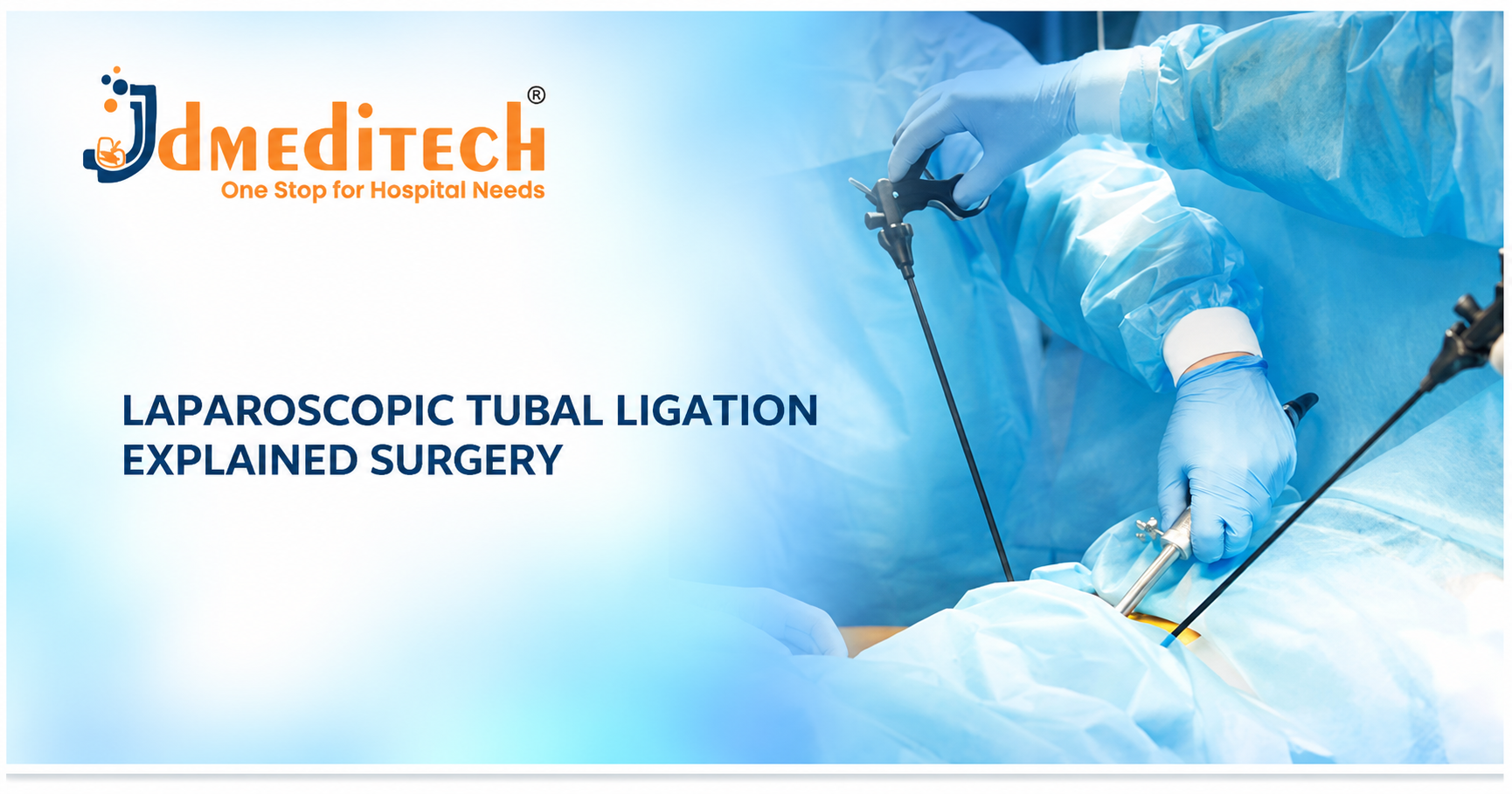
Introduction to Laparoscopic Tubal Ligation Surgery
Laparoscopic Tubal Ligation Surgery is a minimally invasive procedure that provides permanent female contraception. During this operation, surgeons block, seal, or divide the fallopian tubes. As a result, sperm and an egg cannot meet through the usual reproductive pathway.
Healthcare professionals also call this procedure tubal sterilization, female sterilization, or tubectomy. Furthermore, many patients know it as having their tubes tied.
During laparoscopic tubal ligation, surgeons use a laparoscope, camera system, and specialized instruments through small abdominal incisions. Consequently, suitable patients may experience smaller incisions and faster early recovery than with open surgery.
However, tubal ligation provides permanent contraception. Therefore, patients should carefully consider their future reproductive goals before choosing this procedure.
In this article, JDMeditech explains laparoscopic tubal ligation surgery, its methods, instruments, benefits, risks, recovery, and frequently asked questions.
What Is Laparoscopic Tubal Ligation Surgery?
Laparoscopic tubal ligation is a surgical method of permanent contraception. Surgeons perform this procedure through small abdominal incisions using specialized laparoscopic instruments.
First, the surgeon uses a laparoscope to examine the pelvic organs. Next, the surgical team identifies the fallopian tubes and selects an appropriate sterilization method.
Depending on the technique, the surgeon may use tubal clips, silicone rings, bipolar energy, or tubal division. As a result, the procedure interrupts the normal reproductive pathway.
Importantly, the surgeon generally preserves the uterus and ovaries. Therefore, ovarian hormone production and menstrual periods usually continue after surgery.
Understanding the Fallopian Tubes
The fallopian tubes connect the region near the ovaries with the uterus. Normally, these structures help transport an egg toward the uterus.
Furthermore, fertilization usually occurs inside a fallopian tube. Therefore, interrupting tubal function prevents sperm and egg from meeting through the usual pathway.
Important reproductive structures include:
- Fallopian tubes
- Uterus
- Ovaries
- Fimbriae
- Mesosalpinx
- Pelvic blood vessels
- Supporting pelvic tissues
Why Do Patients Choose Laparoscopic Tubal Ligation?
The primary purpose of laparoscopic tubal ligation is permanent contraception. Therefore, patients who do not want future pregnancies may consider this procedure.
Additionally, some patients prefer permanent contraception because they want to avoid ongoing contraceptive medication.
However, tubal ligation does not treat menstrual disorders or pelvic pain. Furthermore, it does not protect against sexually transmitted infections.
For these reasons, healthcare professionals should explain the benefits, limitations, and alternatives before surgery.
Who May Consider Tubal Ligation Surgery?
Appropriately counseled adults may consider permanent contraception when they independently decide against future pregnancies.
However, the decision requires careful consideration because sterilization is intended to be permanent.
Important considerations include:
- Personal reproductive goals
- Understanding of permanent contraception
- Availability of reversible contraceptive methods
- General health and anesthesia risks
- Previous abdominal or pelvic operations
- Individual medical conditions
- Personal preferences
- Applicable consent requirements
Above all, the patient must make this decision voluntarily. Therefore, healthcare professionals should provide unbiased information without pressure.
Types of Laparoscopic Tubal Ligation Methods
1. Tubal Clip Method
In this method, the surgeon applies specialized clips to selected portions of the fallopian tubes. Consequently, the clips interrupt the normal tubal pathway.
2. Tubal Ring Method
The surgeon uses a compatible applicator to place a silicone ring around a selected tubal segment. As a result, the ring blocks the tube.
3. Bipolar Tubal Coagulation
This technique uses approved bipolar energy to seal selected portions of the fallopian tubes. However, surgeons must carefully manage thermal energy to protect surrounding tissues.
4. Tubal Division
During tubal division, the surgeon interrupts the tube by dividing or removing a selected segment. Therefore, the procedure prevents the normal passage of reproductive cells.
5. Bilateral Salpingectomy
Bilateral salpingectomy removes both fallopian tubes completely. Although it also provides permanent contraception, it differs from conventional tubal occlusion.
Furthermore, complete removal of both tubes may reduce the future risk of certain ovarian cancers.
6. Postpartum Sterilization
Some patients choose permanent contraception after childbirth. In these cases, surgeons may use a mini-laparotomy or perform sterilization during a cesarean delivery.
Therefore, postpartum sterilization does not always involve a laparoscopic approach.
Comparison of Tubal Sterilization Methods
| Method | Technique | Important Consideration |
|---|---|---|
| Tubal Clips | Mechanical tubal occlusion | Requires compatible clips and applicators |
| Tubal Rings | Mechanical occlusion using silicone rings | Requires a compatible ring applicator |
| Bipolar Coagulation | Energy-based tubal sealing | Requires careful thermal management |
| Tubal Division | Interruption of a tubal segment | Provides permanent contraception |
| Bilateral Salpingectomy | Complete removal of both tubes | May reduce certain ovarian cancer risks |
How Effective Is Tubal Ligation Surgery?
Tubal ligation provides highly effective permanent contraception. However, no conventional tubal occlusion method guarantees complete protection against pregnancy.
According to CDC guidance, approximately 0.5 out of 100 tubal surgery users become pregnant during the first year of typical use.
Furthermore, long-term effectiveness varies according to the surgical method, patient age, and other factors.
Occasionally, pregnancy may occur years after sterilization. Therefore, patients should seek medical evaluation if they suspect pregnancy.
Importantly, pregnancy after tubal sterilization may be ectopic. Consequently, a positive pregnancy test requires prompt assessment.
Alternatives to Laparoscopic Tubal Ligation
Before choosing permanent contraception, patients should consider other available methods.
For example, long-acting reversible contraception can provide highly effective pregnancy prevention without permanently ending fertility.
Common alternatives include:
- Hormonal intrauterine devices
- Copper intrauterine devices
- Contraceptive implants
- Contraceptive injections
- Oral contraceptive pills
- Contraceptive patches
- Vaginal contraceptive rings
- Condoms
- Vasectomy for a male partner
Additionally, vasectomy generally involves a less invasive procedure than female surgical sterilization. Therefore, couples may wish to discuss both permanent contraception options.
Preparation Before Laparoscopic Tubal Ligation Surgery
Preparation begins with detailed counseling and medical evaluation. First, the healthcare team explains the permanent nature of sterilization.
Next, the surgeon reviews the patient’s medical history, previous operations, and reproductive goals.
Furthermore, the anesthesia team evaluates relevant health conditions and medications.
Preoperative preparation may include:
- Medical history review
- Pregnancy testing
- Relevant blood investigations
- Anesthesia assessment
- Medication review
- Discussion of sterilization methods
- Assessment of previous abdominal surgery
- Explanation of possible complications
- Voluntary informed consent
- Postoperative care planning
Finally, the surgical team confirms the planned procedure and answers the patient’s questions.
How Is Laparoscopic Tubal Ligation Surgery Performed?
Surgeons generally perform laparoscopic tubal ligation under general anesthesia.
First, the surgeon establishes laparoscopic access through small abdominal incisions.
Next, the surgical team introduces a laparoscope and camera system to visualize the pelvic organs.
Then, the surgeon identifies the fallopian tubes and confirms the surrounding anatomy.
Afterward, the surgeon applies the selected sterilization technique using compatible instruments.
For example, the surgical team may use tubal rings, clips, bipolar energy, or tubal division.
Once the surgeon completes the planned tubal interruption, the team checks the operative field for bleeding or other concerns.
Finally, the surgeon removes the instruments and closes the abdominal incisions.
However, the exact approach depends on the sterilization method, patient anatomy, and previous surgical history.
How Long Does Laparoscopic Tubal Ligation Take?
In uncomplicated cases, laparoscopic tubal ligation often takes approximately 20 to 30 minutes.
However, anesthesia preparation and postoperative observation increase the total time spent in the surgical facility.
Additionally, previous abdominal surgery or unexpected findings may extend the procedure.
Essential Instruments Used in Laparoscopic Tubal Ligation Surgery
Laparoscopic tubal ligation instruments help surgeons visualize pelvic structures, handle tissues, perform tubal occlusion, and manage bleeding.
Furthermore, each sterilization method requires compatible instruments and accessories.
The following list describes general instrument categories. However, it does not represent a verified JDMeditech tubal ligation surgical kit.
1. Laparoscope Telescope
The laparoscope provides magnified visualization of the pelvic organs. Therefore, it supports accurate anatomical identification.
2. Laparoscopic Camera System
The camera system transfers laparoscopic images to the surgical monitor. As a result, the surgical team can observe the operative field.
3. Medical Light Source
The light source illuminates the pelvic cavity. Consequently, it improves visualization during surgery.
4. Fiber-Optic Light Cable
The fiber-optic cable transfers illumination to the laparoscope. Therefore, it supports clear visualization.
5. Laparoscopic Trocar and Cannula
Trocars and cannulas provide access for compatible laparoscopic instruments. Additionally, they support instrument movement through the abdominal wall.
6. Veress Needle
Surgeons may use a Veress needle during selected laparoscopic access techniques. However, the preferred access method depends on clinical circumstances.
7. Laparoscopic Atraumatic Grasper
An atraumatic grasper supports gentle tissue manipulation. Therefore, it helps surgeons handle delicate pelvic structures.
8. Laparoscopic Babcock Forceps
Babcock forceps support atraumatic handling of selected soft tissues. Additionally, they may assist with controlled tissue positioning.
9. Laparoscopic Maryland Dissector
The Maryland dissector supports fine dissection and anatomical exposure when necessary.
10. Laparoscopic Scissors
Laparoscopic scissors support selected tissue cutting tasks. Furthermore, surgeons use compatible scissors according to the chosen technique.
11. Laparoscopic Bipolar Forceps
Bipolar forceps support selected coagulation and hemostasis tasks. However, surgeons must manage thermal energy carefully.
12. Falope Ring Applicator
A Falope ring applicator places compatible silicone rings during selected tubal occlusion procedures. Therefore, hospitals must confirm ring and applicator compatibility.
13. Tubal Clip Applicator
A tubal clip applicator places compatible clips on selected tubal segments. Consequently, it supports mechanical tubal occlusion.
14. Laparoscopic Needle Holder
A laparoscopic needle holder supports intracorporeal suturing when required. Additionally, surgeons may use it for selected closure tasks.
15. Laparoscopic Suction and Irrigation Instrument
This instrument helps manage fluids and maintain operative visibility. As a result, it supports a clear surgical field.
16. CO2 Insufflator
The CO2 insufflator creates the laparoscopic working space. Therefore, it supports visualization and instrument movement.
17. Insufflation Tubing
Insufflation tubing connects compatible laparoscopic access equipment to the insufflator.
18. Electrosurgical Generator
The electrosurgical generator supplies energy to compatible instruments. However, healthcare teams must verify device compatibility and approved settings.
19. Surgical Monitor
The surgical monitor displays laparoscopic images. Consequently, it helps the surgical team observe the procedure.
20. Surgical Sutures
Surgical sutures support selected tissue closure tasks when necessary.
21. Sterile Surgical Drapes
Surgical drapes help establish the sterile operative field. Additionally, they support infection prevention practices.
22. Sterile Surgical Accessories
Compatible gloves, tubing, dressings, and other accessories support the surgical setup.
Laparoscopic Tubal Ligation Instruments and Their Functions
| Instrument | Primary Function |
|---|---|
| Laparoscope Telescope | Provides pelvic visualization |
| Camera System | Displays operative images |
| Light Source | Illuminates the operative field |
| Trocar and Cannula | Provide laparoscopic access |
| Atraumatic Grasper | Supports gentle tissue handling |
| Babcock Forceps | Supports selected tissue manipulation |
| Maryland Dissector | Supports fine dissection |
| Laparoscopic Scissors | Support selected tissue cutting |
| Bipolar Forceps | Support selected coagulation tasks |
| Falope Ring Applicator | Applies compatible tubal rings |
| Tubal Clip Applicator | Applies compatible tubal clips |
| Needle Holder | Supports selected suturing tasks |
| Suction and Irrigation | Helps maintain visibility |
| CO2 Insufflator | Creates the laparoscopic working space |
| Electrosurgical Generator | Supplies compatible surgical energy |
What Is a Falope Ring Applicator?
A Falope ring applicator is a specialized instrument for selected tubal sterilization procedures.
During the procedure, the surgeon uses the applicator with a compatible silicone ring to interrupt the fallopian tube.
However, applicators and rings differ in design. Therefore, hospitals must confirm compatibility, approved intended use, and sterilization requirements.
What Is a Tubal Clip Applicator?
A tubal clip applicator helps surgeons apply compatible occlusion clips to the fallopian tubes.
For example, different clip systems may require different applicators.
Therefore, purchasing departments should review manufacturer specifications before selecting a clip system.
Why Is Accurate Tubal Identification Important?
Accurate anatomical identification plays an essential role in tubal sterilization.
First, the surgeon identifies the fallopian tubes and surrounding pelvic structures.
Next, the surgical team confirms the intended sterilization site.
Consequently, careful identification helps reduce the risk of incomplete sterilization and unintended tissue injury.
Potential Benefits of Laparoscopic Tubal Ligation Surgery
1. Permanent Contraception
Tubal ligation provides long-term pregnancy prevention. Therefore, patients generally do not need ongoing contraception for pregnancy prevention after the procedure takes effect.
2. High Effectiveness
Tubal sterilization offers highly effective contraception. However, rare pregnancies may still occur.
3. Nonhormonal Contraception
The procedure does not rely on contraceptive hormones. Consequently, it does not normally change ovarian hormone production.
4. Smaller Surgical Incisions
Laparoscopic techniques use small abdominal incisions. Therefore, suitable patients may experience less postoperative discomfort than after open surgery.
5. Short Hospital Stay
Many uncomplicated procedures take place in outpatient surgical facilities. As a result, patients may return home on the same day.
6. Faster Early Recovery
Many patients resume light activities within several days. However, recovery varies according to individual circumstances.
7. Preservation of Ovarian Function
Surgeons generally preserve the ovaries during tubal ligation. Therefore, natural ovarian hormone production usually continues.
Risks and Complications of Laparoscopic Tubal Ligation
Although laparoscopic tubal ligation is an established procedure, surgical complications can occur.
For example, patients may experience bleeding, infection, or injury to nearby organs. Additionally, energy-based techniques may cause unintended thermal injury.
Potential complications include:
- Bleeding
- Wound infection
- Urinary tract infection
- Bladder injury
- Bowel injury
- Blood vessel injury
- Thermal injury
- Blood clots
- Anesthesia-related complications
- Sterilization failure
- Unintended pregnancy
- Ectopic pregnancy after failure
- Possible regret about permanent contraception
- Need for additional treatment or surgery
Furthermore, the risk of complications depends on the patient’s health, surgical history, and selected technique.
Laparoscopic Tubal Ligation vs Bilateral Salpingectomy
| Feature | Tubal Ligation | Bilateral Salpingectomy |
|---|---|---|
| Technique | Blocks or interrupts the tubes | Removes both tubes |
| Contraception | Permanent | Permanent |
| Ovaries Preserved | Usually | Usually |
| Hormonal Function | Normally continues | Normally continues |
| Menstrual Periods | Normally continue | Normally continue |
| Ovarian Cancer Risk Reduction | Some methods may reduce risk | May offer additional risk reduction |
| Future Natural Conception | Not intended to occur | Not possible after complete removal |
Recovery After Laparoscopic Tubal Ligation Surgery
Recovery depends on the sterilization method, surgical complexity, and the patient’s overall health.
Initially, patients may experience mild abdominal discomfort, bloating, fatigue, or light vaginal bleeding.
However, many patients return home on the same day after uncomplicated laparoscopic sterilization.
Furthermore, patients may gradually resume light daily activities within several days.
Nevertheless, healthcare professionals should provide individualized instructions regarding work, driving, exercise, and lifting.
Postoperative Care After Tubal Ligation
Proper postoperative care supports recovery. Therefore, patients should follow their healthcare team’s instructions carefully.
- Take prescribed medicines as directed
- Follow wound-care instructions
- Gradually resume walking
- Avoid strenuous activity until cleared
- Maintain adequate hydration
- Attend recommended follow-up appointments
- Discuss when to stop previous contraception
- Monitor for unusual pain or bleeding
- Seek medical advice if pregnancy is suspected
- Seek urgent assessment for concerning symptoms
Does Tubal Ligation Affect Menstrual Periods?
Tubal ligation does not normally affect ovarian hormone production. Therefore, menstrual periods generally continue after surgery.
However, some patients notice menstrual changes after discontinuing hormonal contraception.
Consequently, these changes may reflect the absence of previous hormonal treatment rather than the sterilization procedure itself.
Does Tubal Ligation Cause Menopause?
No. Tubal ligation does not normally cause menopause because surgeons preserve the ovaries.
Therefore, ovarian hormone production generally continues until natural menopause.
Can Pregnancy Occur After Tubal Ligation?
Tubal ligation is highly effective, but rare sterilization failures can occur.
Furthermore, pregnancy may occur several years after the original procedure.
Importantly, pregnancy after sterilization may be ectopic. Therefore, anyone who suspects pregnancy after tubal ligation should seek prompt medical evaluation.
Can Tubal Ligation Be Reversed?
Tubal ligation is intended to be permanent. Therefore, patients should not choose the procedure with the expectation of future reversal.
However, selected patients may be candidates for tubal reversal surgery, depending on the original sterilization method and remaining anatomy.
Nevertheless, successful pregnancy after reversal is not guaranteed. Alternatively, some patients may consider in vitro fertilization.
Does Tubal Ligation Protect Against Sexually Transmitted Infections?
No. Tubal ligation does not protect against sexually transmitted infections, including HIV.
Therefore, condoms remain important for reducing the risk of sexually transmitted infections.
Warning Signs After Laparoscopic Tubal Ligation
Patients should monitor their recovery and seek medical assessment for concerning symptoms.
For example, severe abdominal pain, persistent fever, or heavy bleeding may indicate a complication.
Important warning signs include:
- Severe or worsening abdominal pain
- Heavy vaginal bleeding
- Persistent fever
- Persistent vomiting
- Increasing wound redness or discharge
- Difficulty passing urine
- New leg swelling or pain
- Chest pain or breathing difficulty
- Sudden weakness or fainting
- Positive pregnancy test with pelvic pain or bleeding
Importantly, severe breathing difficulty, collapse, or major bleeding requires emergency medical care.
How to Choose Laparoscopic Tubal Ligation Instruments
Hospitals should carefully evaluate their surgical requirements before purchasing laparoscopic tubal ligation instruments.
First, purchasing teams should identify the sterilization methods used by their surgical department.
Next, they should confirm laparoscope dimensions, trocar compatibility, and instrument working lengths.
Furthermore, hospitals should review Falope ring applicators, tubal clip applicators, and compatible bipolar systems when relevant.
Additionally, surgical teams should verify camera systems, light sources, electrosurgical generators, and CO2 insufflators.
Finally, purchasing departments should check approved intended uses, cleaning instructions, sterilization requirements, and applicable regulatory documentation.
Important Equipment Selection Factors
- Approved intended use
- Selected sterilization technique
- Laparoscope diameter and viewing angle
- Trocar and cannula dimensions
- Instrument working length
- Falope ring applicator compatibility
- Tubal clip applicator compatibility
- Approved occlusion rings or clips
- Bipolar forceps compatibility
- Electrosurgical generator compatibility
- Camera system specifications
- Light source compatibility
- CO2 insufflator capabilities
- Reusable or single-use classification
- Cleaning and sterilization instructions
- Manufacturer technical documentation
- Applicable regulatory documentation
Laparoscopic Tubal Ligation Instruments – JDMeditech
JDMeditech welcomes inquiries from hospitals, gynecology departments, laparoscopic surgery centers, healthcare institutions, and international medical distributors.
For example, customers can inquire about available laparoscopic grasping forceps, trocars, scissors, dissectors, and compatible surgical equipment.
Furthermore, hospitals seeking specialized tubal ligation instruments can contact JDMeditech to discuss available applicators and accessories.
However, customers should confirm product availability, technical specifications, compatibility, and applicable regulatory documentation before ordering.
For additional information, visit www.jdmeditech.com.
Frequently Asked Questions About Laparoscopic Tubal Ligation Surgery
1. What is laparoscopic tubal ligation surgery?
Laparoscopic tubal ligation is a minimally invasive surgical procedure that provides permanent female contraception.
2. What is tubectomy surgery?
Tubectomy is a commonly used term for female tubal sterilization. Therefore, both terms often describe permanent surgical contraception.
3. How does tubal ligation prevent pregnancy?
The surgeon blocks, seals, or divides the fallopian tubes. As a result, sperm and egg cannot meet through the usual reproductive pathway.
4. Is laparoscopic tubal ligation permanent?
Yes. Healthcare professionals consider tubal ligation a permanent contraception method.
5. Is tubal ligation 100% effective?
No. Although tubal ligation is highly effective, rare pregnancies can occur.
6. What is a Falope ring?
A Falope ring is a silicone ring that surgeons use with a compatible applicator for selected tubal occlusion procedures.
7. What is a tubal clip applicator?
A tubal clip applicator helps surgeons place compatible occlusion clips on the fallopian tubes.
8. Is laparoscopic tubal ligation minimally invasive?
Yes. Surgeons use small abdominal incisions and camera-based visualization.
9. What instruments do surgeons use in tubal ligation?
Surgeons commonly use laparoscopes, trocars, atraumatic graspers, and technique-specific tubal occlusion instruments.
10. What is a laparoscopic tubal ligation set?
A laparoscopic tubal ligation set contains compatible instruments and accessories for selected sterilization techniques.
11. Does tubal ligation require general anesthesia?
Surgeons generally perform laparoscopic tubal ligation under general anesthesia.
12. How long does tubal ligation surgery take?
Uncomplicated laparoscopic sterilization often takes approximately 20 to 30 minutes. However, timing varies according to surgical complexity.
13. Is tubal ligation painful?
General anesthesia prevents pain during surgery. However, temporary postoperative discomfort may occur.
14. Does tubal ligation stop menstrual periods?
No. Menstrual periods normally continue because the ovaries and uterus remain intact.
15. Does tubal ligation cause menopause?
No. The ovaries generally continue producing reproductive hormones after tubal ligation.
16. Can pregnancy occur after tubal ligation?
Yes. Rare sterilization failures can occur. Therefore, suspected pregnancy requires prompt medical assessment.
17. Can surgeons reverse tubal ligation?
Selected patients may undergo reversal surgery. However, successful pregnancy is not guaranteed, and patients should consider sterilization permanent.
18. How long is recovery after laparoscopic tubal ligation?
Many patients resume light activities within several days. Nevertheless, recovery depends on individual circumstances.
19. Does tubal ligation protect against sexually transmitted infections?
No. Therefore, condoms remain important for reducing the risk of sexually transmitted infections.
20. Where can hospitals inquire about JDMeditech laparoscopic instruments?
Hospitals and medical distributors can visit JDMeditech to inquire about available laparoscopic instruments and accessories.
Conclusion
Laparoscopic Tubal Ligation Surgery provides an established minimally invasive method of permanent female contraception.
The procedure interrupts the fallopian tubes while generally preserving the uterus, ovaries, and natural hormonal function.
Furthermore, laparoscopic techniques may offer smaller incisions and faster early recovery for suitable patients.
However, permanent contraception requires careful counseling and voluntary informed consent. Therefore, patients should discuss their reproductive goals and alternative contraception methods before surgery.
For laparoscopic tubal ligation instrument inquiries and international business requirements, contact JDMeditech – One Stop for Hospital Needs.
Website: www.jdmeditech.com
Medical Disclaimer: This article provides general educational information only. It does not replace professional medical advice, contraception counseling, diagnosis, or surgical training. Qualified healthcare professionals must make treatment and equipment decisions according to current clinical guidance, applicable regulations, and approved manufacturer instructions.




