



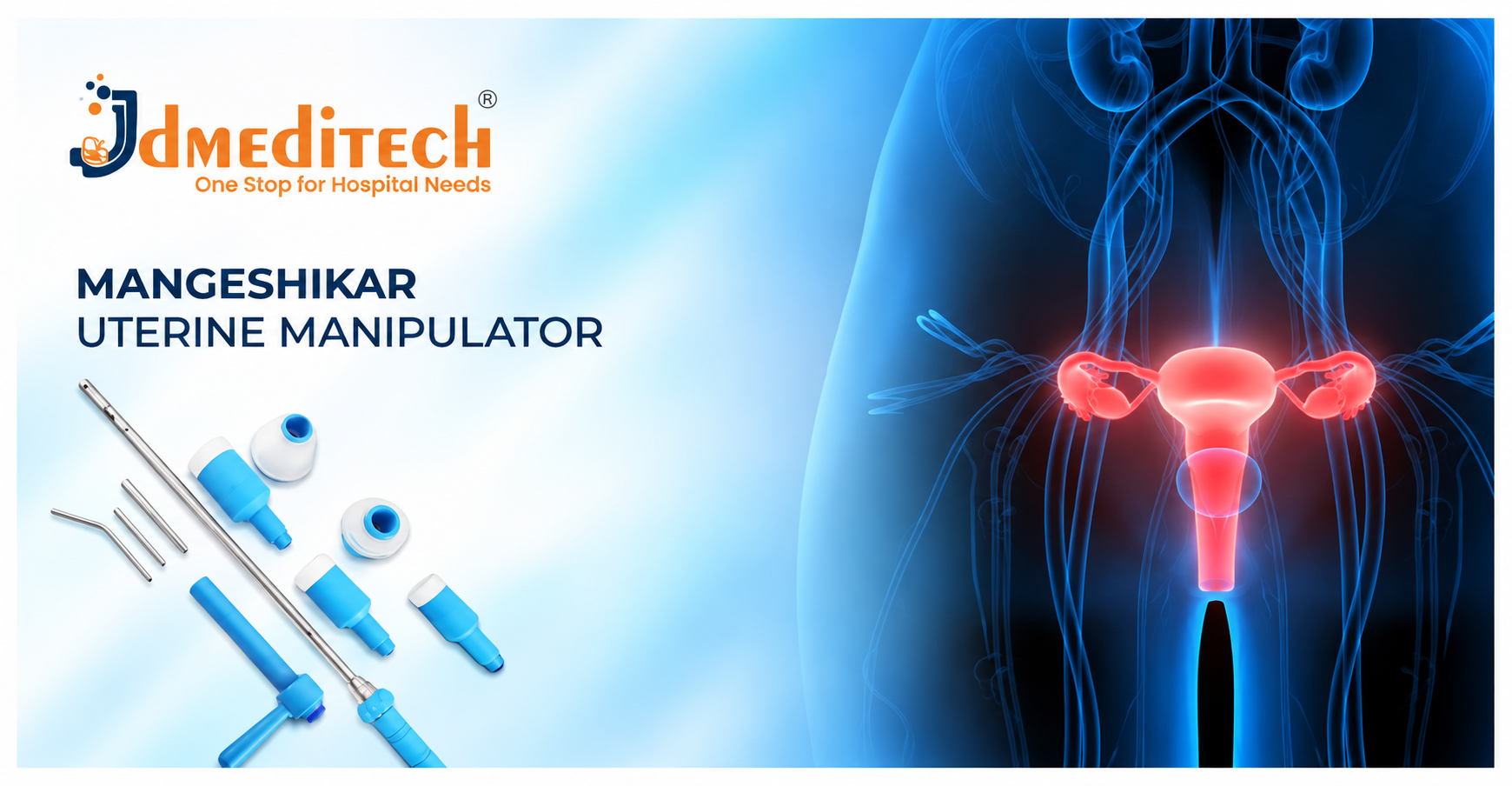
Mangeshikar Uterine Manipulator: Uses, Components, Features and Specifications
The Mangeshikar Uterine Manipulator is a specialized gynecological surgical instrument designed to assist with controlled positioning and movement of the uterus during selected laparoscopic procedures. It helps the surgical team adjust uterine orientation and improve access to pelvic anatomy.
During minimally invasive gynecological surgery, surgeons often need clear exposure of the uterus and surrounding structures. Therefore, a suitable uterine manipulator can support surgical visualization and access.
Furthermore, the Mangeshikar uterine manipulator system may include interchangeable components that support different anatomical and procedural requirements. However, the exact configuration depends on the manufacturer and selected model.
Additionally, proper instrument selection is important because uterine size, cervical anatomy and surgical objectives vary between patients.
JDMeditech supplies gynecology and laparoscopic surgical instruments for hospitals, healthcare professionals and medical distributors. Customers can inquire about available uterine manipulation systems and compatible accessories.
What Is a Mangeshikar Uterine Manipulator?
A Mangeshikar uterine manipulator is an instrument used to position and mobilize the uterus during selected gynecological operations.
The surgeon uses the instrument to support uterine movement while viewing the pelvic cavity through a laparoscopic camera. Consequently, the surgical team can improve exposure of relevant anatomy.
Moreover, certain manipulator configurations provide components intended to help identify surgical landmarks during laparoscopic hysterectomy.
However, the instrument is not suitable for every gynecological procedure. Therefore, surgeons must confirm the intended use and compatibility of the selected system.
Purpose of a Uterine Manipulator in Gynecology
The main purpose of a uterine manipulator is to support controlled uterine positioning. During laparoscopic surgery, the instrument may help the surgeon adjust the uterus to improve visibility.
As a result, the operating team can access selected pelvic structures more effectively.
Additionally, the instrument may assist with anatomical orientation during certain surgical stages. However, its benefits depend on the procedure and the surgeon’s technique.
Why Is Uterine Manipulation Important During Laparoscopy?
Laparoscopic gynecological surgery uses small abdominal incisions and a camera to visualize internal structures. Therefore, maintaining a clear operative field is important.
Furthermore, the uterus can limit access to surrounding pelvic anatomy. Controlled uterine movement may help expose the operative area.
Consequently, surgeons may use a uterine manipulator to support visualization, positioning and access during suitable procedures.
Common Applications of the Mangeshikar Uterine Manipulator
The Mangeshikar uterine manipulator may support selected laparoscopic gynecological procedures. However, actual indications depend on the device’s approved intended use.
- Laparoscopic hysterectomy
- Total laparoscopic hysterectomy
- Selected laparoscopic pelvic procedures
- Selected laparoscopic myomectomy procedures
- Gynecological procedures requiring uterine positioning
- Selected endoscopic gynecological operations
Furthermore, surgeons should review the patient’s anatomy and clinical requirements before choosing the instrument.
Mangeshikar Uterine Manipulator for Laparoscopic Hysterectomy
Laparoscopic hysterectomy involves surgical removal of the uterus using a minimally invasive approach.
During selected procedures, a uterine manipulator helps position the uterus and improve exposure of the operative field.
Additionally, compatible accessories may support identification of anatomical boundaries. Therefore, the instrument can form part of the planned surgical equipment.
However, the surgeon must select the correct device configuration and follow established surgical protocols.
Mangeshikar Uterine Manipulator for Total Laparoscopic Hysterectomy
Total laparoscopic hysterectomy removes the uterus and cervix through a laparoscopic approach.
During the procedure, controlled uterine movement can help the surgeon visualize selected pelvic structures.
Furthermore, certain manipulator systems include components that assist with anatomical orientation. However, their design and function vary between products.
Mangeshikar Uterine Manipulator in Laparoscopic Myomectomy
Laparoscopic myomectomy removes selected uterine fibroids while preserving the uterus.
In some cases, the surgeon may use a uterine manipulator to support positioning. However, the suitability of the instrument depends on fibroid location, uterine anatomy and the planned technique.
Therefore, the surgeon determines whether uterine manipulation is appropriate.
Components of the Mangeshikar Uterine Manipulator
The components of a Mangeshikar uterine manipulator vary according to the selected system. Therefore, the following list describes possible instrument components rather than a guaranteed package configuration.
- Main Manipulator Shaft: Supports the instrument assembly.
- Handle or Control Mechanism: Allows the operator to control positioning according to the device design.
- Uterine Tip: Provides the intended uterine interface in compatible configurations.
- Cervical Cup or Colpotomy Cup: May support anatomical identification during selected hysterectomy procedures.
- Interchangeable Attachments: Allow selected configurations to accommodate different requirements.
- Locking Mechanism: Helps secure compatible components where provided.
- Connection Accessories: Support assembly according to the selected model.
Additionally, hospitals should verify the exact contents of the supplied set before placing an order.
Main Manipulator Shaft
The main shaft forms a structural part of the manipulator system. It supports compatible attachments and allows the surgeon to control the instrument.
Furthermore, shaft dimensions vary between manufacturers. Therefore, hospitals should confirm the working length and other specifications.
Manipulator Handle
The handle provides a control interface for the instrument. Consequently, the operator can adjust uterine positioning according to the device’s design.
However, handle mechanisms vary between models. Therefore, healthcare professionals should review the product instructions before use.
Uterine Tip
The uterine tip forms part of the patient-contacting instrument assembly in compatible systems.
Additionally, different tip sizes or designs may accommodate different anatomical requirements. However, availability depends on the selected product.
Cervical Cup or Colpotomy Cup
Some uterine manipulator systems include a cervical or colpotomy cup. During selected hysterectomy procedures, this component may assist with identifying anatomical boundaries.
Furthermore, cup dimensions and configurations vary. Therefore, surgeons should confirm compatibility with the selected system.
Interchangeable Attachments
Some manipulator systems support interchangeable components. As a result, the healthcare team can select suitable attachments for different clinical requirements.
However, hospitals must use only compatible components. Additionally, staff should follow the manufacturer’s assembly and reprocessing instructions.
Key Features of the Mangeshikar Uterine Manipulator
The Mangeshikar uterine manipulator is designed to support uterine positioning during selected gynecological procedures.
- Supports controlled uterine positioning.
- May improve exposure of selected pelvic structures.
- Supports selected laparoscopic gynecological procedures.
- May offer interchangeable components, depending on the model.
- Can support anatomical orientation during surgery.
- Provides a dedicated uterine manipulation instrument.
- May be available in different configurations.
However, individual product features vary. Therefore, customers should verify the specifications of the model they intend to purchase.
Technical Specifications of the Mangeshikar Uterine Manipulator
Technical specifications depend on the manufacturer and model. Therefore, hospitals should request a verified product datasheet before purchasing.
| Parameter | Specification |
|---|---|
| Product Name | Mangeshikar Uterine Manipulator |
| Medical Specialty | Gynecology / Laparoscopy |
| Primary Application | Uterine positioning during selected gynecological procedures |
| Instrument Category | Gynecological surgical instrument |
| Instrument Configuration | According to selected model |
| Working Length | Confirm product specifications |
| Shaft Diameter | Confirm product specifications |
| Uterine Tip Sizes | According to available configuration |
| Cervical Cup Sizes | Where supplied with the selected model |
| Instrument Material | Confirm manufacturer specifications |
| Handle Design | According to selected model |
| Interchangeable Components | Where supported by the selected system |
| Sterility | According to product labeling |
| Reusable or Single Use | According to manufacturer instructions |
| Cleaning and Sterilization | According to validated manufacturer instructions |
| Supplier | JDMeditech, subject to product availability |
How Does a Mangeshikar Uterine Manipulator Work?
The Mangeshikar uterine manipulator supports uterine positioning through a dedicated instrument assembly.
During surgery, a qualified healthcare professional uses the instrument according to the planned procedure and the manufacturer’s instructions.
Consequently, the surgeon may obtain improved access to selected pelvic structures.
Furthermore, compatible accessories may support anatomical orientation. However, the exact functions depend on the device configuration.
General Clinical Workflow
The use of a uterine manipulator forms part of a broader surgical plan. However, the exact technique varies between patients and procedures.
Step 1: Preoperative Assessment
First, the surgical team reviews the patient’s anatomy, medical history and planned procedure.
Step 2: Instrument Selection
Next, the surgeon selects a suitable manipulator configuration and verifies component compatibility.
Step 3: Patient Preparation
The healthcare team prepares the patient according to established surgical protocols. Additionally, the team confirms anesthesia and positioning requirements.
Step 4: Instrument Use During Surgery
The surgical team uses the manipulator to support uterine positioning and exposure as clinically appropriate.
Step 5: Surgical Monitoring
Throughout the procedure, the surgeon monitors anatomy and instrument positioning. Furthermore, the team checks for potential tissue injury.
Step 6: Procedure Completion
Finally, the healthcare team completes the planned procedure and follows appropriate postoperative protocols.
Important: This overview is educational only. It is not a surgical instruction manual. Trained healthcare professionals must follow the device instructions and established clinical protocols.
Benefits of Using a Uterine Manipulator
A suitable uterine manipulator can offer several practical benefits during selected gynecological procedures.
- Supports controlled uterine movement.
- May improve access to the operative field.
- Can assist with anatomical exposure.
- May support surgical visualization.
- Can support selected laparoscopic hysterectomy techniques.
- May help the surgical team maintain uterine orientation.
- Supports planned minimally invasive gynecological procedures.
However, these potential benefits depend on the patient’s anatomy, the surgical technique and the selected instrument.
Mangeshikar Uterine Manipulator vs. Other Uterine Manipulators
Different uterine manipulator systems provide different control mechanisms and accessories. Therefore, surgeons select instruments according to the planned procedure.
| Feature | Mangeshikar Uterine Manipulator | Other Uterine Manipulators |
|---|---|---|
| Primary Function | Uterine positioning | Uterine positioning |
| Clinical Application | Selected gynecological procedures | Depends on selected device |
| Instrument Design | Model-specific | Model-specific |
| Interchangeable Accessories | Depends on configuration | Depends on configuration |
| Control Mechanism | According to selected model | According to selected model |
| Reuse Requirements | According to product labeling | According to product labeling |
Difference Between a Uterine Manipulator and a Uterine Sound
A uterine manipulator supports uterine positioning during selected procedures. In contrast, a uterine sound is primarily used to assess the depth and direction of the uterine cavity when clinically indicated.
Therefore, these instruments serve different purposes and are not interchangeable.
Difference Between a Uterine Manipulator and a Hysteroscope
A uterine manipulator supports uterine movement and positioning. In contrast, a hysteroscope allows visualization of the inside of the uterus.
Consequently, surgeons use these instruments for different clinical applications.
Possible Risks and Precautions
Uterine manipulation carries potential risks. Therefore, surgeons must consider patient anatomy and procedural requirements.
- Uterine perforation
- Cervical injury
- Vaginal or cervical bleeding
- Local tissue trauma
- Infection
- Instrument-related injury
- Complications associated with the surgical procedure
Furthermore, device use may be inappropriate in certain clinical situations. Therefore, healthcare professionals should review contraindications and warnings in the product instructions.
Safety Considerations During Uterine Manipulation
Appropriate instrument selection and trained use are essential. Additionally, the surgical team should assess anatomy before using a manipulator.
- Confirm the intended use of the instrument.
- Review patient anatomy and relevant clinical findings.
- Check component compatibility.
- Inspect the instrument before use.
- Follow validated cleaning and sterilization instructions.
- Use the device only with appropriate training.
- Follow the manufacturer’s warnings and contraindications.
Cleaning and Sterilization of Uterine Manipulator Instruments
Cleaning and sterilization requirements depend on the selected device. Therefore, hospitals must follow the manufacturer’s validated reprocessing instructions.
Furthermore, reusable components may require disassembly before cleaning if the manufacturer specifies this step.
However, healthcare facilities must never assume that every component supports the same sterilization method.
How to Select a Mangeshikar Uterine Manipulator
Hospitals should consider several factors before purchasing a uterine manipulator. In particular, intended use, dimensions and component compatibility are important.
- Planned gynecological procedure
- Instrument configuration
- Working length
- Available uterine tip sizes
- Cervical cup availability
- Handle and control mechanism
- Instrument material
- Component compatibility
- Sterility and reuse requirements
- Cleaning and sterilization instructions
- Technical documentation
Additionally, customers should confirm the complete set contents before placing an order.
Why Choose JDMeditech for Gynecology Surgical Instruments?
JDMeditech supplies gynecology and laparoscopic surgical instruments for hospitals, healthcare facilities and medical distributors.
Furthermore, customers can contact JDMeditech to inquire about available uterine manipulators and related surgical accessories.
- Gynecology surgical instrument inquiries
- Laparoscopic instrument inquiries
- Uterine manipulator inquiries
- Compatible accessory inquiries
- Product specifications upon request
- International export inquiries
However, product availability and configurations vary. Therefore, customers should confirm the required specifications before ordering.
Frequently Asked Questions About the Mangeshikar Uterine Manipulator
1. What Is a Mangeshikar Uterine Manipulator?
It is a gynecological surgical instrument used to support controlled uterine positioning during selected procedures.
2. What Is the Main Use of a Uterine Manipulator?
Its main purpose is to support uterine movement and improve exposure during appropriate gynecological surgery.
3. Is It Used During Laparoscopic Hysterectomy?
Yes. A suitable uterine manipulator may support selected laparoscopic hysterectomy procedures.
4. Can It Be Used During Total Laparoscopic Hysterectomy?
Yes, when the selected instrument is appropriate for the planned procedure and patient anatomy.
5. Is the Mangeshikar Uterine Manipulator Reusable?
Reuse depends on the selected product and manufacturer instructions.
6. Does the Instrument Have Interchangeable Components?
Some configurations offer interchangeable accessories. However, customers should confirm the exact set contents.
7. What Is the Purpose of a Cervical Cup?
In compatible systems, a cervical or colpotomy cup may help identify anatomical boundaries during selected hysterectomy procedures.
8. Is a Uterine Manipulator Used in Myomectomy?
Surgeons may use a suitable manipulator during selected myomectomy procedures. However, its use depends on the surgical plan.
9. Does the Instrument Improve Visualization?
Controlled uterine positioning may improve exposure of selected pelvic structures.
10. Is the Instrument Suitable for Every Patient?
No. Suitability depends on patient anatomy, clinical findings and the planned procedure.
11. Can a Uterine Manipulator Cause Injury?
Yes. Potential complications include cervical injury, uterine perforation and bleeding.
12. Does the Instrument Require Sterilization?
Reusable instruments require appropriate reprocessing according to the manufacturer’s validated instructions.
13. What Materials Are Used?
Materials vary by model and component. Therefore, customers should request the product datasheet.
14. Are Different Sizes Available?
Some systems offer different component sizes. However, availability depends on the selected model.
15. Is the Mangeshikar Uterine Manipulator Used in Laparoscopy?
Yes. It supports uterine positioning during selected laparoscopic gynecological procedures.
16. What Is the Difference Between a Uterine Manipulator and a Hysteroscope?
A manipulator supports uterine positioning, while a hysteroscope provides visualization inside the uterus.
17. Who Should Use a Uterine Manipulator?
Only appropriately trained healthcare professionals should use the instrument.
18. Where Can I Inquire About a Mangeshikar Uterine Manipulator?
Hospitals and medical distributors can contact JDMeditech for product availability and technical information.
Conclusion
The Mangeshikar Uterine Manipulator is a specialized gynecological instrument that supports controlled uterine positioning during selected laparoscopic procedures.
Furthermore, compatible instrument configurations may help improve exposure and anatomical orientation. However, safe use depends on patient selection, surgical expertise and device compatibility.
Therefore, hospitals should review technical specifications and manufacturer instructions before selecting a uterine manipulator system.
JDMeditech – One Stop for Hospital Needs
Explore our range of gynecology surgical instruments, laparoscopic equipment and related medical devices.
Website:
www.jdmeditech.com
Medical Disclaimer
This article provides general educational and product information only. It does not replace professional medical advice, surgical training or the manufacturer’s instructions for use. Qualified healthcare professionals must select and use medical instruments according to individual clinical requirements.




