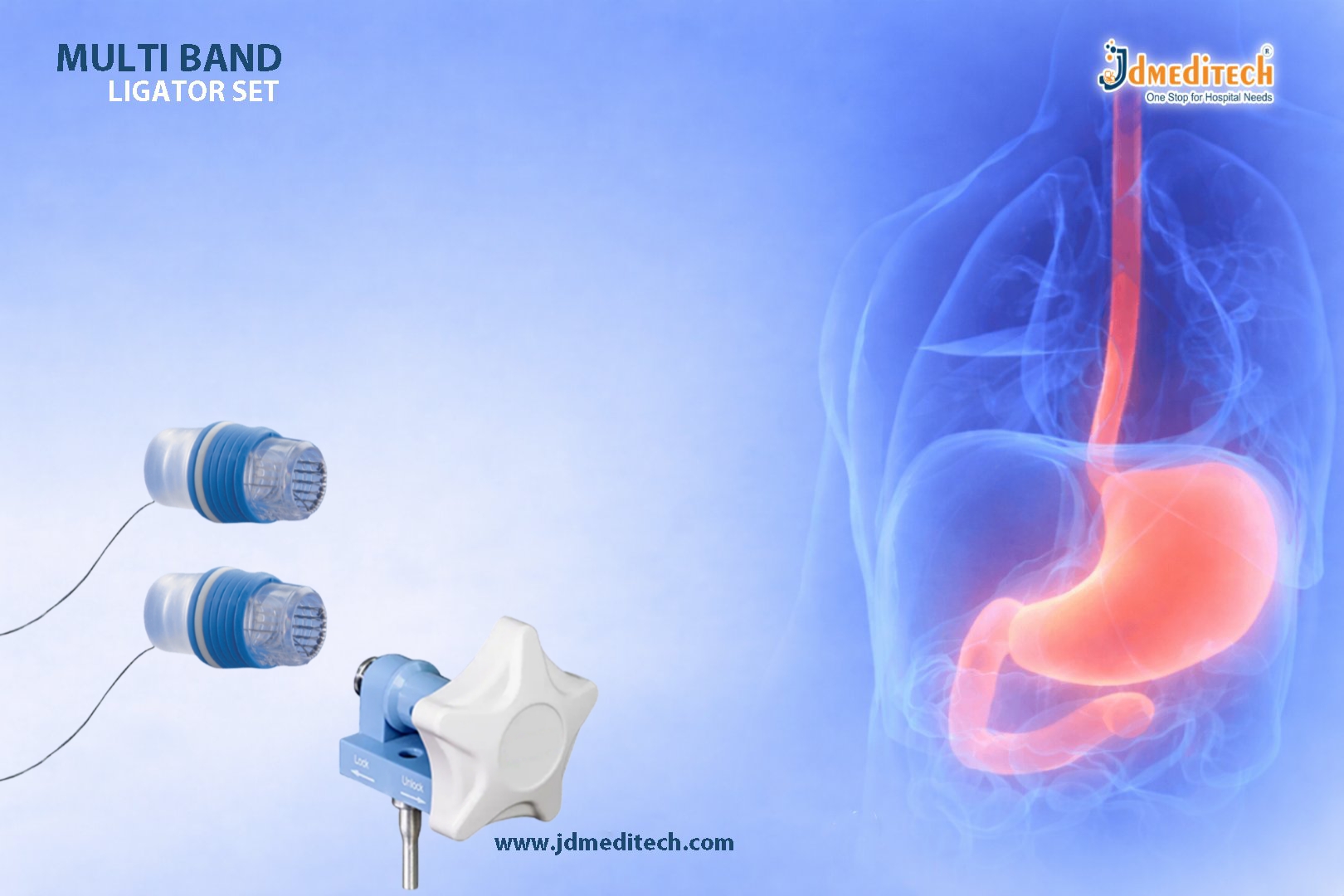
The Multiband Ligator Set helps gastroenterologists manage esophageal varices and gastrointestinal bleeding through advanced endoscopic treatment. Doctors use this device during endoscopic variceal ligation (EVL) procedures to place elastic bands around enlarged veins and stop dangerous bleeding.
Today, many specialists prefer multiband ligation because it offers a minimally invasive, fast, and highly effective treatment option. In addition, modern multiband systems allow physicians to deploy several bands during a single procedure, which improves efficiency and reduces treatment time.
As a result, the Multiband Ligator Set plays an important role in therapeutic endoscopy and advanced gastrointestinal care.
What Is a Multiband Ligator Set?
Understanding the Device
A Multiband Ligator Set is an endoscopic accessory that supports variceal ligation procedures inside the esophagus. Doctors attach the device to the tip of an endoscope before starting the procedure.
The system contains multiple preloaded elastic bands that help physicians ligate enlarged veins quickly and accurately. During treatment, the doctor suctions the targeted varix into the ligator cap and then releases an elastic band around it. Consequently, blood flow decreases, and the treated varix gradually shrinks.
Unlike older single-band systems, the multiband design allows doctors to place multiple bands without removing the endoscope repeatedly. Therefore, the procedure becomes faster and more convenient.
Why Doctors Use Multiband Ligator Sets
Importance in Gastrointestinal Endoscopy
Doctors use multiband ligator sets mainly to treat and prevent bleeding from esophageal varices caused by portal hypertension.
Common clinical uses include:
- Esophageal variceal ligation
- Prevention of recurrent variceal bleeding
- Emergency gastrointestinal bleeding control
- Management of portal hypertension complications
- Therapeutic upper GI endoscopy procedures
Furthermore, the device helps physicians reduce bleeding risks and improve patient safety during endoscopic treatment.
Understanding Esophageal Varices
Causes and Clinical Risks
Esophageal varices develop when increased pressure inside the portal venous system enlarges veins in the lower esophagus.
Several conditions can trigger this problem, including:
- Liver cirrhosis
- Chronic liver disease
- Portal hypertension
- Advanced liver fibrosis
- Hepatic venous obstruction
As pressure rises, the veins become swollen and fragile. Consequently, they can rupture and cause severe internal bleeding.
Therefore, early diagnosis and timely endoscopic treatment remain extremely important.
Key Features of the Multiband Ligator Set
Advanced Design Characteristics
Manufacturers design modern multiband ligator systems with features that improve procedural control and treatment accuracy.
Multiple Preloaded Bands
The device allows doctors to deploy several bands during one procedure without reloading.
Transparent Ligation Cap
The clear cap improves endoscopic visibility during treatment.
Smooth Band Release Mechanism
The trigger system enables controlled and accurate band deployment.
Flexible Endoscope Compatibility
Most systems fit standard therapeutic endoscopes easily.
Durable Medical-Grade Construction
High-quality materials support reliable performance during complex procedures.
As a result, physicians can perform safer and more efficient variceal ligation procedures.
How the Multiband Ligator Set Works
Step-by-Step Procedure
Doctors use the multiband ligator set during upper GI endoscopy procedures.
Device Preparation
First, the physician attaches the ligator system securely to the endoscope tip.
Endoscope Insertion
Next, the doctor advances the endoscope carefully into the esophagus.
Identification of Varices
The physician locates enlarged or bleeding varices that require treatment.
Suction of the Target Vein
Afterward, the doctor suctions the selected varix into the ligator cap.
Elastic Band Deployment
The physician then releases an elastic band around the varix to block blood flow.
Additional Band Placement
If necessary, the doctor deploys additional bands during the same session.
Procedure Completion
Finally, the physician removes the endoscope after completing treatment successfully.
Consequently, the procedure reduces the risk of variceal rupture and bleeding.
Benefits of Using a Multiband Ligator Set
Advantages in Endoscopic Treatment
The Multiband Ligator Set offers several important clinical benefits.
Major advantages include:
- Minimally invasive treatment
- Effective bleeding control
- Faster procedure completion
- Multiple band deployment capability
- Reduced need for repeated endoscope insertion
- Improved procedural efficiency
- Better treatment precision
- Reduced patient recovery time
- Lower risk of severe bleeding complications
Moreover, physicians achieve excellent treatment outcomes with modern multiband ligation systems.
Common Procedures That Use Multiband Ligator Sets
Gastroenterology Applications
Doctors commonly use multiband ligator sets during several therapeutic endoscopic procedures.
These procedures include:
- Endoscopic variceal ligation
- Emergency GI bleeding management
- Preventive variceal therapy
- Portal hypertension treatment
- Follow-up variceal eradication procedures
Therefore, the device remains an essential tool in modern gastroenterology.
Materials Used in Multiband Ligator Sets
High-Quality Medical Construction
Manufacturers use durable and biocompatible materials to ensure device safety and procedural reliability.
Common materials include:
- Medical-grade polymers
- Elastic rubber bands
- Flexible catheter tubing
- Transparent endoscopic caps
- Stainless steel components
As a result, the device performs consistently during advanced endoscopic procedures.
Safety Considerations During Endoscopic Ligation
Important Procedural Precautions
Doctors must follow proper technique to maintain safety during variceal ligation procedures.
Key safety precautions include:
- Maintaining clear endoscopic visualization
- Applying controlled suction carefully
- Positioning bands accurately
- Monitoring for active bleeding
- Following sterile procedural protocols
- Avoiding excessive tissue capture
In addition, trained endoscopy specialists should always perform the procedure.
Recovery After Multiband Variceal Ligation
Post-Procedure Care and Monitoring
Most patients recover smoothly after endoscopic variceal ligation. However, physicians still recommend careful follow-up care.
Mild Throat Irritation
Some patients develop temporary throat discomfort after endoscopy.
Dietary Recommendations
Doctors often advise soft foods and adequate hydration for a short period.
Monitoring for Symptoms
Patients should contact their doctor immediately if they experience severe chest pain or vomiting blood.
Follow-Up Endoscopy
Physicians may schedule additional endoscopic sessions to monitor and treat remaining varices.
Consequently, regular follow-up care supports long-term treatment success.
Multiband Ligator Set vs Injection Sclerotherapy
Comparing Two Endoscopic Treatments
Doctors use both multiband ligation and injection sclerotherapy to manage esophageal varices. However, multiband ligation offers several important advantages.
| Feature | Multiband Ligation | Injection Sclerotherapy |
| Treatment Method | Elastic band placement | Chemical injection |
| Procedure Efficiency | Higher | Moderate |
| Risk of Ulcer Formation | Lower | Higher |
| Bleeding Control | Excellent | Effective |
| Recovery Speed | Faster | Moderate |
| Repeat Sessions | Sometimes needed | Sometimes needed |
As a result, many specialists now prefer multiband ligation for variceal management.
Choosing the Right Multiband Ligator Set
Important Selection Factors
Doctors and healthcare facilities consider several factors before selecting a ligator system.
Important considerations include:
- Number of available bands
- Endoscope compatibility
- Ease of deployment
- Visualization quality
- Device flexibility
- Clinical application requirements
- Physician preference
Therefore, selecting the appropriate system improves procedural efficiency and treatment outcomes.
Future Advancements in Multiband Ligation Technology
Innovations in Endoscopic Devices
Medical technology continues to improve endoscopic ligation systems and gastrointestinal treatment methods.
Future advancements may include:
- Enhanced deployment mechanisms
- Improved visualization systems
- Better ergonomic controls
- Advanced biocompatible materials
- Increased endoscope compatibility
- More efficient multi-band systems
Consequently, innovation continues to improve patient safety and procedural precision in therapeutic endoscopy.
Conclusion
Advanced Endoscopic Support for Variceal Treatment
The Multiband Ligator Set remains a highly effective and reliable solution for endoscopic variceal ligation and gastrointestinal bleeding management. With its ability to deploy multiple bands quickly and accurately, the device improves procedural efficiency, enhances treatment precision, and supports better patient outcomes.
Most importantly, this advanced endoscopic technology helps doctors manage potentially life-threatening variceal bleeding through minimally invasive treatment. Therefore, with expert endoscopic care and modern ligation systems, patients can receive safer, faster, and more effective gastrointestinal treatment.
Get Connected:
+91 79909 93062 | +91 63513 72032 | exports@jdmeditech.com