



Pelvic Floor Repair Surgery is a group of gynecological and urogynecological procedures designed to restore support to pelvic organs affected by prolapse. Depending on the condition, surgery may repair the vaginal walls or support the uterus and vaginal vault.
The pelvic floor consists of muscles, ligaments, and connective tissues that help support the bladder, uterus, vagina, and rectum. However, pregnancy, childbirth, aging, and other factors can weaken these supporting structures.
As a result, some patients experience pelvic pressure, vaginal bulging, urinary symptoms, or bowel-related difficulties.
Fortunately, several treatment options are available. For example, pelvic floor muscle training and vaginal pessaries may help selected patients without surgery.
When symptoms remain troublesome, specialists may recommend an appropriate surgical repair.
This JDMeditech guide explains pelvic floor repair surgery, its indications, surgical techniques, instruments, potential benefits, risks, recovery, and equipment selection factors.
What Is Pelvic Floor Repair Surgery?
Pelvic Floor Repair Surgery refers to surgical procedures that correct selected pelvic support defects and treat symptomatic pelvic organ prolapse.
During treatment, a qualified specialist may repair weakened vaginal tissues or provide additional support to prolapsed pelvic organs.
However, the operation depends on which structures require treatment. Therefore, anterior vaginal repair, posterior vaginal repair, and apical prolapse surgery involve different surgical goals.
In addition, some patients require treatment for more than one area of prolapse.
Understanding the Pelvic Floor and Pelvic Organ Prolapse
The pelvic floor forms a supportive structure at the base of the pelvis.
Its muscles and connective tissues help maintain the position of the bladder, uterus, vagina, and rectum.
Furthermore, these structures contribute to urinary control, bowel function, and pelvic support.
When support becomes insufficient, one or more pelvic organs may descend toward or into the vagina.
This condition is called pelvic organ prolapse.
Common Types of Pelvic Organ Prolapse
1. Anterior Vaginal Wall Prolapse
Anterior vaginal wall prolapse occurs when the front vaginal wall loses support.
As a result, the bladder may bulge toward the vagina. Clinicians commonly use the term cystocele for this condition.
2. Posterior Vaginal Wall Prolapse
Posterior vaginal wall prolapse occurs when the back vaginal wall loses support.
Consequently, the rectum may bulge toward the vagina, creating a rectocele.
3. Uterine Prolapse
Uterine prolapse occurs when weakened pelvic support allows the uterus to descend.
Depending on severity, patients may experience a vaginal bulge or pelvic pressure.
4. Vaginal Vault Prolapse
Vaginal vault prolapse occurs when the upper portion of the vagina descends after hysterectomy.
Therefore, treatment may require a procedure that restores support to the vaginal apex.
5. Enterocele
An enterocele involves herniation of the peritoneal sac, sometimes containing small bowel, toward the vaginal wall.
However, the exact anatomy requires specialist assessment.
Why Is Pelvic Floor Repair Surgery Performed?
Doctors may recommend pelvic floor repair when prolapse causes significant symptoms or affects daily activities.
For example, some patients experience a sensation of heaviness or a visible vaginal bulge.
Others may develop urinary difficulties, bowel symptoms, or discomfort during sexual activity.
However, surgery is not necessary for every patient with prolapse.
Therefore, specialists consider symptom severity, examination findings, medical history, patient preferences, and non-surgical alternatives.
Common Indications for Pelvic Floor Repair Surgery
1. Symptomatic Cystocele
A cystocele may cause vaginal bulging or problems with bladder emptying.
In selected cases, anterior vaginal repair may improve support.
2. Symptomatic Rectocele
A rectocele may cause a vaginal bulge or difficulty with bowel movements.
However, surgery is not always necessary because some symptoms respond to conservative treatment.
3. Uterine Prolapse
Uterine prolapse may create pelvic pressure or discomfort.
Therefore, specialists may discuss uterine-preserving procedures or surgery involving hysterectomy when appropriate.
4. Vaginal Vault Prolapse
After hysterectomy, the upper vagina may lose support.
Consequently, some patients require an apical suspension procedure.
5. Persistent Vaginal Bulging
Patients with bothersome prolapse may experience a bulging sensation during standing or physical activity.
When conservative treatment does not provide suitable relief, surgery may become an option.
6. Selected Urinary Symptoms
Pelvic organ prolapse can sometimes affect bladder emptying or urinary function.
However, prolapse repair does not guarantee improvement in every urinary symptom.
Therefore, the specialist must assess bladder function before treatment.
7. Symptoms Affecting Quality of Life
Some patients experience persistent discomfort or limitations in everyday activities.
Consequently, a specialist may recommend surgery after discussing expected benefits and potential risks.
Types of Pelvic Floor Repair Surgery
1. Anterior Colporrhaphy
Anterior colporrhaphy is a vaginal procedure that repairs selected defects in the anterior vaginal wall.
For example, surgeons may use this approach to treat symptomatic cystocele.
The repair generally uses sutures to reinforce native supporting tissues.
2. Posterior Colporrhaphy
Posterior colporrhaphy repairs selected defects in the posterior vaginal wall.
Therefore, it may be appropriate for symptomatic rectocele.
However, the surgeon must consider bowel symptoms and other pelvic conditions before recommending treatment.
3. Perineorrhaphy
Perineorrhaphy repairs selected weakened tissues of the perineal body.
In some cases, surgeons perform this procedure alongside posterior vaginal repair.
4. Sacrospinous Ligament Fixation
Sacrospinous ligament fixation provides support to the upper vagina or uterus in selected cases.
During the operation, the surgeon uses suitable sutures to attach the prolapsed structure to a supporting ligament.
5. Uterosacral Ligament Suspension
Uterosacral ligament suspension supports the vaginal apex using selected pelvic ligaments.
However, the procedure requires careful assessment because the ureters lie near the operative area.
6. Sacrocolpopexy
Sacrocolpopexy is a procedure that supports the vaginal vault using an abdominal or laparoscopic approach.
It typically uses surgical mesh to connect the upper vagina to the sacrum.
However, mesh use requires careful counseling, regulatory compliance, and consideration of potential complications.
7. Sacrohysteropexy
Sacrohysteropexy is a uterus-preserving procedure for selected patients with uterine prolapse.
Therefore, it may be an option when the patient wishes to retain the uterus.
8. Combined Pelvic Floor Repair
Some patients have prolapse affecting multiple vaginal compartments.
Consequently, the surgeon may combine suitable procedures during one operation.
Nevertheless, the surgical plan must reflect the patient’s symptoms and clinical findings.
Non-Surgical Treatment Options
Not every patient with pelvic organ prolapse requires surgery.
For example, supervised pelvic floor muscle training may help selected patients improve symptoms.
Furthermore, a vaginal pessary can provide mechanical support without an operation.
In some patients, clinicians may recommend lifestyle changes or suitable vaginal estrogen treatment.
Therefore, the healthcare team should discuss conservative and surgical options before treatment.
Common Instruments Used in Pelvic Floor Repair Surgery
Pelvic floor repair requires instruments for vaginal exposure, tissue handling, dissection, bleeding control, and suturing.
Moreover, some procedures require specialized instruments for apical suspension or laparoscopic access.
The following instruments may support selected gynecological operations. However, this overview does not represent a confirmed JDMeditech instrument-set packing list.
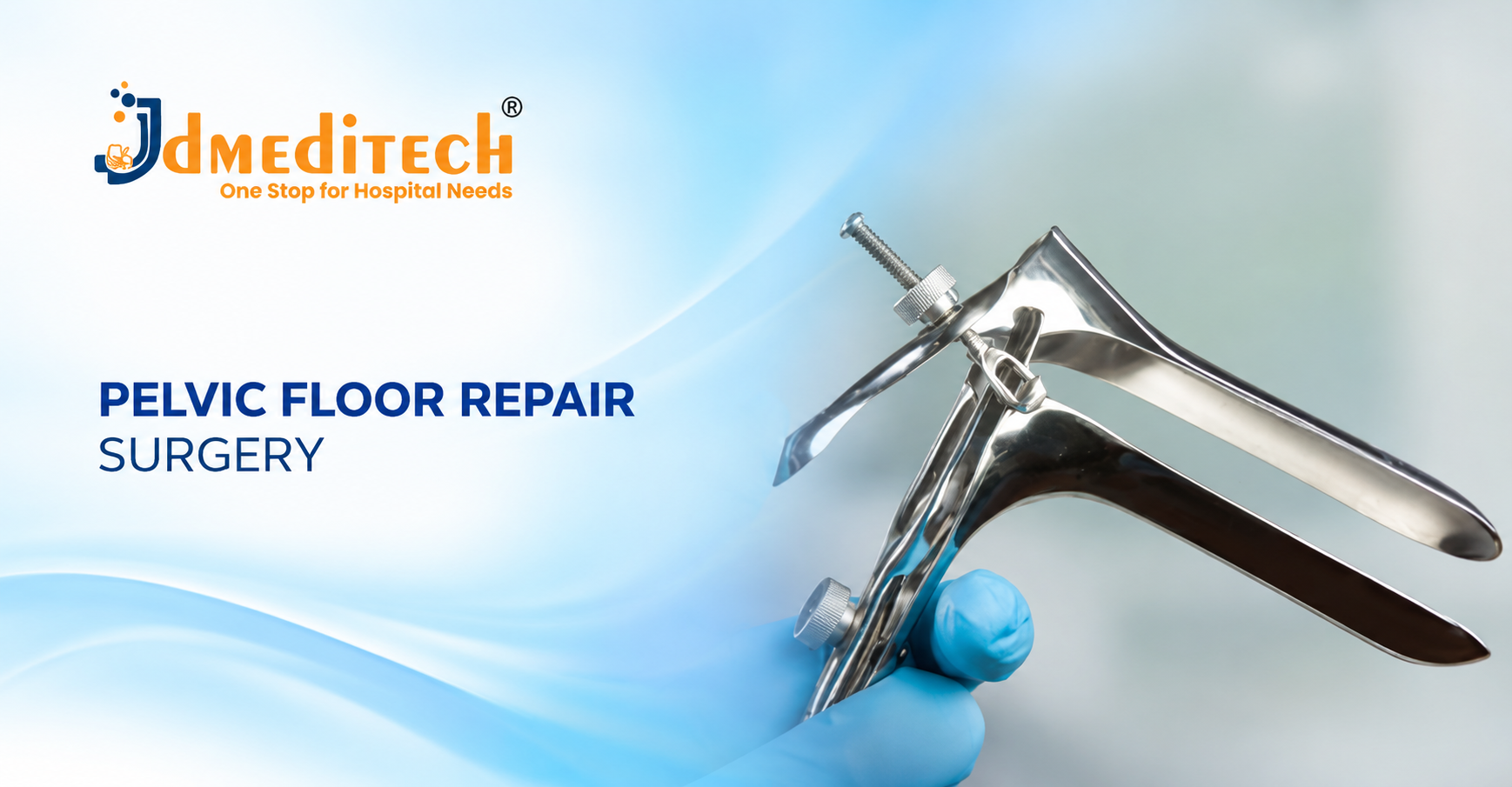
1. Vaginal Speculum
A vaginal speculum helps provide access and visibility during selected vaginal procedures.
Furthermore, different designs support different clinical requirements.
2. Auvard Weighted Speculum
An Auvard weighted speculum may help maintain vaginal exposure during selected operations.
Therefore, the surgeon must choose the appropriate size and configuration.
3. Sims Vaginal Speculum
A Sims speculum supports vaginal wall retraction during suitable examinations and surgical procedures.
However, the exact instrument choice depends on the operative approach.
4. Vaginal Retractors
Vaginal retractors help maintain exposure of the operative field.
As a result, the surgical team can access selected vaginal tissues more effectively.
5. Allis Tissue Forceps
Allis forceps help surgeons hold suitable tissues during vaginal surgery.
However, their toothed jaws require careful handling.
6. Tissue Dissecting Forceps
Dissecting forceps support the handling and manipulation of suitable tissues.
Furthermore, toothed and non-toothed designs serve different purposes.
7. Mayo Scissors
Mayo scissors support cutting suitable tissues and surgical materials.
Depending on their design, they may have straight or curved blades.
8. Metzenbaum Scissors
Metzenbaum scissors support delicate tissue dissection.
Therefore, surgeons select an appropriate configuration for the planned procedure.
9. Artery Forceps
Artery forceps help clamp selected blood vessels and tissues.
In addition, they support temporary bleeding control during suitable surgical tasks.
10. Needle Holder
A needle holder helps the surgeon control compatible surgical needles during suturing.
Moreover, different designs support different surgical applications.
11. Tenaculum Forceps
Tenaculum forceps may support secure grasping of suitable cervical tissue during selected procedures.
However, clinicians must use them carefully to reduce tissue injury.
12. Sponge-Holding Forceps
Sponge-holding forceps help hold suitable surgical swabs during operative preparation and selected tasks.
Furthermore, surgical teams must follow established swab-counting protocols.
13. Electrosurgical Instruments
Compatible electrosurgical instruments support tissue cutting and bleeding control.
However, surgeons must verify generator compatibility and follow approved instructions for use.
14. Suction Instruments
Suction instruments help remove blood and other fluids from the operative field.
Consequently, they can support visualization during appropriate surgical tasks.
15. Laparoscopic Instruments
Selected pelvic reconstruction procedures use laparoscopic instruments.
For example, compatible laparoscopes, graspers, scissors, and suturing instruments may support abdominal or laparoscopic prolapse repair.
16. Additional Surgical Accessories
Depending on the procedure, hospitals may require suitable sutures, drapes, catheters, and other accessories.
Therefore, purchasing teams should verify the complete equipment configuration before ordering.
Pelvic Floor Repair Instruments and Functions
| Instrument | Primary Function |
|---|---|
| Vaginal Speculum | Supports vaginal exposure and access |
| Auvard Weighted Speculum | Helps maintain operative exposure |
| Sims Speculum | Supports vaginal wall retraction |
| Vaginal Retractors | Maintain exposure of selected tissues |
| Allis Forceps | Hold suitable tissues |
| Dissecting Forceps | Support tissue handling |
| Mayo Scissors | Cut suitable tissues and surgical materials |
| Metzenbaum Scissors | Support delicate tissue dissection |
| Artery Forceps | Clamp selected vessels and tissues |
| Needle Holder | Supports surgical suturing |
| Tenaculum Forceps | Support cervical tissue handling when appropriate |
| Sponge-Holding Forceps | Hold suitable surgical swabs |
| Electrosurgical Instruments | Support compatible cutting and bleeding control |
| Suction Instruments | Remove fluids from the operative field |
| Laparoscopic Instruments | Support selected minimally invasive procedures |
Importantly, instrument selection depends on the exact procedure, surgeon preference, and manufacturer instructions.
How Is Pelvic Floor Repair Surgery Performed?
A qualified gynecologist or urogynecologist performs pelvic floor repair in an appropriately equipped medical facility.
First, the healthcare team reviews the patient’s symptoms, medical history, pelvic examination findings, and treatment preferences.
Next, the anesthesia team prepares the patient and provides suitable anesthesia.
During surgery, the specialist accesses the affected pelvic structures through the selected operative approach.
The surgeon then repairs or supports the appropriate tissues according to the planned procedure.
Throughout the operation, the healthcare team monitors bleeding, patient safety, and other important clinical factors.
Afterward, the surgeon completes the necessary closure and arranges postoperative care.
Finally, the healthcare team provides instructions about activity, pelvic floor rehabilitation, and follow-up.
However, the exact surgical technique varies. This overview does not replace professional surgical training.
Potential Benefits of Pelvic Floor Repair Surgery
1. Improved Pelvic Organ Support
Pelvic floor repair aims to restore support to selected prolapsed organs.
As a result, patients may experience reduced vaginal bulging or pressure.
2. Relief From Prolapse-Related Symptoms
Some patients experience improvement in discomfort caused by prolapse.
However, symptom relief depends on the affected structures and the chosen procedure.
3. Improved Daily Comfort
Successful treatment may reduce symptoms that interfere with everyday activities.
Consequently, some patients experience improved quality of life.
4. Different Surgical Approaches
Specialists can select vaginal, abdominal, or laparoscopic procedures according to clinical requirements.
Therefore, treatment can reflect the patient’s anatomy and preferences.
5. Uterus-Preserving Options
Some prolapse operations preserve the uterus.
For example, selected hysteropexy procedures may provide support without hysterectomy.
6. Treatment of Multiple Prolapse Compartments
Some patients require repair of more than one pelvic support defect.
Consequently, specialists may combine suitable procedures when clinically appropriate.
Anterior vs Posterior Pelvic Floor Repair
| Feature | Anterior Repair | Posterior Repair |
|---|---|---|
| Common Procedure | Anterior colporrhaphy | Posterior colporrhaphy |
| Target Area | Front vaginal wall | Back vaginal wall |
| Common Condition | Cystocele | Rectocele |
| Main Goal | Improve anterior vaginal support | Improve posterior vaginal support |
| Typical Access | Vaginal | Vaginal |
| Common Instruments | Speculums, forceps, scissors, needle holders | Speculums, forceps, scissors, needle holders |
However, some patients have defects in more than one compartment. Therefore, specialists may recommend combined treatment.
Pelvic Floor Repair Surgery vs Non-Surgical Treatment
| Feature | Surgical Repair | Non-Surgical Treatment |
|---|---|---|
| Main Approach | Repair or support pelvic structures | Manage symptoms without surgery |
| Examples | Colporrhaphy, apical suspension | Pelvic floor exercises, pessary |
| Anesthesia | Usually required | Usually not required |
| Recovery | Requires postoperative healing | No surgical recovery |
| Potential Risks | Surgical complications | Treatment-specific discomfort or limitations |
| Suitability | Selected symptomatic patients | Many patients, including those avoiding surgery |
Importantly, surgery is not always necessary for pelvic organ prolapse.
Native Tissue Repair vs Surgical Mesh
Native tissue repair uses the patient’s own supporting tissues and sutures.
For example, anterior and posterior colporrhaphy commonly use native tissue repair techniques.
In contrast, certain abdominal prolapse procedures may use surgical mesh.
However, mesh is not appropriate for every operation or patient.
Furthermore, transvaginal mesh for prolapse has important safety concerns and regulatory restrictions in several countries.
Therefore, specialists must consider applicable local regulations, clinical guidance, informed consent, and available alternatives before any mesh-based procedure.
Who May Need Additional Assessment Before Surgery?
Patients with urinary symptoms, bowel dysfunction, previous prolapse surgery, or complex pelvic conditions may need additional assessment.
For example, the specialist may evaluate bladder emptying and pelvic support before recommending treatment.
Furthermore, patients planning future pregnancy should discuss their reproductive goals.
Consequently, individualized assessment helps determine the most suitable treatment plan.
Risks and Complications of Pelvic Floor Repair Surgery
Pelvic floor repair is an invasive procedure with potential complications.
For example, patients may experience bleeding, infection, or postoperative discomfort.
In addition, surgery may injure nearby structures such as the bladder, ureters, bowel, or blood vessels.
Urinary retention, new urinary symptoms, constipation, or pain during sexual activity may also occur.
Furthermore, prolapse may return after surgery and require further treatment.
When surgical mesh is involved, additional complications may include mesh exposure, pain, or infection.
Therefore, patients should discuss procedure-specific risks with their specialist before treatment.
Recovery After Pelvic Floor Repair Surgery
Recovery depends on the procedure, patient’s health, and postoperative progress.
For example, many patients gradually resume usual activities over approximately four to six weeks after uncomplicated vaginal repair.
However, some procedures and individual circumstances require longer recovery.
During the first few weeks, patients may experience mild vaginal bleeding, discomfort, or fatigue.
Furthermore, clinicians may recommend early gentle movement and suitable pelvic floor rehabilitation.
Patients should follow their surgeon’s advice about lifting, exercise, sexual activity, and follow-up appointments.
However, fever, heavy bleeding, severe pain, inability to pass urine, or breathing difficulty requires prompt medical assessment.
Pelvic Floor Exercises After Surgery
Pelvic floor muscle exercises may support rehabilitation after suitable prolapse operations.
However, patients should follow instructions from their surgeon or pelvic health physiotherapist.
Furthermore, gradual activity and appropriate bowel care can help reduce unnecessary straining during recovery.
Therefore, rehabilitation should reflect the individual’s healing progress.
Can Pelvic Organ Prolapse Return After Surgery?
Pelvic floor repair aims to improve support, but it cannot guarantee that prolapse will never return.
For example, aging, connective tissue characteristics, and ongoing pressure on the pelvic floor may affect long-term results.
In addition, some patients develop prolapse in another vaginal compartment.
Consequently, follow-up and symptom assessment remain important after surgery.
How to Choose Pelvic Floor Repair Surgical Instruments
Hospitals and gynecology departments should identify their clinical requirements before purchasing pelvic floor repair instruments.
First, determine whether the planned operation involves anterior repair, posterior repair, apical suspension, or laparoscopic reconstruction.
Next, review instrument dimensions, materials, jaw designs, and compatibility requirements.
Moreover, purchasing teams should verify cleaning, sterilization, and maintenance instructions.
Important Equipment Selection Factors
- Approved intended use
- Complete instrument-set packing list
- Vaginal speculum type and size
- Auvard weighted speculum configuration
- Sims speculum dimensions
- Vaginal retractor design
- Allis forceps configuration
- Dissecting forceps type
- Mayo and Metzenbaum scissors dimensions
- Artery forceps design
- Needle holder compatibility
- Tenaculum forceps configuration
- Electrosurgical equipment compatibility
- Suction instrument requirements
- Laparoscopic equipment compatibility
- Reusable or single-use classification
- Cleaning and sterilization instructions
- Manufacturer technical datasheet
- Applicable regulatory documentation
Furthermore, hospitals should confirm the exact supplied instruments before placing an order.
Gynecology Surgical Instruments by JDMeditech
JDMeditech welcomes inquiries from hospitals, gynecology departments, urogynecology specialists, surgical centers, and international medical distributors regarding gynecological surgical instruments and related medical accessories.
For example, customers can inquire about available vaginal speculums, surgical forceps, scissors, needle holders, retractors, and other compatible instruments.
In addition, the JDMeditech team can confirm available product configurations, technical specifications, and applicable documentation for individual inquiries.
For product details and quotations, visit www.jdmeditech.com.
Frequently Asked Questions About Pelvic Floor Repair Surgery
1. What is pelvic floor repair surgery?
It is a group of surgical procedures designed to improve support for pelvic organs affected by prolapse.
2. Why is pelvic floor repair performed?
Doctors may recommend surgery when pelvic organ prolapse causes significant symptoms and suitable non-surgical treatments do not provide adequate relief.
3. What is anterior vaginal repair?
Anterior vaginal repair, also called anterior colporrhaphy, treats selected defects in the front vaginal wall.
4. What is posterior vaginal repair?
Posterior vaginal repair, also called posterior colporrhaphy, treats selected defects in the back vaginal wall.
5. What instruments are used during pelvic floor repair?
Common instruments include vaginal speculums, retractors, surgical forceps, scissors, needle holders, and suitable electrosurgical equipment.
6. Is hysterectomy always required?
No. Many pelvic floor repair procedures preserve the uterus. The treatment plan depends on the patient’s condition and preferences.
7. Is surgical mesh always used?
No. Many repairs use native tissues and sutures. Mesh-based procedures require specific clinical assessment and consideration of local regulations.
8. How long does recovery take?
Many patients gradually resume usual activities within approximately four to six weeks after uncomplicated vaginal repair. However, recovery varies.
9. Can prolapse return after surgery?
Yes. Although surgery aims to restore support, pelvic organ prolapse may recur or develop in another area.
10. Where can hospitals inquire about JDMeditech pelvic floor repair instruments?
Hospitals and medical distributors can visit JDMeditech to request available product information and quotations.
Conclusion
Pelvic Floor Repair Surgery provides treatment options for selected patients with symptomatic pelvic organ prolapse.
Moreover, suitable gynecological instruments support qualified surgeons during vaginal and abdominal reconstruction procedures.
However, successful treatment requires careful assessment, appropriate equipment, surgical expertise, and postoperative care.
Therefore, hospitals should select instruments according to clinical requirements, professional guidelines, and approved manufacturer instructions.
Contact JDMeditech for gynecology surgical instrument inquiries, medical accessories, and international business requirements.
Medical Disclaimer: This article provides general educational information only. It does not replace professional medical advice or surgical training. Qualified healthcare professionals must make treatment and equipment decisions according to clinical judgment, applicable guidelines, and approved manufacturer instructions.




