



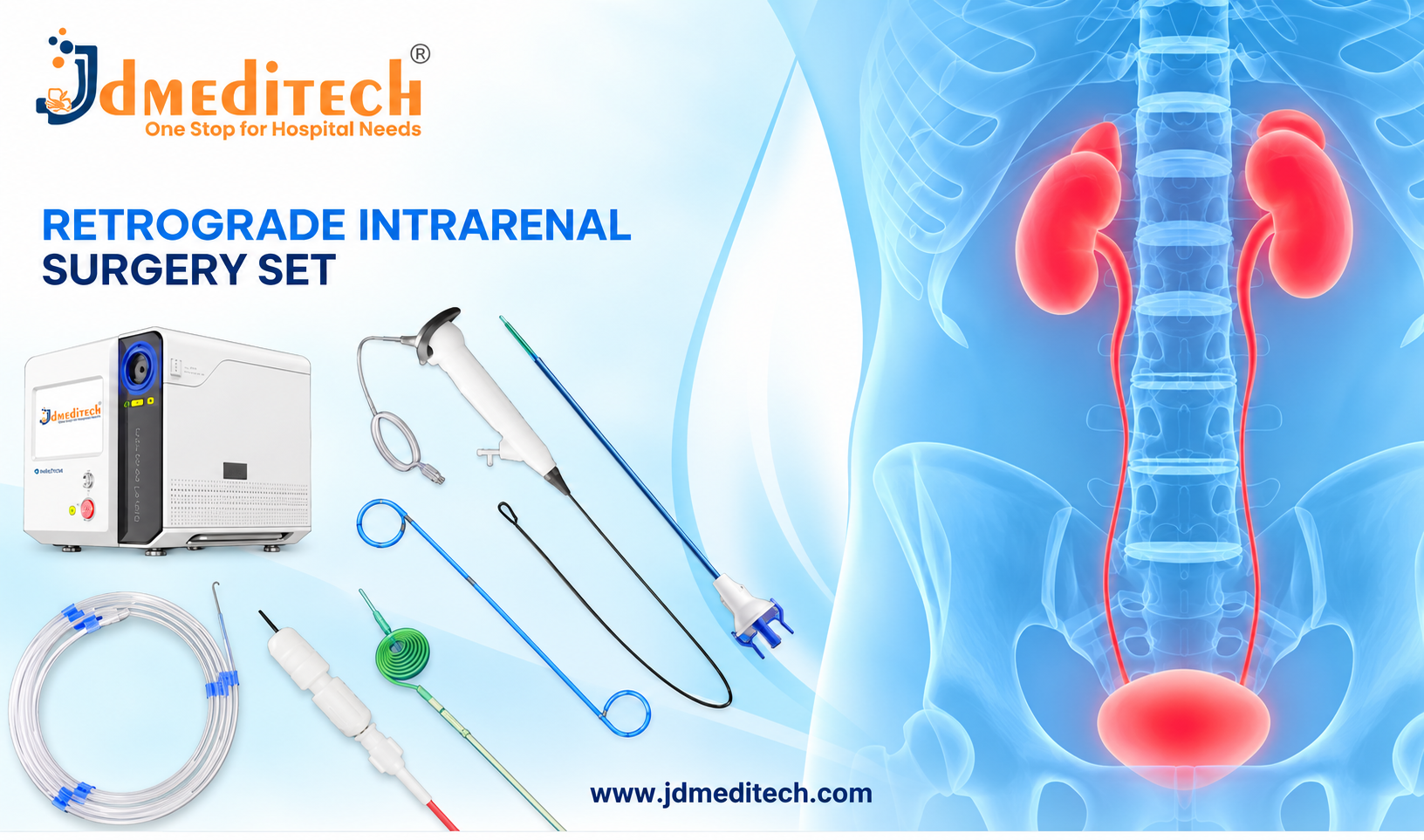
Retrograde Intrarenal Surgery Set: Instruments, Uses & Benefits
A Retrograde Intrarenal Surgery Set, commonly called an RIRS Set, includes specialized urology instruments used during endoscopic kidney stone treatment. This minimally invasive procedure allows urologists to reach the kidney through the natural urinary tract.
Moreover, RIRS is an established treatment option for selected kidney stones. It commonly involves a flexible ureteroscope and compatible laser lithotripsy equipment to fragment stones inside the kidney.
JDMeditech offers urology instruments and accessories for hospitals, surgical centers, and medical distributors worldwide. This article explains the instruments, features, applications, and important selection factors associated with an RIRS Set.
What Is a Retrograde Intrarenal Surgery Set?
A Retrograde Intrarenal Surgery Set is a collection of compatible endoscopic instruments used during selected procedures involving the kidney’s collecting system.
During RIRS, a urologist introduces a flexible ureteroscope through the urethra and bladder. The instrument then passes through the ureter to reach the kidney.
As a result, the surgeon can visualize selected kidney stones and perform treatment using appropriate instruments.
However, the exact equipment depends on the patient’s anatomy, stone characteristics, and planned procedure.
Common Instruments Used in an RIRS Set
Different RIRS procedures require different instruments. Therefore, hospitals should verify the complete equipment configuration before purchasing.
1. Flexible Ureteroscope
A flexible ureteroscope provides endoscopic access to the upper urinary tract. Its deflectable tip supports navigation within the kidney’s collecting system.
Moreover, a compatible working channel allows the use of selected accessories.
2. Urology Guide Wire
A guide wire helps establish and maintain access during selected endoscopic procedures.
In addition, suitable guide wires may assist with the introduction of compatible instruments. The selected diameter, length, and coating must match the intended use.
3. Ureteral Access Sheath
A ureteral access sheath may facilitate repeated passage of a flexible ureteroscope and compatible accessories.
Furthermore, selected sheath designs support irrigation outflow. However, access sheath placement is not necessary or appropriate in every case.
4. Laser Lithotripsy System
Laser lithotripsy equipment can fragment urinary stones during compatible RIRS procedures.
For example, holmium:YAG and thulium fiber laser systems are used for selected endoscopic stone treatments.
However, laser equipment and fibers must be compatible with the ureteroscope and approved for the intended procedure.
5. Laser Fiber
A compatible laser fiber delivers energy to the target stone during lithotripsy.
Therefore, the fiber diameter and operating specifications must be verified before use.
6. Stone Retrieval Basket
A stone retrieval basket can help capture and remove selected stone fragments.
Moreover, the basket must be compatible with the ureteroscope’s working channel and deflection requirements.
7. Double J Ureteral Stent
A Double J Stent may be placed after selected RIRS procedures to support urine drainage.
Nevertheless, routine stenting is not required after every uncomplicated ureteroscopy procedure.
8. Irrigation Accessories
Irrigation accessories support visibility during endoscopic kidney procedures.
In addition, appropriate fluid management helps the surgical team maintain suitable operating conditions.
9. Camera and Visualization System
Compatible camera equipment displays endoscopic images during surgery.
As a result, the surgeon can visualize the operative field and guide the selected instruments.
10. Additional Endoscopic Accessories
Depending on the procedure, the surgical team may use compatible dilators, connectors, or other accessories.
However, not every RIRS Set includes these components.
RIRS Set Components and Functions
| Instrument | Primary Function |
|---|---|
| Flexible Ureteroscope | Supports visualization and navigation inside the upper urinary tract |
| Guide Wire | Helps establish and maintain access |
| Ureteral Access Sheath | Facilitates selected instrument passages and irrigation outflow |
| Laser Lithotripsy System | Provides compatible energy for stone fragmentation |
| Laser Fiber | Delivers laser energy to the stone |
| Stone Retrieval Basket | Captures selected stone fragments |
| Double J Stent | Supports drainage when clinically indicated |
| Irrigation Accessories | Support fluid management and visualization |
| Camera System | Displays endoscopic images |
Importantly, these are common examples rather than a confirmed packing list for every RIRS Set.
Key Features of a Retrograde Intrarenal Surgery Set
1. Minimally Invasive Access
RIRS provides access to the kidney through the natural urinary tract.
Therefore, standard RIRS does not require an external surgical incision.
2. Flexible Endoscopic Navigation
A flexible ureteroscope supports navigation within selected areas of the kidney’s collecting system.
Moreover, its working channel can accommodate compatible instruments.
3. Laser Stone Fragmentation
Suitable laser equipment can fragment kidney stones during RIRS.
For example, compatible laser fibers deliver energy to the stone under endoscopic visualization.
4. Stone Retrieval Support
Selected retrieval baskets can remove suitable stone fragments.
However, the surgeon determines whether fragment extraction is required.
5. Compatible Instrument Configurations
Hospitals may select different ureteroscope systems and accessories according to their procedural requirements.
Consequently, compatibility verification remains an important purchasing consideration.
Applications of a Retrograde Intrarenal Surgery Set
A Retrograde Intrarenal Surgery Set is primarily associated with selected upper urinary tract stone procedures.
- Endoscopic treatment of selected kidney stones
- Flexible ureteroscopic laser lithotripsy
- Management of selected renal collecting-system stones
- Retrieval of suitable kidney stone fragments
- Selected upper ureteral stone procedures
- Endoscopic examination of the upper urinary tract
- Selected diagnostic procedures using compatible equipment
However, the choice of treatment depends on stone size, location, anatomy, and the patient’s clinical condition.
How Is Retrograde Intrarenal Surgery Performed?
RIRS is performed by trained urologists using suitable endoscopic equipment.
First, the clinical team evaluates the patient and reviews relevant imaging and laboratory results.
Next, the surgeon introduces appropriate instruments through the urethra and bladder to access the ureter.
During the procedure, a flexible ureteroscope is advanced toward the kidney’s collecting system.
Once the stone is identified, compatible lithotripsy equipment may be used to fragment it.
Afterward, selected fragments may be retrieved using suitable instruments.
Finally, the surgeon determines whether temporary ureteral stenting or additional treatment is necessary.
The exact procedure varies according to the patient’s condition and the selected treatment plan.
Benefits of Retrograde Intrarenal Surgery
1. No External Surgical Incision
RIRS uses natural urinary tract access rather than a conventional external incision.
As a result, it provides a minimally invasive treatment option for suitable patients.
2. Direct Stone Visualization
A flexible ureteroscope allows the surgeon to visualize selected stones inside the kidney.
Moreover, direct visualization supports controlled use of compatible instruments.
3. Laser Lithotripsy Compatibility
RIRS commonly uses suitable laser systems for urinary stone fragmentation.
Therefore, equipment compatibility is essential during procedure planning.
4. Selected Stone Retrieval
Compatible retrieval baskets may help remove selected stone fragments.
However, complete stone clearance cannot be guaranteed for every patient.
5. Alternative Treatment Option
RIRS may be considered alongside other kidney stone treatments.
Nevertheless, treatment suitability depends on clinical factors and professional judgment.
RIRS vs PCNL: What Is the Difference?
| Feature | RIRS | PCNL |
|---|---|---|
| Full Form | Retrograde Intrarenal Surgery | Percutaneous Nephrolithotomy |
| Access | Through the urinary tract | Through a small incision in the back |
| Common Equipment | Flexible ureteroscope and compatible accessories | Nephroscope and percutaneous access instruments |
| Stone Treatment | Endoscopic fragmentation and selected retrieval | Percutaneous fragmentation and removal |
| Selection | Based on stone and patient factors | Often preferred for larger or complex renal stone burdens |
Although both procedures treat kidney stones, they use different access methods.
Therefore, the treating urologist selects the appropriate approach based on the individual case.
RIRS vs ESWL: Key Differences
Retrograde intrarenal surgery and extracorporeal shock wave lithotripsy are different kidney stone treatment methods.
| Feature | RIRS | ESWL |
|---|---|---|
| Technique | Endoscopic stone treatment | External shock-wave treatment |
| Access | Through the urinary tract | No endoscope required |
| Stone Visualization | Endoscopic visualization | Imaging-guided targeting |
| Fragmentation | Compatible laser lithotripsy | Shock waves |
| Suitability | Depends on clinical factors | Depends on clinical factors |
Consequently, treatment selection should consider the stone characteristics and patient’s medical condition.
How to Choose the Right RIRS Set
Hospitals and medical distributors should review their procedural requirements before purchasing an RIRS Set.
First, identify the flexible ureteroscope system required for the planned procedures.
Next, confirm the compatibility of the selected instruments and accessories.
Important Selection Factors
- Flexible ureteroscope diameter and deflection
- Working-channel specifications
- Guide wire diameter and length
- Ureteral access sheath dimensions
- Laser system and fiber compatibility
- Stone retrieval basket specifications
- Irrigation and fluid management requirements
- Camera and visualization compatibility
- Reusable or single-use device classification
- Cleaning and sterilization instructions
- Manufacturer documentation
- Available instrument configurations
Furthermore, the purchasing team should verify the approved intended use of each device.
Safety and Maintenance Considerations
RIRS requires trained medical professionals, suitable equipment, and appropriate patient assessment.
Before surgery, the healthcare team should evaluate infection risk and inspect the instruments.
Moreover, reusable equipment requires validated reprocessing according to manufacturer instructions.
Potential complications include urinary tract infection, bleeding, ureteral injury, postoperative discomfort, and, in severe cases, sepsis.
Therefore, appropriate clinical monitoring and follow-up care are essential.
Retrograde Intrarenal Surgery Set by JDMeditech
JDMeditech offers urology surgical instruments and accessories for hospitals, healthcare institutions, and international medical distributors.
Our urology product range includes selected flexible ureteroscopes, guide wires, ureteral access sheaths, stone retrieval accessories, and related equipment.
In addition, our team supports technical inquiries, product configuration requests, and international supply requirements.
For information about available Retrograde Intrarenal Surgery Set configurations, contact JDMeditech.
Website: www.jdmeditech.com
Frequently Asked Questions About RIRS Sets
1. What is a Retrograde Intrarenal Surgery Set?
A Retrograde Intrarenal Surgery Set includes selected compatible instruments used during endoscopic kidney stone procedures.
2. What does RIRS stand for?
RIRS stands for Retrograde Intrarenal Surgery.
3. What is RIRS used for?
RIRS is primarily used to treat selected kidney stones through a minimally invasive endoscopic approach.
4. Which instruments are commonly used during RIRS?
Common instruments include a flexible ureteroscope, guide wire, laser lithotripsy equipment, irrigation accessories, and selected stone retrieval devices.
5. Does RIRS require an external incision?
No. Standard RIRS accesses the kidney through the natural urinary tract.
6. Is a Double J Stent always required after RIRS?
No. Stent placement depends on the clinical circumstances and is not mandatory after every uncomplicated procedure.
7. What is the difference between RIRS and PCNL?
RIRS accesses the kidney through the urinary tract, while PCNL uses a percutaneous approach through a small incision in the back.
8. Can RIRS treat every kidney stone?
No. Treatment suitability depends on stone size, location, anatomy, infection status, and other clinical factors.
9. Where can I inquire about JDMeditech RIRS instruments?
Hospitals and medical distributors can visit JDMeditech for product details, technical specifications, and quotations.
Conclusion
A Retrograde Intrarenal Surgery Set supports selected endoscopic procedures for kidney stone management.
Moreover, compatible instruments allow surgeons to visualize, fragment, and retrieve suitable stones.
Therefore, selecting the correct equipment configuration is important for appropriate clinical use.
Contact JDMeditech for RIRS instruments, flexible ureteroscopy accessories, and international medical device inquiries.
Medical Disclaimer: This article provides general educational information. Device selection and medical procedures must follow qualified clinical judgment and approved manufacturer instructions.




