



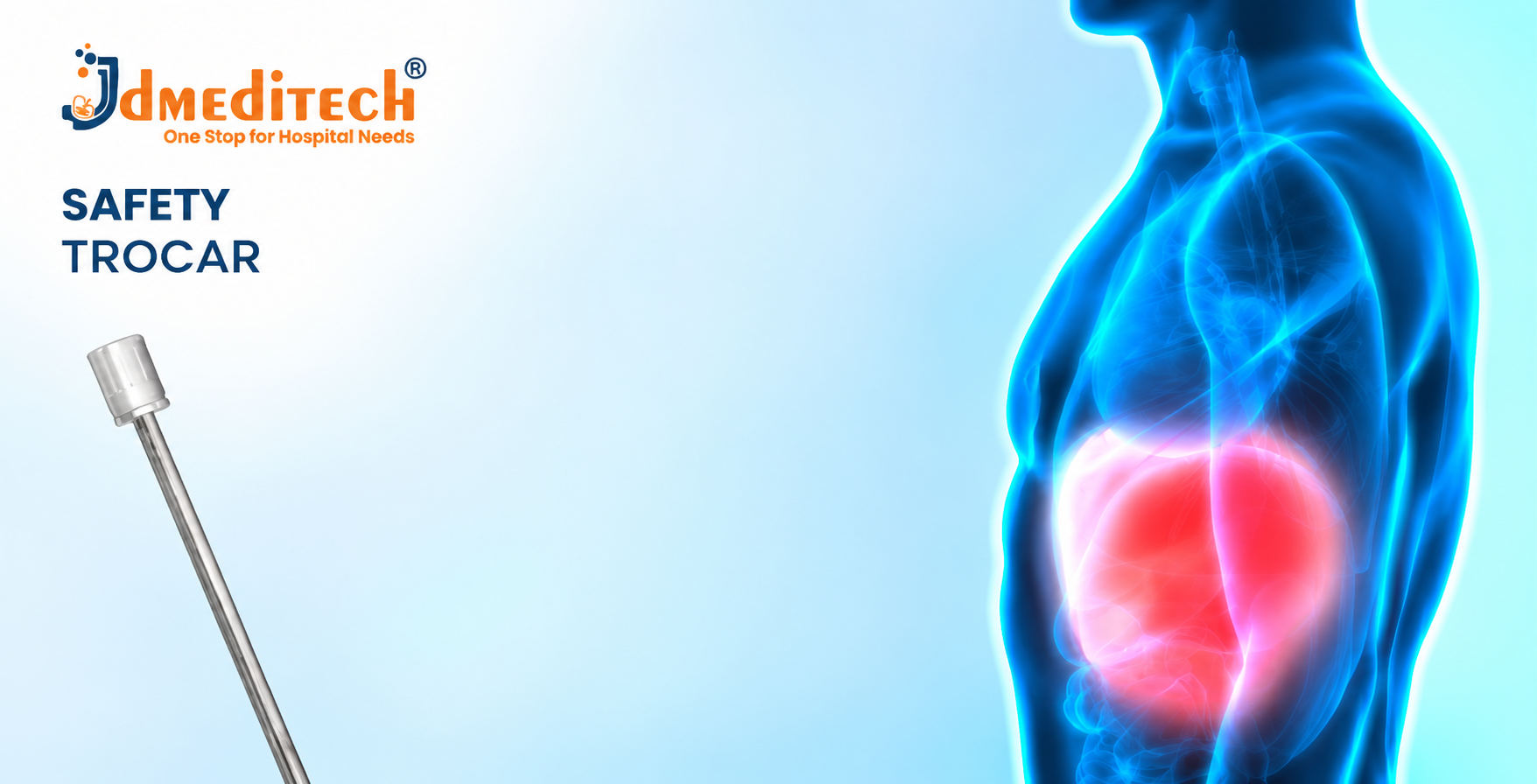
Safety Trocar – Features, Uses, Benefits and Specifications
A Safety Trocar is a surgical access instrument used during selected minimally invasive laparoscopic procedures. It helps surgeons establish an access pathway for compatible laparoscopic instruments.
Many safety trocar designs incorporate a protective shield or another mechanism intended to reduce exposure to the penetrating tip under specified conditions. However, safety mechanisms vary by model and cannot eliminate the risk of surgical injury.
Furthermore, trocar systems may include cannulas, obturators and gas sealing components. Therefore, surgeons must select an appropriate configuration for the planned procedure.
JDMeditech supplies laparoscopic instruments and surgical accessories for hospitals, surgical centers and medical distributors. Customers can contact our team for available product configurations and technical information.
What Is a Safety Trocar?
A Safety Trocar is a laparoscopic access device that incorporates a manufacturer-defined safety feature.
For example, some safety trocars use a spring-loaded protective shield that covers the penetrating tip under specified operating conditions.
However, other designs may use different protective mechanisms. Consequently, the product name alone does not establish the exact mechanism.
Additionally, safety trocars may feature different cannula sizes, obturator designs and sealing systems.
Purpose of a Safety Trocar
The primary purpose of a Safety Trocar is to support surgical access during compatible laparoscopic procedures.
Furthermore, its protective mechanism is intended to perform a specific safety-related function defined by the manufacturer.
However, the device does not replace careful surgical technique, appropriate patient assessment or professional training.
Importance of Safety Trocars in Laparoscopic Surgery
Laparoscopic surgery requires controlled access to the operative cavity.
Therefore, surgeons select access devices according to patient anatomy, procedural requirements and the intended entry technique.
Furthermore, a suitable trocar provides a passage for compatible laparoscopic instruments.
However, all trocar entry techniques carry potential risks. Consequently, trained surgical professionals must follow established safety protocols.
Main Components of a Safety Trocar
A typical Safety Trocar system may include the following components:
- Trocar Cannula
- Obturator
- Protective Shield or Safety Mechanism
- Proximal Housing
- Instrument Entry Port
- Sealing Mechanism
- Insufflation Gas Connector
- Stopcock or Valve
- Model-Specific Accessories
However, the exact configuration varies by manufacturer. Therefore, buyers should verify the supplied components against the official product datasheet.
1. Trocar Cannula
The cannula forms the main access channel for compatible laparoscopic instruments.
Furthermore, its internal diameter determines the approved instrument sizes.
Therefore, surgeons should verify the cannula dimensions before selecting a device.
2. Obturator
The obturator forms part of many trocar access systems.
Additionally, the obturator may incorporate a penetrating tip and a manufacturer-defined protective mechanism.
However, the exact tip design depends on the product model.
3. Protective Shield or Safety Mechanism
Many safety trocars incorporate a protective shield or another safety-related feature.
For example, a spring-loaded shield may cover the penetrating tip under specified conditions.
However, the shield may not prevent injury during insertion or in every clinical situation.
Therefore, users must follow the manufacturer’s instructions and understand the mechanism’s limitations.
4. Proximal Housing
The proximal housing forms the external portion of the trocar assembly.
Additionally, it may contain seals, valves or other functional components.
However, the exact design varies by model.
5. Instrument Entry Port
The instrument entry port allows compatible laparoscopic instruments to pass through the cannula.
Furthermore, an appropriate port configuration supports instrument introduction and exchange.
However, users should never force incompatible instruments through the device.
6. Sealing Mechanism
Many laparoscopic trocar systems include sealing components that help limit carbon dioxide leakage.
Additionally, selected designs accommodate different approved instrument diameters.
However, sealing performance depends on the specific device configuration.
7. Insufflation Gas Connector
Some safety trocar systems include a connector for carbon dioxide insufflation tubing.
Furthermore, this connection supports integration with compatible insufflation equipment.
However, users must confirm connector compatibility before surgery.
8. Stopcock or Valve
A stopcock or valve may allow controlled gas flow through the access assembly.
Additionally, correct valve operation supports the intended insufflation configuration.
However, not every safety trocar includes the same valve design.
Key Features of a Safety Trocar
Depending on the selected model, a Safety Trocar may offer:
- Dedicated Laparoscopic Access Channel
- Manufacturer-Defined Protective Mechanism
- Compatible Instrument Entry Port
- Different Cannula Diameters
- Different Cannula Lengths
- Model-Specific Obturator Design
- Optional Gas Sealing System
- Optional Insufflation Connector
- Optional Stopcock or Valve
- Single-Use or Reusable Configurations
However, customers should verify every feature against the official product specifications.
How Does a Safety Trocar Work?
A Safety Trocar provides an access channel for compatible laparoscopic instruments.
First, the surgeon selects an appropriate entry technique according to the patient’s anatomy and clinical circumstances.
Next, the surgical team uses the device according to its approved instructions.
Depending on the model, a protective shield or another safety mechanism may operate during the access process.
After establishing access, the cannula provides a pathway for compatible laparoscopic instruments.
Furthermore, a sealing mechanism may help limit insufflation gas leakage.
However, the safety mechanism does not guarantee injury-free entry.
Importance of the Protective Mechanism
The protective mechanism is a defining feature of many safety trocar designs.
Furthermore, manufacturers may design these mechanisms to cover or protect the penetrating tip under specified conditions.
However, the mechanism cannot eliminate all access-related risks.
Therefore, surgeons must understand the device’s intended operation and limitations.
Importance of Trocar Diameter
Trocar diameter determines the compatible laparoscopic instrument sizes.
Furthermore, different procedures may require different access diameters.
Therefore, surgeons should select an appropriate cannula size.
Importance of Trocar Length
Trocar length influences the access configuration.
Additionally, patient anatomy and surgical requirements may affect device selection.
Therefore, hospitals should verify the available lengths before purchasing.
Importance of Pneumoperitoneum Maintenance
Many laparoscopic procedures require controlled carbon dioxide insufflation.
Furthermore, compatible trocar seals may help limit gas leakage during instrument exchange.
However, the surgical team must monitor insufflation parameters and patient physiology.
Applications of a Safety Trocar
Surgeons may use safety trocars during selected laparoscopic procedures when the device’s intended use permits it.
- Laparoscopic General Surgery
- Selected Laparoscopic Cholecystectomy
- Selected Laparoscopic Appendectomy
- Selected Laparoscopic Hernia Surgery
- Selected Gynecological Laparoscopy
- Selected Laparoscopic Urological Procedures
- Diagnostic Laparoscopy
- Other Manufacturer-Approved Applications
Application in Laparoscopic General Surgery
General laparoscopic procedures require appropriate surgical access.
Therefore, surgeons select compatible trocar systems according to procedural requirements.
Furthermore, the selected device must accommodate the planned instruments.
Application in Laparoscopic Cholecystectomy
Laparoscopic cholecystectomy commonly requires multiple access ports.
Additionally, compatible safety trocars may provide instrument access when their intended use permits it.
However, the surgeon determines the appropriate port configuration.
Application in Laparoscopic Appendectomy
Laparoscopic appendectomy requires suitable access to the abdominal cavity.
Furthermore, compatible trocar systems support instrument introduction and exchange.
However, device selection depends on clinical circumstances.
Application in Laparoscopic Hernia Surgery
Selected laparoscopic hernia procedures require access to the operative space.
Additionally, safety trocars may support access when their specifications and intended use are appropriate.
However, different hernia techniques require different access configurations.
Application in Gynecological Laparoscopy
Gynecological laparoscopy uses specialized instruments and visualization systems.
Furthermore, compatible safety trocars may provide access channels for selected procedures.
However, patient anatomy and surgical requirements influence device selection.
Application in Laparoscopic Urology
Selected urological laparoscopic procedures require appropriate access instruments.
Additionally, trocar dimensions influence compatibility with the planned surgical equipment.
Therefore, the surgical team should verify the device configuration before use.
Technical Specifications of a Safety Trocar
Exact specifications depend on the manufacturer and product model. Therefore, buyers should request the official technical datasheet before placing an order.
| Parameter | Product Information |
|---|---|
| Product Name | Safety Trocar |
| Alternative Name | Laparoscopic Safety Trocar |
| Product Category | Laparoscopic Access Instrument |
| Primary Application | Selected Laparoscopic Procedures |
| Cannula Material | Confirm Manufacturer Specifications |
| Cannula Diameter | Confirm Available Sizes |
| Cannula Length | Confirm Available Sizes |
| Obturator Design | Confirm Product Configuration |
| Protective Mechanism | Confirm Manufacturer-Defined Function |
| Protective Shield | Model-Dependent |
| Sealing Mechanism | Model-Dependent |
| Insufflation Connector | Confirm Connector Configuration |
| Stopcock or Valve | Model-Dependent |
| Compatible Instrument Sizes | Confirm Official Specifications |
| Single-Use or Reusable | Confirm Product Labeling |
| Sterile Status | Confirm Product Labeling |
| Sterilization Method | Follow Manufacturer Instructions |
| Packaging | Confirm Supplied Configuration |
| Regulatory Documentation | Verify for Destination Market |
Potential Benefits of a Safety Trocar
When appropriately selected and used, a Safety Trocar may offer several practical advantages.
- Provides Access for Compatible Laparoscopic Instruments
- Supports Selected Minimally Invasive Procedures
- May Include a Protective Shield
- May Include a Model-Specific Safety Mechanism
- May Include a Gas Sealing System
- May Support Instrument Introduction and Exchange
- Available in Different Model Configurations
However, these characteristics do not guarantee improved clinical outcomes or eliminate entry-related risks.
Safety Trocar vs Conventional Trocar
| Feature | Safety Trocar | Conventional Trocar |
|---|---|---|
| Primary Function | Laparoscopic Instrument Access | Laparoscopic Instrument Access |
| Protective Mechanism | Manufacturer-Defined | Model-Dependent |
| Obturator Design | Model-Dependent | Model-Dependent |
| Gas Sealing System | May Be Included | May Be Included |
| Available Sizes | Manufacturer-Specific | Manufacturer-Specific |
| Clinical Selection | Based on Intended Use | Based on Intended Use |
| Entry-Related Risks | Remain Present | Remain Present |
Therefore, surgeons should compare verified specifications and clinical requirements rather than assume that a safety trocar eliminates access-related injuries.
Safety Trocar vs Bladeless Trocar
A Safety Trocar is identified by its manufacturer-defined protective mechanism.
In contrast, a bladeless trocar describes a particular obturator design.
Therefore, these terms describe different device characteristics.
Furthermore, the surgical team should verify the approved entry technique for each model.
Safety Trocar vs Hasson Trocar
A Hasson trocar is commonly associated with an open laparoscopic entry technique.
In contrast, a Safety Trocar is identified by a protective mechanism intended for its approved access approach.
However, neither designation guarantees injury-free entry.
Therefore, surgeons must select the appropriate device and technique.
Important Safety Precautions
Only appropriately trained surgical professionals should use safety trocars.
Furthermore, users must follow institutional protocols and manufacturer instructions.
- Confirm the Correct Product Model
- Inspect the Cannula and Obturator
- Verify the Protective Mechanism
- Check Instrument Compatibility
- Inspect Sealing Components
- Confirm Sterile Status
- Use an Approved Surgical Access Technique
- Monitor for Entry-Related Injury
- Check Insufflation Parameters
- Follow Manufacturer Instructions
Additionally, damaged or malfunctioning devices should not be used.
Potential Risks and Complications
Safety trocar use carries recognized surgical risks.
Potential complications include:
- Blood Vessel Injury
- Bowel Injury
- Injury to Other Internal Organs
- Bleeding
- Infection
- Gas Leakage
- Loss of Pneumoperitoneum
- Trocar Displacement
- Port-Site Complications
- Access-Related Tissue Injury
Therefore, careful surgical technique and appropriate monitoring remain essential.
Inspection Before Use
The surgical team should inspect the device according to the manufacturer’s instructions.
- Confirm Product Identification
- Inspect Packaging Integrity
- Verify Sterility and Expiry Date When Applicable
- Inspect the Cannula
- Check the Obturator
- Inspect the Protective Mechanism
- Check the Proximal Housing
- Inspect the Sealing Mechanism
- Confirm Instrument Compatibility
Furthermore, personnel should remove damaged instruments from service.
Cleaning and Reprocessing
Cleaning and reprocessing requirements depend on the product labeling.
For reusable devices, healthcare facilities must follow the manufacturer’s validated cleaning and sterilization instructions.
Additionally, protective shields, springs and seals may require specific handling.
However, users should not assume that all safety trocars support the same sterilization method.
Storage and Handling Guidelines
Proper storage helps protect surgical access instruments.
For example, facilities should protect the cannula and protective mechanism from mechanical damage.
Additionally, sterile products require storage conditions consistent with their labeling.
Therefore, hospitals should follow the manufacturer’s recommendations.
How to Choose the Right Safety Trocar
Hospitals and procurement teams should review several factors before purchasing.
- Intended Surgical Application
- Cannula Diameter
- Cannula Length
- Obturator Design
- Protective Mechanism
- Instrument Compatibility
- Sealing System
- Gas Connector Configuration
- Single-Use or Reusable Design
- Sterile Status
- Reprocessing Requirements
- Regulatory Documentation
Furthermore, the surgical team should confirm the final device selection.
Applications in Hospitals and Surgical Centers
Hospitals performing minimally invasive procedures require suitable laparoscopic access instruments.
Furthermore, different departments may need different trocar sizes and configurations.
Therefore, procurement teams should coordinate with operating room professionals.
Applications for Medical Distributors
Medical distributors should confirm trocar dimensions, protective mechanism and sterile status before preparing quotations.
Additionally, customers may request specific packaging or regulatory documentation.
Therefore, distributors should verify the official product datasheet.
Why Choose JDMeditech?
JDMeditech supplies laparoscopic instruments, surgical accessories and medical equipment for hospitals, surgical centers and medical distributors.
Furthermore, our team can assist customers with product inquiries, available configurations and technical information.
Customers can contact JDMeditech regarding:
- Safety Trocar Inquiries
- Available Trocar Sizes
- Laparoscopic Access Instruments
- Insufflation Accessories
- Hospital Procurement Requirements
- Medical Distributor Requests
- International Export Inquiries
However, exact availability and technical specifications require confirmation.
Frequently Asked Questions About Safety Trocars
1. What Is a Safety Trocar?
A Safety Trocar is a laparoscopic access instrument that incorporates a manufacturer-defined protective mechanism.
2. What Is Its Main Purpose?
Its primary purpose is to provide a passage for compatible laparoscopic instruments.
3. How Does a Safety Trocar Work?
Its cannula provides an access channel, while its protective mechanism performs a model-specific safety-related function.
4. Is It Used in Laparoscopic Surgery?
Yes. Surgeons may use it during selected laparoscopic procedures when the device’s intended use permits it.
5. Does a Safety Trocar Have a Protective Shield?
Many safety trocars include protective shields. However, the exact mechanism varies by model.
6. Does It Eliminate Entry-Related Injuries?
No. Safety mechanisms do not eliminate the risk of vascular, visceral or other access-related injuries.
7. Are Different Sizes Available?
Different sizes may be available depending on the manufacturer. Therefore, buyers should request the official size chart.
8. Is a Safety Trocar Reusable?
Some models are reusable, while others are single-use. Users must follow the product labeling.
9. Can It Be Autoclaved?
Only models with validated steam sterilization compatibility should undergo autoclaving.
10. Does It Include a Gas Connector?
Some safety trocars include an insufflation connector. Buyers should confirm compatibility.
11. What Is the Difference Between a Safety Trocar and a Hasson Trocar?
A Hasson trocar is associated with open laparoscopic entry, while a safety trocar is identified by its protective mechanism.
12. What Are the Main Risks?
Potential risks include vascular injury, visceral injury, bleeding, infection and port-site complications.
13. Who Should Use This Instrument?
Only appropriately trained surgical professionals should use laparoscopic trocars.
14. What Should Buyers Confirm Before Ordering?
Buyers should verify cannula dimensions, protective mechanism, sterile status, compatible instruments and regulatory documentation.
15. Where Can Customers Request Product Information?
Hospitals, surgical centers and medical distributors can contact JDMeditech for product information and quotations.
Conclusion
In conclusion, the Safety Trocar is a specialized surgical access instrument used in selected minimally invasive laparoscopic procedures.
Furthermore, many models incorporate protective mechanisms intended to perform specific safety-related functions.
However, safe use depends on appropriate device selection, surgical expertise and compliance with manufacturer instructions.
Therefore, hospitals should verify the exact specifications, protective mechanism and intended use before purchasing.
JDMeditech – One Stop for Hospital Needs
Website:
www.jdmeditech.com
Related Laparoscopy Instruments
- Disposable Trocar
- Laparoscopic Hasson Trocar
- Laparoscopic Magnetic Trocar
- Laparoscopic Multifunctional Trocar
- Veress Needle
- CO2 Insufflator Tubing
Medical Disclaimer
This article provides general educational and product information only. It does not replace professional surgical training, manufacturer instructions or clinical judgment. Healthcare professionals must verify product specifications, intended use, protective mechanism, sterile status and equipment compatibility before use.




