



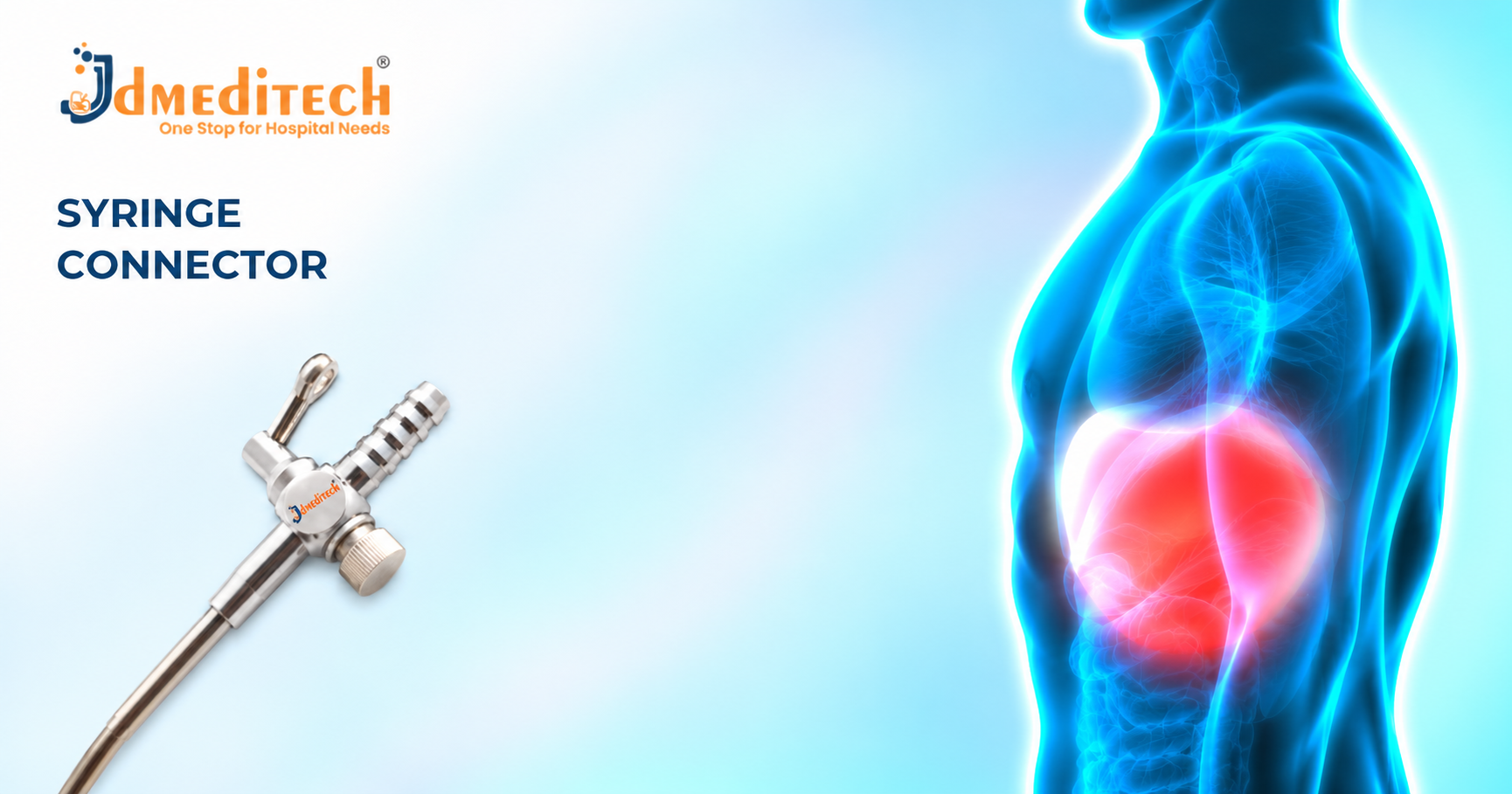
Syringe Connector – Features, Uses and Applications in Surgical Equipment
The Syringe Connector is a medical accessory designed to connect compatible syringes, tubing or designated equipment components. Depending on its configuration, the connector may provide multiple connection points within an approved medical system.
During surgical procedures, healthcare professionals use different accessories to manage fluid pathways and equipment connections. Therefore, selecting the correct connector helps establish the intended device arrangement.
Furthermore, some connector designs include a barbed tubing port, a syringe connection and a flow-control component. However, the exact function depends on the selected product and manufacturer instructions.
JDMeditech supplies surgical instruments, laparoscopic accessories and medical equipment for hospitals, surgical centers and medical distributors.
What Is a Syringe Connector?
A syringe connector is a medical fitting that provides a connection interface between compatible devices.
For example, some designs allow a syringe to connect with a tubing assembly. Additionally, certain models include multiple ports for a specified clinical application.
However, not every connector supports the same fluids, pressures or procedures. Therefore, users must verify the intended use before connecting equipment.
Purpose of a Syringe Connector
The main purpose is to establish a compatible connection between designated medical components.
Furthermore, some designs may support fluid introduction, aspiration or flow direction within an approved system.
However, these functions require manufacturer confirmation. Consequently, healthcare professionals must follow the device instructions.
Importance of Syringe Connectors in Medical Procedures
Medical procedures may require secure connections between syringes, tubing and specialized equipment.
Additionally, different devices use different connection standards and sizes.
Therefore, an appropriate connector helps support the intended equipment configuration.
However, a compatible-looking connection does not guarantee safe clinical use.
Main Components of a Syringe Connector
The illustrated accessory appears to include multiple connection points and a central assembly.
Depending on the model, components may include:
- Main Connector Body
- Syringe Connection Port
- Barbed Tubing Connection
- Additional Equipment Connection
- Internal Flow Passage
- Optional Flow-Control Mechanism
- Optional Sealing Components
However, the exact component arrangement requires confirmation from the official product datasheet.
1. Main Connector Body
The main body supports the connector’s different interfaces.
Furthermore, its construction determines the intended mechanical arrangement.
Therefore, buyers should verify the material and dimensions before ordering.
2. Syringe Connection Port
The syringe port provides a designated connection point for a compatible syringe.
Additionally, the connection may use a specified medical fitting design.
However, users should not assume that every port follows a standard Luer connection.
3. Barbed Tubing Connection
The illustrated product appears to include a ridged or barbed tubing interface.
Furthermore, this type of connection may accommodate compatible flexible tubing.
However, the tubing inner diameter and attachment method must match the manufacturer’s specifications.
4. Additional Equipment Connection
Some connectors include another port for a designated device or tubing component.
Additionally, the connection may support the intended flow pathway.
However, the actual function depends on the product configuration.
5. Internal Flow Passage
The connector may include internal channels between its ports.
Furthermore, these channels determine the available flow pathway.
However, internal dimensions and flow direction require manufacturer confirmation.
6. Optional Flow-Control Mechanism
Some multiport syringe connectors include a valve or stopcock mechanism.
For example, a specified valve may allow clinicians to control an approved fluid pathway.
However, the image alone does not establish the exact operating mechanism.
Key Features of Syringe Connectors
Depending on the selected configuration, syringe connectors may offer the following characteristics:
- Multiple Connection Interfaces
- Compact Accessory Design
- Compatibility With Selected Syringes
- Compatibility With Specified Medical Tubing
- Model-Specific Port Arrangement
- Optional Flow-Control Mechanism
- Different Available Connection Sizes
- Different Material Configurations
- Reusable or Single-Use Options, Where Applicable
However, customers should confirm actual features from the manufacturer.
How Does a Syringe Connector Work?
The connector provides an interface between approved medical components.
First, healthcare professionals identify the intended equipment and connection requirements.
Next, they select the connector specified for the approved system.
When correctly assembled according to the manufacturer instructions, the connector establishes the intended connection pathway.
However, the exact flow-control and operating method depend on the model.
Role in Medical Fluid Connections
Some medical systems require controlled fluid transfer between compatible components.
Furthermore, suitable connectors may form part of the approved tubing arrangement.
However, the intended fluid, pressure and flow conditions must match the product specifications.
Role in Aspiration Systems
Selected syringe connectors may support aspiration-related applications when specifically designed for that purpose.
Additionally, the connector may provide a connection between a syringe and designated tubing.
However, the product must be approved for the intended aspiration procedure.
Role in Laparoscopic Equipment
Laparoscopic equipment may use specialized connection accessories.
Furthermore, certain systems require syringes or tubing for designated functions.
However, this does not mean that every syringe connector is suitable for laparoscopy.
Therefore, healthcare facilities must confirm the intended application.
Importance of Correct Connection Compatibility
Medical devices use different connector designs and dimensions.
For example, some systems use Luer-type fittings, while others use manufacturer-specific connections.
Additionally, tubing ports may require a particular inner diameter.
Therefore, users must verify the complete connection specification before use.
Importance of Leak-Resistant Connections
Medical tubing assemblies may require secure connections for their intended operation.
Furthermore, an incompatible fitting may increase the risk of leakage or disconnection.
However, the connector’s appearance does not establish its sealing performance.
Therefore, healthcare professionals should follow the manufacturer’s assembly and inspection instructions.
Applications of Syringe Connectors
Depending on the approved model, syringe connectors may support different medical applications.
- Medical Tubing Assemblies
- Selected Surgical Equipment Connections
- Approved Fluid Transfer Systems
- Designated Aspiration Applications
- Compatible Syringe-Based Procedures
- Other Manufacturer-Approved Uses
However, the intended use must be verified for each product.
Application in Surgical Procedures
Surgical teams may use syringes and tubing for designated tasks.
Furthermore, suitable connectors can help establish the approved device arrangement.
However, the selected connector must match the procedure and equipment.
Application in Laparoscopic Surgery
Some laparoscopic systems use specialized fluid-handling accessories.
Additionally, compatible connectors may form part of an approved equipment setup.
However, clinicians must confirm that the connector is intended for the specific system.
Application in Hospital Equipment
Hospitals use different medical devices that require specified connections.
Furthermore, connector selection may depend on tubing dimensions, material and flow requirements.
Therefore, biomedical engineering teams should verify compatibility before procurement.
Types of Syringe Connectors
Medical connector designs vary according to the intended application.
Examples include:
- Straight Syringe Connector
- Multiport Syringe Connector
- Luer-Type Syringe Connector
- Barbed Tubing Connector
- Stopcock-Type Connector
- Manufacturer-Specific Surgical Connector
However, these categories are not automatically interchangeable.
Straight Syringe Connector
A straight connector provides an in-line connection between compatible components.
Furthermore, the connection dimensions must match the intended equipment.
Multiport Syringe Connector
A multiport design provides more than two connection interfaces.
Additionally, some models include a specified flow-control arrangement.
However, the number of ports does not establish the permitted flow directions.
Luer-Type Syringe Connector
A Luer-type connector uses a defined connection interface.
Furthermore, compatible devices must meet the applicable connection requirements.
However, customers should not assume that the illustrated product has a Luer connection without confirmation.
Barbed Tubing Connector
A barbed connector uses a shaped interface intended for suitable flexible tubing.
Additionally, tubing material and diameter influence the connection.
Therefore, buyers should verify the approved tubing specifications.
Technical Specifications of a Syringe Connector
Exact specifications depend on the selected model. Therefore, customers should request the official product datasheet.
| Parameter | Product Information |
|---|---|
| Product Name | Syringe Connector |
| Product Category | Surgical and Medical Equipment Accessory |
| Primary Function | Connection of Compatible Medical Components |
| Illustrated Design | Multi-Connection Fitting |
| Material | Confirm Manufacturer Specifications |
| Connection Type | Model-Specific |
| Syringe Port Specification | Confirm Official Dimensions |
| Tubing Connection Size | Confirm Compatible Tubing Diameter |
| Number of Functional Ports | Confirm Product Datasheet |
| Internal Bore Diameter | Model-Specific |
| Flow-Control Function | Confirm Manufacturer Specifications |
| Pressure Rating | Manufacturer Confirmation Required |
| Fluid Compatibility | Manufacturer Confirmation Required |
| Sterile Status | Confirm Product Labeling |
| Reusable Status | Confirm Product Labeling |
| Cleaning Requirements | Follow Manufacturer Instructions |
| Sterilization Compatibility | Verify Manufacturer Validation |
| Packaging | Confirm Supplied Configuration |
| Regulatory Documentation | Verify for Destination Market |
Importance of Material Selection
Medical connectors may use different metals or polymers.
Furthermore, material selection influences chemical compatibility, mechanical performance and reprocessing requirements.
However, the image alone cannot confirm the exact material.
Therefore, customers should request the manufacturer’s specifications.
Potential Benefits of Syringe Connectors
Appropriately selected connectors may provide several practical advantages.
- Connection Between Compatible Devices
- Support for Approved Tubing Assemblies
- Compact Accessory Construction
- Different Available Port Configurations
- Compatibility With Selected Syringes
- Model-Specific Flow-Control Features
- Different Connection Size Options
- Reusable Configurations, Where Applicable
Furthermore, suitable connectors may support the intended equipment setup.
However, these features do not independently guarantee improved clinical outcomes.
Important Safety Precautions
Only trained healthcare professionals should use medical syringe connectors in clinical settings.
Furthermore, personnel must verify the approved connection arrangement.
- Confirm Product Identification
- Verify Equipment Compatibility
- Check Syringe Connection Type
- Confirm Tubing Dimensions
- Inspect All Connection Ports
- Check for Cracks or Deformation
- Verify Intended Fluid Compatibility
- Confirm Pressure Limitations
- Follow Manufacturer Instructions
- Confirm Sterile Status When Required
Additionally, damaged or incompatible connectors should not be used.
Potential Risks of Incorrect Connector Use
Improper selection or use may create device-related concerns.
- Unintended Fluid Leakage
- Incompatible Connections
- Tubing Disconnection
- Flow Restriction
- Incorrect Flow Direction
- Connector Damage
- Contamination
- Improper Sealing
- Equipment Malfunction
Therefore, healthcare professionals must follow the manufacturer’s approved instructions.
Inspection Before Use
Healthcare personnel should inspect the connector before use.
- Confirm the Correct Model
- Inspect the Main Body
- Check the Syringe Port
- Examine the Tubing Interface
- Inspect Any Flow-Control Components
- Check for Corrosion or Damage
- Verify Compatible Equipment
- Confirm Product Integrity
- Follow Manufacturer Instructions
Furthermore, personnel should remove damaged components from service.
Cleaning and Reprocessing
Reusable connectors require appropriate cleaning and reprocessing.
Furthermore, internal channels and connection interfaces may require particular attention.
However, the validated cleaning method depends on the product design.
Therefore, facilities must follow the manufacturer’s instructions for use.
Sterilization Requirements
Sterilization compatibility depends on the connector’s intended use and material.
For example, some reusable accessories may support specified sterilization methods.
However, other products may be supplied for single use.
Therefore, users should not assume that every connector is autoclavable.
Storage and Handling Guidelines
Proper storage helps protect medical accessories.
For example, facilities should store clean connectors in designated areas.
Additionally, personnel should protect the connection interfaces from damage.
Therefore, hospitals should follow the manufacturer’s storage recommendations.
How to Choose the Right Syringe Connector
Hospitals and procurement teams should review several factors before purchasing.
- Intended Medical Application
- Compatible Syringe Type
- Required Connection Standard
- Tubing Inner Diameter
- Number of Ports
- Flow-Control Requirements
- Material Specification
- Pressure Rating
- Fluid Compatibility
- Reusable or Single-Use Status
- Sterile Packaging Requirements
- Regulatory Documentation
Furthermore, the clinical or biomedical engineering team should confirm the final product selection.
Applications in Hospitals
Hospitals use different syringe-based equipment and tubing systems.
Additionally, suitable connectors may form part of approved medical assemblies.
However, the required fitting depends on the hospital’s existing equipment.
Applications in Surgical Centers
Surgical centers may use specialized medical tubing and connection accessories.
Furthermore, compatible fittings support the intended equipment configuration.
However, facilities must verify the applicable safety requirements.
Applications for Medical Distributors
Medical distributors should confirm the required connector dimensions before preparing quotations.
For example, customers may request a specific syringe interface or tubing size.
Additionally, destination-market regulations may affect documentation requirements.
Therefore, distributors should request the official technical specifications.
Why Choose JDMeditech?
JDMeditech supplies surgical instruments, medical equipment and laparoscopic accessories for hospitals, surgical centers and medical distributors.
Furthermore, our team can assist customers with available product information, technical specifications and quotation requests.
Customers can contact JDMeditech regarding:
- Syringe Connector Inquiries
- Medical Tubing Connection Requirements
- Available Connector Configurations
- Surgical Equipment Accessories
- Hospital Procurement Requirements
- Medical Distributor Inquiries
- International Export Requests
However, exact availability, specifications and regulatory documentation require confirmation.
Frequently Asked Questions About Syringe Connectors
1. What Is a Syringe Connector?
It is a medical accessory that connects compatible syringes, tubing or designated equipment.
2. What Is the Main Purpose of a Syringe Connector?
Its primary purpose is to establish an approved connection between medical components.
3. How Does a Syringe Connector Work?
It provides a connection interface between compatible devices.
4. Are Different Connector Sizes Available?
Different configurations may be available. Therefore, customers should request the official size chart.
5. Can It Be Used With Every Syringe?
No. Compatibility depends on the connector design and applicable fitting standard.
6. Can It Connect Medical Tubing?
Some models include tubing connection interfaces. However, tubing dimensions must match the manufacturer’s specifications.
7. Does It Support Fluid Transfer?
Some connectors support approved fluid pathways. However, the intended application requires manufacturer confirmation.
8. Does It Include a Flow-Control Valve?
Some models include flow-control components. However, the illustrated product’s exact mechanism requires confirmation.
9. What Materials Are Used?
Materials vary by manufacturer. Therefore, buyers should verify the official product specifications.
10. Are Syringe Connectors Reusable?
Reusable configurations may exist. However, the manufacturer must confirm the intended use and reprocessing requirements.
11. Can These Connectors Be Autoclaved?
Some models may support validated steam sterilization. However, compatibility must be confirmed.
12. Can They Be Used in Surgical Procedures?
Yes, when the connector is approved for the intended procedure and equipment.
13. What Should Buyers Confirm Before Ordering?
Buyers should verify connection dimensions, material, intended use, pressure rating and regulatory documentation.
14. Why Is Correct Connector Selection Important?
Correct selection helps establish the intended connection and reduces the risk of incompatibility.
15. Where Can Customers Request Product Information?
Hospitals, surgical centers and medical distributors can contact JDMeditech for product information and quotations.
Conclusion
In conclusion, the Syringe Connector is a medical accessory designed to connect compatible syringes, tubing and designated equipment.
Furthermore, different models may offer different connection interfaces and port arrangements.
Additionally, suitable connectors may support approved fluid-handling applications.
However, safe use requires correct compatibility, appropriate inspection and compliance with manufacturer instructions.
Therefore, healthcare facilities should verify all technical specifications before purchasing.
JDMeditech – One Stop for Hospital Needs
Website:
www.jdmeditech.com
Related Surgical and Laparoscopy Products
- Laparoscopic Tubing Connector
- Laparoscopic Insufflation Tubing
- Laparoscopic Trocar
- Metal Trocar Reducer
- Plastic Trocar Reducer
- Laparoscopic Instrument Set
- Laparoscopic Equipment Accessories
Medical Disclaimer
This article provides general educational and product information only. It does not replace manufacturer instructions, surgical training or clinical judgment. Healthcare professionals must verify connector compatibility, intended use, fluid and pressure limitations, reprocessing requirements and applicable safety instructions before use.




