



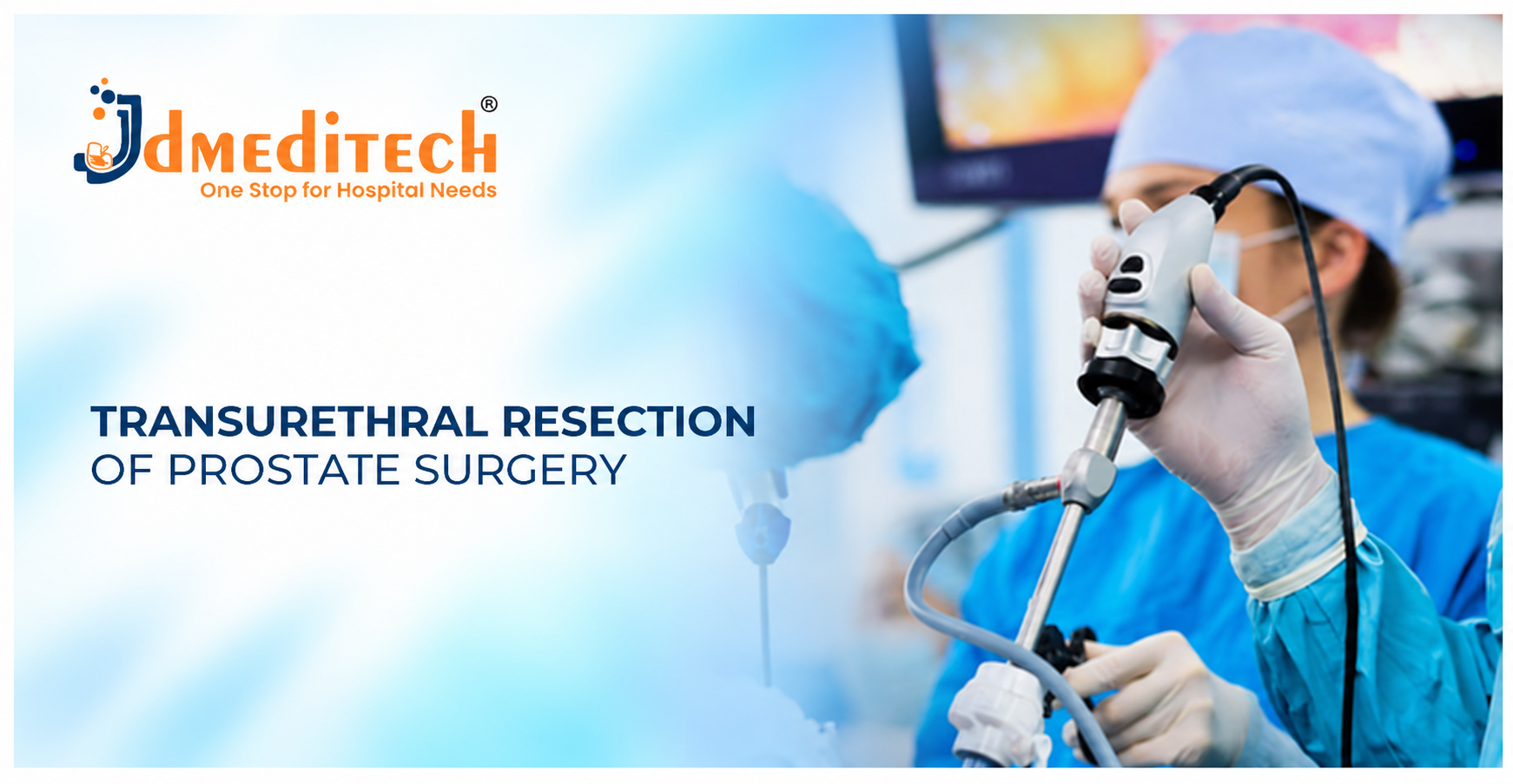
Transurethral Resection of Prostate (TURP) Surgery: Procedure, Instruments, Benefits and Recovery
Transurethral Resection of Prostate (TURP) Surgery is an established endoscopic procedure that treats urinary obstruction caused by an enlarged prostate. Doctors commonly recommend TURP for selected patients with benign prostatic hyperplasia, also known as BPH.
During TURP surgery, the urologist introduces a specialized instrument called a resectoscope through the urethra. The surgeon then removes prostate tissue that blocks urinary flow. As a result, urine can pass more freely through the urinary channel.
Furthermore, TURP does not usually require an external abdominal incision. However, the procedure still requires anesthesia, surgical expertise and appropriate postoperative care.
JDMeditech supplies urology surgical instruments, endoscopic equipment and related medical devices for hospitals, healthcare professionals and medical distributors.
What Is TURP Surgery?
TURP stands for Transurethral Resection of the Prostate. It is an endoscopic operation that removes obstructing prostate tissue through the urethra.
The prostate gland sits below the urinary bladder and surrounds part of the urethra. When the prostate enlarges, it may narrow the urinary passage.
Consequently, patients may experience weak urinary flow, difficulty starting urination or incomplete bladder emptying.
Therefore, TURP aims to relieve the obstruction and improve urinary symptoms in appropriately selected patients.
Understanding Benign Prostatic Hyperplasia
Benign prostatic hyperplasia, or BPH, refers to noncancerous enlargement of the prostate gland. It commonly develops with increasing age.
As the prostate enlarges, it may compress the urethra. Consequently, the bladder must work harder to empty urine.
However, prostate size does not always predict symptom severity. Therefore, doctors assess symptoms, urinary flow and bladder function before recommending treatment.
Common Symptoms of an Enlarged Prostate
BPH may cause several lower urinary tract symptoms. Additionally, symptoms can affect sleep and daily activities.
- Weak urinary stream
- Difficulty starting urination
- Frequent urination
- Urgent need to urinate
- Waking frequently at night to urinate
- Intermittent urinary flow
- Feeling that the bladder has not emptied completely
- Straining during urination
- Urinary retention in severe cases
However, similar symptoms can occur with other urinary conditions. Therefore, patients should consult a qualified urologist for diagnosis.
Why Is TURP Surgery Performed?
Doctors recommend TURP when prostate enlargement causes significant urinary obstruction or complications. In particular, surgery may help patients whose symptoms remain troublesome despite appropriate treatment.
- Moderate to severe urinary symptoms
- Persistent urinary obstruction
- Recurrent urinary retention
- Failure or intolerance of suitable medication
- Recurrent urinary tract infections related to obstruction
- Bladder stones associated with prostate obstruction
- Recurrent bleeding attributed to BPH in selected patients
- Kidney or bladder complications caused by prolonged obstruction
Furthermore, doctors consider patient preferences and other available treatments. Therefore, TURP is not necessary for every enlarged prostate.
Who May Be a Candidate for TURP Surgery?
Urologists evaluate several factors before recommending TURP. Most importantly, they determine whether prostate obstruction explains the patient’s symptoms.
- Severity of urinary symptoms
- Prostate size and anatomy
- Urinary flow measurements
- Post-void residual urine
- History of urinary retention
- Kidney function
- Response to medication
- Current medicines, including blood thinners
- General health and anesthesia fitness
- Patient treatment preferences
Additionally, doctors discuss possible effects on ejaculation and sexual function. Consequently, patients can make informed treatment decisions.
Diagnosis Before TURP Surgery
Before surgery, the urologist reviews the patient’s symptoms and medical history. Furthermore, the doctor may recommend diagnostic tests.
1. Physical Examination
The doctor evaluates general health and may examine the prostate when appropriate.
2. Urine Examination
Urine testing helps identify infection, blood or other abnormalities.
3. Prostate-Specific Antigen Test
Doctors may recommend a PSA test after discussing its benefits and limitations. However, PSA results alone cannot diagnose prostate cancer.
4. Ultrasound Examination
Ultrasound can help assess prostate size, bladder emptying and selected urinary tract abnormalities.
5. Uroflowmetry
Uroflowmetry measures urinary flow. Consequently, it helps evaluate possible obstruction.
6. Cystoscopy
The urologist may perform cystoscopy when additional examination of the urethra or bladder is necessary.
Types of TURP Surgery
Surgeons commonly use monopolar or bipolar electrosurgical systems for TURP. However, each technique requires compatible instruments and irrigation solutions.
1. Monopolar TURP
Monopolar TURP uses a monopolar electrosurgical system and a compatible resection electrode. Additionally, the procedure requires an appropriate nonconductive irrigation solution.
2. Bipolar TURP
Bipolar TURP uses a compatible bipolar resectoscope and electrosurgical generator. Many bipolar systems use normal saline irrigation.
As a result, bipolar TURP reduces the risk of classic dilutional TUR syndrome associated with absorption of hypotonic irrigation fluid. Nevertheless, fluid absorption and other complications can still occur.
How Is TURP Surgery Performed?
TURP involves several planned surgical stages. However, the exact approach depends on prostate anatomy, surgical equipment and patient requirements.
Step 1: Preoperative Preparation
First, the healthcare team reviews test results, medicines and the planned procedure.
Step 2: Anesthesia
Next, the anesthesia team administers suitable anesthesia, often spinal or general anesthesia.
Step 3: Resectoscope Introduction
The surgeon introduces the resectoscope through the urethra. Therefore, the procedure generally avoids external abdominal incisions.
Step 4: Prostate Examination
The surgeon examines the obstructing prostate tissue and surrounding anatomy.
Step 5: Tissue Resection
The surgeon removes selected prostate tissue using a compatible resection electrode. Meanwhile, irrigation supports endoscopic visibility.
Step 6: Tissue Fragment Removal
The surgical team removes resected tissue fragments using suitable instruments. Additionally, the team may send tissue for pathological examination.
Step 7: Bleeding Control
The surgeon evaluates the operative area and manages bleeding.
Step 8: Urinary Catheter Placement
Finally, the surgeon commonly places a urinary catheter. The healthcare team then monitors urine drainage and recovery.
Important: This overview provides general educational information only. Qualified urological surgeons must perform TURP according to established clinical protocols.
Surgical Instruments Used in TURP Surgery
TURP requires specialized endoscopic instruments, visualization equipment and compatible electrosurgical accessories. Furthermore, the selected system determines the instrument configuration.
- TURP Resectoscope: Provides endoscopic access to the prostate.
- Resectoscope Outer Sheath: Supports access and irrigation according to its design.
- Resectoscope Inner Sheath: Supports compatible working components.
- Working Element: Controls movement of the resection electrode.
- Resection Loop Electrode: Removes obstructing prostate tissue.
- Coagulation Electrode: Supports bleeding control with a compatible system.
- Endoscopic Telescope: Provides visualization of the operative area.
- Camera System: Displays the endoscopic view on a monitor.
- Medical Light Source: Illuminates the surgical field.
- Electrosurgical Generator: Supplies controlled electrical energy to compatible instruments.
- Irrigation System: Supports visibility during surgery.
- Ellik Evacuator: May assist with removal of resected tissue fragments.
- Three-Way Foley Catheter: May support bladder drainage and continuous irrigation after surgery.
- Urine Collection Bag: Collects drained urine during recovery.
Additionally, hospitals should confirm compatibility between the resectoscope, electrodes, generator and irrigation system.
Technical Specifications of TURP Surgical Instruments
Hospitals should verify product specifications before selecting TURP equipment. In particular, they should confirm instrument diameter, working length, telescope compatibility and reprocessing requirements.
| Parameter | Specification |
|---|---|
| Procedure | Transurethral Resection of Prostate |
| Abbreviation | TURP |
| Category | Urology / Endoscopic Surgery |
| Primary Application | Resection of obstructing prostate tissue |
| Resectoscope Type | Monopolar or bipolar, according to selected model |
| Resectoscope Diameter | Confirm available sizes with JDMeditech |
| Working Element | According to selected system |
| Electrode Configuration | Compatible resection and coagulation electrodes |
| Telescope Compatibility | According to product specifications |
| Electrosurgical Generator | Compatible monopolar or bipolar system |
| Irrigation Solution | According to system instructions |
| Catheter Configuration | According to postoperative requirements |
| Sterility and Reprocessing | Follow individual product labeling |
| Reusable or Single Use | According to manufacturer instructions |
| Supplier | JDMeditech |
Benefits of TURP Surgery
TURP can provide meaningful relief from urinary obstruction in suitable patients. Most importantly, it removes tissue that narrows the urethra.
- May improve urinary flow.
- Can reduce difficulty starting urination.
- May improve bladder emptying.
- Can reduce urinary frequency and urgency.
- May reduce nighttime urination.
- Offers an established treatment for symptomatic BPH.
- Usually avoids an external abdominal incision.
- May reduce complications caused by persistent urinary obstruction.
However, symptom improvement varies between patients. Therefore, doctors discuss expected outcomes before surgery.
Monopolar TURP vs. Bipolar TURP
Both techniques remove obstructing prostate tissue. However, their electrosurgical systems and irrigation requirements differ.
| Feature | Monopolar TURP | Bipolar TURP |
|---|---|---|
| Energy System | Monopolar electrosurgery | Bipolar electrosurgery |
| Resection Electrode | Compatible monopolar loop | Compatible bipolar loop |
| Irrigation | Suitable nonconductive irrigation solution | Normal saline commonly used |
| Classic TUR Syndrome Risk | Associated with hypotonic irrigation fluid absorption | Substantially reduced with saline irrigation |
| Equipment Requirements | Compatible monopolar system | Compatible bipolar system |
TURP vs. HoLEP Surgery
Holmium Laser Enucleation of the Prostate, or HoLEP, is another surgical treatment for BPH. Unlike TURP, HoLEP uses a holmium laser to separate obstructing prostate tissue.
Both procedures can improve urinary symptoms. However, HoLEP may offer advantages for selected patients with larger prostates.
Furthermore, equipment availability and surgeon expertise influence treatment selection. Therefore, patients should discuss the available options with their urologist.
TURP vs. Open Prostate Surgery
TURP removes obstructing prostate tissue through the urethra. In contrast, simple open prostatectomy uses an abdominal surgical approach to remove enlarged inner prostate tissue.
Consequently, TURP generally involves less extensive surgical access. However, surgeons may recommend other procedures for very large prostates or complex cases.
Importantly, simple prostatectomy for BPH differs from radical prostatectomy for prostate cancer.
Possible Risks and Complications of TURP Surgery
TURP is an established procedure, but it still carries surgical risks. Therefore, patients should understand possible complications.
- Bleeding
- Urinary tract infection
- Temporary urinary discomfort
- Temporary urinary retention
- Urethral stricture
- Bladder neck contracture
- Urinary incontinence
- Retrograde ejaculation
- Changes in erectile function
- Fluid absorption complications
- TUR syndrome, particularly with monopolar techniques using hypotonic irrigation
- Need for additional treatment
- Anesthesia-related complications
Furthermore, complication risk depends on prostate size, surgical technique and patient health. Consequently, careful evaluation remains important.
What Is Retrograde Ejaculation After TURP?
Retrograde ejaculation occurs when semen travels backward into the bladder during ejaculation rather than exiting through the penis.
This change is common after TURP. However, it does not necessarily prevent orgasm.
Nevertheless, retrograde ejaculation can affect fertility. Therefore, patients who wish to have children should discuss this risk before surgery.
What Is TUR Syndrome?
TUR syndrome is a potentially serious complication associated with absorption of certain irrigation fluids during transurethral surgery.
Classic TUR syndrome can cause dilutional low blood sodium and neurological or cardiovascular symptoms. However, modern bipolar systems using saline substantially reduce this specific risk.
Nevertheless, fluid overload can still occur. Therefore, the surgical team monitors fluid management carefully.
Recovery After TURP Surgery
Recovery varies according to prostate size, surgical technique and patient health. Many patients require a short hospital stay, although some need longer observation.
After surgery, the healthcare team monitors urinary drainage and bleeding. Additionally, the surgeon may recommend temporary bladder irrigation through a catheter.
Patients may notice urinary urgency, mild discomfort or blood in the urine during early recovery. However, severe bleeding or inability to urinate requires prompt medical attention.
Postoperative Care After TURP Surgery
Patients should follow their urologist’s recovery instructions. Furthermore, appropriate postoperative care helps identify complications early.
- Take prescribed medicines as directed.
- Drink fluids according to medical advice.
- Follow urinary catheter instructions.
- Avoid heavy lifting until approved.
- Avoid strenuous activity during the recommended recovery period.
- Follow advice about sexual activity.
- Attend scheduled follow-up appointments.
- Report fever or worsening urinary pain.
- Seek medical attention for heavy bleeding or large blood clots.
- Seek urgent care if unable to urinate.
Additionally, patients should ask their surgeon when they can safely resume work and normal activities.
How Long Does TURP Surgery Take?
The operation often takes approximately one to two hours. However, the duration varies according to prostate size and surgical complexity.
Furthermore, anesthesia preparation and postoperative monitoring add to the total hospital time. Therefore, the surgeon provides an individualized estimate.
How Long Does It Take to Recover From TURP?
Many patients gradually return to routine activities over several weeks. However, full healing and stabilization of urinary symptoms may take longer.
Additionally, temporary urinary urgency or frequency can occur during recovery. Therefore, patients should follow their postoperative care plan.
Can Prostate Tissue Grow Again After TURP?
Yes. TURP removes obstructing inner prostate tissue but does not remove the entire prostate gland. Consequently, some patients may develop recurrent symptoms over time.
However, many patients experience long-lasting improvement. Therefore, follow-up helps identify persistent or returning urinary problems.
Does TURP Surgery Treat Prostate Cancer?
TURP primarily treats urinary obstruction caused by benign prostate enlargement. It is not a standard curative treatment for prostate cancer.
However, doctors may use TURP in selected situations to relieve urinary obstruction in patients with prostate cancer.
Therefore, patients should distinguish TURP from radical prostatectomy and other cancer treatments.
How to Select TURP Surgical Instruments
Hospitals should consider several factors before selecting TURP equipment. In particular, instrument compatibility and intended use remain essential.
- Monopolar or bipolar system requirements
- Resectoscope sheath diameter
- Working element configuration
- Resection electrode compatibility
- Endoscopic telescope requirements
- Camera and light source compatibility
- Electrosurgical generator compatibility
- Irrigation system requirements
- Cleaning and sterilization instructions
- Product technical documentation
Additionally, healthcare professionals should verify compatibility between the generator, working element and electrodes before use.
Why Choose JDMeditech for TURP Surgical Instruments?
JDMeditech supplies urology surgical instruments and medical devices for hospitals, urologists, healthcare facilities and medical distributors.
Our product portfolio includes endoscopic instruments and accessories for various diagnostic and surgical applications. Furthermore, customers can inquire about available TURP instruments and compatible components.
- TURP resectoscope inquiries
- Resectoscope sheaths
- Working elements
- Resection electrodes
- Endoscopic telescopes and accessories
- Urology surgical instruments
- Urinary catheters and drainage accessories
- International export inquiries
- Technical specifications upon request
Additionally, customers can contact JDMeditech for available product configurations and documentation.
Frequently Asked Questions About TURP Surgery
1. What is TURP surgery?
TURP is an endoscopic procedure that removes obstructing prostate tissue. As a result, it can improve urinary flow.
2. What does TURP stand for?
TURP stands for Transurethral Resection of the Prostate.
3. Why do doctors recommend TURP?
Doctors recommend TURP for selected patients with urinary obstruction caused by BPH.
4. Is TURP major surgery?
TURP is an endoscopic operation without an external abdominal incision. However, it still requires anesthesia and carries surgical risks.
5. What instruments are used during TURP?
Surgeons use resectoscopes, working elements, resection electrodes, telescopes and compatible electrosurgical equipment.
6. What is the difference between monopolar and bipolar TURP?
They use different electrosurgical systems. Additionally, their compatible irrigation solutions differ.
7. How long does TURP surgery take?
The procedure often takes approximately one to two hours. However, the exact duration varies.
8. Will I need a catheter after TURP?
Yes, doctors commonly place a temporary urinary catheter. The duration depends on postoperative recovery.
9. How long does recovery take?
Many patients recover over several weeks. Nevertheless, full healing may take longer.
10. Can TURP improve urine flow?
Yes. TURP removes tissue that obstructs the urethra. Consequently, many patients experience improved urinary flow.
11. Can TURP affect ejaculation?
Yes. Retrograde ejaculation is common after TURP. Therefore, patients should discuss fertility concerns before surgery.
12. Is TURP used for prostate cancer?
TURP primarily treats BPH-related obstruction. However, doctors may use it to relieve obstruction in selected cancer patients.
13. Can the prostate enlarge again after TURP?
Yes. Some prostate tissue remains after TURP. Consequently, symptoms may return over time.
14. Is bipolar TURP safer than monopolar TURP?
Bipolar TURP reduces the risk of classic dilutional TUR syndrome. However, both techniques carry surgical risks.
15. Where can I inquire about TURP surgical instruments?
Hospitals and medical distributors can contact JDMeditech for information about available TURP instruments and accessories.
Conclusion
TURP Surgery is an established treatment for urinary obstruction caused by benign prostate enlargement. It removes obstructing prostate tissue through the urethra.
Furthermore, appropriate patient selection and compatible surgical equipment support treatment planning. However, patients should understand the risks and possible effects on urinary and sexual function.
Therefore, a qualified urologist should guide treatment decisions and postoperative follow-up.
JDMeditech – One Stop for Hospital Needs
Explore our range of resectoscope instruments, working elements, endoscopic equipment and urology surgical accessories.
Website:
www.jdmeditech.com
Medical References
- European Association of Urology – Management of Male Lower Urinary Tract Symptoms
- NIDDK – Benign Prostatic Hyperplasia
- NHS – Transurethral Resection of the Prostate
Medical Disclaimer: This article provides general educational information only. It does not replace professional medical advice, surgical training or the manufacturer’s instructions for use. Qualified healthcare professionals must select treatment and equipment according to individual clinical requirements.




