



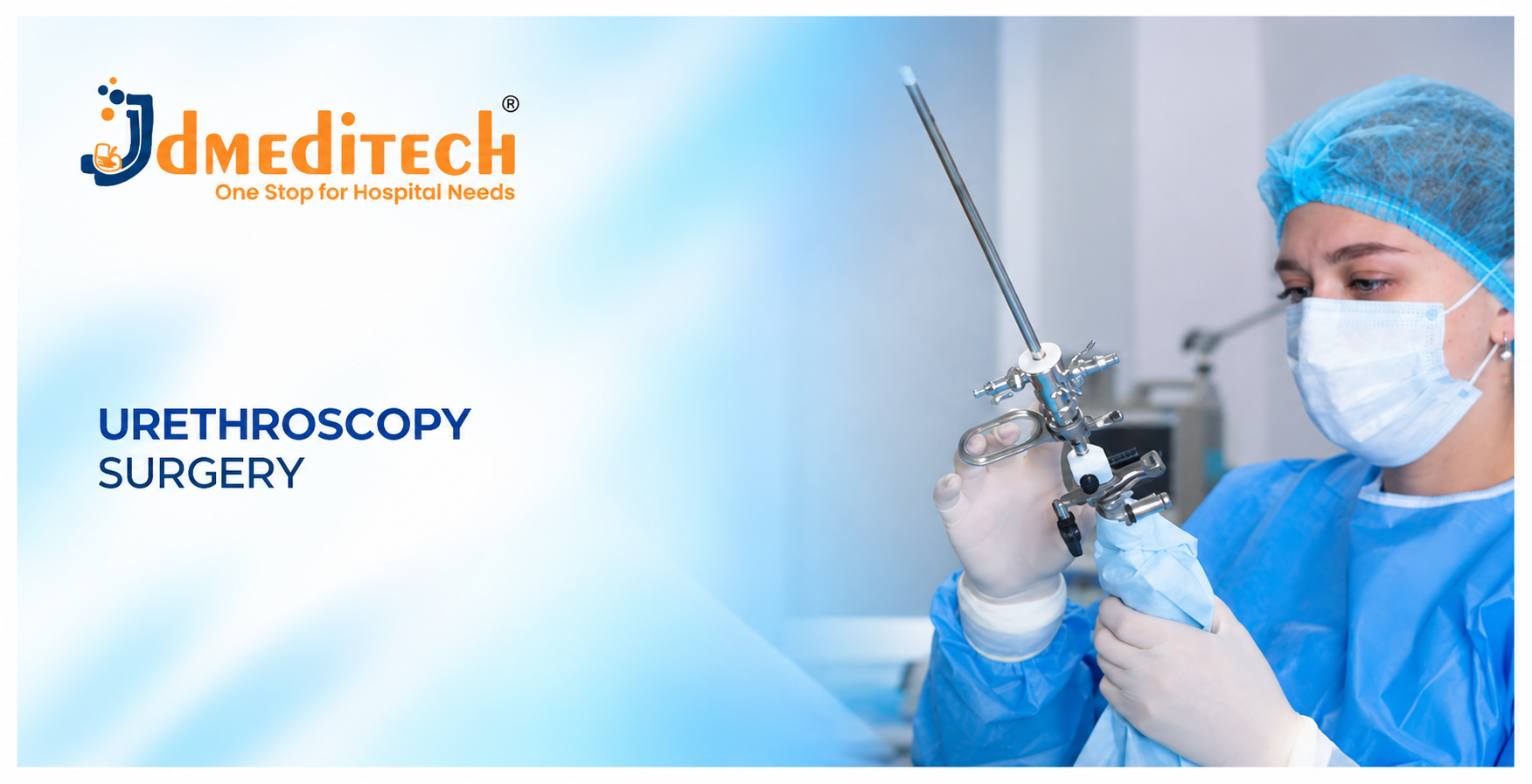
Urethroscopy Surgery: Procedure, Surgical Instruments, Benefits and Recovery
Urethroscopy Surgery is an endoscopic procedure that allows a urologist to examine the inside of the urethra. Using a specialized instrument called a urethroscope, doctors can identify narrowing, inflammation, injuries and other abnormalities.
The urethra carries urine from the bladder to the outside of the body. Therefore, any obstruction or abnormality within this passage may affect normal urination.
Fortunately, urethroscopy provides direct visualization of the urethral lining. As a result, doctors can assess selected urinary conditions and determine whether further treatment is necessary.
Furthermore, some endoscopic procedures allow doctors to perform treatment during the same session. However, the exact procedure depends on the patient’s condition and the instruments available.
JDMeditech supplies urology surgical instruments, endoscopic equipment and related medical devices for hospitals, healthcare professionals and medical distributors.
What Is Urethroscopy Surgery?
Urethroscopy is a medical procedure that uses a thin endoscopic instrument to examine the urethra.
During the examination, the urologist introduces a suitable urethroscope through the urethral opening. The instrument provides a view of the internal urinary passage.
Consequently, the doctor can identify certain abnormalities and assess the condition of the urethral lining.
However, diagnostic urethroscopy does not always involve surgery. In many cases, it serves as an examination rather than a treatment.
Understanding the Urethra
The urethra is a tube that carries urine from the bladder to the outside of the body. In men, it also carries semen during ejaculation.
However, the anatomy of the urethra differs between men and women. Therefore, the urologist selects suitable instruments according to the patient’s anatomy.
Furthermore, inflammation, injury or scar tissue can narrow the urethra. Consequently, patients may experience difficulty urinating.
Why Is Urethroscopy Performed?
Doctors perform urethroscopy to examine the urethra and investigate selected urinary symptoms. Additionally, it may help guide further diagnostic or surgical treatment.
- Evaluation of suspected urethral stricture
- Investigation of urinary obstruction
- Assessment of selected urethral injuries
- Evaluation of persistent urinary symptoms
- Investigation of certain urethral abnormalities
- Assessment of suspected urethral lesions
- Evaluation before selected urethral procedures
- Follow-up after certain urethral treatments
However, urethroscopy is not necessary for every urinary complaint. Therefore, doctors recommend it only when clinically appropriate.
Common Symptoms That May Require Urethroscopy
Several urinary symptoms may lead a doctor to consider urethral examination. However, these symptoms can also result from other conditions.
- Weak urinary stream
- Difficulty starting urination
- Interrupted urinary flow
- Straining during urination
- Burning during urination
- Frequent urinary infections
- Incomplete bladder emptying
- Urinary retention
- Blood in the urine
- Persistent urinary discomfort
Therefore, a qualified healthcare professional should evaluate the symptoms before recommending urethroscopy.
Medical Conditions Diagnosed Through Urethroscopy
Urethroscopy can help identify several conditions affecting the urethra. Furthermore, direct visualization may support treatment planning.
Urethral Stricture
A urethral stricture occurs when scar tissue narrows the urethra. Consequently, urine may pass more slowly through the narrowed area.
Additionally, the condition may cause urinary retention or recurrent urinary infections.
Urethral Inflammation
Inflammation can affect the urethral lining. However, doctors often diagnose urethritis through clinical assessment and laboratory testing rather than urethroscopy alone.
Therefore, the urologist considers the patient’s symptoms and medical history before selecting investigations.
Urethral Injury
Injury can damage the urethral passage. In selected cases, endoscopic examination may help assess the affected area.
However, suspected major urethral trauma often requires imaging before instrumentation. Therefore, doctors follow appropriate trauma evaluation protocols.
Urethral Stones
Urinary stones may occasionally become lodged within the urethra. Consequently, patients may develop pain or difficulty urinating.
Furthermore, endoscopic examination can help identify a stone when clinically appropriate.
Urethral Lesions
Urethroscopy may help identify abnormal growths or lesions within the urethra. However, direct visualization alone may not establish a final diagnosis.
Therefore, doctors may recommend additional investigations or tissue sampling.
Types of Urethroscopy
Doctors can use different endoscopic instruments depending on the clinical purpose. Furthermore, instrument selection depends on urethral anatomy and the planned examination.
Rigid Urethroscopy
Rigid urethroscopy uses a straight endoscopic instrument. It can provide clear visualization and support selected procedures.
However, the urologist must consider patient anatomy and comfort when choosing the instrument.
Flexible Urethroscopy
Flexible urethroscopy uses a flexible endoscope to examine the urinary passage. Consequently, the instrument can adapt to the natural curvature of the urethra.
Additionally, flexible instruments may improve patient comfort in selected settings.
Diagnostic Urethroscopy
Diagnostic urethroscopy focuses on examining the urethra and identifying abnormalities.
Therefore, the doctor may use the findings to plan further tests or treatment.
Operative Urethroscopy
Operative urethroscopy involves endoscopic treatment of selected urethral conditions. However, the exact procedure depends on the diagnosis.
For example, a urologist may perform a separate procedure such as direct vision internal urethrotomy for an appropriately selected urethral stricture.
How Is Urethroscopy Performed?
Urethroscopy involves several planned clinical stages. However, the exact method depends on the patient’s condition, the instrument and the examination setting.
Step 1: Patient Evaluation
First, the doctor reviews symptoms, medical history and relevant investigations. Additionally, the healthcare team confirms the reason for the examination.
Step 2: Patient Preparation
Next, the healthcare team prepares the patient and explains the procedure. Furthermore, the team checks for factors such as urinary infection or previous urethral injury.
Step 3: Anesthesia or Local Anesthetic
The doctor selects suitable pain control according to the planned procedure. For example, some diagnostic examinations use local anesthetic gel.
However, operative procedures may require regional or general anesthesia.
Step 4: Endoscopic Examination
The urologist introduces the selected endoscope through the urethral opening. Consequently, the doctor can examine the urethral lining under direct visualization.
Step 5: Identification of Abnormalities
The doctor examines the urethra for narrowing, lesions or other abnormalities. Additionally, the findings may guide further investigation.
Step 6: Additional Treatment When Indicated
In selected cases, the doctor may perform a planned therapeutic procedure. However, diagnostic urethroscopy does not automatically involve treatment.
Step 7: Completion and Recovery
Finally, the healthcare team completes the examination and monitors the patient as required.
Important: This description provides general educational information only. Qualified healthcare professionals must perform urethroscopy according to established clinical protocols and device instructions.
Surgical Instruments Used in Urethroscopy
Urethroscopy requires specialized endoscopic instruments and compatible visualization equipment. Furthermore, the selected procedure determines the exact accessories.
- Rigid Urethroscope: Provides direct visualization of the urethra.
- Flexible Urethroscope: Supports examination using a flexible endoscope.
- Endoscopic Telescope: Provides visualization in compatible rigid systems.
- Urethroscope Sheath: Supports the endoscope and selected accessories.
- Endoscopic Camera: Displays images on a monitor.
- Medical Light Source: Illuminates the examination area.
- Irrigation System: Supports visibility when required.
- Endoscopic Grasping Forceps: May support selected operative procedures.
- Guide Wire: May assist certain related urological procedures when indicated.
- Urethral Catheter: Supports urinary drainage when clinically necessary.
- Urine Collection Bag: Collects urine when catheter drainage is required.
Additionally, hospitals should verify compatibility between the endoscope, camera, light source and accessories.
Rigid Urethroscope
A rigid urethroscope provides a direct view of the urethral passage. Furthermore, it can support selected diagnostic and operative applications.
However, instrument diameter and configuration vary between manufacturers. Therefore, hospitals should confirm technical specifications before purchasing.
Flexible Urethroscope
A flexible urethroscope uses a flexible insertion section to examine the urethra. Consequently, it may improve access and comfort in selected patients.
Furthermore, flexible endoscopes may use fiberoptic or digital imaging technology. Therefore, the selected system determines the required accessories.
Endoscopic Telescope and Camera
The telescope and camera provide visualization during urethroscopy. Additionally, the monitor allows the healthcare team to observe the examination.
However, camera compatibility and optical specifications depend on the selected system.
Medical Light Source
A medical light source illuminates the endoscopic field. Consequently, it supports clear visualization during examination.
Furthermore, the light source must be compatible with the selected endoscope and light cable.
Irrigation System for Urethroscopy
An irrigation system may help maintain visibility during selected endoscopic procedures. However, irrigation requirements depend on the examination and instrument design.
Therefore, the healthcare team should follow the manufacturer’s instructions and clinical protocols.
Technical Specifications of Urethroscopy Instruments
Hospitals should review technical specifications before selecting urethroscopy equipment. In particular, instrument dimensions, imaging compatibility and reprocessing requirements remain important.
| Parameter | Specification |
|---|---|
| Procedure | Urethroscopy |
| Medical Specialty | Urology |
| Primary Application | Endoscopic examination of the urethra |
| Instrument Type | Rigid or flexible urethroscope |
| Endoscope Diameter | According to selected model |
| Working Length | According to selected model |
| Viewing Angle | According to selected optical system |
| Imaging Technology | According to selected system |
| Camera Compatibility | According to manufacturer specifications |
| Light Source Compatibility | According to selected system |
| Working Channel | Where provided by the selected model |
| Irrigation Requirements | According to procedure and equipment instructions |
| Instrument Material | Confirm individual product specifications |
| Sterility | According to product labeling |
| Reusable or Single Use | According to manufacturer instructions |
| Supplier | JDMeditech, subject to product availability |
Benefits of Urethroscopy
Urethroscopy provides several potential diagnostic benefits. Most importantly, it allows direct examination of the urethral lining.
- Provides direct visualization of the urethra.
- Helps identify selected urethral abnormalities.
- Supports assessment of suspected urethral strictures.
- May help evaluate certain urethral lesions.
- Can support treatment planning.
- Usually avoids external surgical incisions.
- May support selected endoscopic treatments.
- Can provide useful follow-up information.
However, urethroscopy does not replace every diagnostic test. Therefore, doctors select investigations according to clinical requirements.
Urethroscopy vs. Cystoscopy
Urethroscopy and cystoscopy are closely related endoscopic examinations. However, their primary areas of assessment differ.
| Feature | Urethroscopy | Cystoscopy |
|---|---|---|
| Primary Area | Urethra | Bladder and often urethra |
| Main Purpose | Assessment of urethral conditions | Assessment of bladder and lower urinary tract conditions |
| Instrument | Suitable urethroscope or endoscope | Cystoscope |
| External Incision | Usually none | Usually none |
| Clinical Selection | Depends on suspected urethral disease | Depends on suspected bladder or urethral disease |
Furthermore, many cystoscopes can visualize the urethra during passage into the bladder. Therefore, the terminology may overlap in clinical practice.
Urethroscopy vs. Urethrotomy
Urethroscopy examines the urethra. In contrast, urethrotomy involves an incision into a urethral stricture.
Therefore, urethroscopy is primarily diagnostic, while urethrotomy is a treatment procedure.
However, a urologist may use endoscopic visualization during urethrotomy.
Urethroscopy vs. Urethral Dilatation
Urethroscopy allows direct examination of the urethra. In contrast, urethral dilatation aims to widen a narrowed urethral passage.
Furthermore, dilation may not provide a permanent solution for certain strictures. Therefore, treatment selection depends on stricture characteristics and patient history.
Possible Risks and Complications of Urethroscopy
Urethroscopy is generally a routine urological examination, but it carries potential risks. Therefore, patients should understand possible complications.
- Temporary burning during urination
- Mild blood in the urine
- Urinary tract infection
- Temporary urinary discomfort
- Urinary retention
- Urethral irritation
- Urethral injury
- Possible stricture formation
- Complications related to anesthesia when used
Furthermore, complication risks depend on the patient’s condition and the type of procedure.
Recovery After Urethroscopy
Recovery depends on whether the procedure is diagnostic or operative. Many patients recover quickly after uncomplicated diagnostic urethroscopy.
However, some patients experience temporary burning or mild urinary discomfort.
Additionally, recovery may take longer when the doctor performs a therapeutic procedure.
Postoperative Care After Urethroscopy
Patients should follow their urologist’s instructions after the examination. Furthermore, appropriate care helps identify complications early.
- Take prescribed medicines as directed.
- Drink fluids according to medical advice.
- Follow catheter instructions when applicable.
- Attend scheduled follow-up appointments.
- Report fever or worsening urinary pain.
- Seek medical attention for heavy bleeding.
- Seek urgent care if unable to urinate.
How Long Does Urethroscopy Take?
Diagnostic urethroscopy is often a relatively short procedure. However, the duration depends on the examination findings and whether treatment is necessary.
Therefore, the doctor provides an individualized estimate.
Is Urethroscopy Painful?
Patients may experience discomfort during urethroscopy. However, suitable local anesthetic or other anesthesia can help manage pain.
Furthermore, comfort varies according to anatomy and the type of instrument.
Can Urethroscopy Detect Urethral Strictures?
Yes. Urethroscopy can help identify narrowing within the urethra.
However, doctors may need additional imaging or investigations to determine stricture length and plan treatment.
How to Select Urethroscopy Instruments
Hospitals should evaluate several factors before purchasing urethroscopy equipment. In particular, instrument dimensions and compatibility remain essential.
- Rigid or flexible instrument requirements
- Endoscope diameter
- Working length
- Viewing angle
- Imaging technology
- Camera compatibility
- Light source compatibility
- Working channel requirements
- Irrigation compatibility
- Cleaning and sterilization instructions
- Technical documentation
Furthermore, healthcare facilities should ensure appropriate staff training and follow the manufacturer’s instructions for use.
Why Choose JDMeditech for Urethroscopy Instruments?
JDMeditech supplies urology surgical instruments, endoscopic equipment and related medical devices for hospitals, healthcare facilities and medical distributors.
Our urology portfolio supports various diagnostic and surgical applications. Additionally, customers can inquire about available urethroscopy instruments and accessories.
- Urethroscope inquiries
- Rigid endoscopic instruments
- Flexible endoscopic equipment inquiries
- Endoscopic telescopes
- Urology surgical instruments
- Urinary catheters
- Drainage accessories
- International export inquiries
- Technical specifications upon request
However, product availability and compatibility vary. Therefore, customers should confirm their requirements before ordering.
Frequently Asked Questions About Urethroscopy
1. What Is Urethroscopy?
Urethroscopy is an endoscopic examination of the urethra. It helps doctors identify selected urinary passage abnormalities.
2. Why Is Urethroscopy Performed?
Doctors perform urethroscopy to investigate suspected urethral conditions, including strictures and selected lesions.
3. Is Urethroscopy a Surgical Procedure?
Diagnostic urethroscopy is usually an examination. However, doctors may perform separate therapeutic procedures using endoscopic instruments.
4. What Instruments Are Used During Urethroscopy?
Doctors use a suitable rigid or flexible endoscope with compatible visualization equipment.
5. Is Urethroscopy Painful?
Some patients experience discomfort. However, suitable pain control can help improve comfort.
6. Does Urethroscopy Require General Anesthesia?
Not always. Some diagnostic procedures use local anesthetic, while selected operative procedures require regional or general anesthesia.
7. Can Urethroscopy Detect Urethral Strictures?
Yes. It can help identify urethral narrowing. However, additional investigations may be necessary.
8. What Is the Difference Between Urethroscopy and Cystoscopy?
Urethroscopy focuses on the urethra, while cystoscopy examines the bladder and commonly also the urethra.
9. How Long Does Urethroscopy Take?
The duration varies according to the examination and any additional procedures.
10. How Long Does Recovery Take?
Many patients recover quickly after diagnostic urethroscopy. However, operative procedures may require longer recovery.
11. Can Urethroscopy Cause Infection?
Yes. Urinary tract infection is a possible complication. Therefore, patients should report fever or worsening symptoms.
12. Can Urethroscopy Cause Bleeding?
Mild temporary bleeding can occur. However, heavy or persistent bleeding requires medical evaluation.
13. Can Urethroscopy Treat Urethral Strictures?
Diagnostic urethroscopy does not itself treat strictures. However, the findings may guide a separate treatment procedure.
14. Is Urethroscopy Suitable for Women?
Yes. Doctors may perform urethroscopy in women when clinically indicated.
15. Is a Catheter Necessary After Urethroscopy?
Not always. Catheter use depends on the examination findings and any treatment performed.
16. Are Urethroscopes Reusable?
Some urethroscopes are reusable, while others may be single-use. Therefore, hospitals should follow individual product labeling.
17. What Is the Role of an Endoscopic Camera?
The camera displays images from compatible endoscopic equipment. Consequently, it supports visualization during examination.
18. Where Can I Inquire About Urethroscopy Instruments?
Hospitals and medical distributors can contact JDMeditech for information about available urology instruments and accessories.
Conclusion
Urethroscopy Surgery provides an important endoscopic approach for examining the urethra and identifying selected urinary conditions.
Furthermore, urethroscopy can support diagnosis and treatment planning. However, the procedure should be selected according to clinical findings and performed by trained healthcare professionals.
Therefore, patients should consult a qualified urologist for appropriate diagnosis and treatment.
JDMeditech – One Stop for Hospital Needs
Explore our range of urology surgical instruments, endoscopic equipment and related medical devices.
Website:
www.jdmeditech.com
Medical References
- European Association of Urology – Urethral Strictures Guidelines
- NIDDK – Cystoscopy and Ureteroscopy
- NHS – Cystoscopy
Medical Disclaimer: This article provides general educational information only. It does not replace professional medical advice, surgical training or the manufacturer’s instructions for use. Qualified healthcare professionals must select treatment and equipment according to individual clinical requirements.




