



URS Drapes – Features, Types, Uses and Benefits
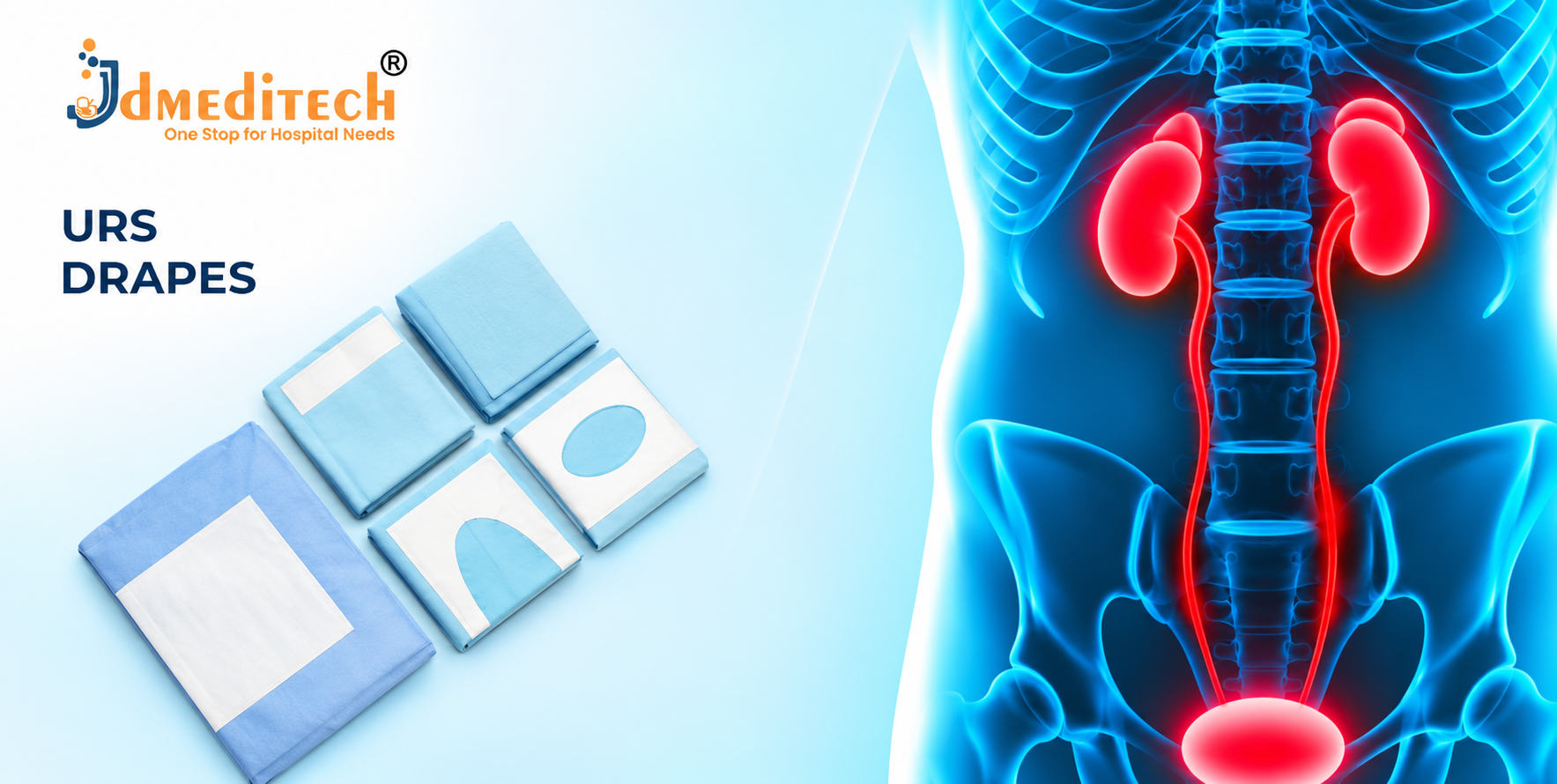
URS Drapes are surgical drapes used during ureteroscopy and related urological procedures. They help the clinical team establish a defined operative field while supporting infection prevention practices.
Furthermore, procedure-specific drapes may include access openings, absorbent sections and fluid-resistant materials. As a result, healthcare professionals can select a suitable configuration for their surgical workflow.
JDMeditech supplies medical consumables and urology products for hospitals, surgical centers and medical distributors. Additionally, our team assists customers with product information and quotation requests.
What Are URS Drapes?
Ureteroscopy drapes are protective surgical coverings designed for use during selected endoscopic urology procedures.
They help separate the prepared surgical area from surrounding surfaces. Moreover, appropriately designed openings allow clinicians to access the operative site.
However, drapes are only one part of infection prevention. Therefore, healthcare teams must also follow appropriate skin preparation, aseptic technique and institutional protocols.
What Is Ureteroscopy?
Ureteroscopy is an endoscopic procedure in which a urologist examines or treats conditions involving the ureter and, in selected cases, the kidney.
For example, clinicians may use ureteroscopy to evaluate or manage urinary stones.
Additionally, the procedure may support diagnosis or treatment of other selected urinary tract conditions. Consequently, appropriate surgical preparation is essential.
Importance of Surgical Draping in Urology
Proper surgical draping supports a controlled operating environment.
First, the clinical team prepares the patient according to the procedure. Next, staff position suitable drapes to define the operative area.
Furthermore, fluid-management features may help reduce unwanted fluid spread when the drape design supports that function.
However, the selected product must match the procedure and its approved intended use.
Key Features of URS Surgical Drapes
- Procedure-specific drape configurations
- Designed surgical access openings
- Available fluid-resistant materials
- Optional absorbent sections
- Different sheet dimensions
- Selected adhesive fenestration options
- Disposable configurations
- Manufacturer-defined sterile packaging
- Compatibility with selected urology workflows
- Different drape kit arrangements
However, individual features vary by model. Therefore, buyers should confirm the official product specifications.
Main Components of a URS Draping Set
A procedure-specific draping set may contain several protective materials. Nevertheless, the exact contents depend on the selected configuration.
- Main surgical drape
- Fenestrated drape
- Absorbent reinforcement where included
- Adhesive area where included
- Additional protective sheets
- Fluid collection features where included
- Other manufacturer-defined accessories
Additionally, hospitals can request the official packing list before placing an order.
1. Main Surgical Drape
The main drape covers selected areas around the operative field.
Furthermore, its size and design depend on the intended surgical application.
2. Fenestrated Surgical Drape
A fenestrated drape contains an opening that provides access to the prepared operative area.
For example, the opening may have a shape and position suited to a particular procedure.
However, fenestration dimensions must match the clinical requirements.
3. Absorbent Reinforcement
Selected drapes include absorbent material near the operative field.
Consequently, these sections may help manage limited amounts of procedural fluid.
However, absorbency depends on the material and product construction.
4. Adhesive Fenestration
Some drapes include an adhesive area around the access opening.
Additionally, this feature may help maintain the intended drape position during surgery.
Nevertheless, clinicians should consider skin compatibility and manufacturer instructions.
5. Fluid Collection Features
Selected urology drapes may include fluid collection pouches or other fluid-management features.
Furthermore, these features can support operating room fluid management when used correctly.
However, not every URS drape includes a collection pouch.
Materials Used in Surgical Drapes
Manufacturers use different materials according to the intended application.
For example, surgical drapes may contain nonwoven fabrics, polyethylene film or multilayer laminates.
Additionally, selected materials provide absorbent or fluid-barrier properties.
Therefore, healthcare facilities should verify the actual material composition and relevant performance data.
Common Material Options
- SMS nonwoven fabric
- SMMS nonwoven fabric
- Polypropylene-based nonwoven material
- Polyethylene film
- Absorbent nonwoven layers
- Multilayer laminated materials
However, these are general surgical drape material options. The uploaded image does not establish the material used in the pictured products.
Types of URS Drapes
Hospitals may select different drape configurations depending on their procedure.
1. Standard Ureteroscopy Drape
A standard drape provides coverage around the prepared operative area.
Furthermore, the manufacturer may offer different dimensions and opening designs.
2. Fenestrated Urology Drape
This configuration includes a surgical access opening.
Additionally, selected versions include adhesive reinforcement around the fenestration.
3. Fluid-Management Drape
Some drapes include features intended to help manage procedural fluids.
For example, a collection pouch may direct fluid away from selected surfaces.
However, the actual collection capacity and construction require verification.
4. Disposable Urology Drape
Disposable surgical drapes are intended for single-patient use according to their labeling.
Consequently, healthcare facilities must follow the manufacturer’s instructions and applicable disposal requirements.
Clinical Applications of URS Drapes
Urology teams may use suitable surgical drapes during several endoscopic procedures.
- Diagnostic ureteroscopy
- Ureteroscopic stone management
- Ureteroscopic lithotripsy
- Selected flexible ureteroscopy procedures
- Selected retrograde intrarenal surgery
- Ureteral stent-related procedures
- Other compatible endoscopic urology procedures
However, each application requires an appropriately designed drape. Therefore, buyers should verify compatibility before use.
Use of Drapes During Ureteroscopic Lithotripsy
Ureteroscopic lithotripsy involves endoscopic treatment of selected urinary stones.
During the procedure, surgical drapes help define the operative field.
Furthermore, suitable fluid-management features may support operating room workflow.
However, draping does not replace standard infection prevention measures.
Use of Drapes During Flexible Ureteroscopy
Flexible ureteroscopy allows a urologist to examine selected areas of the upper urinary tract.
Additionally, the procedure may involve irrigation and specialized endoscopic instruments.
Therefore, the clinical team should choose draping materials suitable for the procedure and expected fluid exposure.
Potential Benefits of URS Drapes
Appropriate surgical draping supports organized clinical preparation.
Furthermore, selected product features can improve practical workflow management.
- Helps define the operative field
- Supports aseptic surgical preparation
- Provides coverage around the operative area
- Allows access through designed openings
- Offers different procedure-specific configurations
- May support fluid management
- Supports organized operating room preparation
- Offers disposable options
However, performance depends on the product design and correct clinical use.
Technical Specifications of URS Drapes
Technical specifications vary by manufacturer and model. Therefore, hospitals should verify the official datasheet before purchasing.
| Parameter | Product Information |
|---|---|
| Product Name | URS Drapes |
| Product Category | Urology Surgical Consumables |
| Primary Application | Ureteroscopy Procedures |
| Product Configuration | Confirm Available Models |
| Material | Confirm Manufacturer Datasheet |
| Fabric GSM | Confirm Product Specifications |
| Available Dimensions | Confirm Size Chart |
| Fenestration Size | Model-Dependent |
| Adhesive Area | Model-Dependent |
| Absorbent Reinforcement | Model-Dependent |
| Fluid Collection Pouch | Model-Dependent |
| Fluid Barrier Performance | Confirm Test Data |
| Sterility | Confirm Product Labeling |
| Single-Use Status | Confirm Product Labeling |
| Packaging | Confirm Manufacturer Specifications |
| Shelf Life | Confirm Product Labeling |
| Regulatory Documentation | Verify for Destination Market |
URS Drapes vs General Surgical Drapes
Procedure-specific and general-purpose surgical drapes may serve different clinical needs.
| Feature | URS Drapes | General Surgical Drapes |
|---|---|---|
| Primary Application | Ureteroscopy Procedures | Various Surgical Procedures |
| Access Opening | Procedure-Dependent | Design-Dependent |
| Fluid Management | Optional Specialized Features | Varies by Product |
| Dimensions | Selected for Urology Procedures | Different General Sizes |
| Material | Model-Dependent | Model-Dependent |
Importance of Fluid Barrier Performance
Surgical drapes may encounter irrigation fluids and other liquids during urology procedures.
Therefore, appropriate barrier performance is an important product-selection consideration.
Furthermore, manufacturers may provide test data for fluid resistance and related performance characteristics.
However, not every drape offers the same barrier protection.
Importance of Absorbency
Selected drapes include absorbent sections that help manage fluid near the operative field.
Additionally, absorbency can support operating room housekeeping and fluid management.
Nevertheless, absorbent materials may have different fluid capacities. Therefore, hospitals should review product performance data.
Importance of Sterile Packaging
Sterile drapes require suitable packaging that maintains sterility until use.
Furthermore, healthcare professionals should inspect the package before opening it.
However, a damaged sterile barrier may compromise product suitability.
Safety Precautions
- Verify the intended clinical application
- Confirm the required drape dimensions
- Inspect the packaging before use
- Check expiration dates where applicable
- Follow the manufacturer’s instructions
- Maintain appropriate aseptic technique
- Confirm suitable barrier performance
- Avoid using damaged drapes
- Follow single-use labeling
- Dispose of used materials appropriately
Possible Limitations of Surgical Drapes
Although surgical drapes support infection prevention practices, they cannot eliminate every clinical risk.
For example, incorrect placement or unsuitable material selection may reduce their effectiveness.
Additionally, excessive fluid exposure can exceed the performance of certain materials.
Therefore, clinicians must select and use drapes according to their approved specifications.
Storage and Handling Recommendations
Healthcare facilities should store surgical drapes according to manufacturer instructions.
- Keep products in suitable storage conditions
- Protect packaging from moisture and damage
- Avoid unnecessary compression
- Check product identification
- Verify expiration dates
- Maintain inventory records
- Follow manufacturer storage instructions
How to Choose the Right URS Drapes
First, hospitals should identify the intended urology procedure.
Next, procurement teams should review drape dimensions, material properties and fenestration requirements.
Additionally, buyers should confirm sterility, packaging and relevant regulatory documentation.
- Approved intended use
- Procedure compatibility
- Drape dimensions
- Material composition
- Fabric weight
- Fenestration design
- Adhesive options
- Absorbency requirements
- Fluid barrier performance
- Sterility and packaging
- Regulatory documentation
Why Choose JDMeditech?
JDMeditech supplies medical consumables, urology instruments and surgical equipment for hospitals and medical distributors.
Furthermore, our team assists customers with product inquiries, available configurations and quotation requests.
Additionally, buyers can request information about surgical drape materials, dimensions and packaging options.
Related Urology Products
- Urology Surgical Drapes
- Ureteroscopy Procedure Sets
- Ureteroscopes
- Ureteral Access Sheaths
- Urology Guide Wires
- Stone Retrieval Baskets
- Ureteral Stents
- Urology Surgical Consumables
Frequently Asked Questions
1. What Are URS Drapes?
They are surgical drapes intended for selected ureteroscopy procedures.
2. What Is the Main Purpose of Ureteroscopy Drapes?
They help define the operative field and provide coverage around the surgical area.
3. Are URS Drapes Sterile?
Sterility depends on the supplied product configuration. Therefore, customers should verify the manufacturer’s labeling.
4. Are URS Drapes Disposable?
Many surgical drapes are intended for single use. However, buyers should confirm the product’s approved labeling.
5. What Materials Are Used in URS Drapes?
Manufacturers may use nonwoven fabrics, films or multilayer materials. However, exact composition varies by model.
6. Do URS Drapes Have Surgical Openings?
Some configurations include fenestrations. Therefore, hospitals should verify the available opening designs.
7. Can URS Drapes Include Adhesive Areas?
Yes. Selected models include adhesive fenestrations to support drape positioning.
8. Are Fluid Collection Pouches Available?
Some procedure-specific drapes include fluid collection features. However, these are not standard on every model.
9. Can These Drapes Be Used for Flexible Ureteroscopy?
Suitable configurations may support flexible ureteroscopy. Nevertheless, the intended use must match the selected procedure.
10. Can URS Drapes Be Used for RIRS?
Selected urology drapes may be appropriate for retrograde intrarenal surgery. However, clinicians should verify procedural compatibility.
11. What Is a Fenestrated Surgical Drape?
It is a surgical covering with a designed opening that provides access to the operative area.
12. Why Is Fluid Resistance Important?
Fluid resistance helps limit liquid penetration through suitable barrier materials.
13. How Should Surgical Drapes Be Stored?
Healthcare facilities should follow manufacturer storage instructions and protect the packaging from damage.
14. Can Hospitals Request Different Sizes?
Available sizes depend on the manufacturer and product configuration. Therefore, customers should request the current size chart.
15. Where Can Hospitals Request Product Information?
Hospitals and medical distributors can contact JDMeditech for information about available surgical drape configurations and quotations.
Conclusion
In conclusion, URS Drapes support surgical preparation during selected ureteroscopy procedures.
Furthermore, appropriate drape selection helps clinicians establish a defined operative field and manage procedural requirements.
Therefore, hospitals should verify material composition, dimensions, barrier performance, sterility and product labeling before purchasing.
JDMeditech – One Stop for Hospital Needs.
Website:
www.jdmeditech.com
Medical Information and References
For general information about infection prevention in healthcare settings, visit the
Centers for Disease Control and Prevention – Infection Control.
For information about medical devices and safety, visit the
World Health Organization – Medical Devices.
Medical Disclaimer
This article provides general educational and product information only. It does not replace professional medical advice, clinical judgment, surgical training or manufacturer instructions. Healthcare professionals must verify product specifications, sterility, material composition, barrier performance, regulatory documentation and approved intended use before clinical application.




