



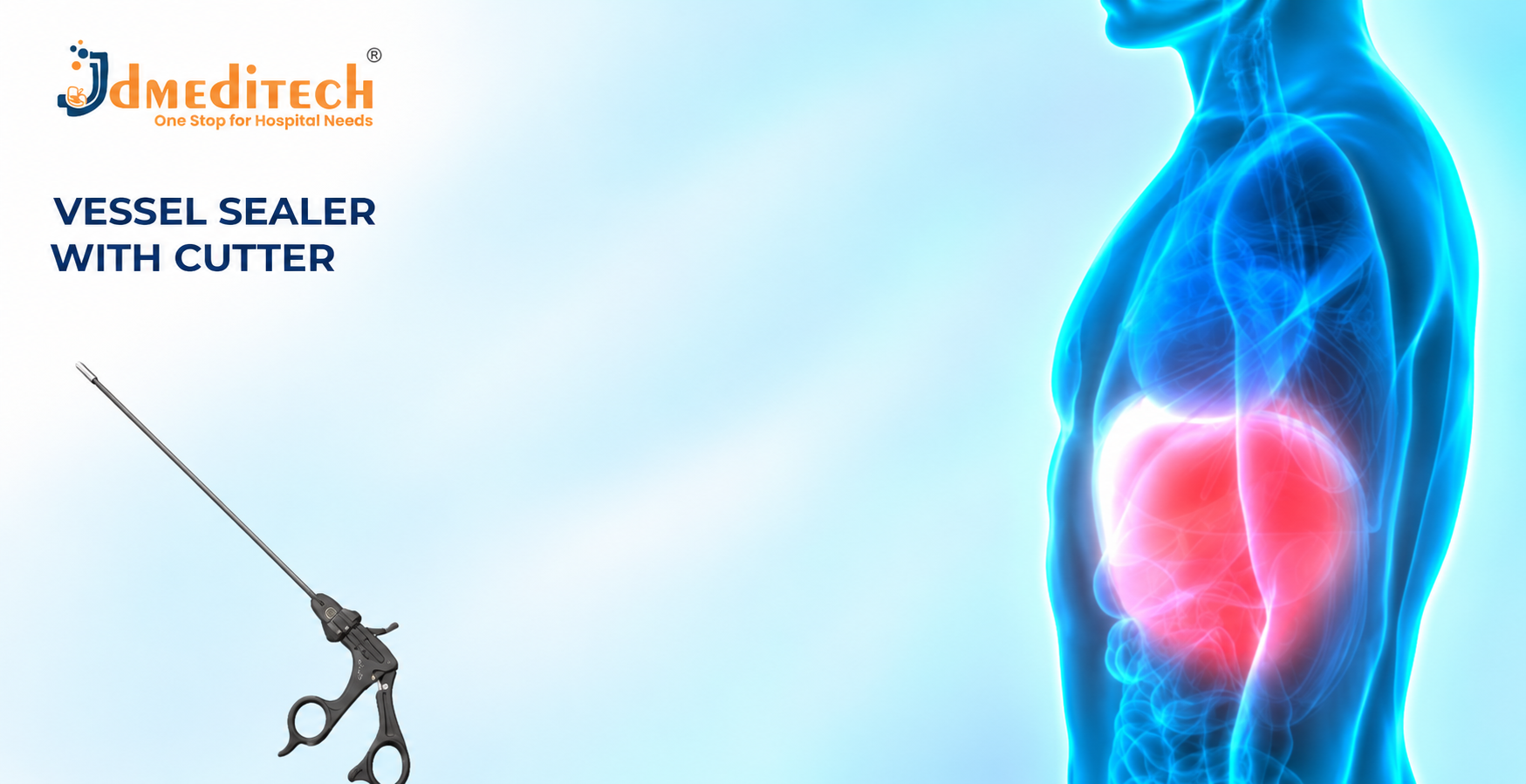
Vessel Sealer with Cutter – Features, Uses and Surgical Applications
The Vessel Sealer with Cutter is a specialized surgical instrument designed to support the sealing and division of suitable blood vessels and tissue during selected surgical procedures. Depending on its design, the instrument combines a tissue-sealing mechanism with a cutting function.
During minimally invasive surgery, surgeons frequently need to control bleeding while dividing tissue. Therefore, an appropriately selected vessel-sealing system can support these tasks within its approved indications.
Furthermore, certain systems use advanced bipolar energy and controlled tissue compression to create a seal. However, the exact sealing technology, cutting mechanism and performance depend on the device model and compatible generator.
JDMeditech supplies laparoscopic instruments, surgical accessories and medical equipment for hospitals, surgical centers and medical distributors.
What Is a Vessel Sealer with Cutter?
A vessel sealer with cutter is a surgical instrument designed to seal and divide selected vessels or tissue within its approved operating limits.
Unlike a conventional bipolar coagulation instrument, a validated vessel-sealing system is designed for specific tissue-sealing applications.
Additionally, an integrated cutting mechanism may allow tissue division after sealing.
However, users must confirm the manufacturer’s approved indications, vessel diameter limits and compatible equipment.
Purpose of a Vessel Sealer with Cutter
The primary purpose is to support hemostatic vessel sealing and tissue division during selected procedures.
For example, surgeons may use compatible instruments to seal suitable vessels before dividing them.
Furthermore, integrated cutting functionality may reduce the need to exchange instruments for selected tasks.
However, the clinical application depends on the device’s validated performance and instructions for use.
Importance of Vessel Sealing in Laparoscopic Surgery
Minimally invasive surgery requires reliable methods for managing bleeding.
Additionally, surgeons often work through narrow access ports and limited operating spaces.
Therefore, suitable vessel-sealing instruments may support selected laparoscopic techniques.
However, inappropriate energy application or tissue selection can cause serious complications.
Main Components of a Vessel Sealer with Cutter
The illustrated product shows a long laparoscopic shaft and a proximal handle assembly.
Depending on the model, the instrument may include:
- Distal Sealing Jaw Assembly
- Tissue Compression Mechanism
- Long Laparoscopic Shaft
- Integrated Cutting Mechanism
- Proximal Handle Assembly
- Energy Activation Control
- Compatible Generator Connection
- Electrical Insulation Components
- Model-Specific Safety Mechanisms
However, the exact components and operating mechanisms require manufacturer confirmation.
1. Distal Sealing Jaw Assembly
The distal jaw assembly holds suitable tissue during the sealing process.
Furthermore, jaw geometry influences tissue compression and energy delivery.
However, the exact design depends on the device model.
2. Tissue Compression Mechanism
Selected vessel-sealing systems apply controlled compression to the intended tissue.
Additionally, compression works with the system’s energy delivery characteristics.
However, not every device uses the same compression mechanism.
3. Long Laparoscopic Shaft
The elongated shaft supports access through a compatible laparoscopic trocar.
Furthermore, working length influences instrument reach.
Therefore, buyers should verify the required dimensions before ordering.
4. Integrated Cutting Mechanism
The cutting mechanism divides suitable tissue according to the device’s approved operating method.
Additionally, some instruments use a mechanical blade.
However, other systems may use different cutting technologies.
5. Proximal Handle Assembly
The handle allows the surgeon to operate the instrument’s mechanical functions.
Furthermore, selected designs include controls for jaw movement or cutting.
However, the exact handle configuration varies by manufacturer.
6. Energy Activation Control
Energy activation controls the delivery of electrical energy in compatible electrosurgical systems.
Additionally, some systems incorporate generator-controlled energy delivery.
However, users must follow the approved activation instructions.
7. Compatible Generator Connection
The electrical connection links the instrument to its approved energy platform.
Furthermore, system compatibility is essential for intended performance.
However, connector appearance alone does not establish compatibility.
Key Features of a Vessel Sealer with Cutter
Depending on the selected model, these instruments may offer the following features:
- Vessel Sealing Function
- Integrated Tissue Cutting
- Long-Shafted Laparoscopic Design
- Specialized Sealing Jaw Configuration
- Model-Specific Tissue Compression
- Compatible Energy Delivery System
- Different Working Length Options
- Different Shaft Diameter Options
- Reusable or Single-Use Configurations
However, actual features require confirmation from the official product specifications.
How Does a Vessel Sealer with Cutter Work?
A compatible vessel-sealing system combines tissue compression with a validated sealing technology.
During an approved surgical procedure, the surgeon positions suitable tissue within the device’s working jaws.
When activated, the system applies its specified sealing process.
For advanced bipolar devices, controlled electrical energy heats tissue proteins while the jaws maintain appropriate compression.
After the system completes the intended sealing cycle, the cutting mechanism may divide the tissue according to the manufacturer’s instructions.
However, the exact sequence and performance depend on the device model.
Understanding Vessel Sealing Technology
Vessel sealing uses a validated process to create a hemostatic tissue seal.
Furthermore, some advanced bipolar systems regulate energy delivery according to tissue conditions.
However, not all vessel-sealing instruments use the same technology.
Therefore, users must verify the device’s approved operating principles.
Understanding the Cutting Function
The integrated cutting function divides suitable tissue according to the device’s intended use.
Additionally, some instruments combine sealing and cutting within one device.
However, the cutting function must not be used outside the manufacturer’s approved indications.
Difference Between a Vessel Sealer and Bipolar Forceps
Conventional bipolar forceps primarily support tissue coagulation.
In contrast, a validated vessel-sealing system is designed to seal suitable vessels within defined operating limits.
Furthermore, a vessel sealer with cutter may include an integrated tissue division mechanism.
However, ordinary bipolar forceps should not be assumed to provide equivalent vessel-sealing performance.
Applications of a Vessel Sealer with Cutter
Approved vessel-sealing instruments may support selected surgical procedures.
Potential applications include:
- Laparoscopic General Surgery
- Selected Gynecological Procedures
- Selected Laparoscopic Urological Procedures
- Selected Gastrointestinal Procedures
- Selected Bariatric Procedures
- Other Manufacturer-Approved Surgical Applications
However, the exact indications depend on the product labeling.
Application in Laparoscopic General Surgery
General laparoscopic procedures may require vessel sealing and tissue division.
Furthermore, compatible instruments can support selected operative tasks.
However, the surgeon must assess vessel characteristics and the approved device limits.
Application in Gynecological Surgery
Some gynecological procedures require management of blood vessels and tissue.
Additionally, suitable vessel-sealing systems may support selected surgical techniques.
However, the surgeon must consider nearby anatomical structures and thermal injury risks.
Application in Laparoscopic Urology
Selected urological procedures may require vessel sealing and tissue division.
Furthermore, compatible instruments may support the intended operative technique.
However, the exact device selection depends on clinical requirements.
Application in Gastrointestinal Surgery
Selected gastrointestinal procedures may require hemostasis and tissue division.
Additionally, compatible vessel-sealing instruments can support approved surgical applications.
However, surgeons must consider tissue characteristics and nearby organs.
Application in Bariatric Surgery
Selected bariatric procedures may require tissue dissection and hemostasis.
Furthermore, approved vessel-sealing systems may support suitable operative tasks.
However, device selection depends on the procedure and manufacturer instructions.
Technical Specifications of a Vessel Sealer with Cutter
Exact specifications vary by model. Therefore, customers should request the official manufacturer datasheet.
| Parameter | Product Information |
|---|---|
| Product Name | Vessel Sealer with Cutter |
| Product Category | Surgical Vessel-Sealing Instrument |
| Primary Function | Sealing and Division of Suitable Vessels or Tissue |
| Instrument Design | Long-Shafted Surgical Instrument |
| Sealing Technology | Confirm Manufacturer Specifications |
| Distal Jaw Configuration | Model-Specific |
| Cutting Mechanism | Confirm Product Datasheet |
| Material | Confirm Manufacturer Specifications |
| Overall Length | Model-Specific |
| Working Length | Confirm Official Dimensions |
| Shaft Diameter | Confirm Official Dimensions |
| Jaw Length | Confirm Product Datasheet |
| Maximum Vessel Diameter | Confirm Validated Device Limit |
| Energy Type | Confirm Product Configuration |
| Compatible Generator | Manufacturer Confirmation Required |
| Electrical Connector | Confirm Official Specifications |
| Compatible Trocar Size | Confirm Official Specifications |
| Reusable or Single-Use | Confirm Product Labeling |
| Sterile Status | Confirm Product Labeling |
| Cleaning Requirements | Follow Manufacturer Instructions |
| Sterilization Compatibility | Verify Manufacturer Validation |
| Packaging | Confirm Supplied Configuration |
| Regulatory Documentation | Verify for Destination Market |
Importance of Vessel Diameter Limits
Validated vessel diameter limits define part of the device’s approved operating range.
Furthermore, using the device outside these limits may result in inadequate sealing.
However, the maximum vessel diameter varies between systems.
Therefore, surgeons must follow the specific device instructions.
Importance of Jaw Design
The distal jaw geometry influences tissue compression and contact.
Additionally, jaw design forms part of the validated sealing system.
However, different instruments may use different jaw configurations.
Therefore, buyers should verify the intended application.
Importance of Generator Compatibility
Energy-based vessel sealers require compatible equipment.
Furthermore, the generator and instrument must operate within the manufacturer’s approved specifications.
However, compatibility cannot be assumed from connector appearance alone.
Therefore, hospitals must verify the approved system combination.
Potential Benefits of a Vessel Sealer with Cutter
When appropriately selected, a vessel sealer with cutter may provide several practical advantages.
- Sealing of Suitable Blood Vessels
- Integrated Tissue Cutting Function
- Support for Selected Hemostasis Tasks
- Long-Shafted Laparoscopic Access
- Specialized Jaw Configuration
- Model-Specific Energy Delivery
- Different Instrument Configurations
- Potential Reduction in Instrument Exchanges
Furthermore, appropriate instrument selection supports the intended surgical technique.
However, these characteristics do not independently guarantee improved clinical outcomes.
Important Safety Precautions
Only appropriately trained surgical professionals should use vessel-sealing instruments.
Furthermore, the surgical team must verify the approved generator, operating settings and vessel diameter limits.
- Confirm Product Identification
- Inspect the Distal Jaw Assembly
- Check the Cutting Mechanism
- Verify Electrical Connections
- Confirm Generator Compatibility
- Verify Approved Vessel Diameter Limits
- Inspect Instrument Integrity
- Confirm Trocar Compatibility
- Verify Sterile Status
- Follow Manufacturer Instructions
Additionally, damaged or incompatible instruments should not be used.
Potential Risks of Incorrect Vessel Sealer Use
Improper instrument selection or operation may create serious clinical risks.
- Inadequate Vessel Sealing
- Unintended Bleeding
- Thermal Injury
- Damage to Nearby Anatomical Structures
- Mechanical Cutting Failure
- Electrical Equipment Incompatibility
- Instrument Malfunction
- Contamination or Infection
Therefore, vessel sealing requires appropriate training and clinical judgment.
Inspection Before Use
Healthcare personnel should inspect the instrument before surgery.
- Confirm the Correct Device Model
- Inspect the Sealing Jaws
- Check the Shaft
- Verify the Cutting Mechanism
- Inspect Electrical Connections
- Confirm Generator Compatibility
- Check Instrument Integrity
- Verify Trocar Compatibility
- Confirm Sterile Status
- Follow Manufacturer Instructions
Furthermore, personnel should remove damaged instruments from service.
Cleaning and Reprocessing
Reusable vessel-sealing instruments require validated cleaning and reprocessing.
Furthermore, jaw assemblies and cutting components may require particular attention.
However, the correct processing method depends on the device design and material.
Therefore, healthcare facilities must follow the manufacturer’s instructions for use.
Sterilization Requirements
Reusable surgical instruments require appropriate sterilization before clinical use.
Additionally, the manufacturer should specify validated processing methods.
However, users should not assume that every vessel sealer supports the same sterilization cycle.
Therefore, hospitals must verify the approved method.
Storage and Handling Guidelines
Proper storage helps protect surgical instruments.
For example, facilities should protect the distal jaws and cutting mechanism from mechanical damage.
Additionally, personnel should store reprocessed instruments according to institutional procedures.
Therefore, hospitals should follow the manufacturer’s storage recommendations.
How to Choose the Right Vessel Sealer with Cutter
Hospitals and procurement teams should review several factors before purchasing.
- Intended Surgical Application
- Validated Vessel Diameter Limit
- Sealing Technology
- Cutting Mechanism
- Jaw Configuration
- Required Working Length
- Shaft Diameter
- Compatible Trocar Size
- Generator Compatibility
- Electrical Connector Type
- Reusable or Single-Use Status
- Cleaning and Sterilization Requirements
- Regulatory Documentation
Furthermore, the operating surgeon should confirm the final instrument selection.
Applications in Hospitals
Hospitals performing laparoscopic procedures may require specialized vessel-sealing instruments.
Additionally, different surgical departments may use different device configurations.
Therefore, procurement teams should coordinate with surgical professionals.
Applications in Surgical Centers
Surgical centers may use compatible vessel sealers during selected minimally invasive procedures.
Furthermore, suitable instruments support the planned operative technique.
However, the exact configuration depends on clinical requirements.
Applications for Medical Distributors
Medical distributors should confirm device dimensions, sealing limits and generator compatibility before preparing quotations.
For example, customers may request a particular working length or cutting mechanism.
Additionally, destination-market regulations may affect documentation requirements.
Therefore, distributors should request the official product specifications.
Why Choose JDMeditech?
JDMeditech supplies laparoscopic instruments, surgical accessories and medical equipment for hospitals, surgical centers and medical distributors.
Furthermore, our team can assist customers with product inquiries, available configurations and technical information.
Customers can contact JDMeditech regarding:
- Vessel Sealer with Cutter Inquiries
- Laparoscopic Vessel Sealer Requirements
- Available Device Configurations
- Hospital Procurement Inquiries
- Medical Distributor Requests
- International Export Inquiries
However, exact availability and technical specifications require confirmation.
Frequently Asked Questions About Vessel Sealer with Cutter Instruments
1. What Is a Vessel Sealer with Cutter?
It is a surgical instrument designed to seal and divide suitable blood vessels or tissue within its approved operating limits.
2. What Is Its Main Purpose?
Its main purpose is to support selected vessel sealing, hemostasis and tissue division tasks.
3. How Does a Vessel Sealer Work?
The device uses its validated sealing technology to create a hemostatic tissue seal. Some systems combine tissue compression with controlled electrical energy.
4. Is It Used in Laparoscopic Surgery?
Yes, when the instrument is specifically designed and approved for the intended laparoscopic procedure.
5. Does It Include a Cutting Function?
Yes, a vessel sealer with cutter includes a tissue division function. However, the cutting mechanism depends on the device model.
6. What Is the Maximum Vessel Diameter?
The validated maximum diameter varies between systems. Therefore, users must consult the official product specifications.
7. Are Different Working Lengths Available?
Different lengths may be available. However, customers should verify the official product range.
8. What Materials Are Used?
Materials vary by manufacturer. Therefore, buyers should request the official datasheet.
9. Is the Instrument Reusable?
Reusable configurations may be available. However, the manufacturer must confirm the intended use.
10. Can It Be Autoclaved?
Only when the manufacturer validates steam sterilization for the specific model.
11. Does It Require a Special Generator?
Energy-based vessel sealers require an approved compatible energy platform.
12. What Should Buyers Confirm Before Ordering?
Buyers should verify sealing technology, vessel diameter limits, shaft dimensions, generator compatibility and regulatory documentation.
13. Who Should Use This Instrument?
Only appropriately trained surgical professionals should use it during clinical procedures.
14. Is a Vessel Sealer the Same as Bipolar Forceps?
No. A validated vessel-sealing device has specific performance requirements that conventional bipolar forceps may not meet.
15. Where Can Customers Request Product Information?
Hospitals, surgical centers and medical distributors can contact JDMeditech for product information and quotations.
Conclusion
In conclusion, the Vessel Sealer with Cutter is a specialized surgical instrument designed to support sealing and division of suitable vessels and tissue during selected procedures.
Furthermore, certain systems combine controlled tissue compression with advanced bipolar energy.
Additionally, integrated cutting functionality may support selected operative tasks.
However, safe use requires specialist training, approved generator compatibility and compliance with manufacturer instructions.
Therefore, healthcare facilities should verify all technical specifications and validated operating limits before purchasing.
JDMeditech – One Stop for Hospital Needs
Website:
www.jdmeditech.com
Related Laparoscopy Instruments
- Laparoscopic Bipolar Forceps
- Laparoscopic Bipolar Electrodes
- Laparoscopic Monopolar Electrodes
- Laparoscopic Dissecting Forceps
- Laparoscopic Trocar
- Laparoscopic Instrument Set
- Electrosurgical Accessories
Medical Disclaimer
This article provides general educational and product information only. It does not replace surgical training, manufacturer instructions or clinical judgment. Healthcare professionals must verify instrument dimensions, intended use, validated vessel diameter limits, generator compatibility, sterile status and reprocessing requirements before use.




