Fluid management plays a crucial role in interventional cardiology procedures. During coronary angiography, angioplasty, and other cardiovascular interventions, physicians rely on manifold systems to control the delivery of contrast media, saline, and medications safely and efficiently.
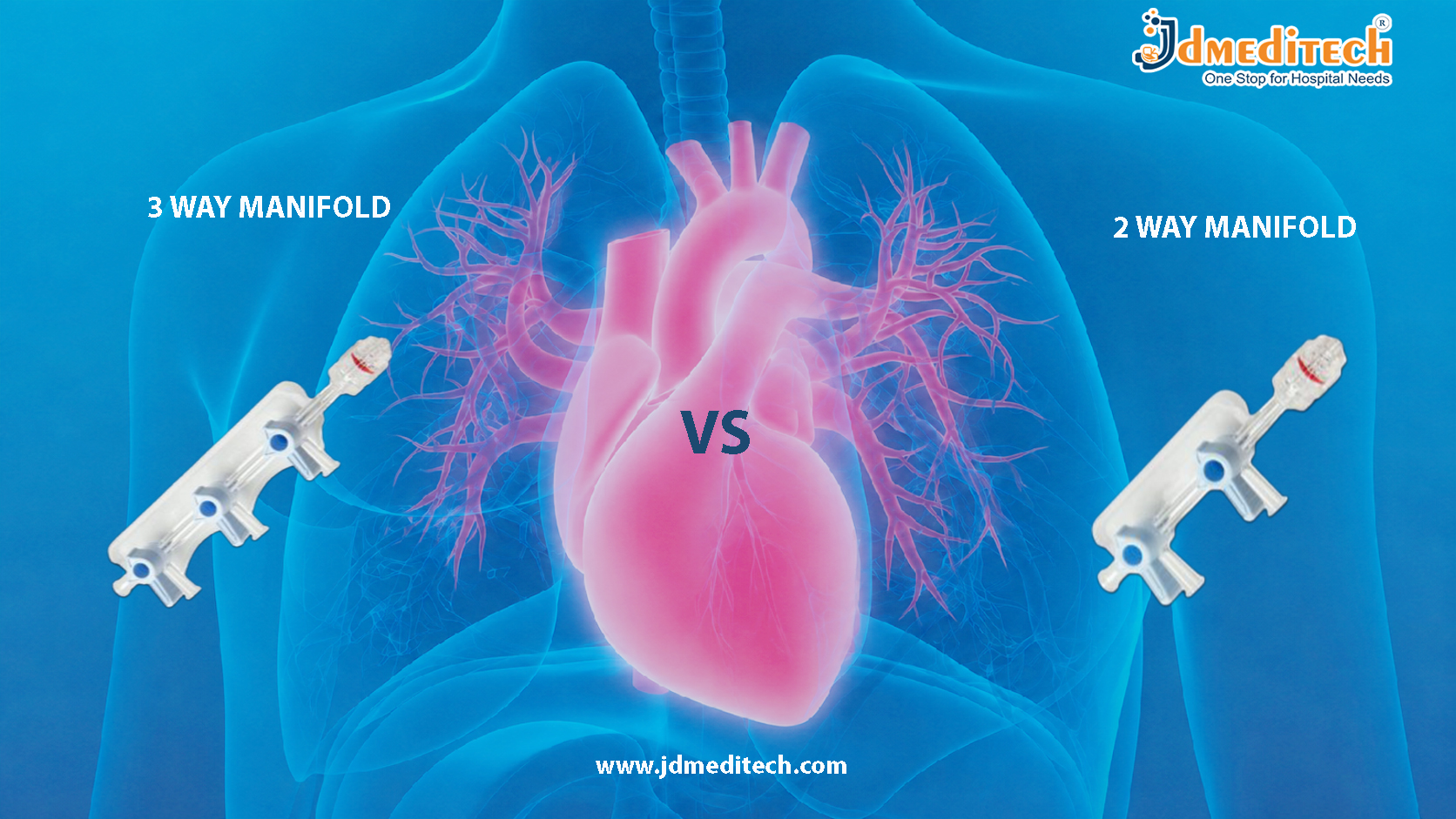
Among the various options available, 2 Way Manifolds and 3 Way Manifolds are the most commonly used fluid control devices in catheterization laboratories. Although both systems facilitate fluid management, they differ in functionality, versatility, and clinical applications.
Therefore, healthcare professionals must understand the differences between these manifold systems to select the most appropriate device for specific cardiology procedures.
What is a 2 Way Manifold?
A 2 Way Manifold is a fluid control device that features two ports or pathways for directing fluids during cardiovascular procedures.
Typically, physicians use a 2 Way Manifold to manage contrast media and saline flow between syringes, catheters, and monitoring systems. Because the device features a simple design, it offers straightforward operation and reliable fluid management.
Consequently, many catheterization laboratories utilize 2 Way Manifolds for routine diagnostic procedures.
What is a 3 Way Manifold?
A 3 Way Manifold is an advanced fluid control system that incorporates three independent ports or channels. As a result, clinicians can simultaneously manage multiple fluid pathways during complex interventional procedures.
Moreover, the additional port provides greater flexibility for administering contrast media, saline flushes, medications, or pressure monitoring.
Therefore, cardiologists frequently choose 3 Way Manifolds for advanced interventional procedures requiring multiple fluid connections.
2 Way Manifold vs 3 Way Manifold: Key Differences
Number of Fluid Channels
2 Way Manifold: Features two fluid pathways for basic fluid management.
3 Way Manifold: Features three independent fluid channels for enhanced procedural flexibility.
Procedural Complexity
Physicians commonly use 2 Way Manifolds during routine diagnostic angiography and straightforward procedures.
In contrast, clinicians often select 3 Way Manifolds for complex interventions that require multiple fluid sources or simultaneous pressure monitoring.
Fluid Management Flexibility
A 2 Way Manifold offers efficient management for standard fluid administration.
However, a 3 Way Manifold enables clinicians to administer contrast media, saline, and medications simultaneously. Consequently, it significantly improves workflow efficiency.
Workflow Efficiency
Although 2 Way Manifolds simplify routine procedures, operators may need additional connectors during advanced interventions.
Conversely, 3 Way Manifolds reduce the need for additional accessories and streamline fluid management.
Cost Considerations
Generally, 2 Way Manifolds offer a more economical solution for standard procedures.
On the other hand, 3 Way Manifolds may involve slightly higher costs due to their advanced design and additional functionality.
Advantages of 2 Way Manifold
- Simple and user-friendly design
- Cost-effective solution
- Reliable fluid control
- Easy setup and operation
- Suitable for routine diagnostic procedures
- Reduces procedural complexity
Advantages of 3 Way Manifold
- Provides greater procedural flexibility
- Supports multiple fluid pathways simultaneously
- Improves workflow efficiency
- Reduces accessory requirements
- Facilitates complex interventions
- Enhances procedural control
- Supports advanced catheterization procedures
Clinical Applications of 2 Way Manifold
Healthcare professionals commonly use 2 Way Manifolds for:
- Diagnostic coronary angiography
- Routine cardiac catheterization
- Standard contrast injection procedures
- Basic pressure monitoring applications
Clinical Applications of 3 Way Manifold
Cardiologists frequently use 3 Way Manifolds for:
- Percutaneous Coronary Intervention (PCI)
- Complex angioplasty procedures
- Multi-device interventions
- Advanced hemodynamic monitoring
- Structural heart interventions
- Interventional cardiology procedures
Which Manifold is Better for Cardiology Procedures?
Neither manifold system is universally superior. Instead, physicians should select the manifold according to procedural complexity, fluid management requirements, and operator preference.
For routine diagnostic procedures, a 2 Way Manifold often provides sufficient functionality while maintaining simplicity and cost efficiency.
However, for complex interventional procedures, a 3 Way Manifold offers greater flexibility and enhanced procedural control.
Ultimately, the specific clinical scenario determines the ideal manifold configuration.
Why Choose JDMeditech Cardiology Manifolds?
JDMeditech manufactures premium-quality cardiology manifolds designed to support safe, precise, and efficient cardiovascular procedures.
Key Features
- High-pressure resistant construction
- Transparent body for clear visualization
- Smooth rotational control
- Leak-proof design
- Excellent fluid flow performance
- Sterile and ready-to-use configuration
- Available in multiple configurations
Conclusion
Both 2 Way Manifolds and 3 Way Manifolds play essential roles in modern interventional cardiology. While 2 Way Manifolds offer simplicity and cost-effectiveness, 3 Way Manifolds provide greater versatility and procedural efficiency.
Therefore, healthcare professionals should carefully evaluate procedural requirements before selecting a manifold system.
By choosing high-quality manifold systems from JDMeditech, clinicians can improve fluid management, enhance procedural safety, and achieve better clinical outcomes.
Get Connected:
+91 79909 93062 | +91 63513 72032 | exports@jdmeditech.com