



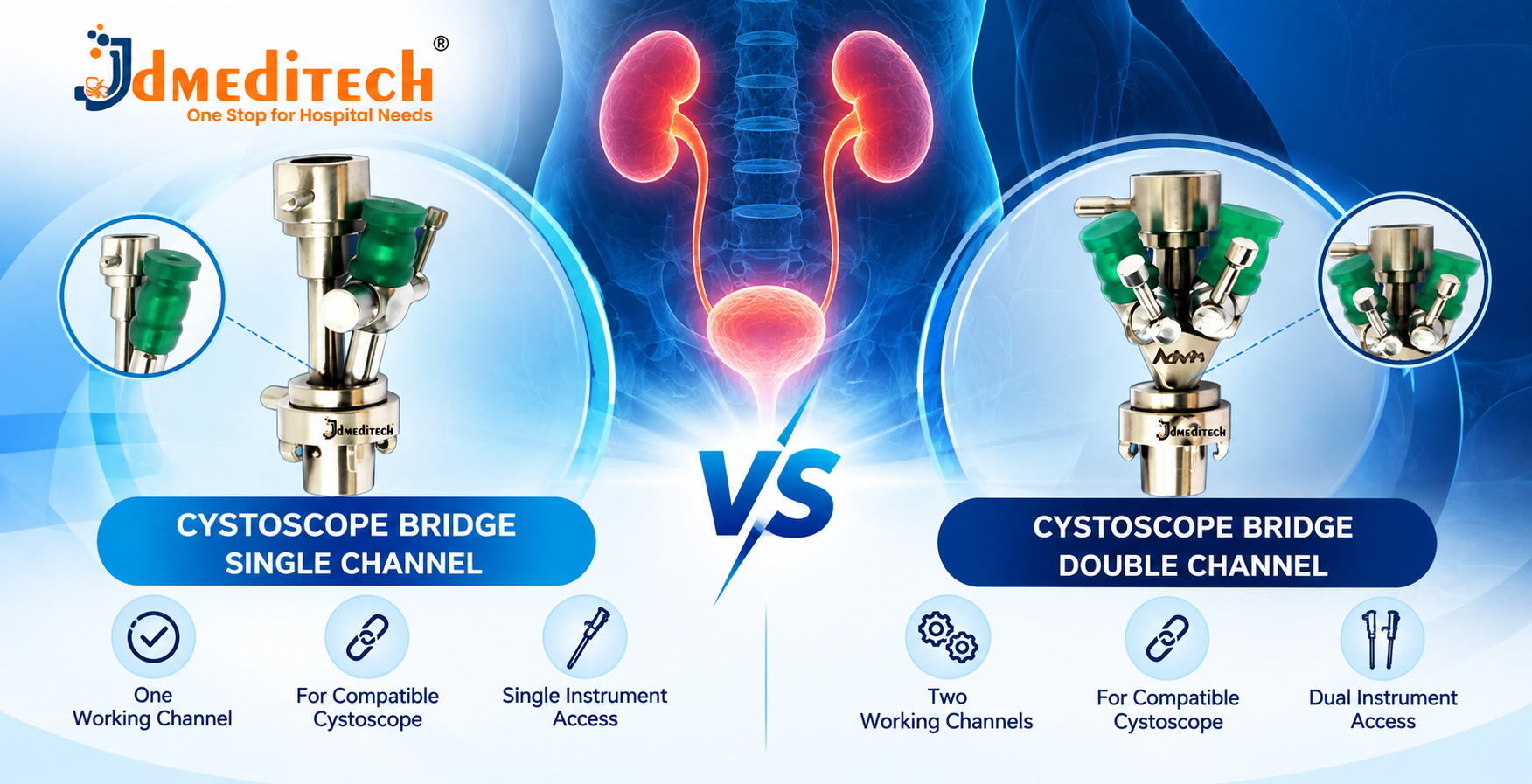
Cystoscope Bridge Single Channel vs Double Channel: Key Differences, Features and Applications
Cystoscope Bridge Single Channel vs Double Channel is an important comparison for healthcare professionals who use cystoscopy instruments. Both bridge designs support the introduction of compatible accessories during endoscopic urological procedures. However, they differ in their working channel configurations and potential instrument-handling options.
Therefore, understanding these differences helps urologists and medical purchasing teams evaluate suitable cystoscopy accessories. In this guide, JDMeditech explains the main features, working principles, applications, and compatibility considerations.
What Is a Cystoscope Bridge?
A cystoscope bridge is an accessory that connects with a compatible cystoscope assembly and provides access for suitable instruments or accessories.
During cystoscopy, healthcare professionals use a cystoscope to examine the urethra and urinary bladder. Additionally, compatible instruments may help clinicians perform selected diagnostic or therapeutic tasks.
Depending on its design, a cystoscope bridge may provide one or two working channels. Therefore, clinicians must choose a configuration that matches the intended procedure and equipment.
What Is a Single Channel Cystoscope Bridge?
A single channel cystoscope bridge provides one working channel for a compatible endoscopic accessory.
For example, a clinician may introduce a suitable instrument through the bridge during a cystoscopic procedure. The instrument type depends on the bridge design, channel dimensions, and manufacturer instructions.
Additionally, a single channel design may suit procedures that require only one accessory pathway.
However, the bridge must fit the relevant cystoscope assembly and support the selected instrument.
Key Features of Single Channel Cystoscope Bridges
- One working channel
- Designed for compatible cystoscope assemblies
- Supports suitable endoscopic accessories
- Provides a single instrument access pathway
- May suit selected diagnostic and therapeutic procedures
- Requires appropriate instrument compatibility
Furthermore, actual features depend on the manufacturer, bridge model, and associated cystoscopy equipment.
What Is a Double Channel Cystoscope Bridge?
A double channel cystoscope bridge provides two working channels for compatible endoscopic accessories.
Unlike a single channel bridge, this configuration offers two access pathways. Consequently, it may support the use of two compatible accessories during selected procedures.
For example, a clinician may need separate instrument pathways for a particular cystoscopic task. However, the ability to use both channels simultaneously depends on the equipment design and available working space.
Therefore, healthcare professionals should verify the bridge specifications before selecting instruments.
Key Features of Double Channel Cystoscope Bridges
- Two working channels
- Separate access pathways for compatible accessories
- May support selected procedures requiring two instruments
- Designed for compatible cystoscope assemblies
- Requires channel and instrument size verification
- Offers additional instrument access options
Additionally, users must consider the available working space and any restrictions in the manufacturer instructions.
Cystoscope Bridge Single Channel vs Double Channel: Comparison
Although both bridges serve as cystoscopy accessories, their channel configurations differ. Therefore, the following table highlights the main differences.
| Feature | Single Channel Bridge | Double Channel Bridge |
|---|---|---|
| Working Channels | One | Two |
| Instrument Access | Single pathway | Two pathways |
| Instrument Handling | One compatible accessory pathway | Potential access for two compatible accessories |
| Typical Selection | Procedures requiring one access channel | Procedures requiring two access channels |
| Equipment Compatibility | Model-specific | Model-specific |
| Instrument Size | Must fit the working channel | Must fit the relevant working channels |
| Main Advantage | Straightforward single-channel access | Additional accessory access pathway |
How Does a Single Channel Cystoscope Bridge Work?
A single channel cystoscope bridge provides a pathway for one compatible accessory. First, a trained healthcare professional connects the bridge to the appropriate cystoscope assembly.
Next, the clinician checks the connection and confirms instrument compatibility. Then, the clinician may introduce a suitable accessory through the working channel as required by the procedure.
As a result, the bridge supports controlled instrument access within the intended cystoscopy system.
How Does a Double Channel Cystoscope Bridge Work?
A double channel cystoscope bridge provides two accessory pathways. First, the clinician connects the bridge to a compatible cystoscope assembly.
Next, the clinician selects suitable accessories according to the working channel dimensions. Depending on the procedure and equipment design, the clinician may use one or both pathways.
Consequently, the double channel configuration offers additional access options. However, it does not automatically guarantee simultaneous use of every instrument combination.
Clinical Applications of Cystoscope Bridges
Healthcare professionals use compatible cystoscope bridges during selected diagnostic and therapeutic urological procedures.
For example, possible applications include:
- Diagnostic cystoscopy with accessory instruments
- Selected bladder biopsy procedures
- Introduction of compatible grasping instruments
- Selected ureteral catheterization procedures
- Endoscopic instrument access during urological treatment
However, the intended application depends on the complete cystoscopy system, accessory compatibility, and manufacturer instructions.
Single Channel vs Double Channel: Which Is Better?
Neither design is automatically better for every procedure. Instead, the choice depends on the required instrument access and equipment compatibility.
For example, a single channel bridge may meet the requirements of a procedure that uses one accessory pathway.
In contrast, a double channel bridge may offer additional flexibility when the clinician needs two compatible instrument pathways.
Nevertheless, healthcare professionals must consider channel dimensions, available working space, and the intended procedure.
Therefore, selecting the correct bridge configuration is more important than simply choosing the model with more channels.
Important Factors Before Selecting a Cystoscope Bridge
Before purchasing a cystoscope bridge, healthcare professionals should review the product specifications.
Additionally, purchasing teams should confirm the following details:
- Single channel or double channel configuration
- Compatibility with the cystoscope model
- Connection and locking mechanism
- Working channel dimensions
- Compatible instrument sizes
- Intended clinical applications
- Material and reprocessing requirements
- Manufacturer instructions for use
Furthermore, users should verify whether the product is reusable or single-use and follow the relevant cleaning, disinfection, or sterilization instructions.
JDMeditech Cystoscopy Instruments and Accessories
JDMeditech offers a range of urology instruments and medical accessories for hospitals, healthcare institutions, importers, and distributors.
Our urology product portfolio includes cystoscopy instruments and accessories for compatible endoscopic systems.
Additionally, our team assists customers with product specifications, available configurations, and international supply inquiries.
Explore our JDMeditech medical device range for further information.
Frequently Asked Questions
1. What is a cystoscope bridge?
A cystoscope bridge is an accessory that connects with a compatible cystoscope assembly and provides instrument access during selected urological procedures.
2. What is the difference between single channel and double channel cystoscope bridges?
A single channel bridge provides one accessory pathway. In contrast, a double channel bridge provides two working channels.
3. Can a double channel bridge support two instruments?
Depending on its design, a double channel bridge may support two compatible accessories. However, clinicians must verify channel dimensions and instrument compatibility.
4. Are cystoscope bridges compatible with every cystoscope?
No. Compatibility depends on the manufacturer, model, connection system, and technical specifications.
5. Are cystoscope bridges reusable?
Some models are reusable. However, users must check the product labeling and follow the manufacturer’s validated reprocessing instructions.
6. Which bridge should a hospital choose?
Hospitals should consider the intended procedure, required working channels, and existing cystoscopy equipment. Therefore, purchasing teams should confirm compatibility before ordering.
7. Where can I inquire about JDMeditech cystoscopy accessories?
Visit www.jdmeditech.com for product information and international business inquiries.
Conclusion
Understanding Cystoscope Bridge Single Channel vs Double Channel helps healthcare professionals compare two common cystoscopy accessory configurations.
A single channel bridge provides one instrument pathway. In contrast, a double channel bridge offers two access pathways for compatible accessories.
Therefore, clinicians should evaluate equipment compatibility, instrument dimensions, and procedural requirements before selecting a bridge.
For cystoscopy instruments, urology accessories, and international product inquiries, contact JDMeditech.
JDMeditech – One Stop for Hospital Needs.
Medical Disclaimer: This article provides general educational information. Product configurations and compatibility vary by model. Healthcare professionals should follow manufacturer instructions and applicable clinical guidelines.




