



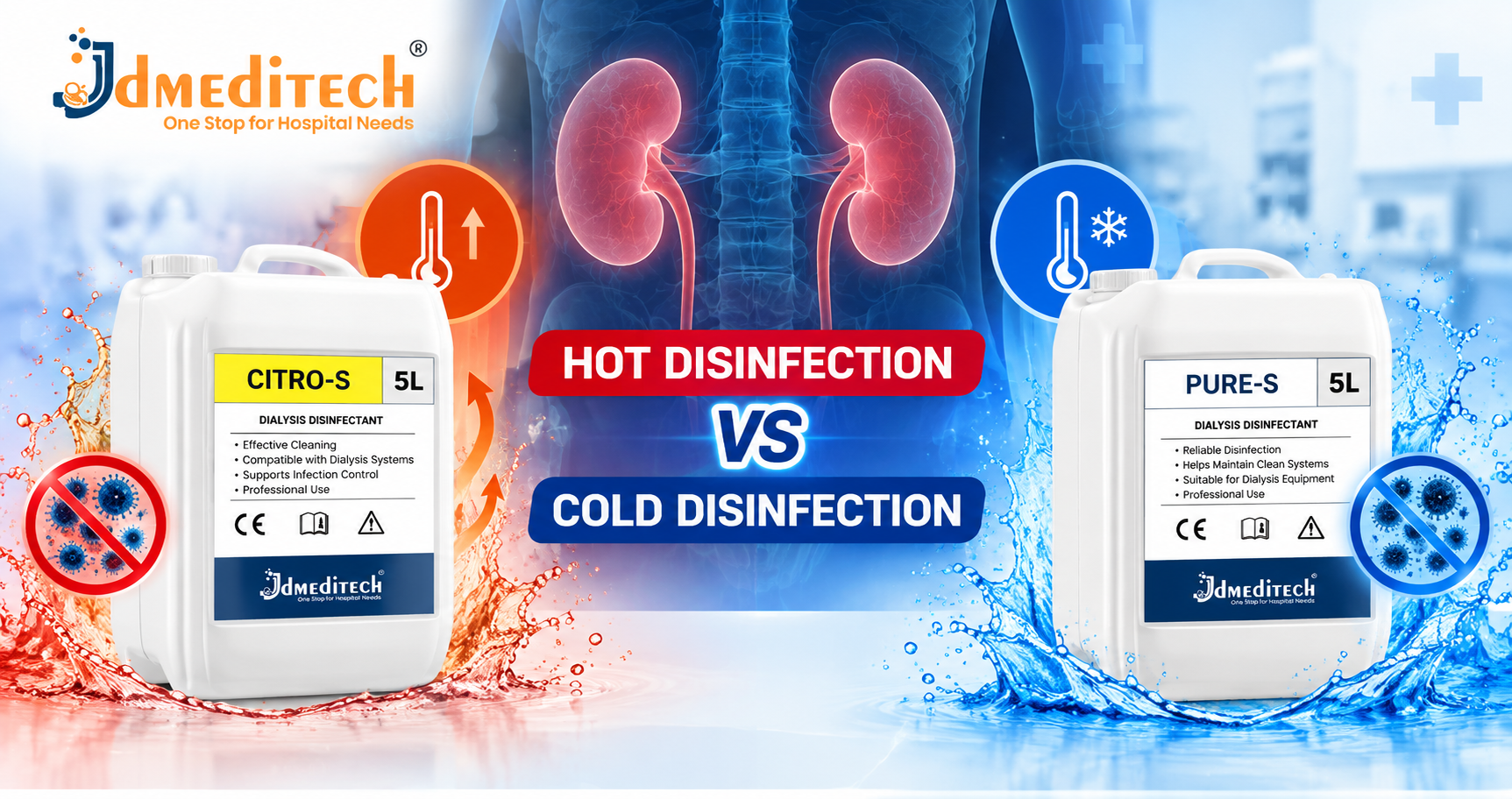
Hot Disinfection vs Cold Disinfection: Key Differences, Benefits and Applications
Hot Disinfection vs Cold Disinfection is an important topic for healthcare professionals who manage dialysis machines and compatible medical equipment. Both methods help control microbial contamination. However, they differ in temperature requirements, chemical use, equipment compatibility, and operating procedures.
Therefore, understanding these differences helps dialysis centers select appropriate disinfection methods. In this guide, JDMeditech explains the working principles, advantages, limitations, and important safety considerations.
What Is Hot Disinfection?
Hot disinfection uses elevated temperatures to reduce microbial contamination in compatible equipment. Depending on the system, the process may use heated water alone or combine heat with an approved chemical agent.
First, a compatible machine runs its programmed disinfection cycle. Next, the system circulates the heated fluid through the specified internal pathways. The process must maintain the validated operating conditions.
Furthermore, some dialysis systems support heat-based disinfection to help maintain their internal fluid pathways.
However, not every dialysis machine supports this method. Therefore, healthcare professionals must follow the equipment manufacturer’s instructions.
Key Features of Hot Disinfection
- Uses elevated temperatures
- May use heated water or compatible chemicals
- Supports microbial control in approved equipment
- May include automated disinfection cycles
- Requires temperature-compatible components
- Needs appropriate cooling and safety precautions
Advantages of Hot Disinfection
Hot disinfection can offer several advantages when a medical device supports a validated thermal cycle.
For example, some heat-only systems can reduce the need for chemical disinfectants during that cycle. Additionally, automated equipment may simplify routine operation.
However, effectiveness depends on the validated temperature, exposure time, fluid circulation, and equipment design.
What Is Cold Disinfection?
Cold disinfection generally refers to chemical disinfection without a high-temperature thermal cycle. Instead, an approved chemical agent provides the main antimicrobial action.
First, trained personnel prepare the disinfectant according to its instructions. Next, the compatible system runs the required chemical disinfection process.
Afterward, personnel complete any required rinsing and residual testing before returning the equipment to service.
Furthermore, cold chemical disinfection may suit equipment that does not support a thermal disinfection process.
However, the chemical must match the equipment manufacturer’s approved specifications.
Key Features of Cold Disinfection
- Uses an approved chemical disinfectant
- Does not require a high-temperature cycle
- Depends on chemical concentration and contact time
- Requires chemical compatibility checks
- May require rinsing and residual testing
- Needs safe handling and appropriate protective equipment
Advantages of Cold Disinfection
Cold chemical disinfection provides an alternative when equipment cannot tolerate high temperatures.
Additionally, suitable chemical agents can support microbial control in compatible dialysis systems.
Nevertheless, healthcare professionals must follow the product’s approved dilution, contact time, temperature range, and rinsing instructions.
Hot Disinfection vs Cold Disinfection: Comparison
Although both methods support infection control, their requirements differ. Therefore, the following table explains their main characteristics.
| Feature | Hot Disinfection | Cold Disinfection |
|---|---|---|
| Main Method | Thermal treatment, sometimes with chemicals | Chemical antimicrobial action |
| Temperature | Elevated temperature | No high-temperature cycle |
| Chemical Requirement | Depends on the system and cycle | Approved disinfectant required |
| Equipment Compatibility | Requires heat-compatible equipment | Requires chemical-compatible equipment |
| Important Controls | Temperature, time and circulation | Concentration, contact time and rinsing |
| Main Risks | Heat exposure and equipment damage | Chemical exposure and harmful residues |
| Maintenance | Thermal system and cycle checks | Chemical handling and residual checks |
How Does Hot Disinfection Work?
Hot disinfection relies on a validated thermal process. First, the compatible equipment begins its programmed cycle.
Next, the system raises the fluid temperature to the specified operating range. Then, the fluid circulates through the intended internal pathways.
Consequently, the thermal process helps reduce microbial contamination when the system meets its validated conditions.
Finally, the machine completes its required cooling, flushing, and safety checks before use.
How Does Cold Disinfection Work?
Cold disinfection uses an approved chemical agent to control microbial contamination.
First, personnel verify the disinfectant and its compatibility with the equipment. Next, they prepare and apply the chemical according to the instructions.
Then, the system maintains the required contact time. Afterward, personnel complete the specified rinsing process.
Importantly, some chemical disinfectants require residual testing before the equipment can return to patient use.
Why Is Disinfection Important in Dialysis Equipment?
Dialysis equipment requires careful cleaning and disinfection because microbial contamination can create serious patient safety risks.
For example, bacteria and other contaminants may enter water and fluid pathways if healthcare facilities do not maintain suitable infection-control procedures.
Therefore, dialysis centers must follow established cleaning, disinfection, water-quality, and equipment-maintenance protocols.
Additionally, staff must distinguish between internal machine disinfection and cleaning external equipment surfaces. These tasks may require different products and procedures.
Hot Disinfection vs Cold Disinfection: Which Is Better?
Neither method is automatically better for every dialysis machine.
For example, a compatible heat-disinfection system may support a validated thermal cycle. In contrast, another machine may require a particular chemical disinfectant.
Furthermore, some systems support more than one disinfection method. However, the manufacturer must approve the relevant process.
Therefore, healthcare professionals should compare equipment compatibility, validated effectiveness, operating requirements, and maintenance needs before choosing a method.
Important Safety Considerations
Healthcare facilities must follow the equipment and disinfectant manufacturers’ instructions.
Additionally, trained personnel should check the following factors:
- Approved equipment and disinfectant compatibility
- Required chemical concentration
- Validated operating temperature
- Required contact time
- Suitable personal protective equipment
- Required rinsing and residual testing
- Equipment inspection and maintenance
- Local infection-control requirements
Moreover, personnel must never mix disinfectants unless the manufacturer explicitly permits it.
Finally, healthcare professionals should verify that the equipment meets all required safety checks before patient use.
JDMeditech Dialysis Disinfection Products
JDMeditech offers medical devices, dialysis consumables, and healthcare equipment for hospitals, dialysis centers, importers, and medical distributors.
Our product range supports healthcare facilities with various dialysis equipment and consumable requirements.
Additionally, customers can contact our team for available disinfectant specifications, packaging information, and international business inquiries.
Explore the JDMeditech medical device range for further information.
Frequently Asked Questions
1. What is the difference between hot and cold disinfection?
Hot disinfection uses elevated temperatures. In contrast, cold disinfection generally relies on chemical agents without a high-temperature cycle.
2. Can hot disinfection use chemicals?
Yes. Some systems combine heat with approved chemical agents. However, other systems use heat without an added disinfectant.
3. Does cold disinfection require rinsing?
Many chemical disinfection procedures require rinsing. Additionally, some systems require residual testing before patient use. Always follow the relevant instructions.
4. Can every dialysis machine use hot disinfection?
No. Only compatible equipment should undergo a manufacturer-approved thermal disinfection cycle.
5. Is cold disinfection suitable for dialysis machines?
Yes, when the machine manufacturer approves the chemical and disinfection process. However, users must follow the specified operating requirements.
6. Which disinfection method is more effective?
Effectiveness depends on the validated process, equipment design, and correct operation. Therefore, facilities should not select a method based on temperature alone.
7. Where can I inquire about JDMeditech dialysis products?
Visit www.jdmeditech.com for medical product information and international inquiries.
Conclusion
Understanding Hot Disinfection vs Cold Disinfection helps healthcare professionals evaluate two important approaches to equipment disinfection.
Hot disinfection uses elevated temperatures, while cold disinfection generally relies on chemical antimicrobial action.
However, both methods require appropriate equipment compatibility, validated procedures, and careful safety checks.
Therefore, healthcare facilities should follow manufacturer instructions and established infection-control protocols when selecting disinfection methods.
For dialysis equipment and medical consumable inquiries, contact JDMeditech.
JDMeditech – One Stop for Hospital Needs.
References
- CDC – Disinfection of Healthcare Equipment
- CDC – Infection Prevention in Hemodialysis
- FDA – Dialysis Equipment Cleaning and Disinfection
Disclaimer: This article provides general educational information. It does not replace product labeling, safety data sheets, equipment instructions, or professional infection-control guidance.




