



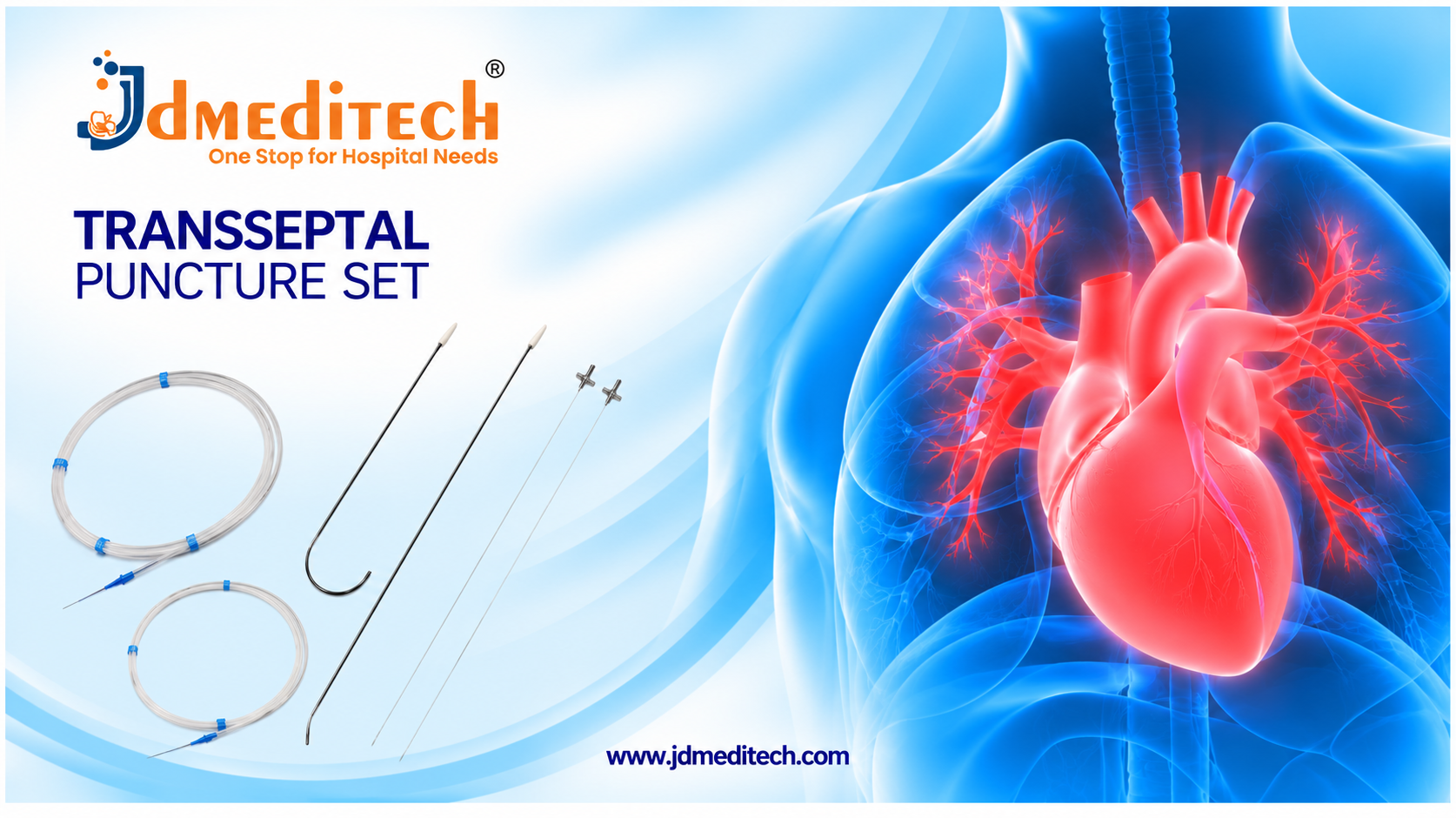
A Transseptal Puncture Set is a specialized collection of medical instruments used to support access to the left atrium during selected catheter-based cardiac procedures. Interventional cardiologists and electrophysiologists use compatible devices to cross the interatrial septum when clinically indicated.
Transseptal access plays an important role in modern cardiac electrophysiology and structural heart interventions. For example, specialists may require left atrial access during atrial fibrillation ablation and selected mitral valve procedures.
Moreover, suitable transseptal needles, sheaths, dilators, and related accessories support the procedure. However, component selection depends on patient anatomy, procedural requirements, and approved device compatibility.
JDMeditech offers selected cardiology devices and catheter-based accessories for hospitals, cardiac centers, and international medical distributors. This guide explains the components, applications, features, benefits, and safety considerations associated with transseptal puncture equipment.
What Is a Transseptal Puncture Set?
A Transseptal Puncture Set refers to a collection of specialized devices used during transseptal catheterization.
The procedure involves creating a controlled passage through the interatrial septum, which separates the right and left atria of the heart.
Consequently, specialists can introduce compatible catheters into the left atrium for selected diagnostic or interventional procedures.
However, transseptal puncture is an invasive cardiac procedure. Therefore, it requires appropriate clinical expertise, imaging guidance, and safety monitoring.
Understanding Transseptal Catheterization
Transseptal catheterization provides a route to the left atrium through the venous circulation and interatrial septum.
In particular, the technique is important when clinicians need left atrial access for electrophysiological mapping, ablation, or selected structural heart interventions.
Furthermore, imaging technologies such as fluoroscopy, transesophageal echocardiography, and intracardiac echocardiography may support procedural planning and guidance.
Nevertheless, the selected imaging approach depends on the clinical procedure, patient anatomy, and available equipment.
Why Is Transseptal Puncture Performed?
Transseptal puncture allows specialists to access the left atrium during procedures that require catheter-based intervention.
For example, the technique may support selected atrial fibrillation ablation procedures.
In addition, clinicians may use transseptal access during left atrial appendage closure and certain percutaneous mitral valve interventions.
However, transseptal puncture is not required for every cardiac catheterization procedure. Consequently, specialists must evaluate the indication and potential risks before proceeding.
Common Components of a Transseptal Puncture Set
Different manufacturers offer different transseptal device configurations. Therefore, the following components represent commonly associated equipment rather than a confirmed packing list.
1. Transseptal Puncture Needle
A transseptal puncture needle is designed for use during controlled access across the interatrial septum.
For example, selected procedures use a conventional Brockenbrough-type needle with a compatible sheath and dilator.
However, the needle design, dimensions, and curvature must match the intended system and approved application.
2. Transseptal Sheath
A transseptal sheath provides a compatible access pathway for selected catheters and interventional devices.
Moreover, different sheath designs may offer fixed or steerable configurations depending on the intended procedure.
3. Transseptal Dilator
A compatible dilator works with the selected sheath during transseptal access.
Therefore, hospitals must verify that the dilator and sheath are approved for use together.
4. Guide Wire
A suitable guide wire may support selected vascular access and catheter exchange tasks.
In addition, clinicians must confirm its diameter, length, and compatibility with the intended devices.
5. Hemostatic Valve
A compatible hemostatic valve helps manage blood loss and air entry during selected catheter-based procedures.
However, its presence and configuration depend on the specific sheath system.
6. Sidearm and Connection Tubing
Selected transseptal sheaths include a sidearm or compatible connection tubing.
Furthermore, these components may support specified flushing or pressure-monitoring arrangements.
7. Vascular Access Accessories
Some procedural configurations require separate access needles, introducers, or other vascular access devices.
Nevertheless, these accessories may not be included in a transseptal puncture set.
8. Imaging and Monitoring Equipment
Fluoroscopy and echocardiographic imaging may support safe transseptal access.
In addition, appropriate hemodynamic and cardiac monitoring equipment is essential during the procedure.
Importantly, imaging systems and monitors are generally separate from disposable transseptal puncture sets.
Transseptal Puncture Set Components and Functions
The following table summarizes commonly associated components and their functions.
| Component | Primary Function |
|---|---|
| Transseptal Needle | Supports controlled puncture of the interatrial septum |
| Transseptal Sheath | Provides a compatible catheter access pathway |
| Transseptal Dilator | Works with the sheath during transseptal access |
| Guide Wire | Supports selected access and exchange tasks |
| Hemostatic Valve | Helps manage blood loss and air entry |
| Connection Tubing | Supports specified fluid or monitoring connections |
| Vascular Access Accessories | Support selected vascular access requirements |
| Imaging Equipment | Supports visualization and procedural guidance |
Importantly, this table is educational. Customers must verify the exact JDMeditech set contents, dimensions, and device specifications before ordering.
Key Features of Transseptal Puncture Equipment
1. Specialized Left Atrial Access
Transseptal instruments support selected procedures requiring access to the left atrium.
Consequently, compatible systems play an important role in cardiac electrophysiology and structural heart interventions.
2. Compatible Needle and Sheath Configurations
Transseptal needles and sheaths are available in different designs.
Therefore, clinicians must select a compatible combination according to the intended procedure.
3. Catheter-Based Access
Suitable sheaths provide an access route for selected cardiac catheters.
Moreover, catheter compatibility depends on sheath dimensions and approved device specifications.
4. Imaging-Guided Procedures
Modern transseptal procedures may use fluoroscopy or echocardiographic guidance.
As a result, specialists can assess anatomy and confirm important procedural findings.
5. Different Procedural Configurations
Hospitals may require different transseptal systems for electrophysiology and structural heart procedures.
However, no single configuration is appropriate for every application.
Clinical Applications of Transseptal Puncture
Transseptal puncture supports selected procedures involving the left atrium.
1. Atrial Fibrillation Ablation
Catheter ablation for atrial fibrillation often requires access to the left atrium.
Therefore, transseptal access is an important part of many pulmonary vein isolation procedures.
2. Left Atrial Electrophysiology Procedures
Selected electrophysiology procedures require left atrial mapping or catheter intervention.
In addition, transseptal access may provide a suitable route for specific left-sided arrhythmia treatments.
3. Left Atrial Appendage Closure
Selected left atrial appendage closure procedures use transseptal access.
Consequently, clinicians can introduce compatible closure equipment into the left atrium.
4. Percutaneous Mitral Valve Interventions
Certain catheter-based mitral valve procedures require transseptal access.
Moreover, the required puncture location and equipment configuration depend on the planned intervention.
5. Selected Structural Heart Procedures
Other structural heart interventions may also require left atrial access.
However, clinicians must confirm the specific procedural indication and equipment requirements.
How Does Transseptal Puncture Work?
A qualified interventional cardiologist or electrophysiologist performs transseptal puncture in an appropriately equipped clinical setting.
First, the clinical team evaluates the patient’s anatomy, procedure requirements, and potential risks.
Next, specialists select suitable vascular access equipment and compatible transseptal devices.
During the procedure, the team uses appropriate imaging and monitoring to guide the transseptal system toward the interatrial septum.
Subsequently, the operator establishes and confirms the intended left atrial access.
Afterward, compatible interventional catheters may be introduced according to the planned procedure.
Finally, the healthcare team monitors the patient and evaluates for potential complications.
However, the exact technique depends on anatomy, equipment, and clinical protocols. This overview is not intended as procedural training.
Benefits of Transseptal Access Systems
1. Access to the Left Atrium
Transseptal systems provide an established route to the left atrium for selected procedures.
As a result, specialists can perform interventions that require access to left atrial structures.
2. Support for Catheter Ablation
Compatible transseptal devices support many left atrial electrophysiology procedures.
Furthermore, they form part of the equipment used during selected atrial fibrillation ablation procedures.
3. Support for Structural Heart Interventions
Selected transseptal systems support catheter-based structural heart procedures.
For example, certain mitral valve and left atrial appendage interventions require this access route.
4. Compatibility With Specialized Catheters
Suitable transseptal sheaths provide a pathway for approved catheter systems.
However, the operator must verify the compatibility of each component.
5. Different Device Options
Conventional and alternative transseptal access technologies are available for selected clinical situations.
Therefore, specialists can evaluate device options according to procedural requirements and patient anatomy.
Conventional vs Radiofrequency Transseptal Puncture
Different technologies can support transseptal access. However, their mechanisms and equipment requirements vary.
| Feature | Conventional Needle | RF Transseptal System |
|---|---|---|
| Access Mechanism | Mechanical needle puncture | Radiofrequency-assisted puncture |
| Equipment | Compatible needle, sheath, and dilator | Compatible RF device and associated equipment |
| Clinical Use | Selected transseptal procedures | Selected transseptal procedures |
| Energy Source | No RF energy required for puncture | Requires compatible RF equipment |
| Selection | Based on anatomy and clinical requirements | Based on anatomy and clinical requirements |
Importantly, RF devices are not interchangeable with conventional needles. Therefore, hospitals must verify approved compatibility and system requirements.
Risks and Safety Considerations
Transseptal puncture is an invasive procedure that can cause serious complications.
Potential risks include cardiac perforation, pericardial bleeding, cardiac tamponade, vascular injury, and thromboembolic events.
In addition, inadvertent puncture of an unintended cardiac or vascular structure may require emergency treatment.
Furthermore, air embolism, device-related complications, and access-site bleeding are important safety concerns.
Consequently, trained specialists must use appropriate imaging, anticoagulation management, and clinical monitoring according to established protocols.
Moreover, healthcare facilities should have suitable emergency equipment and complication-management arrangements available.
How to Choose a Transseptal Puncture Set
Hospitals and medical distributors should evaluate the intended cardiac procedure before selecting a transseptal system.
First, confirm whether the requirement involves a conventional transseptal needle, a complete sheath system, or an alternative access technology.
Next, review the approved compatibility of all selected components.
Important Equipment Selection Factors
- Approved intended use
- Transseptal needle design
- Needle curvature and usable length
- Transseptal sheath diameter and length
- Fixed or steerable sheath configuration
- Dilator compatibility
- Guide wire compatibility
- Hemostatic valve configuration
- Sidearm and connector design
- Radiopacity and imaging compatibility
- Sterile packaging requirements
- Single-use or reusable classification
- Manufacturer instructions for use
- Relevant technical documentation
Furthermore, purchasing teams should confirm the actual set contents and available sizes before placing an order.
Transseptal Puncture Instruments by JDMeditech
JDMeditech offers selected cardiology devices and catheter-based accessories for hospitals, cardiac care centers, and international medical distributors.
Our cardiology product range includes selected introducer sheaths, guide wires, and related interventional accessories.
Moreover, customers can contact JDMeditech to discuss transseptal puncture equipment availability, compatible configurations, and product specifications.
For more information, visit www.jdmeditech.com.
Frequently Asked Questions About Transseptal Puncture Set
1. What is a Transseptal Puncture Set?
A Transseptal Puncture Set is a collection of specialized devices used to support access across the interatrial septum during selected cardiac procedures.
2. What is the purpose of transseptal puncture?
Transseptal puncture provides access to the left atrium for selected catheter-based diagnostic and interventional procedures.
3. Which instruments are commonly used?
Common components include a compatible transseptal needle, sheath, dilator, and selected accessories.
4. What is a Brockenbrough needle?
A Brockenbrough needle is a conventional transseptal needle design used with compatible equipment during selected transseptal procedures.
5. Is transseptal puncture used during atrial fibrillation ablation?
Yes. Transseptal access is commonly used during left atrial catheter ablation procedures, including many atrial fibrillation treatments.
6. What is the function of a transseptal sheath?
A transseptal sheath provides a compatible pathway for selected catheters and interventional devices.
7. Are transseptal needles and sheaths interchangeable?
No. Clinicians must confirm that the selected components are approved and compatible with one another.
8. What imaging is used during transseptal puncture?
Depending on the procedure, clinicians may use fluoroscopy, transesophageal echocardiography, or intracardiac echocardiography.
9. What are the major risks of transseptal puncture?
Potential complications include cardiac perforation, tamponade, vascular injury, and thromboembolic events.
10. Where can hospitals inquire about JDMeditech transseptal equipment?
Hospitals and medical distributors can visit JDMeditech to request information about available cardiology devices and quotations.
Conclusion
A Transseptal Puncture Set supports selected cardiac procedures that require access to the left atrium.
Moreover, compatible needles, sheaths, dilators, and related accessories are important components of conventional transseptal systems.
However, transseptal puncture carries significant procedural risks and requires specialized training, imaging guidance, and monitoring.
Therefore, hospitals should select appropriate equipment according to clinical requirements, manufacturer specifications, and professional guidelines.
Contact JDMeditech for cardiology instruments, catheter-based accessories, and international medical device inquiries.
Medical Disclaimer: This article is intended for general educational purposes and does not provide procedural instructions. Qualified healthcare professionals must make treatment and device-selection decisions according to clinical judgment, applicable guidelines, and approved manufacturer instructions.




