



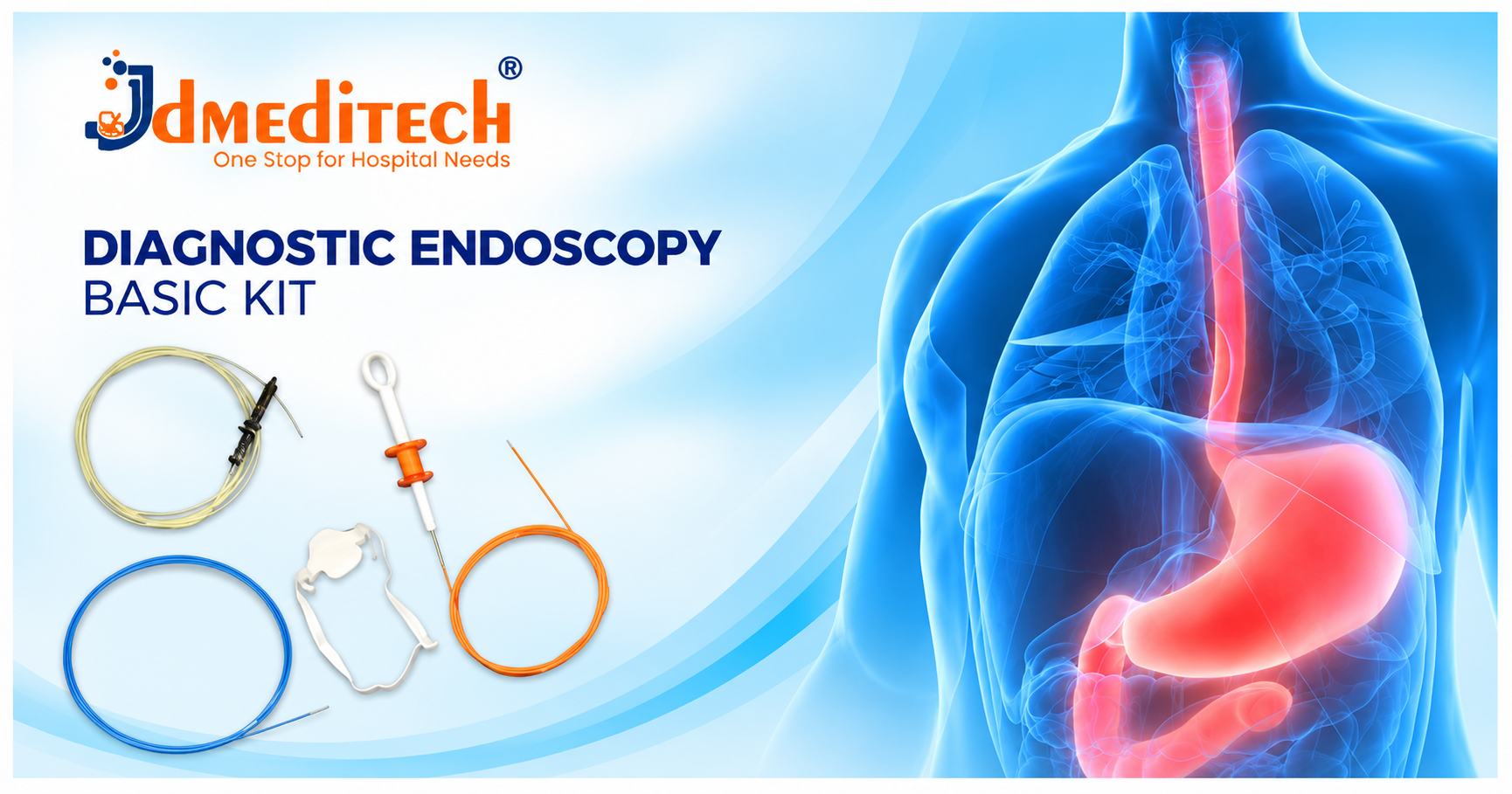
Gastrointestinal endoscopy allows specialists to examine the digestive tract using a suitable endoscope. Moreover, compatible accessories extend the capabilities of the examination when additional diagnostic procedures are necessary.
However, not every diagnostic endoscopy kit contains the same instruments. Therefore, hospitals and medical distributors should verify the intended use, dimensions, and exact supplied components before purchasing.
JDMeditech offers selected gastroenterology instruments and endoscopy accessories for hospitals, endoscopy centers, and international medical distributors. This guide explains common kit components, clinical applications, features, benefits, and safety considerations.
What Is a Diagnostic Endoscopy Basic Kit?
A Diagnostic Endoscopy Basic Kit is a collection of selected accessories intended to support compatible diagnostic endoscopy procedures.
For example, a gastrointestinal endoscopy accessory configuration may include devices for tissue sampling, specimen collection, or selected catheter-based tasks.
In addition, healthcare professionals may use these accessories with suitable gastroscopes, colonoscopes, or other endoscopic equipment, depending on their approved applications.
Nevertheless, the exact kit configuration varies. Consequently, purchasing teams must confirm the manufacturer’s packing list and compatibility information.
Understanding Diagnostic Gastrointestinal Endoscopy
Diagnostic gastrointestinal endoscopy allows clinicians to examine selected parts of the digestive tract.
During upper gastrointestinal endoscopy, a specialist may inspect the esophagus, stomach, and duodenum. In contrast, colonoscopy allows examination of the colon and, when appropriate, the terminal ileum.
Furthermore, suitable accessories may support biopsy collection or other investigations when clinically indicated.
However, accessory selection depends on the procedure and the endoscope’s working channel dimensions.
Common Accessories Associated With Diagnostic Endoscopy
Different endoscopy procedures require different accessories. Therefore, the following instruments represent examples rather than a confirmed list of components in every kit.
1. Endoscopic Biopsy Forceps
Endoscopic biopsy forceps support tissue sampling from selected areas of the gastrointestinal tract.
During a suitable procedure, the clinician introduces compatible forceps through the endoscope’s working channel.
Afterward, the healthcare team handles the tissue specimen according to the relevant laboratory protocol.
2. Endoscopic Cytology Brush
A cytology brush supports collection of cellular samples from selected gastrointestinal or ductal sites when indicated.
Moreover, the clinician selects the brush according to the intended procedure and device compatibility.
3. Diagnostic Endoscopy Catheter
Selected endoscopic catheters support fluid delivery, aspiration, or other approved diagnostic applications.
However, the catheter’s function depends on its specific design and approved intended use.
4. Endoscopic Guide Wire
A compatible guide wire may support selected catheter-based endoscopic procedures.
In addition, guide wire diameter, length, and tip configuration must match the intended accessories.
5. Aspiration Accessories
Suitable aspiration accessories may support the collection or removal of fluids during selected procedures.
Consequently, clinicians must verify connections and intended applications before use.
6. Endoscopic Injection Needle
An endoscopic injection needle supports selected injection procedures when clinically indicated.
However, it is not necessarily part of a basic diagnostic kit and may be used for therapeutic rather than purely diagnostic purposes.
7. Endoscope Cleaning Brush
A compatible cleaning brush supports manual cleaning of designated endoscope channels during reprocessing.
Importantly, cleaning brushes are reprocessing accessories and should not be confused with cytology brushes used for specimen collection.
8. Collection and Connection Accessories
Selected kits may include suitable connectors or collection accessories.
Furthermore, hospitals should verify whether these items are supplied separately or included in the package.
Diagnostic Endoscopy Instruments and Their Functions
The following table summarizes common endoscopy accessories and their potential applications.
| Accessory | Primary Function |
|---|---|
| Biopsy Forceps | Collect tissue samples during compatible endoscopic procedures |
| Cytology Brush | Collect cellular specimens from selected sites |
| Endoscopy Catheter | Support specified fluid or catheter-based applications |
| Guide Wire | Support compatible catheter positioning |
| Aspiration Accessory | Support selected fluid collection tasks |
| Injection Needle | Support selected endoscopic injection procedures |
| Cleaning Brush | Support endoscope channel cleaning during reprocessing |
| Collection Accessories | Support suitable specimen or fluid handling |
Importantly, this table is educational. It does not establish the actual contents of a JDMeditech Diagnostic Endoscopy Basic Kit.
Key Features of Diagnostic Endoscopy Accessories
1. Compatibility With Endoscopic Equipment
Suitable accessories work with specified endoscope models and channel dimensions.
Therefore, clinicians and purchasing teams must confirm compatibility before use.
2. Support for Diagnostic Procedures
Selected accessories allow clinicians to collect tissue or cellular specimens.
As a result, laboratory testing may provide additional diagnostic information.
3. Different Instrument Configurations
Endoscopy accessories are available in different dimensions and designs.
Moreover, device selection depends on the clinical procedure and approved intended use.
4. Catheter-Based Applications
Selected catheter accessories support specific endoscopic tasks.
However, clinicians should not assume that all catheters are interchangeable.
5. Sterile and Reusable Options
Endoscopy accessories may be supplied as single-use or reusable devices.
Consequently, healthcare facilities must follow the manufacturer’s labeling and reprocessing instructions.
Clinical Applications of Diagnostic Endoscopy Accessories
Diagnostic endoscopy accessories support a range of gastrointestinal investigations.
For example, clinicians may use suitable devices during:
- Upper gastrointestinal endoscopy
- Colonoscopy
- Selected endoscopic biopsy procedures
- Endoscopic cytology sampling
- Selected fluid aspiration procedures
- Specified catheter-based diagnostic procedures
- Other compatible gastrointestinal investigations
However, each accessory has its own approved intended use. Therefore, the clinician must select the appropriate device for the planned examination.
How Are Diagnostic Endoscopy Accessories Used?
A qualified healthcare professional selects diagnostic endoscopy accessories according to the patient’s clinical needs.
First, the endoscopy team reviews the planned examination and relevant patient information.
Next, staff confirm that the selected accessory is compatible with the endoscope and suitable for its intended application.
During the examination, the clinician may introduce an approved accessory through the working channel when indicated.
Afterward, the healthcare team collects and identifies any required specimens.
Finally, staff dispose of single-use accessories or reprocess reusable instruments according to validated instructions.
Nevertheless, actual clinical techniques depend on the procedure, device design, and applicable medical protocols.
Benefits of a Diagnostic Endoscopy Basic Kit
1. Convenient Accessory Organization
A suitably configured kit can bring selected instruments together for a planned procedure.
As a result, purchasing and preparation teams may find it easier to organize compatible accessories.
2. Support for Tissue Sampling
Suitable biopsy instruments help clinicians collect specimens for laboratory examination.
Furthermore, specimen analysis may contribute to the diagnostic process.
3. Support for Different Investigations
Different accessories serve different diagnostic purposes.
Therefore, a carefully selected configuration may support the needs of a particular endoscopy service.
4. Equipment Compatibility Planning
Reviewing accessories as a set can help hospitals assess compatibility with existing endoscopes.
However, every component still requires individual verification.
5. Procurement Convenience
Hospitals may prefer clearly documented accessory configurations when requesting quotations.
Moreover, an accurate packing list helps customers compare available products.
Diagnostic Endoscopy Kit vs Therapeutic Endoscopy Kit
Diagnostic and therapeutic endoscopy accessories have different primary purposes.
| Feature | Diagnostic Accessories | Therapeutic Accessories |
|---|---|---|
| Primary Purpose | Support examination and diagnostic sampling | Support selected endoscopic treatments |
| Examples | Biopsy forceps and cytology brushes | Selected snares, clips, and treatment catheters |
| Clinical Application | Diagnostic investigations | Endoscopic intervention |
| Equipment Selection | Depends on examination requirements | Depends on planned treatment |
However, some accessories can serve different roles depending on their approved intended use. Consequently, clinicians should follow the device documentation rather than relying on kit names alone.
Safety and Infection Prevention
Diagnostic endoscopy requires suitable equipment, trained personnel, and appropriate infection prevention practices.
Before use, staff should inspect device packaging, labeling, and compatibility information.
Furthermore, healthcare facilities must follow validated reprocessing instructions for reusable endoscopes and accessories.
Reusable accessories that penetrate mucosal tissue require appropriate sterilization between patients. In contrast, single-use devices must not be reused unless expressly permitted by applicable regulations and validated processes.
Moreover, damaged or incompatible instruments may increase procedural risks.
Therefore, healthcare professionals must follow the approved instructions for use and applicable infection control guidelines.
How to Choose a Diagnostic Endoscopy Basic Kit
Hospitals and medical distributors should review the intended clinical application before purchasing endoscopy accessories.
First, confirm whether the kit is intended for upper gastrointestinal endoscopy, colonoscopy, or another procedure.
Next, compare the available instrument configurations with the hospital’s equipment.
Important Equipment Selection Factors
- Approved intended use
- Exact kit components
- Endoscope channel compatibility
- Instrument working length
- Catheter or accessory diameter
- Biopsy forceps configuration
- Cytology brush dimensions
- Guide wire compatibility
- Connection requirements
- Sterile packaging and labeling
- Single-use or reusable classification
- Reprocessing requirements
- Manufacturer technical documentation
In addition, purchasing teams should confirm the actual quantity of each supplied component.
Diagnostic Endoscopy Accessories by JDMeditech
JDMeditech offers selected gastroenterology instruments and endoscopy accessories for hospitals, clinics, endoscopy centers, and international medical distributors.
Our gastroenterology product range includes selected biopsy forceps, cytology brushes, endoscopic catheters, guide wires, and related devices.
Furthermore, customers can contact JDMeditech to discuss available product configurations, specifications, and quotations.
For additional product information, visit www.jdmeditech.com.
Frequently Asked Questions About Diagnostic Endoscopy Basic Kit
1. What is a Diagnostic Endoscopy Basic Kit?
A Diagnostic Endoscopy Basic Kit is a selected collection of accessories intended to support compatible endoscopic procedures. However, the contents vary by configuration.
2. What is the purpose of diagnostic endoscopy?
Diagnostic endoscopy allows clinicians to examine selected areas of the digestive tract and investigate suspected abnormalities.
3. Which instruments are used during diagnostic endoscopy?
Depending on the procedure, clinicians may use compatible biopsy forceps, cytology brushes, catheters, and other accessories.
4. Does every diagnostic endoscopy kit contain biopsy forceps?
No. Customers should verify the actual packing list before ordering.
5. What is an endoscopic cytology brush?
A cytology brush is an accessory used to collect cellular specimens from selected anatomical sites.
6. Can the same kit be used for gastroscopy and colonoscopy?
Only when the supplied devices are approved and compatible with the intended endoscopes and procedures.
7. Are diagnostic endoscopy accessories reusable?
Some accessories are reusable, while others are single-use. Therefore, hospitals must follow the manufacturer’s labeling and instructions.
8. Why is working channel compatibility important?
Compatible dimensions help ensure that an accessory can be used with the selected endoscope according to its approved specifications.
9. Does a basic kit include the endoscope itself?
Not necessarily. The endoscope and other equipment may be supplied separately.
10. Where can hospitals inquire about JDMeditech endoscopy accessories?
Hospitals and medical distributors can visit JDMeditech to request product information and quotations.
Conclusion
A Diagnostic Endoscopy Basic Kit can support selected gastrointestinal investigations through compatible diagnostic accessories.
Moreover, suitable biopsy instruments, cytology brushes, and other devices help clinicians perform specified diagnostic tasks.
However, the exact kit contents, device compatibility, and approved applications must be verified before clinical use.
Therefore, hospitals should select endoscopy accessories according to their procedural requirements and manufacturer documentation.
Contact JDMeditech for gastroenterology instruments, endoscopy accessories, and international medical device inquiries.
Medical Disclaimer: This article provides general educational information and does not replace professional medical advice or device instructions. Qualified healthcare professionals must select medical procedures and instruments according to clinical judgment, approved manufacturer instructions, and applicable guidelines.Diagnostic Endoscopy Basic Kit




