



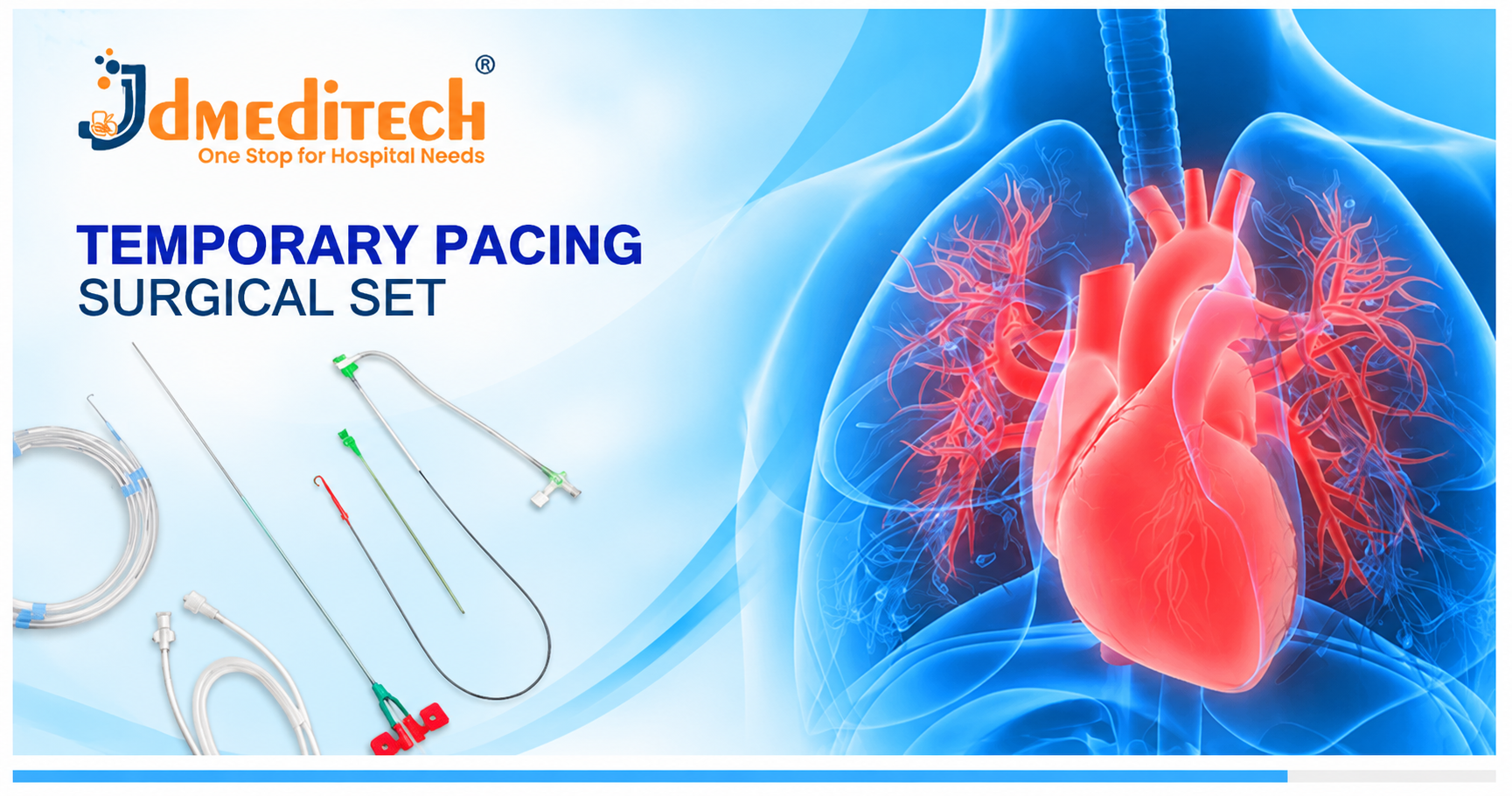
Temporary cardiac pacing may help manage certain serious heart rhythm disturbances. In particular, specialists may use it when severe bradycardia causes hemodynamic instability or when an immediate pacing requirement is expected.
Moreover, compatible pacing leads, vascular access instruments, and external pacing equipment support selected procedures. Therefore, hospitals must choose suitable components according to clinical requirements and device compatibility.
JDMeditech offers selected cardiology instruments and accessories for hospitals, cardiac care centers, and international medical distributors. This guide explains temporary pacing equipment, applications, benefits, and important safety considerations.
What Is a Temporary Pacing Surgical Set?
A Temporary Pacing Surgical Set refers to a selected collection of instruments and accessories used to establish temporary cardiac pacing.
During temporary transvenous pacing, a qualified specialist positions a compatible pacing lead inside the heart through an appropriate venous access route. Subsequently, the lead connects to a suitable external pulse generator.
The external pacemaker delivers electrical impulses when pacing is clinically indicated. As a result, the system may help maintain an appropriate heart rate in selected patients.
However, temporary pacing is not necessary for every slow heart rhythm. Instead, clinicians consider symptoms, hemodynamic status, underlying causes, and alternative treatments.
Understanding Temporary Cardiac Pacing
Temporary cardiac pacing provides short-term electrical stimulation to support the heartbeat.
For example, clinicians may consider temporary pacing for selected patients with severe symptomatic bradycardia or significant atrioventricular conduction disturbances.
In addition, temporary pacing may serve as a bridge while specialists treat a reversible condition or arrange permanent pacemaker implantation.
Nevertheless, transvenous temporary pacing carries important procedural risks. Therefore, clinical guidelines recommend limiting its use to appropriate indications and maintaining close monitoring.
When Is Temporary Cardiac Pacing Used?
Healthcare professionals may consider temporary cardiac pacing in selected emergency or perioperative situations.
Common clinical circumstances include:
- Severe bradycardia with hemodynamic compromise
- Selected high-grade atrioventricular blocks
- Selected reversible conduction disturbances
- Bradyarrhythmias associated with certain medication effects
- Selected rhythm disturbances following cardiac procedures
- Temporary support while arranging permanent pacing
- Anticipated pacing requirements during selected procedures
However, these conditions do not automatically require a temporary pacemaker. Consequently, clinicians must assess the patient and follow applicable treatment guidelines.
Common Components of a Temporary Pacing Surgical Set
Different temporary pacing systems require different components. Furthermore, the contents of a commercial surgical set vary by manufacturer and configuration.
1. Temporary Pacing Lead
A temporary pacing lead provides an electrical connection between the external pacing system and the selected cardiac pacing site.
In addition, the lead must be compatible with the intended pulse generator and procedural technique.
2. Balloon-Tipped Temporary Pacing Catheter
Selected transvenous pacing procedures use a balloon-tipped pacing catheter to assist positioning.
Moreover, the catheter configuration depends on the approved intended use and clinical requirements.
3. Vascular Introducer Sheath
A compatible introducer sheath provides a route for selected pacing catheters or leads during transvenous procedures.
Therefore, clinicians must confirm the sheath dimensions and compatibility before use.
4. Guide Wire
A suitable guide wire may support vascular access during selected procedures.
However, guide wire selection must follow the intended application and manufacturer instructions.
5. Dilator
A compatible dilator may support preparation of the vascular access route.
Furthermore, its dimensions must match the selected introducer system.
6. Access Needle
A suitable access needle supports venous entry during selected transvenous procedures.
Nevertheless, the exact needle configuration depends on the access technique and approved device requirements.
7. Connecting Cable
A compatible connecting cable establishes the electrical connection between the pacing lead and external equipment.
Consequently, purchasing teams should verify connector compatibility before selecting accessories.
8. External Temporary Pacemaker
An external temporary pacemaker generates electrical pacing impulses for a compatible temporary pacing system.
In addition, clinicians monitor device function and adjust settings according to the patient’s clinical needs.
Importantly, the external pacemaker may be supplied separately rather than as part of the surgical set.
9. Fixation and Dressing Accessories
Suitable fixation and dressing accessories help secure the access site and associated equipment.
Moreover, appropriate site care supports infection prevention and device stability.
Temporary Pacing Surgical Set Components and Functions
The following table summarizes commonly associated equipment. However, it does not represent a verified JDMeditech packing list.
| Component | Primary Function |
|---|---|
| Temporary Pacing Lead | Conducts pacing impulses to the selected cardiac site |
| Balloon-Tipped Pacing Catheter | Supports selected transvenous pacing procedures |
| Introducer Sheath | Provides compatible vascular access |
| Guide Wire | Supports selected vascular access techniques |
| Dilator | Supports preparation of the access route |
| Access Needle | Supports initial venous access |
| Connecting Cable | Connects compatible pacing components |
| External Pacemaker | Generates temporary pacing impulses |
| Fixation Accessories | Help secure selected components |
Before ordering, customers should confirm which components are included and which items require separate purchase.
Key Features of Temporary Pacing Equipment
1. Short-Term Cardiac Support
Temporary pacing systems provide electrical stimulation when short-term cardiac pacing is clinically necessary.
As a result, suitable systems can support selected patients while clinicians manage the underlying condition.
2. Compatibility With External Pacemakers
Temporary pacing leads connect to suitable external pacing equipment.
Therefore, hospitals must verify electrical and connector compatibility.
3. Different Pacing Lead Configurations
Temporary pacing leads are available in different designs and dimensions.
Moreover, clinicians select a suitable configuration according to the intended procedure.
4. Compatibility With Vascular Access Equipment
Selected transvenous pacing systems work with compatible introducer sheaths and related accessories.
However, sheath dimensions and catheter compatibility must follow the manufacturer’s specifications.
5. Support for Emergency Cardiac Care
Temporary pacing may provide important short-term support during selected cardiac emergencies.
Nevertheless, trained professionals must supervise the system and continuously assess its performance.
Types of Temporary Cardiac Pacing
Healthcare professionals use different temporary pacing approaches according to the patient’s clinical condition.
1. Temporary Transvenous Pacing
Transvenous pacing uses a compatible lead positioned through a venous access route.
Subsequently, an external pulse generator provides electrical stimulation when required.
2. Transcutaneous Pacing
Transcutaneous pacing delivers electrical impulses through external electrode pads.
For example, clinicians may use it as an emergency measure when immediate pacing support is required.
However, discomfort and other limitations may affect prolonged use.
3. Temporary Epicardial Pacing
Epicardial pacing uses electrodes attached to the heart’s outer surface.
In particular, cardiac surgical teams may use temporary epicardial pacing wires following selected heart operations.
Temporary Transvenous vs Transcutaneous Pacing
Both techniques provide temporary cardiac pacing. However, their equipment and clinical applications differ.
| Feature | Transvenous Pacing | Transcutaneous Pacing |
|---|---|---|
| Access Method | Intravascular pacing lead | External electrode pads |
| Invasive Procedure | Yes | No vascular insertion required |
| Main Equipment | Pacing lead and external generator | Compatible external pacing device and pads |
| Typical Role | Selected temporary cardiac support | Rapid emergency pacing support |
| Monitoring | Continuous clinical monitoring | Continuous clinical monitoring |
Therefore, clinicians must select the approach according to urgency, patient stability, available equipment, and established guidelines.
How Does Temporary Transvenous Pacing Work?
Temporary transvenous pacing uses an electrode lead connected to an external pacing device.
First, the clinical team assesses the patient’s cardiac rhythm and need for temporary support.
Next, a qualified specialist selects appropriate equipment and an access approach.
During the procedure, the clinician positions the pacing lead using suitable clinical guidance.
Afterward, the lead connects to a compatible external pacemaker.
The healthcare team then assesses electrical capture, cardiac response, and overall patient stability.
Finally, clinicians continue appropriate monitoring and reassess whether temporary pacing remains necessary.
However, the exact procedure varies according to the patient’s condition and institutional protocols.
Benefits of Temporary Pacing Systems
1. Immediate Pacing Support When Indicated
Temporary pacing can provide short-term electrical stimulation for selected serious bradyarrhythmias.
Consequently, it may help support cardiac function while clinicians address the underlying problem.
2. Support During Reversible Conditions
Some conduction disturbances improve after treatment of their underlying causes.
Therefore, temporary pacing may provide support during the recovery period when clinically indicated.
3. Bridge to Permanent Pacemaker Implantation
Selected patients require pacing support before permanent pacemaker implantation becomes possible.
In these circumstances, an appropriate temporary system may provide interim support.
4. Different Clinical Approaches
Temporary pacing includes transvenous, transcutaneous, and epicardial techniques.
As a result, specialists can select the most suitable approach for a particular clinical situation.
5. External Pacing Control
Compatible external pacemakers allow trained professionals to manage pacing parameters.
However, continuous monitoring and appropriate device checks remain essential.
Temporary Pacemaker vs Permanent Pacemaker
Temporary and permanent pacemakers have different intended uses.
| Feature | Temporary Pacemaker | Permanent Pacemaker |
|---|---|---|
| Primary Purpose | Short-term pacing support | Long-term pacing therapy |
| Pulse Generator | Usually external | Usually implanted |
| Duration | Limited to clinical need | Long-term use |
| Common Application | Selected urgent or reversible conditions | Persistent pacing indications |
| Clinical Monitoring | Close monitoring required | Regular device follow-up |
Consequently, clinicians should choose the pacing strategy according to the diagnosis and expected duration of treatment.
Risks and Safety Considerations
Temporary transvenous pacing carries important risks. Therefore, only appropriately trained healthcare professionals should perform and supervise the procedure.
Potential complications include bleeding, infection, vascular injury, cardiac perforation, and arrhythmias.
In addition, lead displacement or electrical malfunction may interrupt effective pacing.
Furthermore, prolonged temporary lead use can increase certain complications.
As a result, clinicians should regularly reassess pacing requirements and remove temporary equipment when it is no longer needed.
How to Choose a Temporary Pacing Surgical Set
Hospitals and medical distributors should review the intended procedure before purchasing temporary pacing equipment.
First, confirm whether the requirement involves a temporary transvenous pacing lead, a complete access kit, or a separate external pacemaker.
Next, review the relevant dimensions, connectors, and device compatibility.
Important Equipment Selection Factors
- Approved intended use
- Temporary pacing lead type
- Lead diameter and usable length
- Balloon-tipped or non-balloon configuration
- Introducer sheath compatibility
- Guide wire and dilator specifications
- External pacemaker compatibility
- Electrical connector configuration
- Radiopacity and imaging requirements
- Sterile packaging and labeling
- Single-use or reusable classification
- Instructions for use
- Manufacturer technical documentation
Moreover, purchasing teams should confirm the exact product contents and available specifications before placing an order.
Temporary Pacing Equipment and Cardiology Devices by JDMeditech
JDMeditech offers selected cardiology devices and vascular access accessories for hospitals, cardiac care centers, and international medical distributors.
Our cardiology product range includes selected temporary pacing leads, introducer sheaths, guide wires, and related medical devices.
Furthermore, customers can contact our team to discuss available configurations, compatibility requirements, and product specifications.
For additional information, visit www.jdmeditech.com.
Frequently Asked Questions About Temporary Pacing Surgical Set
1. What is a Temporary Pacing Surgical Set?
A Temporary Pacing Surgical Set includes selected instruments and accessories used during temporary cardiac pacing procedures. However, exact kit contents vary.
2. What is the purpose of temporary cardiac pacing?
Temporary pacing provides short-term electrical stimulation when clinically necessary, particularly in selected serious bradyarrhythmias.
3. Which components are commonly used?
Common equipment includes a temporary pacing lead, compatible vascular access accessories, connecting cables, and an external pacemaker.
4. What is a temporary pacing lead?
A temporary pacing lead conducts electrical impulses between the external pacing system and the selected cardiac pacing site.
5. What is a balloon-tipped temporary pacing catheter?
A balloon-tipped pacing catheter is a specialized device used during selected temporary transvenous pacing procedures.
6. Is temporary pacing the same as permanent pacing?
No. Temporary pacing provides short-term support, while permanent pacemakers are intended for long-term treatment of suitable conditions.
7. Does every temporary pacing kit include an external pacemaker?
No. External pacemakers may be supplied separately. Therefore, customers should confirm the exact packing list.
8. What are the risks of temporary transvenous pacing?
Potential risks include bleeding, infection, arrhythmias, cardiac perforation, lead displacement, and pacing malfunction.
9. Who performs temporary transvenous pacing?
Qualified healthcare professionals with appropriate training perform the procedure in suitable clinical settings.
10. Where can hospitals inquire about JDMeditech cardiology devices?
Hospitals and distributors can visit JDMeditech to request product details and quotations.
Conclusion
A Temporary Pacing Surgical Set supports selected procedures that provide short-term electrical cardiac stimulation.
Moreover, compatible pacing leads, vascular access devices, and external pacemakers help healthcare professionals establish appropriate temporary pacing systems.
However, temporary transvenous pacing carries important risks and requires careful patient selection and monitoring.
Therefore, hospitals should select suitable equipment according to clinical requirements, approved device specifications, and professional guidelines.
Contact JDMeditech for temporary pacing leads, cardiology instruments, and international medical device inquiries.
Medical Disclaimer: This article provides general educational information and is not a procedural training guide. Qualified healthcare professionals must make all treatment and device-selection decisions according to clinical judgment, applicable guidelines, and approved manufacturer instructions.




