



Gastroenterology Disposable Products: Complete Guide to Endoscopy Accessories and Devices
Gastroenterology Disposable Products support diagnostic and therapeutic procedures involving the digestive system. Today, gastroenterologists use specialized endoscopic devices to examine the gastrointestinal tract, collect tissue samples, and perform selected treatments.
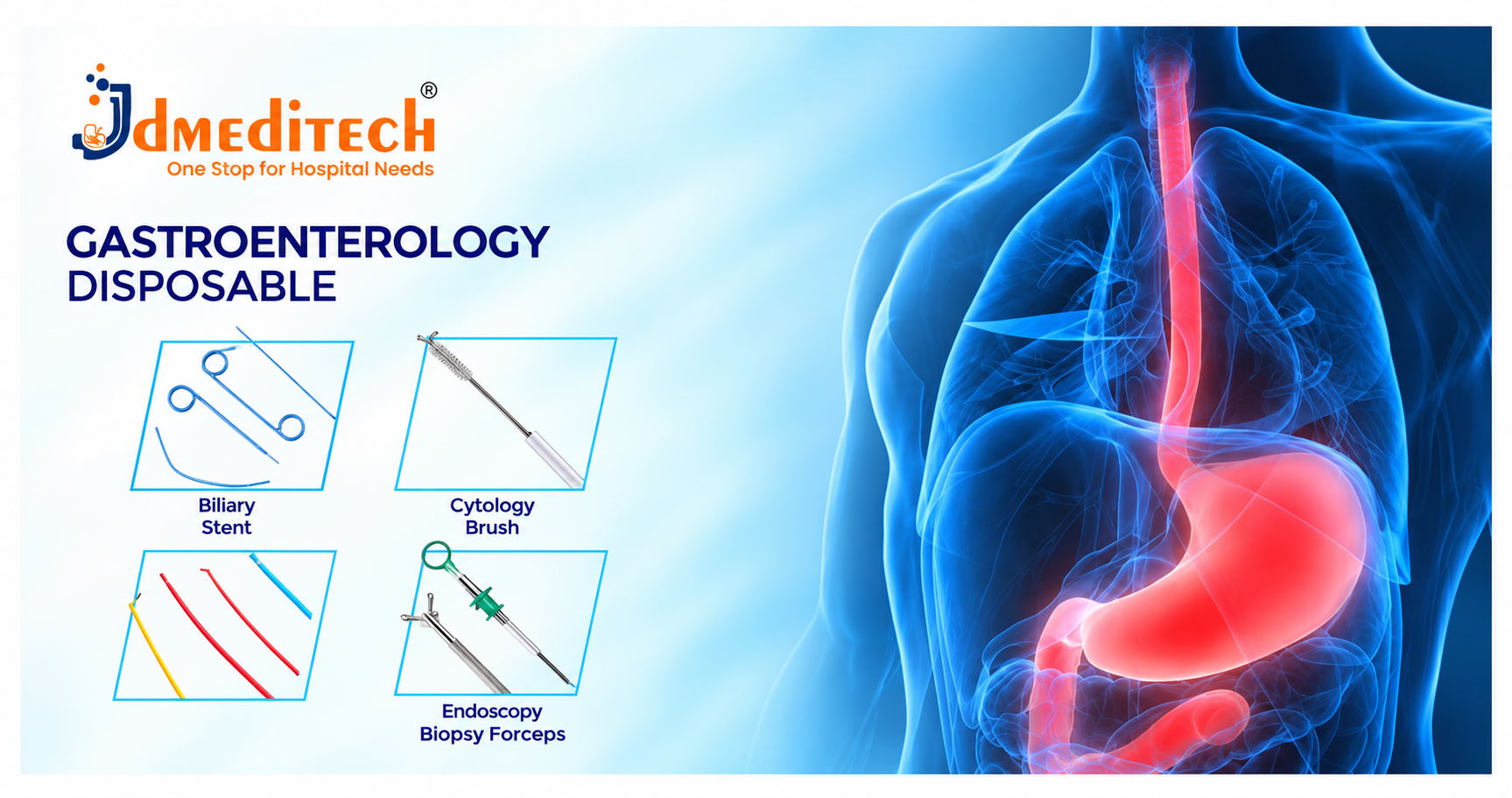
For example, biliary stents help maintain bile drainage in suitable clinical situations. Meanwhile, cytology brushes collect cells for laboratory examination. In addition, endoscopy biopsy forceps allow clinicians to obtain tissue samples during compatible endoscopic procedures.
Therefore, these products play important roles in modern gastrointestinal care. However, healthcare professionals must select suitable devices according to clinical requirements and manufacturer instructions.
JDMeditech supplies medical instruments and endoscopy accessories for hospitals, healthcare facilities, and medical distributors. Furthermore, customers can inquire about available gastroenterology disposable products and technical specifications.
What Are Gastroenterology Disposable Products?
Gastroenterology disposable products are medical devices intended for single-use applications during selected gastrointestinal procedures.
These products include endoscopic accessories, diagnostic sampling devices, stents, and compatible therapeutic instruments.
For instance, biopsy forceps support tissue sampling, while cytology brushes collect cells. Consequently, different devices serve different clinical purposes.
Importance of Disposable Endoscopy Devices
Single-use endoscopy devices support established infection prevention practices.
Furthermore, appropriate packaging helps maintain product integrity until clinical use.
However, clinicians must still follow aseptic procedures and device instructions. Therefore, healthcare facilities should verify packaging condition and expiry information before use.
Types of Gastroenterology Disposable Products
Gastroenterology departments use different disposable instruments. In particular, product selection depends on the intended diagnostic or therapeutic procedure.
- Biliary Stent
- Cytology Brush
- Endoscopy Biopsy Forceps
- ERCP Cannula
- ERCP Guide Wire
- Polypectomy Snare
- Endoscopic Injection Needle
- Endoscopic Retrieval Basket
- Foreign Body Forceps
- Endoscopic Cleaning Brush
- Hemoclip and Compatible Accessories
- Selected Gastrointestinal Stents
Nevertheless, product availability varies. Therefore, customers should confirm the required model and configuration.
1. Biliary Stent
A Biliary Stent is a medical device designed to support bile drainage through the biliary system.
During selected procedures, clinicians may place a suitable stent to manage certain bile duct obstructions or strictures.
However, stent selection depends on the diagnosis, anatomy, and clinical treatment plan.
What Is a Biliary Stent?
A biliary stent is a tubular device that helps maintain a pathway for bile flow.
Depending on the model, biliary stents may use plastic or metal construction.
Furthermore, different configurations support different clinical applications.
Applications of Biliary Stents
Clinicians use biliary stents for selected biliary drainage procedures.
- Management of selected bile duct obstructions
- Drainage support in certain biliary strictures
- Selected benign biliary conditions
- Selected malignant biliary obstructions
- Other clinician-approved biliary drainage applications
However, the treating specialist must determine whether stent placement is appropriate.
Types of Biliary Stents
Different biliary stents offer different structural designs.
- Plastic Biliary Stent
- Self-Expanding Metal Biliary Stent
- Covered Metal Biliary Stent
- Uncovered Metal Biliary Stent
- Selected Straight or Pigtail Configurations
Therefore, hospitals should verify the device type before purchasing.
Key Features of Biliary Stents
Biliary stent features vary by model. For example, buyers may need to compare dimensions and material options.
- Stent diameter
- Stent length
- Material construction
- Stent configuration
- Delivery system compatibility
- Radiopaque features, where applicable
- Manufacturer-specified drainage design
Furthermore, customers should confirm the actual specifications through the product datasheet.
Benefits of Biliary Stents
Biliary stents support drainage in selected clinical situations.
- Help maintain a bile drainage pathway
- Support selected obstruction-management procedures
- Offer different size and material options
- Work with compatible endoscopic delivery systems
However, clinical outcomes depend on the underlying condition and selected device.
2. Cytology Brush
A Cytology Brush is a diagnostic sampling device used to collect cells from selected anatomical areas.
During compatible endoscopic procedures, clinicians use the brush to obtain material for cytological examination.
As a result, laboratories can assess collected cells for selected abnormalities.
What Is a Cytology Brush?
A cytology brush is a flexible sampling instrument with a brush tip.
Depending on the design, the brush may pass through a compatible endoscope or catheter system.
However, working length and channel compatibility vary by model.
Applications of Cytology Brushes
Clinicians use cytology brushes during selected diagnostic procedures.
- Selected biliary duct sampling
- Selected pancreatic duct sampling
- Collection of cells from suspected abnormalities
- Compatible gastrointestinal endoscopic examinations
- Other manufacturer-approved cytology applications
Nevertheless, the clinical team must select the correct device for the intended sampling site.
Key Features of Cytology Brushes
Cytology brushes offer different designs and dimensions.
- Flexible shaft
- Brush tip configuration
- Working length options
- Compatible working channel diameter
- Selected protective sheath designs
- Single-use configurations
Furthermore, hospitals should confirm all dimensions before ordering.
How Does a Cytology Brush Work?
A cytology brush collects cells from a selected anatomical surface during an appropriate procedure.
Next, the clinical team prepares the collected sample for laboratory analysis.
Consequently, cytology may contribute to diagnostic assessment. However, results require professional interpretation and may not provide a definitive diagnosis on their own.
Benefits of Cytology Brushes
Cytology brushes support selected endoscopic sampling procedures.
- Enable cellular sample collection
- Support diagnostic evaluation
- Offer different working lengths
- Provide compatibility options for selected endoscopes
However, sampling quality and diagnostic yield depend on several clinical factors.
3. Endoscopy Biopsy Forceps
Endoscopy Biopsy Forceps are specialized instruments used to obtain tissue samples during compatible endoscopic procedures.
For example, clinicians may collect tissue from selected areas of the gastrointestinal tract.
Subsequently, a laboratory can examine the sample through histopathological analysis.
What Are Endoscopy Biopsy Forceps?
Endoscopy biopsy forceps are flexible instruments with jaws designed to collect small tissue samples.
Different models offer different jaw designs and working lengths.
Therefore, clinicians must select forceps that suit the endoscope and sampling requirements.
Applications of Endoscopy Biopsy Forceps
Biopsy forceps support selected diagnostic gastrointestinal procedures.
- Upper gastrointestinal endoscopy
- Colonoscopy
- Selected mucosal tissue sampling
- Evaluation of suspected gastrointestinal abnormalities
- Other compatible endoscopic biopsy procedures
However, the clinician must determine the appropriate sampling method.
Types of Endoscopy Biopsy Forceps
Different forceps designs support different applications.
- Standard Biopsy Forceps
- Alligator Jaw Biopsy Forceps
- Oval Cup Biopsy Forceps
- Biopsy Forceps with Needle
- Selected Hot Biopsy Forceps
Nevertheless, electrosurgical forceps require specific compatibility and safety considerations.
Key Features of Endoscopy Biopsy Forceps
Biopsy forceps vary according to their construction.
- Jaw design
- Working length
- Insertion diameter
- Compatible endoscope channel
- Handle configuration
- Opening and closing mechanism
- Single-use or reusable design
Furthermore, customers should verify the product’s intended use and specifications.
How Do Endoscopy Biopsy Forceps Work?
Biopsy forceps allow clinicians to collect small tissue samples during an endoscopic examination.
After collection, the healthcare team prepares the specimen for laboratory analysis.
Consequently, histopathology may help identify selected gastrointestinal conditions.
Benefits of Endoscopy Biopsy Forceps
Endoscopy biopsy forceps support tissue sampling during compatible procedures.
- Enable selected tissue collection
- Support histopathological diagnosis
- Offer different jaw configurations
- Work with compatible endoscopes
- Provide options for different clinical applications
However, diagnostic accuracy depends on sample quality and clinical interpretation.
4. Additional Gastroenterology Disposable Accessories
Gastroenterology departments also use other endoscopic accessories.
For example, ERCP cannulas support selected biliary and pancreatic duct procedures. Meanwhile, polypectomy snares support appropriate endoscopic polyp removal.
Therefore, hospitals should select accessories according to their clinical needs.
ERCP Cannula
An ERCP cannula supports selected endoscopic retrograde cholangiopancreatography procedures.
For instance, clinicians may use compatible cannulas during selected duct-access procedures.
However, device selection depends on anatomy and procedural requirements.
ERCP Guide Wire
An ERCP guide wire supports navigation and placement of compatible endoscopic devices.
Additionally, different guide wires offer different tip designs and dimensions.
Therefore, clinicians must verify compatibility before use.
Polypectomy Snare
A polypectomy snare supports the removal of selected gastrointestinal polyps.
Depending on the device and procedure, clinicians may use cold or compatible electrosurgical techniques.
However, the treating specialist must select the appropriate method.
Endoscopic Injection Needle
An endoscopic injection needle supports the delivery of selected agents during compatible endoscopic procedures.
Furthermore, different needle dimensions suit different applications.
Nevertheless, clinicians must follow the device’s intended use.
Foreign Body Forceps
Foreign body forceps support the retrieval of selected objects during compatible endoscopic procedures.
For example, clinicians may use specialized gripping designs for suitable retrieval tasks.
However, the selected instrument must suit the object and anatomical location.
Endoscopic Retrieval Basket
An endoscopic retrieval basket supports the capture and retrieval of selected material.
Additionally, different basket configurations suit different procedures.
Therefore, the clinical team should confirm the required design.
Endoscopic Cleaning Brush
An endoscopic cleaning brush supports cleaning tasks for compatible reusable equipment.
However, cleaning accessories differ from devices intended for use inside patients.
Therefore, hospitals should follow validated reprocessing instructions.
Technical Specifications of Gastroenterology Disposable Products
Technical specifications vary by product and manufacturer. Therefore, customers should request verified product datasheets.
| Product | Parameter | Specification |
|---|---|---|
| Biliary Stent | Application | Selected biliary drainage procedures |
| Biliary Stent | Diameter | According to selected model |
| Biliary Stent | Length | Confirm product datasheet |
| Biliary Stent | Material | Model-dependent |
| Cytology Brush | Application | Cellular sampling |
| Cytology Brush | Working Length | According to selected model |
| Cytology Brush | Brush Diameter | Confirm manufacturer specifications |
| Cytology Brush | Channel Compatibility | Model-dependent |
| Biopsy Forceps | Application | Tissue sampling |
| Biopsy Forceps | Working Length | According to selected model |
| Biopsy Forceps | Jaw Configuration | Model-dependent |
| Biopsy Forceps | Insertion Diameter | Confirm product datasheet |
| All Products | Sterility | According to product labeling |
| All Products | Single-Use Status | According to manufacturer instructions |
Benefits of Gastroenterology Disposable Products
Gastroenterology disposable products support diagnostic and therapeutic endoscopy.
- Support selected gastrointestinal examinations
- Enable cellular and tissue sampling
- Provide specialized biliary drainage options
- Offer different instrument configurations
- Support compatible endoscopic procedures
- Help healthcare teams prepare procedure-specific equipment
However, clinical benefits depend on the device and patient condition.
Importance of Sterile Endoscopy Accessories
Sterile endoscopy accessories support infection prevention practices.
Furthermore, appropriate packaging helps maintain device sterility before use.
However, staff must inspect packaging integrity and follow aseptic procedures.
Single-Use Gastroenterology Devices
Many gastroenterology accessories are designed for single use.
Therefore, healthcare facilities must follow manufacturer instructions and applicable regulations.
Additionally, hospitals should dispose of used devices according to appropriate clinical waste procedures.
How to Select Gastroenterology Disposable Products
Hospitals should review the intended procedure before selecting endoscopic devices.
- Clinical application
- Device diameter
- Working length
- Endoscope channel compatibility
- Stent configuration
- Brush or jaw design
- Sterility requirements
- Single-use labeling
- Manufacturer documentation
- Packaging integrity
Furthermore, clinicians should confirm the required specifications.
Device Compatibility in Gastroenterology Procedures
Compatibility is essential during endoscopic procedures.
For example, biopsy forceps must suit the endoscope working channel.
Similarly, cytology brushes require compatible dimensions and working lengths.
Therefore, hospitals should verify the complete device configuration before use.
Potential Risks of Gastrointestinal Endoscopy
Endoscopic procedures carry potential risks. For example, tissue sampling may cause bleeding.
- Bleeding
- Infection
- Perforation
- Device-related complications
- Procedure-related discomfort
- Other complications depending on the intervention
Consequently, trained healthcare professionals must follow appropriate safety protocols.
Storage and Handling of Endoscopy Disposables
Medical devices require appropriate storage conditions.
For example, hospitals should protect packaged devices from moisture, damage, and unsuitable environmental conditions.
Additionally, staff should follow manufacturer storage instructions.
Applications in Healthcare Facilities
Gastroenterology disposable products support different healthcare settings.
- Gastroenterology Departments
- Endoscopy Centers
- Hospitals
- ERCP Units
- Digestive Disease Clinics
- Specialized Healthcare Facilities
However, every facility must maintain suitable equipment and trained personnel.
Why Choose JDMeditech for Gastroenterology Disposable Products?
JDMeditech supplies medical devices and endoscopy accessories for hospitals and medical distributors.
Furthermore, customers can contact our team for information about available gastroenterology disposable products.
- Biliary Stent inquiries
- Cytology Brush inquiries
- Endoscopy Biopsy Forceps inquiries
- ERCP Accessory inquiries
- Polypectomy Snare inquiries
- Endoscopic Instrument inquiries
- Technical Specification requests
- Quotation requests
- International Export inquiries
However, availability and specifications vary. Therefore, customers should confirm the required product details before ordering.
Frequently Asked Questions About Gastroenterology Disposable Products
1. What Are Gastroenterology Disposable Products?
Gastroenterology disposable products include single-use devices for selected digestive system procedures. For example, they may include stents, brushes, and biopsy forceps.
2. What Is a Biliary Stent?
A biliary stent supports bile drainage in selected clinical situations. However, clinicians must determine whether stent placement is appropriate.
3. What Is a Cytology Brush?
A cytology brush collects cells during compatible diagnostic procedures. Subsequently, laboratories examine the collected material.
4. What Are Endoscopy Biopsy Forceps?
Endoscopy biopsy forceps collect small tissue samples. As a result, histopathology may help clinicians assess selected gastrointestinal conditions.
5. What Is ERCP?
ERCP stands for endoscopic retrograde cholangiopancreatography. Clinicians use it for selected biliary and pancreatic duct procedures.
6. What Is the Purpose of a Biliary Stent?
A biliary stent helps maintain a pathway for bile drainage. Therefore, clinicians may use it for selected obstructions.
7. Are Biliary Stents Available in Different Sizes?
Yes. Different models offer different dimensions. However, customers should verify the available sizes.
8. What Is the Difference Between Cytology and Biopsy?
Cytology examines collected cells, while biopsy usually involves tissue sampling. Therefore, clinicians select the method according to the diagnostic requirement.
9. Can Cytology Brushes Be Used During ERCP?
Selected cytology brushes support sampling during compatible ERCP procedures. However, the device must suit the intended application.
10. What Are Hot Biopsy Forceps?
Hot biopsy forceps are devices intended for selected electrosurgical applications. However, their use requires specific safety considerations and is not appropriate for every sampling task.
11. What Is a Polypectomy Snare?
A polypectomy snare supports the removal of selected gastrointestinal polyps. Furthermore, different designs suit different procedures.
12. What Is an Endoscopic Injection Needle?
An endoscopic injection needle supports the delivery of selected agents during compatible procedures. However, clinicians must follow the device’s intended use.
13. Are Gastroenterology Disposables Sterile?
Many invasive disposable accessories are supplied sterile. Nevertheless, hospitals must verify the specific product labeling.
14. Can Single-Use Endoscopy Devices Be Reused?
Single-use devices should not undergo unauthorized reuse. Therefore, healthcare facilities must follow manufacturer instructions.
15. What Is Endoscope Channel Compatibility?
Channel compatibility refers to whether an accessory fits the endoscope’s working channel. Consequently, hospitals must verify device dimensions.
16. What Are the Risks of Endoscopic Biopsy?
Potential risks include bleeding, infection, and perforation. Therefore, trained clinicians must follow appropriate safety protocols.
17. How Should Endoscopy Disposables Be Stored?
Hospitals should follow manufacturer storage instructions. Additionally, staff must inspect packaging before use.
18. What Information Is Required for a Quotation?
Customers should provide the product name, size, length, quantity, and destination country. Furthermore, they should mention any special configuration requirements.
19. How Should Hospitals Select Biopsy Forceps?
Hospitals should review jaw design, working length, insertion diameter, and endoscope compatibility. Additionally, clinicians must confirm the intended application.
20. Where Can I Inquire About Gastroenterology Disposable Products?
Hospitals and medical distributors can contact JDMeditech for information about available endoscopy devices and accessories.
Conclusion
In conclusion, Gastroenterology Disposable Products support important diagnostic and therapeutic procedures involving the digestive system.
Furthermore, biliary stents support selected drainage procedures, while cytology brushes help collect cellular samples.
Meanwhile, endoscopy biopsy forceps support tissue collection during compatible examinations.
Therefore, hospitals should select appropriate devices, verify compatibility, and follow established clinical protocols.
JDMeditech – One Stop for Hospital Needs
Website:
www.jdmeditech.com
Medical References
- American Society for Gastrointestinal Endoscopy
- National Institute of Diabetes and Digestive and Kidney Diseases
- U.S. FDA – Medical Devices
Medical Disclaimer
This article provides general educational and product information only. It does not replace professional medical advice, clinical training, or manufacturer instructions for use. Qualified healthcare professionals must select and use endoscopic devices according to individual clinical requirements and applicable safety standards.




