



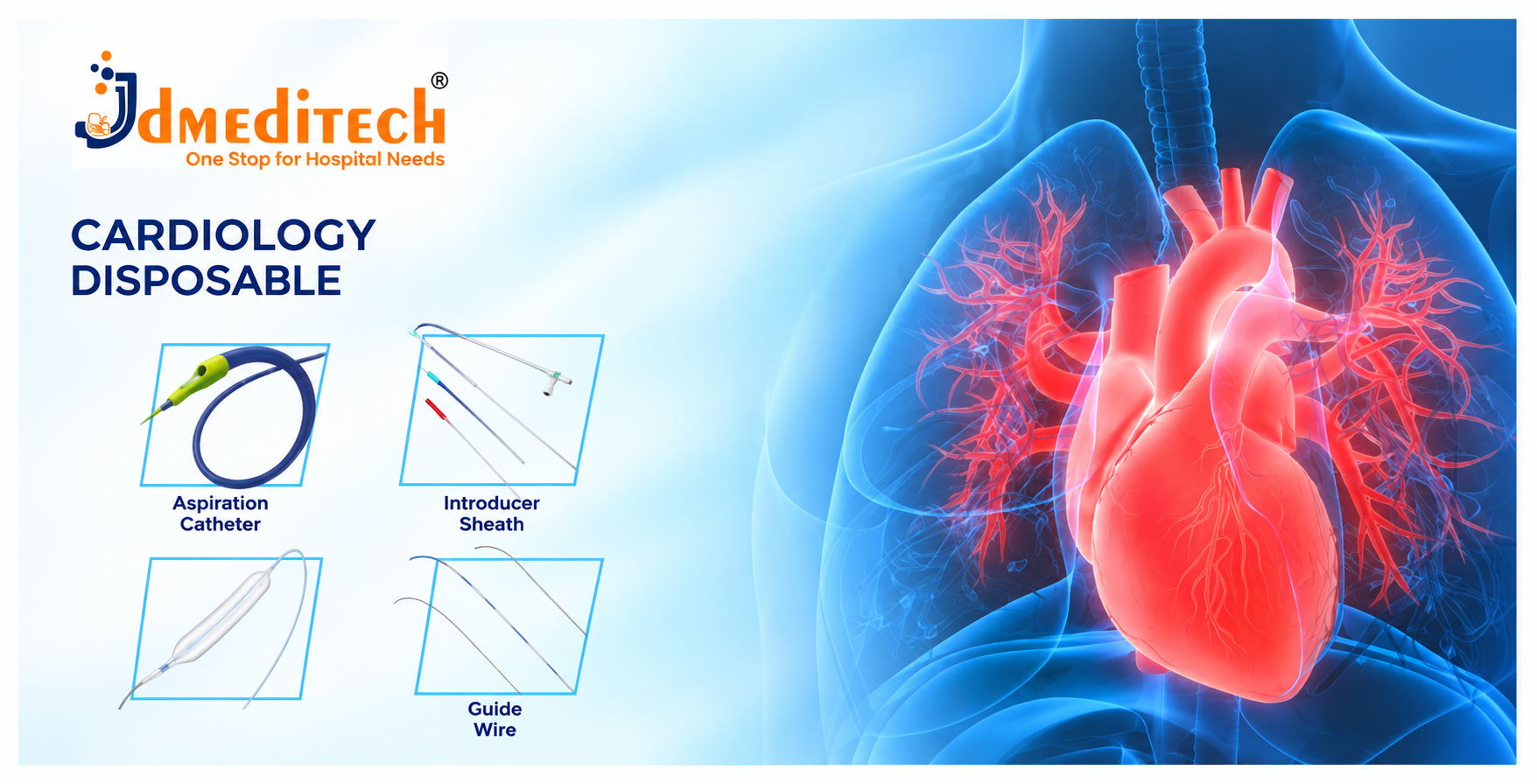
Cardiology Disposable Products: Complete Guide to Aspiration Catheters, Introducer Sheaths and Guide Wires
Cardiology Disposable Products support diagnostic and interventional procedures involving the heart and blood vessels. Today, healthcare professionals use specialized catheters, introducer sheaths, and guide wires during selected cardiovascular procedures.
For example, an aspiration catheter may help remove thrombotic material in carefully selected clinical situations. Meanwhile, an introducer sheath provides a controlled access pathway for compatible devices. In addition, a guide wire supports catheter navigation through the vascular system.
Therefore, these products play important roles in cardiovascular care. However, device selection depends on the procedure, patient condition, and clinical requirements.
JDMeditech supplies medical devices and instruments for hospitals, cardiovascular centers, and medical distributors. Furthermore, customers can inquire about available cardiology disposable products and their technical specifications.
What Are Cardiology Disposable Products?
Cardiology disposable products are medical devices intended for single use during selected cardiovascular procedures.
These products include different catheter systems, vascular access devices, and compatible accessories. Additionally, each device performs a specific clinical function.
For instance, introducer sheaths support vascular access, while guide wires help clinicians navigate compatible catheters. Consequently, hospitals must select devices according to their intended applications.
Importance of Disposable Cardiology Devices
Single-use cardiology devices support established infection prevention practices and procedural workflows.
Furthermore, sterile devices help clinicians prepare appropriate equipment for selected interventions.
However, sterile packaging alone does not eliminate procedural risks. Therefore, healthcare professionals must follow aseptic techniques and manufacturer instructions.
Types of Cardiology Disposable Products
Cardiovascular procedures may require different disposable devices. In particular, the product selection depends on the intended intervention.
- Aspiration Catheter
- Introducer Sheath
- Guide Wire
- Diagnostic Catheter
- Guiding Catheter
- PTCA Balloon Catheter
- PTCA Guide Wire
- Radial Sheath
- Femoral Introducer Sheath
- Extension Tubing
- Hemostasis Valve Accessories
- Selected Cardiovascular Procedure Kits
Nevertheless, product availability and specifications vary. Therefore, buyers should verify the required configuration before ordering.
1. Aspiration Catheter
An Aspiration Catheter is a specialized device designed to support the aspiration of selected intravascular material during appropriate procedures.
Depending on the device and clinical situation, clinicians may use aspiration systems during selected thrombus-management interventions.
However, routine manual thrombus aspiration is not recommended for every coronary intervention. Therefore, the treating specialist must evaluate the indication carefully.
What Is an Aspiration Catheter?
An aspiration catheter is a catheter designed to create a pathway for aspiration within the vascular system.
Typically, the clinician uses it with compatible aspiration accessories and a suitable guiding system.
Furthermore, different models offer different catheter dimensions and configurations.
Applications of Aspiration Catheters
Aspiration catheters may support selected interventional procedures. For example, clinicians may consider them when managing specific thrombotic conditions.
- Selected thrombus aspiration procedures
- Selected coronary interventions when clinically indicated
- Selected peripheral vascular interventions, depending on device labeling
- Removal of certain intravascular material when appropriate
- Other manufacturer-approved vascular applications
However, not every aspiration catheter is suitable for every vascular territory. Therefore, clinicians must verify the device’s intended use.
Key Features of Aspiration Catheters
Aspiration catheters vary by design. In particular, the following features may influence device selection.
- Catheter lumen configuration
- Working length
- Distal tip design
- Guide wire compatibility
- Guiding catheter compatibility
- Catheter shaft construction
- Compatible aspiration connections
- Selected radiopaque markers
Furthermore, customers should confirm the actual features through the manufacturer datasheet.
Components of an Aspiration Catheter Kit
Depending on the product configuration, an aspiration catheter kit may contain several accessories.
- Aspiration Catheter
- Aspiration Syringe
- Extension Line
- Three-Way Stopcock
- Filter Basket or Filter Accessory
- Other Manufacturer-Specified Accessories
However, not every kit includes these components. Therefore, hospitals should verify the complete packing list.
How Does an Aspiration Catheter Work?
An aspiration catheter provides a pathway through which a compatible aspiration system can apply negative pressure.
As a result, clinicians may remove selected material from the target vessel when the device and clinical indication permit.
Nevertheless, the procedure requires trained specialists and appropriate imaging guidance.
Benefits of Aspiration Catheters
Aspiration catheters may provide useful functionality in selected clinical situations.
- Support selected thrombus-removal interventions
- Provide an aspiration pathway
- Work with compatible vascular access systems
- Offer different configurations for selected procedures
However, clinical outcomes depend on patient selection, procedure type, and device performance.
2. Introducer Sheath
An Introducer Sheath supports vascular access during diagnostic and interventional procedures.
For example, clinicians may use compatible introducer systems during coronary angiography or selected catheter-based interventions.
Additionally, a suitable sheath provides a pathway for compatible catheters and accessories.
What Is an Introducer Sheath?
An introducer sheath is a vascular access device that allows compatible instruments to enter the vascular system.
Typically, an introducer system includes a sheath and dilator. Some configurations also include additional accessories.
However, the exact components depend on the product model.
Applications of Introducer Sheaths
Introducer sheaths support various vascular procedures. For instance, clinicians use compatible systems during selected diagnostic and interventional applications.
- Coronary angiography
- Selected percutaneous coronary interventions
- Peripheral vascular procedures
- Selected electrophysiology procedures
- Other compatible catheter-based interventions
Nevertheless, clinicians must select the access site and device configuration according to the procedure.
Key Features of Introducer Sheaths
Introducer sheath designs vary. Therefore, hospitals should review the following technical parameters.
- French size
- Sheath length
- Internal diameter
- Dilator compatibility
- Hemostasis valve design
- Side-arm configuration
- Compatible guide wire dimensions
- Device material and coating, where applicable
Furthermore, customers should confirm each feature against the selected product datasheet.
Components of an Introducer Sheath Set
Depending on the configuration, an introducer sheath set may include:
- Introducer Sheath
- Dilator
- Compatible Guide Wire
- Introducer Needle
- Side-Port Tubing
- Other Manufacturer-Specified Accessories
However, set contents differ between manufacturers. Therefore, customers should request a detailed component list.
Radial Introducer Sheath
A radial introducer sheath supports vascular access through the radial artery during selected procedures.
For example, clinicians commonly use radial access during coronary angiography and selected interventions.
However, patient anatomy and clinical circumstances influence access-site selection.
Femoral Introducer Sheath
A femoral introducer sheath supports vascular access through the femoral vessels.
Additionally, femoral access may suit selected procedures requiring particular catheter sizes or configurations.
Nevertheless, clinicians must evaluate bleeding and vascular complication risks.
Benefits of Introducer Sheaths
Introducer sheaths provide a structured pathway for compatible vascular devices.
- Support selected vascular access procedures
- Allow passage of compatible catheters
- Offer different sizes and lengths
- Support radial or femoral access configurations
- Provide selected hemostasis features
However, device selection and proper clinical technique remain essential.
3. Guide Wire
A Guide Wire is a medical device that supports navigation and placement of compatible catheters and other vascular instruments.
During selected procedures, clinicians use guide wires to establish a path through the vascular system.
Consequently, guide wires play an important role in catheter-based interventions.
What Is a Guide Wire?
A guide wire is a flexible wire designed to support the movement or placement of compatible medical devices.
Different guide wires offer different tip designs, lengths, diameters, and performance characteristics.
Therefore, clinicians must choose a guide wire that suits the intended application.
Applications of Guide Wires
Guide wires support different diagnostic and interventional procedures.
- Vascular access procedures
- Coronary catheterization
- Selected coronary interventions
- Peripheral vascular procedures
- Catheter placement
- Navigation of compatible medical devices
However, not every guide wire is suitable for coronary, peripheral, or other vascular applications.
Types of Guide Wires
Different guide wire designs support different procedural needs.
- PTFE-Coated Guide Wire
- Hydrophilic Guide Wire
- J-Tip Guide Wire
- Straight-Tip Guide Wire
- PTCA Guide Wire
- Selected Nitinol Guide Wires
Furthermore, each model has its own intended use and compatibility requirements.
Key Features of Guide Wires
Guide wire selection depends on several technical parameters.
- Wire diameter
- Working length
- Tip configuration
- Core material
- Coating type
- Flexibility
- Torque response
- Radiopacity, where applicable
However, customers should confirm the actual specifications before ordering.
PTFE-Coated Guide Wire
A PTFE-coated guide wire uses a coating designed to influence surface characteristics.
For example, selected designs may support movement through compatible devices.
Nevertheless, performance depends on the complete wire construction and clinical application.
Hydrophilic Guide Wire
A hydrophilic guide wire has a surface coating that becomes lubricious when properly hydrated according to its instructions for use.
As a result, selected models may support navigation through suitable anatomy.
However, clinicians must consider the potential risks of vessel injury and unintended wire movement.
J-Tip Guide Wire
A J-tip guide wire features a curved distal tip.
Depending on the device design, this configuration may support selected vascular access applications.
However, the clinician must confirm compatibility and intended use.
Benefits of Guide Wires
Guide wires support the placement and navigation of compatible devices.
- Support catheter navigation
- Offer different tip configurations
- Provide various diameter and length options
- Support selected diagnostic procedures
- Assist compatible interventional procedures
Nevertheless, the clinical team must select the appropriate wire for each procedure.
4. Additional Cardiology Disposable Devices
Cardiology departments use several additional disposable devices.
For example, diagnostic catheters support selected imaging procedures. Meanwhile, balloon catheters support appropriate angioplasty interventions.
Therefore, hospitals should prepare a device list based on the planned procedures.
Diagnostic Catheter
A diagnostic catheter supports selected cardiovascular diagnostic examinations.
For instance, clinicians may use compatible catheters during coronary angiography.
However, catheter shape and dimensions must match the clinical requirements.
Guiding Catheter
A guiding catheter supports the delivery of compatible interventional devices.
Additionally, different guiding catheter shapes suit different anatomical and procedural requirements.
Therefore, clinicians must verify compatibility with the selected devices.
PTCA Balloon Catheter
A PTCA balloon catheter supports balloon angioplasty in selected coronary lesions.
During the procedure, clinicians use the balloon system according to the device’s intended use.
However, patient selection and procedural planning remain essential.
Radial Sheath
A radial sheath supports vascular access through the radial artery.
Furthermore, compatible radial access systems may support selected coronary procedures.
Nevertheless, device size and patient anatomy influence the selection.
Cardiology Disposable Products Technical Specifications
Technical specifications vary according to the product model. Therefore, customers should verify all parameters through manufacturer documentation.
| Product | Parameter | Specification |
|---|---|---|
| Aspiration Catheter | Application | Selected aspiration procedures |
| Aspiration Catheter | French Size | According to selected model |
| Aspiration Catheter | Working Length | Confirm product datasheet |
| Aspiration Catheter | Guide Wire Compatibility | Confirm manufacturer specifications |
| Introducer Sheath | Application | Vascular access |
| Introducer Sheath | French Size | According to selected model |
| Introducer Sheath | Sheath Length | Confirm manufacturer specifications |
| Introducer Sheath | Valve Configuration | Model-dependent |
| Guide Wire | Application | Catheter navigation and placement |
| Guide Wire | Diameter | According to selected model |
| Guide Wire | Length | Confirm product datasheet |
| Guide Wire | Tip Configuration | Model-dependent |
| Guide Wire | Coating | According to selected model |
| All Products | Sterility | Confirm product labeling |
| All Products | Single-Use Status | Confirm manufacturer instructions |
Benefits of Cardiology Disposable Products
Cardiology disposable products support selected cardiovascular procedures.
- Support vascular access
- Assist catheter navigation
- Provide specialized aspiration functionality
- Offer different device configurations
- Support diagnostic and interventional workflows
- Help healthcare teams prepare procedure-specific equipment
However, clinical benefits depend on the selected device and procedure.
Importance of Sterile Cardiology Devices
Sterile medical devices support infection prevention practices during invasive procedures.
Furthermore, appropriate packaging helps maintain sterility until the device is opened according to instructions.
However, users must inspect packaging integrity and expiry information before use.
Single-Use Cardiology Products
Many cardiology disposable products are intended for one procedure or patient.
Therefore, healthcare facilities must follow manufacturer instructions and applicable regulations.
Additionally, hospitals should implement appropriate disposal procedures after use.
How to Select Cardiology Disposable Products
Hospitals should consider several factors before purchasing cardiovascular devices.
- Clinical application
- Device diameter
- Working length
- Catheter compatibility
- Guide wire compatibility
- Access-site requirements
- Packaging integrity
- Sterility requirements
- Product labeling
- Manufacturer documentation
Furthermore, clinicians should confirm that the selected device suits the intended procedure.
Device Compatibility in Cardiology Procedures
Compatibility plays an important role in catheter-based procedures.
For example, an aspiration catheter must suit the selected guiding catheter and guide wire.
Similarly, an introducer sheath must accommodate compatible devices.
Therefore, the clinical team should verify dimensions and connections before use.
Potential Risks of Vascular Procedures
Cardiovascular interventions carry potential risks. For example, vascular access may cause bleeding or vessel injury.
- Bleeding
- Vascular injury
- Thrombosis
- Embolization
- Infection
- Vessel perforation
- Other procedure-related complications
Consequently, trained specialists must follow appropriate clinical protocols.
Storage and Handling of Cardiology Disposables
Medical devices require appropriate storage and handling.
For example, hospitals should protect packaged devices from conditions that may damage the packaging or product.
Additionally, staff should follow the manufacturer’s storage instructions.
Applications in Healthcare Facilities
Cardiology disposable products support different healthcare settings.
- Cardiology Departments
- Cardiac Catheterization Laboratories
- Interventional Cardiology Centers
- Hospitals
- Vascular Intervention Centers
- Specialized Healthcare Facilities
However, each facility must maintain suitable equipment and trained personnel.
Why Choose JDMeditech for Cardiology Disposable Products?
JDMeditech supplies medical devices and instruments for healthcare facilities and medical distributors.
Furthermore, customers can contact our team for information about available cardiology disposable products.
- Aspiration Catheter inquiries
- Introducer Sheath inquiries
- Guide Wire inquiries
- PTCA Catheter inquiries
- Radial Sheath inquiries
- Diagnostic Catheter inquiries
- Technical Specification requests
- Quotation requests
- International Export inquiries
However, availability and specifications vary. Therefore, customers should confirm the product details before ordering.
Frequently Asked Questions About Cardiology Disposable Products
1. What Are Cardiology Disposable Products?
Cardiology disposable products include single-use devices for selected cardiovascular procedures. For example, they may include catheters, introducer sheaths, and guide wires.
2. What Is an Aspiration Catheter?
An aspiration catheter supports the removal of selected intravascular material when clinically appropriate. However, the intended use depends on the device.
3. What Is an Introducer Sheath?
An introducer sheath provides a pathway for compatible devices during vascular access procedures. Additionally, different models offer different sizes.
4. What Is a Guide Wire?
A guide wire supports catheter navigation and placement. Furthermore, different designs suit different clinical applications.
5. What Is a Radial Sheath?
A radial sheath supports vascular access through the radial artery. Therefore, clinicians may use it during selected coronary procedures.
6. What Is a Femoral Introducer Sheath?
A femoral introducer sheath supports access through the femoral vessels. However, device selection depends on the procedure.
7. Are Aspiration Catheters Used in Every PCI Procedure?
No. Routine manual thrombus aspiration is not recommended for every PCI procedure. Therefore, clinicians consider aspiration only when appropriate.
8. What Is the Purpose of a Guide Wire?
A guide wire helps clinicians navigate compatible catheters. Additionally, selected wires support specialized interventional procedures.
9. What Is a Hydrophilic Guide Wire?
A hydrophilic guide wire has a coating that becomes lubricious when properly hydrated. However, users must follow the manufacturer’s instructions.
10. What Is a PTFE-Coated Guide Wire?
A PTFE-coated guide wire has a specialized surface coating. Furthermore, its performance depends on the complete device design.
11. What Is French Size?
French size is a unit commonly used to describe catheter or sheath dimensions. However, buyers should verify whether a specification refers to an outer or inner diameter.
12. Are Cardiology Disposables Sterile?
Many invasive cardiology disposables are supplied sterile. Nevertheless, customers must confirm the specific product labeling.
13. Can Disposable Cardiology Devices Be Reused?
Single-use devices should not undergo unauthorized reuse. Therefore, healthcare facilities must follow manufacturer instructions and applicable regulations.
14. What Are the Risks of Vascular Access?
Potential risks include bleeding, infection, and vessel injury. Consequently, trained clinicians must follow appropriate safety protocols.
15. How Should Hospitals Select Guide Wires?
Hospitals should review diameter, length, tip design, coating, and compatibility. Additionally, clinicians must confirm the intended use.
16. What Is a Diagnostic Catheter?
A diagnostic catheter supports selected cardiovascular diagnostic examinations. For example, clinicians may use compatible catheters during angiography.
17. What Is a PTCA Balloon Catheter?
A PTCA balloon catheter supports selected coronary angioplasty procedures. However, the treating specialist must determine clinical suitability.
18. How Should Cardiology Devices Be Stored?
Hospitals should follow manufacturer storage instructions. Furthermore, staff must inspect packaging before use.
19. What Information Is Required for a Quotation?
Customers should provide the product name, size, length, quantity, and delivery destination. Additionally, they should mention any required configuration.
20. Where Can I Inquire About Cardiology Disposable Products?
Hospitals and medical distributors can contact JDMeditech for information about available cardiovascular devices.
Conclusion
In conclusion, Cardiology Disposable Products support important cardiovascular diagnostic and interventional procedures.
Furthermore, aspiration catheters provide specialized aspiration functionality, while introducer sheaths support vascular access.
Meanwhile, guide wires help clinicians navigate compatible catheters and other devices.
Therefore, hospitals should select suitable products, verify compatibility, and follow appropriate clinical protocols.
JDMeditech – One Stop for Hospital Needs
Website:
www.jdmeditech.com
Medical References
Medical Disclaimer
This article provides general educational and product information only. It does not replace professional medical advice, clinical training, or manufacturer instructions for use. Qualified healthcare professionals must select and use cardiovascular devices according to individual clinical requirements and applicable safety standards.




