



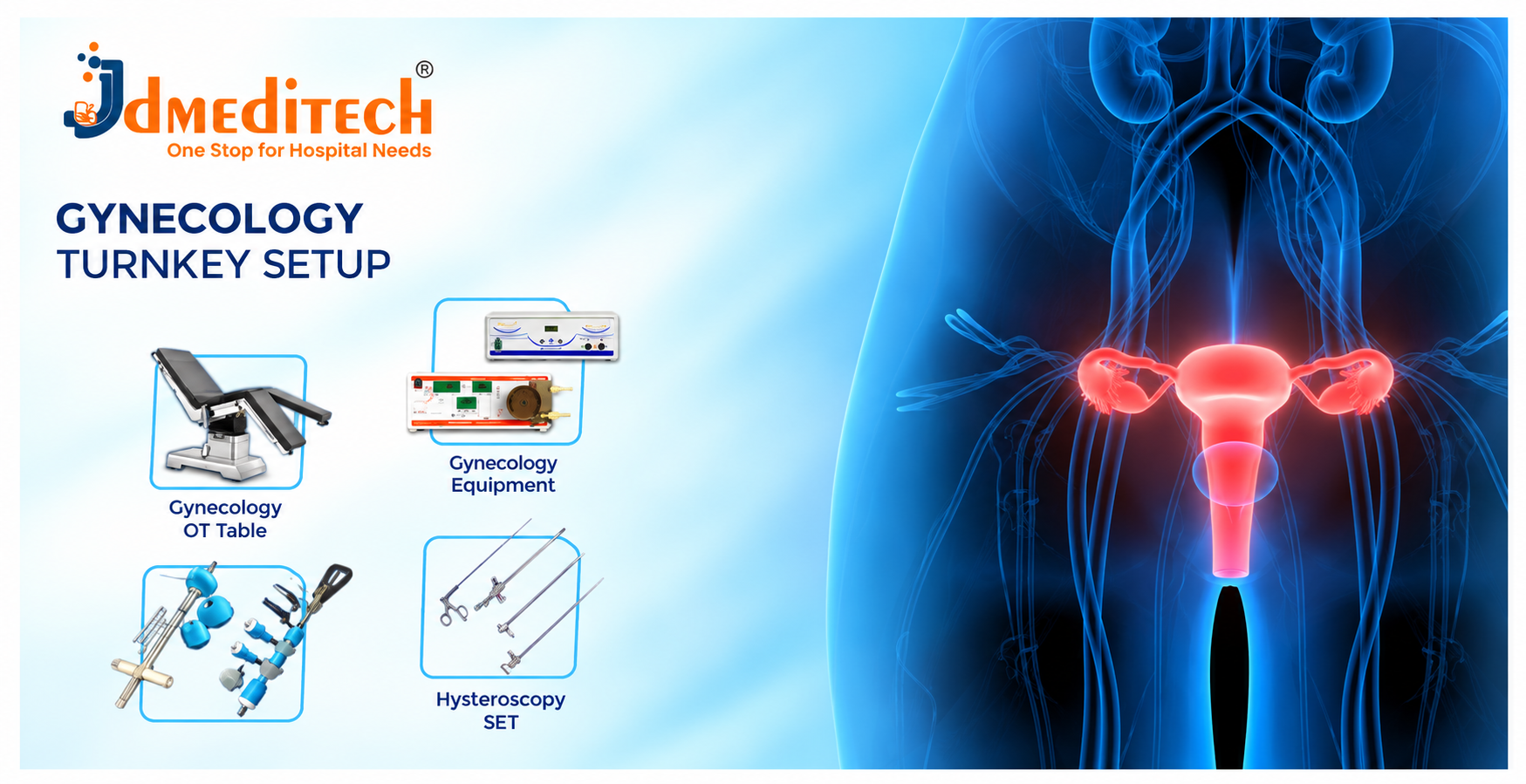
Gynecology Turnkey Setup: Complete OT Equipment, Instruments and Hospital Solutions
Gynecology Turnkey Setup refers to the planning and arrangement of medical equipment, surgical instruments, and essential accessories for a gynecology operating room or procedure facility. Hospitals use these setups to support examinations, diagnostic procedures, and selected gynecological surgeries.
Today, healthcare facilities require compatible instruments and reliable clinical equipment. For example, a gynecology OT table supports patient positioning. Meanwhile, a hysteroscopy set allows clinicians to examine the uterine cavity. In addition, specialized surgical instruments support selected gynecological procedures.
Therefore, a well-planned setup helps hospitals organize clinical workflows. Furthermore, equipment selection must consider patient safety, staff training, device compatibility, and maintenance requirements.
JDMeditech supplies medical equipment and surgical instruments for hospitals, healthcare facilities, and medical distributors. Additionally, customers can inquire about equipment configurations for gynecology departments and operating rooms.
What Is a Gynecology Turnkey Setup?
A gynecology turnkey setup is a coordinated collection of equipment and instruments intended for a gynecology operating room or clinical procedure area.
Depending on the project, the setup may include operating tables, endoscopic instruments, surgical accessories, and supporting equipment.
However, a complete turnkey project may also require installation, staff training, testing, and other services. Therefore, customers should confirm the exact scope of supply.
Importance of Gynecology Turnkey Setup
A properly planned gynecology setup supports efficient clinical operations. Furthermore, suitable equipment helps healthcare professionals perform selected diagnostic and surgical procedures.
For example, appropriate patient positioning equipment supports examination and operative access. Similarly, compatible hysteroscopy instruments provide visualization of the uterine cavity.
Consequently, hospitals should consider the complete equipment workflow rather than purchasing individual instruments without compatibility checks.
Main Components of a Gynecology Turnkey Setup
Gynecology turnkey setups may include several categories of medical equipment. In particular, hospitals should select components according to their intended clinical services.
- Gynecology OT Table
- Gynecology Equipment
- Hysteroscopy Set
- Gynecology Surgical Instrument Set
- Diagnostic Gynecology Instruments
- Operative Gynecology Instruments
- Endoscopic Camera System
- Medical Light Source
- Hysteroscopy Irrigation Pump
- Suction Equipment
- Patient Monitoring Equipment
- Compatible Surgical Accessories
However, these items represent possible setup components rather than a fixed package. Therefore, the final equipment list should follow the approved project requirements.
1. Gynecology OT Table
A Gynecology OT Table supports patient positioning during selected gynecological examinations and surgical procedures.
Depending on the model, the table may offer adjustable sections and compatible positioning accessories.
Furthermore, the operating team must verify load capacity, positioning range, and clinical suitability before use.
What Is a Gynecology OT Table?
A gynecology OT table is a specialized patient-support platform designed for gynecological procedures.
For example, selected models allow adjustments to support different patient positions. Additionally, compatible accessories may support the legs or other body areas.
However, adjustment functions vary by model. Therefore, buyers should review the technical datasheet.
Applications of Gynecology OT Tables
- Selected gynecological surgical procedures
- Diagnostic examinations
- Operative hysteroscopy
- Selected vaginal procedures
- Other procedures requiring compatible patient positioning
Nevertheless, the clinical team must determine whether a specific table suits the intended procedure.
Key Features of Gynecology OT Tables
Different gynecology tables provide different configurations. For instance, selected models may include adjustable sections or positioning accessories.
- Patient positioning support
- Adjustable table sections
- Compatible leg supports
- Height adjustment, depending on model
- Suitable patient-support surface
- Cleaning-compatible construction
- Selected positioning accessories
However, hospitals should confirm all features and safety limits against the manufacturer’s documentation.
2. Gynecology Equipment
Gynecology Equipment includes medical devices that support examinations, endoscopic procedures, and selected treatments.
For example, endoscopic camera systems provide visualization during compatible procedures. Meanwhile, irrigation pumps support fluid management.
As a result, suitable equipment helps clinicians carry out planned clinical workflows.
Types of Gynecology Equipment
Hospitals may require several equipment categories. However, the final selection depends on available clinical services.
- Hysteroscopy Camera System
- Medical Light Source
- Hysteroscopy Irrigation Pump
- Endoscopic Display Monitor
- Suction Equipment
- Electrosurgical Equipment for compatible procedures
- Patient Monitoring Equipment
- Instrument Storage Accessories
Furthermore, each device requires appropriate installation, maintenance, and compatibility verification.
Endoscopic Camera System
An endoscopic camera system displays images from compatible hysteroscopes and other endoscopes.
Consequently, clinicians can observe selected anatomical structures during examinations and procedures.
However, the camera head, coupler, and endoscope must be compatible.
Medical Light Source
A medical light source provides illumination for compatible endoscopic systems.
Additionally, suitable light transmission supports visualization during procedures.
Therefore, hospitals should confirm cable and connector compatibility before purchasing.
Hysteroscopy Irrigation Pump
A hysteroscopy irrigation pump supports fluid delivery during compatible hysteroscopic procedures.
For example, distension fluid helps expand the uterine cavity and maintain visibility.
However, excessive fluid absorption can cause serious complications. Therefore, trained clinicians must monitor fluid balance according to established protocols.
Endoscopic Display Monitor
An endoscopic monitor displays images from compatible camera systems.
Furthermore, appropriate positioning helps the surgical team view the operative field.
Nevertheless, image quality and compatibility depend on the selected equipment.
Suction Equipment
Suction equipment supports fluid removal during selected clinical procedures.
Additionally, compatible accessories help connect the suction system to the intended workflow.
However, healthcare facilities must confirm the equipment’s intended use and operating requirements.
3. Hysteroscopy Set
A Hysteroscopy Set includes specialized instruments for examining the uterine cavity. Depending on the configuration, it may also support selected operative procedures.
During hysteroscopy, a clinician uses a hysteroscope to visualize the inside of the uterus.
As a result, the healthcare team can assess selected uterine abnormalities.
What Is a Hysteroscopy Set?
A hysteroscopy set is a collection of compatible endoscopic instruments.
Typically, it may include a hysteroscope, sheath, obturator, and selected accessories.
However, component lists vary by manufacturer. Therefore, customers should request the complete set configuration.
Applications of a Hysteroscopy Set
- Diagnostic hysteroscopy
- Evaluation of abnormal uterine bleeding
- Assessment of selected uterine cavity abnormalities
- Evaluation of suspected endometrial polyps
- Selected operative hysteroscopy procedures
- Assessment of selected intrauterine adhesions
Nevertheless, clinicians must select procedures according to the patient’s condition.
Components of a Hysteroscopy Set
Depending on the product model, a hysteroscopy set may contain the following instruments.
- Hysteroscope
- Hysteroscopy Sheath
- Obturator
- Working Channel Accessories
- Light Cable Connector
- Selected Operative Instruments
Furthermore, customers should verify the dimensions and compatibility of every component.
Diagnostic Hysteroscopy
Diagnostic hysteroscopy allows clinicians to examine the uterine cavity.
For example, doctors may recommend it when investigating abnormal uterine bleeding or suspected structural abnormalities.
However, the examination must follow appropriate clinical assessment.
Operative Hysteroscopy
Operative hysteroscopy supports selected treatments inside the uterine cavity.
For instance, trained specialists may use compatible instruments to treat certain endometrial polyps.
Nevertheless, the procedure depends on the diagnosis and available equipment.
4. Gynecology Surgical Instrument Set
A gynecology surgical instrument set contains instruments used during selected gynecological operations.
For example, forceps and scissors support tissue handling and dissection. Meanwhile, needle holders support suturing.
However, the required instruments vary according to the procedure.
Common Gynecology Surgical Instruments
- Surgical Forceps
- Dissecting Forceps
- Surgical Scissors
- Needle Holders
- Hemostatic Forceps
- Retractors
- Speculums
- Selected Uterine Instruments
- Compatible Endoscopic Accessories
Therefore, hospitals should confirm the exact surgical instrument list with the operating team.
Diagnostic Gynecology Instruments
Diagnostic instruments help clinicians examine reproductive anatomy.
For example, hysteroscopes provide uterine cavity visualization. Additionally, other diagnostic instruments support selected examinations.
Consequently, instrument selection should match the intended diagnostic procedure.
Operative Gynecology Instruments
Operative instruments support selected gynecological surgical procedures.
Furthermore, compatible accessories help surgeons perform specific tasks.
However, trained healthcare professionals must use each instrument according to its intended purpose.
5. Supporting Equipment for Gynecology OT
A complete operating room requires more than the primary surgical instruments.
For example, appropriate lighting and patient monitoring support clinical workflows. Similarly, suitable instrument processing equipment supports infection prevention.
Therefore, hospitals should include supporting equipment in the project plan.
Patient Monitoring Equipment
Patient monitoring equipment supports clinical observation during selected procedures.
Additionally, the anesthesia team may require specialized monitoring systems.
However, equipment requirements depend on the procedure and anesthesia plan.
Surgical Lighting
Surgical lighting helps illuminate the clinical workspace.
Furthermore, adjustable positioning supports selected operating room requirements.
Therefore, hospitals should review illumination and installation specifications.
Instrument Cleaning and Sterilization
Reusable medical instruments require appropriate cleaning and reprocessing.
For example, facilities must follow validated manufacturer instructions for cleaning, disinfection, and sterilization.
However, single-use devices must not undergo unauthorized reuse.
Gynecology Turnkey Setup Equipment List
The following table provides an illustrative equipment planning list. However, the final supply package must follow the approved quotation.
| Equipment | Primary Application | Selection Requirement |
|---|---|---|
| Gynecology OT Table | Patient positioning | Verify load and adjustment specifications |
| Hysteroscopy Set | Uterine cavity examination | Confirm components and dimensions |
| Hysteroscopy Camera System | Endoscopic visualization | Confirm endoscope compatibility |
| Medical Light Source | Endoscopic illumination | Verify cable and connector compatibility |
| Irrigation Pump | Fluid management | Confirm pressure and flow specifications |
| Endoscopic Monitor | Image display | Confirm video connections |
| Gynecology Instrument Set | Selected surgical procedures | Confirm the instrument list |
| Suction Equipment | Fluid removal | Verify intended use and accessories |
| Patient Monitor | Clinical monitoring | Confirm clinical requirements |
| Surgical Lighting | Operating field illumination | Confirm installation requirements |
Technical Specifications of Gynecology Turnkey Setup
Technical specifications depend on the selected equipment and manufacturer. Therefore, customers should request verified datasheets before finalizing a purchase.
| Parameter | Specification |
|---|---|
| Setup Type | Gynecology OT / Procedure Room |
| Primary Application | Selected gynecological procedures |
| OT Table Configuration | According to selected model |
| OT Table Load Capacity | Confirm manufacturer specifications |
| Hysteroscope Diameter | According to selected model |
| Hysteroscope Working Length | Confirm product datasheet |
| Camera System | According to selected configuration |
| Light Source | Confirm compatibility |
| Irrigation Pump Pressure Range | Confirm manufacturer specifications |
| Irrigation Pump Flow Range | Confirm manufacturer specifications |
| Power Requirements | According to equipment model |
| Surgical Instrument Material | Confirm manufacturer specifications |
| Instrument Sterility | According to product labeling |
| Reusable or Single Use | According to manufacturer instructions |
| Installation Requirements | According to equipment and facility specifications |
| Supplier | JDMeditech, subject to availability |
Benefits of Gynecology Turnkey Setup
A coordinated equipment plan offers several practical advantages.
- Supports organized equipment planning
- Helps identify compatible instruments
- Supports clinical workflow preparation
- Helps coordinate equipment procurement
- Supports staff training planning
- Helps organize installation requirements
- Supports maintenance planning
- Provides a structured purchasing checklist
However, these benefits depend on project planning, installation, and staff readiness.
Advantages of Integrated Equipment Planning
Integrated planning helps hospitals identify equipment requirements before procurement.
For example, camera systems must match compatible endoscopes. Similarly, irrigation equipment requires appropriate tubing and accessories.
Therefore, early compatibility checks can reduce avoidable procurement problems.
Importance of Equipment Compatibility
Compatibility is essential for safe clinical equipment integration.
For instance, hospitals must confirm that endoscopes work with the selected camera and light source.
Additionally, irrigation systems require suitable connections and fluid management accessories.
Consequently, the purchasing team should verify the complete configuration.
Planning a Gynecology Operating Room
Gynecology OT planning requires careful consideration of clinical services and facility requirements.
First, the hospital should define its intended procedures. Next, the clinical team should identify essential equipment.
Furthermore, the facility must consider installation, electrical requirements, infection prevention, and staff training.
Space and Layout Requirements
Operating room layout should support patient access, staff movement, and equipment positioning.
Additionally, suitable space helps the team organize endoscopic systems and surgical accessories.
However, room dimensions must follow applicable facility standards.
Electrical and Installation Requirements
Medical equipment may require specific electrical connections and installation conditions.
Therefore, hospitals should review manufacturer requirements before delivery.
Furthermore, qualified personnel should complete applicable installation and safety checks.
Equipment Testing and Commissioning
Commissioning helps confirm that installed equipment operates according to its specifications.
For example, the responsible team may verify system connections and required safety functions.
Additionally, facilities should document relevant testing and acceptance procedures.
Staff Training and Clinical Readiness
Staff training is an important part of equipment implementation.
Furthermore, clinicians and technical personnel should understand the intended use, safety requirements, and maintenance procedures.
Therefore, hospitals should arrange appropriate training before clinical operation.
Maintenance of Gynecology Equipment
Regular maintenance supports equipment reliability.
For example, hospitals should follow manufacturer recommendations for inspection and servicing.
Additionally, technical teams should maintain appropriate equipment records.
Cleaning and Infection Prevention
Healthcare facilities must follow appropriate infection prevention procedures.
For example, reusable instruments require validated reprocessing methods. Meanwhile, single-use devices require proper handling and disposal.
Therefore, staff should follow manufacturer instructions and applicable regulations.
How to Select a Gynecology Turnkey Setup Supplier
Hospitals should evaluate suppliers before purchasing a gynecology setup.
In particular, buyers should review the equipment list, technical documentation, and project scope.
- Product range
- Technical specifications
- Equipment compatibility
- Manufacturer documentation
- Quotation clarity
- Installation scope
- Training availability
- Warranty terms
- Maintenance requirements
- Delivery arrangements
- After-sales support terms
Furthermore, customers should confirm which services the supplier includes in the quotation.
Gynecology Turnkey Setup for Hospitals
Hospitals may require equipment for diagnostic examinations and selected gynecological surgeries.
Therefore, the project team should define the intended clinical services before selecting equipment.
Additionally, hospitals should consider future service expansion when planning the setup.
Gynecology Turnkey Setup for Clinics
Specialized clinics may require smaller equipment configurations.
For example, a clinic may focus on selected diagnostic examinations rather than a complete operating room.
Consequently, the required setup depends on clinical services and facility capabilities.
Gynecology Turnkey Setup for Medical Centers
Medical centers may require coordinated equipment for different gynecological services.
Furthermore, integrated planning can help organize equipment purchasing and installation.
However, each facility must follow applicable clinical and regulatory requirements.
Why Choose JDMeditech for Gynecology Equipment?
JDMeditech supplies medical equipment and surgical instruments for hospitals, healthcare facilities, and medical distributors.
Additionally, customers can contact our team to inquire about available equipment for gynecology departments.
- Gynecology OT Table inquiries
- Hysteroscopy Set inquiries
- Gynecology Equipment inquiries
- Gynecology Surgical Instrument inquiries
- Endoscopic Equipment inquiries
- Irrigation Pump inquiries
- Product Specification requests
- Quotation requests
- International Export inquiries
However, product availability, installation services, and project scope require confirmation. Therefore, customers should request a detailed quotation.
Frequently Asked Questions About Gynecology Turnkey Setup
1. What Is a Gynecology Turnkey Setup?
A gynecology turnkey setup is a coordinated equipment arrangement for selected gynecological procedures. Furthermore, the project may include installation and training when specified.
2. What Equipment Is Required for a Gynecology OT?
Equipment may include an OT table, surgical instruments, endoscopic systems, lighting, and patient monitoring. However, the final list depends on clinical requirements.
3. What Is a Gynecology OT Table?
A gynecology OT table supports patient positioning during selected examinations and surgical procedures. Additionally, some models offer adjustable sections.
4. What Is a Hysteroscopy Set?
A hysteroscopy set contains compatible instruments for examining the uterine cavity. Furthermore, selected configurations support operative procedures.
5. What Is a Hysteroscopy Irrigation Pump?
A hysteroscopy irrigation pump supports fluid delivery during compatible hysteroscopic procedures. However, clinicians must monitor fluid balance carefully.
6. Is a Camera System Required for Hysteroscopy?
Many hysteroscopy systems use compatible camera equipment for visualization. Nevertheless, the exact configuration depends on the selected system.
7. What Instruments Are Used in Gynecology Surgery?
Common instruments include forceps, scissors, needle holders, retractors, and specialized accessories. However, the required set varies by procedure.
8. Can Hospitals Customize a Gynecology Setup?
Hospitals can plan equipment configurations around their clinical needs. However, customization options depend on supplier availability and compatibility.
9. What Is Included in a Turnkey Project?
A turnkey project may include equipment supply, installation, testing, and training. However, customers must confirm the contracted scope.
10. Is Installation Included in the Equipment Price?
Installation terms vary between suppliers. Therefore, customers should review the quotation before ordering.
11. Is Staff Training Necessary?
Yes. Appropriate training supports safe equipment operation. Furthermore, healthcare facilities should follow manufacturer instructions.
12. Are Gynecology Instruments Reusable?
Some instruments are reusable, while others are single-use. Therefore, hospitals must follow product labeling and reprocessing instructions.
13. How Should Hospitals Maintain Gynecology Equipment?
Hospitals should follow manufacturer maintenance schedules. Additionally, qualified technical personnel should perform required servicing.
14. What Should Buyers Check Before Purchasing?
Buyers should verify equipment specifications, compatibility, project scope, and warranty terms. Furthermore, they should request a detailed component list.
15. Can Gynecology Equipment Be Used in Fertility Clinics?
Selected gynecology devices support fertility-related examinations. However, equipment selection depends on the clinic’s services.
16. Is Hysteroscopy Equipment Part of Every Setup?
Not necessarily. Hysteroscopy equipment is relevant when the facility plans to perform compatible procedures.
17. What Is the Importance of Equipment Compatibility?
Compatibility helps ensure that selected instruments and systems work together. Therefore, hospitals should verify connections and dimensions before purchasing.
18. How Long Does Installation Take?
Installation time depends on the equipment list and facility readiness. Consequently, suppliers should provide a project-specific schedule.
19. Can Hospitals Request Technical Specifications?
Yes. Hospitals should request verified technical documentation before purchasing medical equipment.
20. Where Can I Inquire About Gynecology Equipment?
Hospitals and medical distributors can contact JDMeditech for information about available gynecology instruments and equipment.
Conclusion
In conclusion, a Gynecology Turnkey Setup supports coordinated equipment planning for gynecological healthcare services.
Furthermore, OT tables support patient positioning, while hysteroscopy sets provide visualization during selected procedures.
In addition, compatible equipment and surgical instruments support different clinical workflows.
Therefore, hospitals should prioritize equipment compatibility, clinical requirements, staff training, and maintenance planning.
JDMeditech – One Stop for Hospital Needs
Website:
www.jdmeditech.com
Medical References
- American College of Obstetricians and Gynecologists
- MedlinePlus – Hysteroscopy
- World Health Organization – Medical Devices
Medical Disclaimer
This article provides general educational and product information only. It does not replace professional medical advice, clinical training, facility planning requirements, or manufacturer instructions for use. Qualified healthcare professionals and technical specialists must select, install, and operate equipment according to applicable standards and clinical requirements.




