



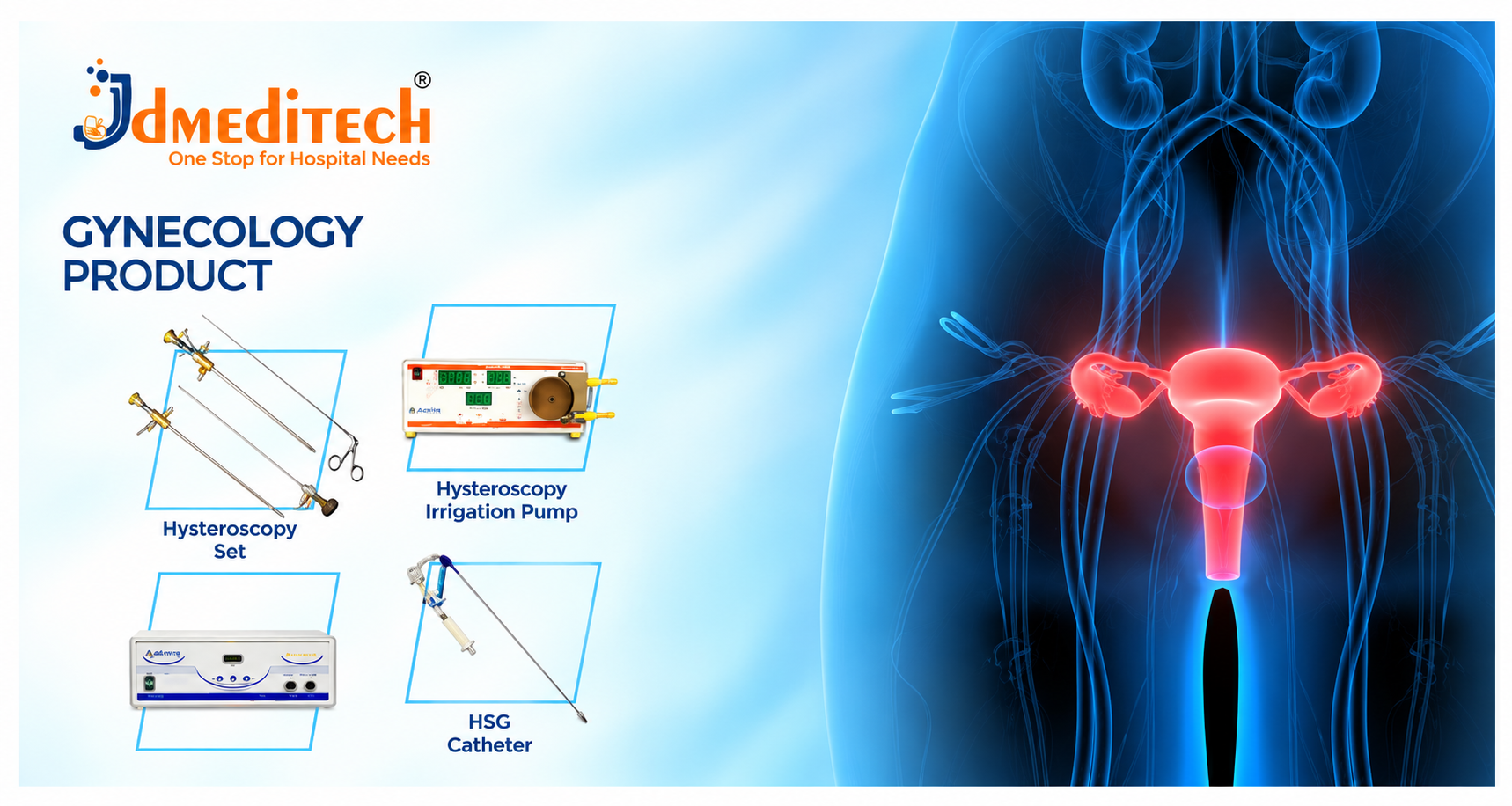
Gynecology Products: Complete Guide to Hysteroscopy Sets, Irrigation Pumps and HSG Catheters
Gynecology Products help healthcare professionals examine, diagnose, and treat conditions affecting the female reproductive system. Today, hospitals use specialized medical instruments to support accurate examinations and selected surgical procedures.
For example, hysteroscopy sets help doctors examine the uterine cavity. Meanwhile, irrigation pumps support fluid management during compatible endoscopic procedures. In addition, HSG catheters assist with selected diagnostic imaging examinations.
As a result, these devices support important gynecological services. However, healthcare professionals must select suitable equipment and follow established clinical guidelines.
JDMeditech supplies medical instruments and devices for hospitals, healthcare facilities, and medical distributors. Furthermore, customers can inquire about available gynecology products and their technical specifications.
What Are Gynecology Products?
Gynecology products include medical devices and instruments used in women’s reproductive healthcare. These products support diagnostic examinations, minimally invasive procedures, and selected surgical treatments.
For instance, a hysteroscope provides direct visualization of the uterine cavity. Similarly, an HSG catheter supports contrast administration during hysterosalpingography.
Therefore, each device serves a specific clinical purpose. Before purchasing, hospitals should confirm the intended application and product compatibility.
Importance of Gynecology Instruments
Modern gynecology instruments support effective clinical assessment and treatment planning. Moreover, compatible endoscopic systems help clinicians visualize selected anatomical structures.
In addition, diagnostic accessories support specialized examinations. Consequently, healthcare facilities can select equipment according to their clinical requirements.
Types of Gynecology Products
Healthcare facilities use different gynecology products for different procedures. The following instruments are common examples.
- Hysteroscopy Set
- Hysteroscopy Irrigation Pump
- HSG Catheter
- Diagnostic Hysteroscope
- Operative Hysteroscope
- Hysteroscopy Sheath
- Gynecology Endoscopic Instruments
- Fluid Management Accessories
- Gynecology Surgical Instruments
However, product availability and configurations vary. Therefore, customers should verify the selected model before ordering.
1. Hysteroscopy Set
A Hysteroscopy Set contains specialized instruments for examining the uterine cavity. Depending on the configuration, it may also support selected operative procedures.
During hysteroscopy, a clinician uses an endoscope to visualize the inside of the uterus. As a result, the healthcare team can assess selected uterine abnormalities.
What Is a Hysteroscopy Set?
A hysteroscopy set combines compatible instruments for diagnostic or operative hysteroscopy. Typically, the configuration includes a hysteroscope and selected accessories.
However, the exact contents depend on the product model. Therefore, hospitals should review the manufacturer’s component list.
Applications of a Hysteroscopy Set
Doctors use hysteroscopy sets for selected diagnostic and operative procedures. For example, these instruments may support the following applications.
- Diagnostic hysteroscopy
- Evaluation of abnormal uterine bleeding
- Assessment of suspected uterine polyps
- Examination of selected uterine abnormalities
- Selected operative hysteroscopy procedures
- Assessment of intrauterine adhesions
- Selected fertility-related examinations
Nevertheless, the clinician must determine whether hysteroscopy is suitable for the patient.
Key Features of Hysteroscopy Sets
Hysteroscopy sets offer different features according to their design. In particular, customers should consider instrument dimensions and system compatibility.
- Endoscopic visualization capability
- Diagnostic and operative configurations
- Compatible hysteroscopy sheaths
- Selected working channel accessories
- Camera system compatibility
- Light source compatibility
- Different instrument dimensions
Furthermore, hospitals should confirm each feature through the product datasheet.
Components of a Hysteroscopy Set
Depending on the selected model, a hysteroscopy set may include several instruments.
- Hysteroscope
- Hysteroscopy Sheath
- Obturator
- Working Channel Accessories
- Light Cable Connector
- Selected Operative Instruments
However, manufacturers supply different configurations. Therefore, buyers should request the complete packing list.
2. Hysteroscopy Irrigation Pump
A Hysteroscopy Irrigation Pump supports fluid delivery during compatible hysteroscopic procedures. During the examination, distension fluid helps expand the uterine cavity.
As a result, clinicians can obtain the visualization needed for selected procedures. However, safe fluid management remains essential.
What Is a Hysteroscopy Irrigation Pump?
A hysteroscopy irrigation pump is a medical device that supports fluid management during hysteroscopy. Depending on the model, it may provide adjustable pressure or flow settings.
Additionally, selected systems include monitoring features. Therefore, hospitals should review the available functions before purchasing.
Applications of Hysteroscopy Irrigation Pumps
Healthcare professionals use compatible irrigation pumps during selected gynecological endoscopic procedures.
- Diagnostic hysteroscopy
- Operative hysteroscopy
- Uterine cavity distension
- Endoscopic visualization support
- Selected gynecological procedures
Furthermore, clinicians must use appropriate distension media and monitor fluid balance.
Features of Hysteroscopy Irrigation Pumps
Different irrigation pumps offer different functions. For example, selected models may include the following features.
- Adjustable fluid delivery
- Pressure control
- Flow management
- Digital display
- Compatible tubing connections
- Monitoring functions
- Selected alarm features
However, these functions are model-dependent. Therefore, buyers should confirm the exact specifications.
Importance of Fluid Management
Fluid management plays an important role during hysteroscopy. For example, suitable distension helps maintain visibility inside the uterine cavity.
However, excessive fluid absorption may cause serious complications. Consequently, the clinical team must monitor fluid use according to established safety protocols.
3. HSG Catheter
An HSG Catheter supports hysterosalpingography, a diagnostic imaging examination of the uterus and fallopian tubes.
During the examination, the clinician introduces contrast material using a suitable catheter. Subsequently, imaging helps assess the uterine cavity and fallopian tube patency.
What Is an HSG Catheter?
An HSG catheter is a diagnostic catheter designed for contrast administration during hysterosalpingography.
Depending on the model, it may include a balloon or another positioning design. However, dimensions and configurations vary.
Applications of HSG Catheters
Doctors use HSG catheters during selected diagnostic examinations. In particular, these devices support the following applications.
- Hysterosalpingography
- Fallopian tube patency assessment
- Selected infertility investigations
- Evaluation of uterine cavity abnormalities
- Diagnostic contrast administration
Nevertheless, clinicians must assess the patient before recommending the examination.
Key Features of HSG Catheters
HSG catheters are available in different configurations. Therefore, hospitals should compare product specifications carefully.
- Flexible catheter construction
- Different catheter dimensions
- Selected balloon configurations
- Contrast delivery lumen
- Compatible connectors
- Diagnostic application design
Furthermore, the healthcare team should confirm that the selected device suits the intended examination.
How Does an HSG Catheter Work?
During hysterosalpingography, the catheter supports contrast administration into the uterine cavity.
Next, imaging equipment captures the distribution of contrast. As a result, clinicians can assess selected uterine findings and fallopian tube patency.
However, trained professionals must perform and interpret the examination.
4. Additional Gynecology Instruments
Gynecology departments may also use other diagnostic and operative instruments. For example, compatible endoscopic accessories support selected clinical procedures.
Additionally, fluid management systems and surgical instruments help complete specialized equipment configurations.
Therefore, hospitals should select products according to their intended clinical applications.
Diagnostic Gynecology Instruments
Diagnostic instruments help clinicians examine reproductive anatomy. For instance, hysteroscopes provide direct uterine cavity visualization.
Similarly, HSG catheters support selected imaging examinations. Consequently, each device contributes to a different diagnostic workflow.
Operative Gynecology Instruments
Operative instruments support selected gynecological treatments. In addition, specialized accessories may assist with minimally invasive procedures.
However, surgeons must confirm instrument compatibility before use.
Diagnostic Hysteroscopy
Diagnostic hysteroscopy allows clinicians to examine the uterine cavity. For example, doctors may recommend it when investigating abnormal uterine bleeding.
Additionally, the examination can help identify selected structural abnormalities. Nevertheless, treatment decisions depend on the clinical findings.
Operative Hysteroscopy
Operative hysteroscopy supports selected treatments inside the uterine cavity. For instance, surgeons may remove certain endometrial polyps using compatible equipment.
However, not every uterine condition is suitable for hysteroscopic treatment. Therefore, patient selection remains important.
Diagnostic vs. Operative Hysteroscopy
| Feature | Diagnostic Hysteroscopy | Operative Hysteroscopy |
|---|---|---|
| Purpose | Examination and assessment | Selected treatment procedures |
| Equipment | Diagnostic hysteroscopy system | Operative hysteroscopy system |
| Accessories | Diagnostic accessories | Compatible operative instruments |
| Application | Clinical diagnosis | Selected surgical treatment |
Hysteroscopy vs. Hysterosalpingography
Hysteroscopy and hysterosalpingography serve different diagnostic purposes.
Hysteroscopy provides direct endoscopic visualization of the uterine cavity. In contrast, hysterosalpingography uses contrast imaging to assess the uterus and fallopian tubes.
Therefore, doctors choose the appropriate examination according to the patient’s clinical needs.
Technical Specifications of Gynecology Products
Technical specifications vary by manufacturer and model. Therefore, customers should request verified product datasheets.
| Product | Parameter | Specification |
|---|---|---|
| Hysteroscopy Set | Application | Diagnostic or operative hysteroscopy |
| Hysteroscopy Set | Instrument Diameter | According to selected model |
| Hysteroscopy Set | Working Length | Confirm product datasheet |
| Hysteroscopy Set | Camera Compatibility | According to selected system |
| Irrigation Pump | Application | Fluid management |
| Irrigation Pump | Pressure Range | Confirm manufacturer specifications |
| Irrigation Pump | Flow Range | Confirm manufacturer specifications |
| Irrigation Pump | Power Requirements | Confirm product datasheet |
| HSG Catheter | Application | Hysterosalpingography |
| HSG Catheter | French Size | According to selected model |
| HSG Catheter | Length | Confirm manufacturer specifications |
| HSG Catheter | Balloon Configuration | Model-dependent |
| All Products | Sterility | According to product labeling |
| All Products | Reusable or Single Use | According to manufacturer instructions |
Benefits of Modern Gynecology Products
Modern gynecology products support diagnostic and operative workflows. Moreover, specialized instruments allow clinicians to perform selected minimally invasive examinations.
- Support reproductive health examinations
- Provide endoscopic visualization
- Assist selected diagnostic procedures
- Support compatible fluid management systems
- Offer different instrument configurations
- Support selected minimally invasive treatments
However, clinical benefits depend on the procedure, equipment, and patient condition.
Benefits of Hysteroscopy Sets
Hysteroscopy sets allow direct examination of the uterine cavity. Additionally, compatible instruments support selected operative procedures.
As a result, clinicians can assess certain conditions without a conventional abdominal incision.
Benefits of Hysteroscopy Irrigation Pumps
Compatible irrigation pumps support controlled fluid delivery. Furthermore, selected models provide monitoring features.
However, clinicians must monitor fluid balance carefully throughout the procedure.
Benefits of HSG Catheters
HSG catheters support diagnostic contrast administration. Consequently, imaging may help clinicians evaluate selected uterine abnormalities and fallopian tube patency.
Nevertheless, diagnostic findings require professional interpretation.
Possible Risks of Hysteroscopy
Hysteroscopy carries potential risks. For example, patients may experience temporary discomfort or bleeding.
- Temporary pain or cramping
- Bleeding
- Infection
- Uterine perforation
- Fluid-related complications
- Anesthesia-related complications when applicable
Therefore, clinicians must follow established safety protocols.
Possible Risks of Hysterosalpingography
Hysterosalpingography may cause temporary discomfort. Additionally, other complications are possible.
- Pelvic cramping
- Spotting
- Infection
- Contrast-related reactions
- Radiation exposure during X-ray imaging
Furthermore, clinicians must assess pregnancy status and relevant contraindications before the examination.
How to Select Gynecology Products
Hospitals should evaluate the intended clinical application before selecting equipment. In addition, buyers should confirm device compatibility and technical specifications.
- Clinical application
- Instrument dimensions
- Camera compatibility
- Light source compatibility
- Fluid management requirements
- Catheter configuration
- Sterility requirements
- Reusable or single-use design
- Reprocessing instructions
- Technical documentation
Therefore, customers should discuss the required configuration with the clinical team.
Instrument Compatibility
Compatibility plays an important role in gynecology equipment selection. For example, a hysteroscope must suit the selected sheath, camera, and light source.
Similarly, irrigation pumps require compatible tubing and accessories. Therefore, hospitals should verify the complete system before purchasing.
Cleaning and Sterilization
Medical instruments require appropriate cleaning and reprocessing. Furthermore, reusable devices need validated manufacturer instructions.
However, single-use devices must not undergo unauthorized reuse. Consequently, healthcare facilities should follow product labeling and local regulations.
Applications in Healthcare Facilities
Gynecology products support different healthcare settings. For example, hospitals and specialized clinics use these devices for selected diagnostic and operative procedures.
- Hospitals
- Gynecology Departments
- Women’s Health Clinics
- Fertility Clinics
- Diagnostic Imaging Centers
- Endoscopy Units
- Surgical Centers
Nevertheless, each facility must maintain suitable equipment and trained personnel.
Why Choose JDMeditech for Gynecology Products?
JDMeditech supplies medical instruments and devices for healthcare facilities and distributors. Furthermore, customers can request information about available gynecology products.
For example, our team can assist with product inquiries, technical documentation requests, and quotations.
- Hysteroscopy Set inquiries
- Hysteroscopy Irrigation Pump inquiries
- HSG Catheter inquiries
- Hysteroscope inquiries
- Gynecology Instrument inquiries
- Technical Specification requests
- Product Quotation requests
- International Export inquiries
However, availability and specifications vary. Therefore, customers should confirm all product details before ordering.
Frequently Asked Questions About Gynecology Products
1. What Are Gynecology Products?
Gynecology products include instruments used for reproductive health examinations and selected treatments. Additionally, different devices support different clinical applications.
2. What Is a Hysteroscopy Set?
A hysteroscopy set contains compatible instruments for examining the uterine cavity. Furthermore, selected configurations support operative procedures.
3. What Is a Hysteroscopy Irrigation Pump?
A hysteroscopy irrigation pump supports fluid delivery during compatible hysteroscopic procedures. Therefore, clinicians use it according to established fluid management protocols.
4. What Is an HSG Catheter?
An HSG catheter supports contrast administration during hysterosalpingography. As a result, imaging can help evaluate selected uterine findings and tubal patency.
5. Why Do Doctors Perform Hysteroscopy?
Doctors perform hysteroscopy to examine the uterine cavity. Additionally, operative hysteroscopy supports selected treatments.
6. Can Hysteroscopy Detect Uterine Polyps?
Yes. Hysteroscopy can help clinicians identify selected uterine cavity abnormalities, including polyps.
7. Is Hysteroscopy Minimally Invasive?
Hysteroscopy usually uses the natural cervical passage. Therefore, it generally does not require an abdominal incision.
8. What Is the Purpose of an Irrigation Pump?
An irrigation pump supports fluid delivery during compatible endoscopic procedures. However, the clinical team must monitor fluid use.
9. Can HSG Evaluate Fallopian Tubes?
Yes. HSG helps assess fallopian tube patency. Therefore, doctors may recommend it during selected fertility investigations.
10. Are HSG Catheters Available in Different Sizes?
Yes. Different models may offer different dimensions. However, customers should verify available options.
11. What Is Operative Hysteroscopy?
Operative hysteroscopy supports selected treatments inside the uterine cavity. For example, clinicians may remove certain polyps using compatible instruments.
12. Are Gynecology Instruments Reusable?
Some instruments are reusable, while others are single-use. Therefore, hospitals must follow manufacturer instructions.
13. What Are the Risks of Hysteroscopy?
Possible risks include bleeding, infection, uterine perforation, and fluid-related complications. Consequently, appropriate clinical monitoring is essential.
14. How Should Hospitals Select Hysteroscopy Equipment?
Hospitals should review device compatibility, intended use, technical specifications, and reprocessing requirements. Additionally, clinicians should confirm the required configuration.
15. Where Can I Inquire About Gynecology Products?
Hospitals and distributors can contact JDMeditech for product information. Furthermore, customers can request quotations and technical details.
Conclusion
In conclusion, Gynecology Products support important diagnostic and operative procedures in women’s healthcare. Furthermore, hysteroscopy sets help clinicians examine the uterine cavity.
Meanwhile, irrigation pumps support fluid management during compatible procedures. In addition, HSG catheters assist with selected diagnostic imaging examinations.
Therefore, hospitals should select suitable instruments and verify technical compatibility. Above all, trained healthcare professionals must use these devices according to established clinical guidelines.
JDMeditech – One Stop for Hospital Needs
Website:
www.jdmeditech.com
Medical References
- American College of Obstetricians and Gynecologists
- MedlinePlus – Hysteroscopy
- RadiologyInfo – Hysterosalpingography
Medical Disclaimer
This article provides general educational and product information only. It does not replace professional medical advice, clinical training, or manufacturer instructions for use. Qualified healthcare professionals must select medical devices and procedures according to individual clinical requirements.




