



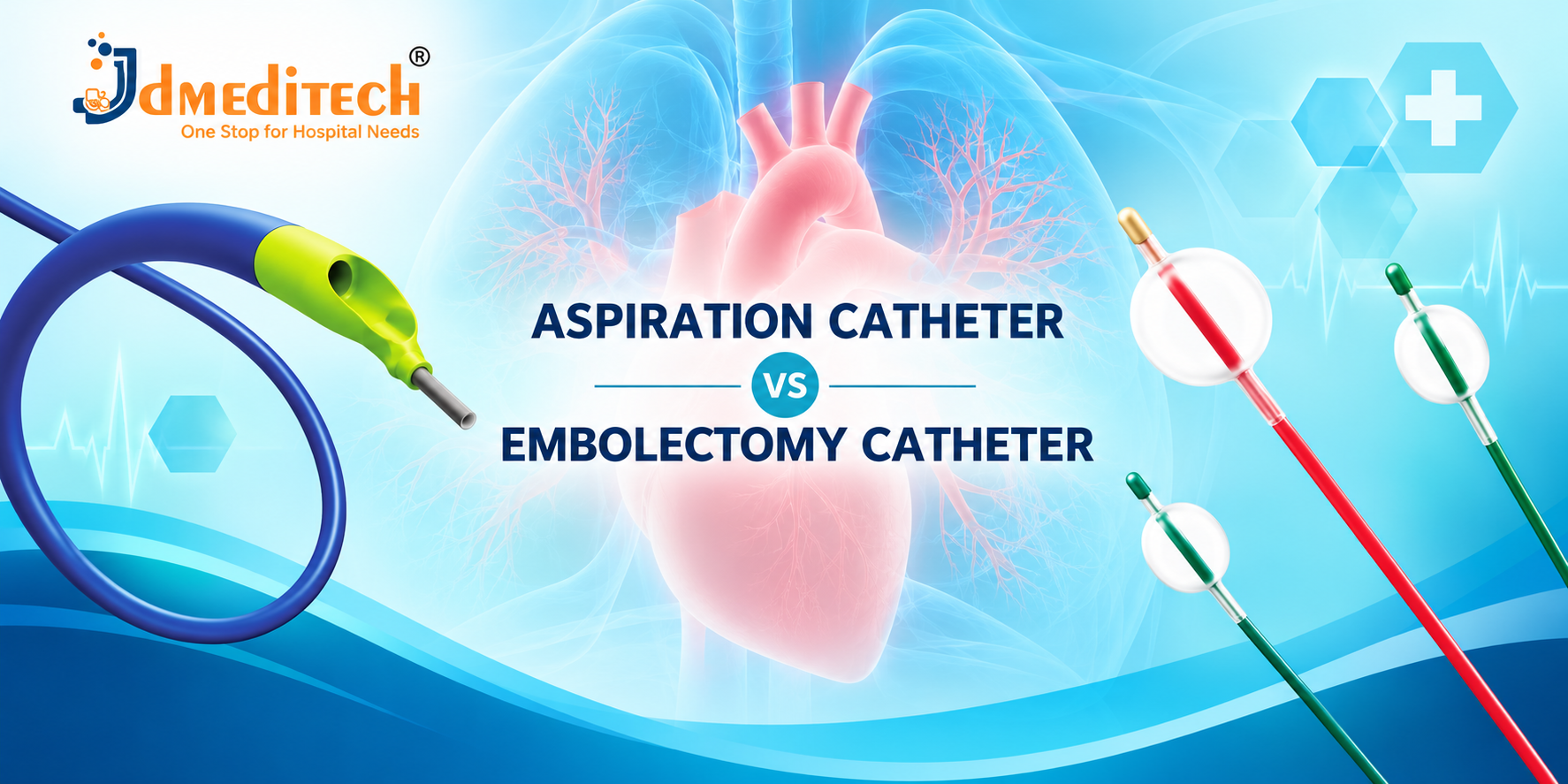
Catheter-based clot removal plays an important role in cardiovascular and vascular procedures. Healthcare professionals use different devices to manage thrombus and embolic material. Two important options include Aspiration Catheters and Embolectomy Catheters.
Although both devices support clot removal, they work in different ways. Aspiration Catheter vs Embolectomy Catheter mainly differs in the method of clot removal. Therefore, understanding these differences can help healthcare professionals, hospitals, and medical-device distributors learn more about their functions and applications.
What Is an Aspiration Catheter?
An Aspiration Catheter removes thrombotic material from blood vessels through aspiration or suction. During the procedure, the physician advances the catheter toward the target area. Then, negative pressure draws thrombotic material into the catheter.
Additionally, aspiration technology allows clinicians to remove thrombotic material without relying only on mechanical extraction. However, the exact application depends on the catheter design, vascular territory, and intended use.
Therefore, healthcare professionals should always follow the manufacturer’s instructions for use, indications, warnings, and contraindications.
What Is an Embolectomy Catheter?
An Embolectomy Catheter helps remove embolic or thrombotic material from blood vessels. Traditional balloon embolectomy catheters usually include an inflatable balloon near the distal end.
During an appropriate procedure, the physician positions the catheter and controls the balloon according to the device instructions. The balloon can then help with mechanical extraction of the obstructing material.
However, catheter designs can vary. Therefore, healthcare professionals should always check the intended use and instructions for the specific device.
Aspiration Catheter vs Embolectomy Catheter
| Feature | Aspiration Catheter | Embolectomy Catheter |
|---|---|---|
| Primary Mechanism | Aspiration or suction | Mechanical extraction, often balloon-based |
| Main Purpose | Removal of thrombotic material | Removal of embolic or thrombotic material |
| Design | Includes an aspiration lumen | Often includes an inflatable distal balloon |
| Removal Method | Uses suction to draw material into the catheter | Uses mechanical action to withdraw material |
| Application | Depends on the specific device indication | Depends on the specific device indication |
Overall, both catheters support clot-removal procedures. However, their primary working mechanisms differ. Moreover, some modern thrombectomy technologies may combine aspiration with mechanical techniques.
How Does an Aspiration Catheter Work?
First, the physician positions the aspiration catheter near the target thrombus. Next, the system applies negative pressure manually or through a compatible aspiration system.
As a result, suction draws thrombotic material into the catheter. The physician can then remove the material according to the specific device technique. Therefore, aspiration provides a different clot-removal approach compared with traditional balloon-based extraction.
How Does an Embolectomy Catheter Work?
A conventional balloon embolectomy catheter uses a different approach. First, the physician introduces and positions the catheter according to the required procedure. Next, the physician manages the balloon according to the manufacturer’s instructions.
The balloon can assist with mechanical extraction of embolic or thrombotic material. Therefore, this technique differs from conventional aspiration because it primarily relies on mechanical action rather than suction.
Key Difference: Aspiration vs Mechanical Extraction
The main Aspiration Catheter vs Embolectomy Catheter difference involves the clot-removal mechanism.
An Aspiration Catheter primarily uses negative pressure to draw thrombotic material through the catheter. In contrast, a traditional Embolectomy Catheter may use an inflatable balloon to assist with mechanical extraction.
However, modern thrombectomy technologies continue to evolve. As a result, some systems may combine aspiration and mechanical techniques.
Which Catheter Should Be Used?
Healthcare professionals should consider several factors when selecting an appropriate catheter. For example, they may consider the thrombus location, vessel anatomy, catheter compatibility, access route, procedural requirements, and intended use of the device.
Furthermore, clinicians should review the manufacturer’s instructions before using any catheter. They should also follow applicable clinical guidance, warnings, and contraindications.
JDMeditech Cardiovascular Solutions
JDMeditech provides medical devices and solutions for cardiovascular and interventional applications.
Moreover, we support hospitals, healthcare professionals, distributors, and healthcare organizations with product specifications and relevant documentation.
For Aspiration Catheters, Embolectomy Catheters, and other cardiology products, customers can contact JDMeditech for available sizes, specifications, packaging details, quotations, and export requirements.
Frequently Asked Questions
What is the difference between an Aspiration Catheter and an Embolectomy Catheter?
An aspiration catheter primarily uses suction to remove thrombotic material. In contrast, a traditional balloon embolectomy catheter uses an inflatable balloon to assist with mechanical extraction.
What is an Aspiration Catheter used for?
An aspiration catheter helps remove thrombotic material through aspiration. However, the exact intended use depends on the individual device and its approved indications.
How does a balloon Embolectomy Catheter work?
A balloon embolectomy catheter uses an inflatable distal balloon to assist with mechanical removal of embolic or thrombotic material. Therefore, healthcare professionals should follow the manufacturer’s instructions for the specific catheter.
Are Aspiration Catheters and thrombectomy catheters the same?
Not always. Aspiration represents one method of thrombectomy. For example, some thrombectomy devices primarily use aspiration, while others use mechanical techniques or combine different technologies.
Can aspiration and mechanical thrombectomy work together?
Yes. Some modern thrombectomy technologies combine aspiration with mechanical clot-management techniques. However, the exact mechanism depends on the specific device.
Conclusion
Both Aspiration Catheters and Embolectomy Catheters support the removal of thrombotic or embolic material. However, they can use different working mechanisms.
Aspiration catheters primarily use suction to remove thrombotic material. In contrast, traditional balloon embolectomy catheters use mechanical extraction. Moreover, some modern thrombectomy technologies combine aspiration and mechanical techniques.
Therefore, understanding the Aspiration Catheter vs Embolectomy Catheter comparison can help readers understand their different functions. Healthcare professionals should always select and use a device according to its intended use, manufacturer’s instructions, and appropriate clinical guidance.




