



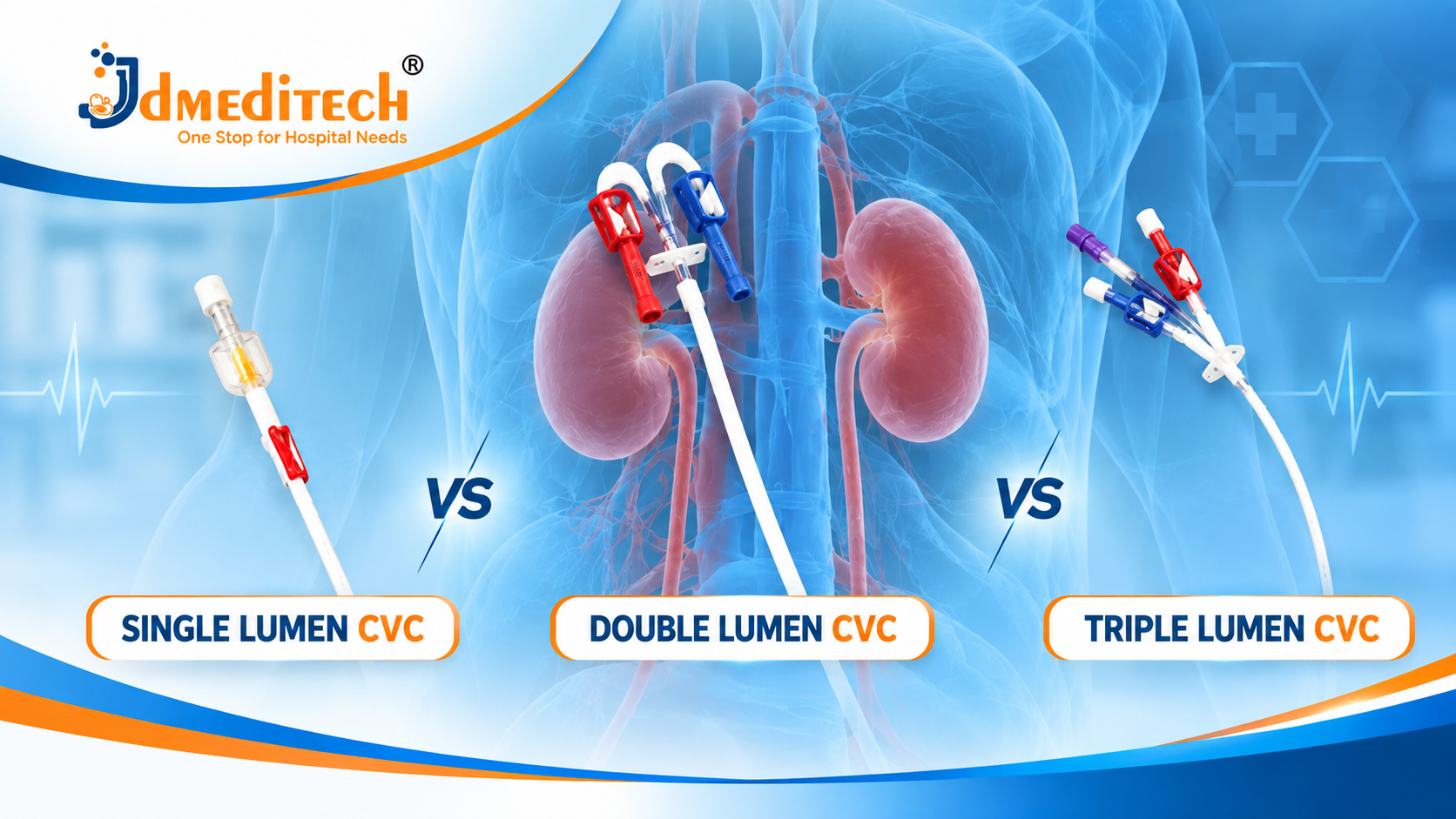
Single Lumen vs Double Lumen vs Triple Lumen CVC: Key Differences
A Central Venous Catheter (CVC) provides access to the central venous system. Healthcare professionals use CVCs for different clinical requirements. For example, they may use them for appropriate fluid administration, medication delivery, blood sampling, or monitoring. However, the exact use depends on the patient’s condition and treatment plan.
CVCs are available with different numbers of lumens. The common options include Single Lumen CVC, Double Lumen CVC, and Triple Lumen CVC. Each lumen creates a separate internal pathway. Therefore, the number of lumens affects the number of access channels available through the catheter.
Understanding the Single Lumen vs Double Lumen vs Triple Lumen CVC comparison can help healthcare professionals and medical-device buyers understand these different configurations. Moreover, it helps explain why one catheter design may suit a particular clinical requirement better than another.
What Is a Central Venous Catheter (CVC)?
A Central Venous Catheter, also known as a CVC or central line, is a catheter designed for central venous access. It provides a pathway into the central venous circulation. Therefore, clinicians can use it when a treatment plan requires reliable central access.
CVCs come in different sizes, lengths, materials, and lumen configurations. In addition, manufacturers may offer different catheter designs for specific clinical requirements. As a result, healthcare professionals should consider both the catheter design and the intended application before selecting a device.
Another important consideration is the number of lumens. For example, some patients may require only one access pathway. In contrast, other patients may need two or three independent pathways.
What Is a Single Lumen CVC?
A Single Lumen CVC contains one internal channel. Therefore, it provides one central venous access pathway. This configuration may be suitable when one access channel meets the patient’s clinical requirements.
In addition, a single lumen catheter has a relatively simple configuration. It does not provide additional independent channels that may not be necessary. As a result, clinicians can consider this configuration when one central access pathway is sufficient.
Key Features of Single Lumen CVC
- Contains one internal lumen
- Provides one access pathway
- Offers a simple catheter configuration
- Suitable when one lumen meets the clinical requirement
- Available in different sizes and lengths
What Is a Double Lumen CVC?
A Double Lumen CVC contains two separate internal channels within one catheter. Therefore, it provides two independent access pathways. Each lumen generally connects to a separate external access port.
Compared with a single lumen catheter, a double lumen design provides an additional access channel. Consequently, clinicians may consider it when a patient requires two independent pathways. However, the exact application should always follow the product specifications and relevant clinical protocols.
Moreover, clinicians should consider compatibility when using different access channels. They should also follow the manufacturer’s Instructions for Use (IFU) and their healthcare facility’s procedures.
Key Features of Double Lumen CVC
- Contains two independent lumens
- Provides two access pathways
- Offers separate external access ports
- Supports multiple access requirements
- Available in different sizes and configurations
What Is a Triple Lumen CVC?
A Triple Lumen CVC contains three independent internal channels. As a result, it provides three separate access pathways through one catheter. This design offers additional access options when several pathways are clinically necessary.
Furthermore, each lumen provides an independent channel according to the catheter’s design. Therefore, a triple lumen CVC can support more complex access requirements. However, more lumens do not automatically make the catheter a better option for every patient.
Instead, clinicians should select the catheter according to actual treatment requirements. In addition, they should consider the patient’s condition, catheter specifications, intended therapy, and applicable clinical protocols.
Key Features of Triple Lumen CVC
- Contains three independent lumens
- Provides three access pathways
- Offers separate access ports
- Supports multiple access requirements
- Provides additional access flexibility when required
Single Lumen vs Double Lumen vs Triple Lumen CVC
The main difference between Single Lumen vs Double Lumen vs Triple Lumen CVC is the number of internal channels. A single lumen CVC has one channel. Meanwhile, a double lumen CVC has two independent channels. A triple lumen CVC, in comparison, provides three independent channels.
Therefore, the appropriate configuration depends on the number of access pathways required for patient management. However, clinicians should not select a catheter only because it provides more lumens.
| Feature | Single Lumen CVC | Double Lumen CVC | Triple Lumen CVC |
|---|---|---|---|
| Number of Lumens | 1 | 2 | 3 |
| Access Pathways | One | Two | Three |
| Configuration | Simple | Two-channel | Three-channel |
| Typical Requirement | Single access requirement | Two access requirements | Multiple access requirements |
| Selection | When one lumen is sufficient | When two lumens are required | When three lumens are required |
Key Differences Between CVC Configurations
1. Number of Lumens
First, the number of lumens is the most obvious difference. A single lumen catheter has one channel. In comparison, a double lumen catheter has two channels, while a triple lumen catheter has three.
2. Number of Access Pathways
Each lumen provides an independent pathway through the catheter. Therefore, increasing the number of lumens also increases the number of available access pathways.
3. Clinical Requirements
Clinical requirements also influence catheter selection. For example, one patient may require only one central access pathway. In contrast, another patient may require more than one independent pathway.
4. Catheter Configuration
The internal catheter design changes as the number of lumens increases. Consequently, healthcare professionals should consider the required configuration before selecting a CVC.
5. Access Flexibility
Multi-lumen catheters provide additional access options. However, additional lumens should serve a genuine clinical requirement. Therefore, clinicians should select an appropriate configuration rather than automatically choosing the catheter with the most lumens.
How to Select the Appropriate CVC
Selecting a Single Lumen, Double Lumen, or Triple Lumen CVC requires careful clinical assessment. First, healthcare professionals should determine how many central access pathways the patient requires. Next, they should consider the intended therapy and expected duration of access.
In addition, several other factors can influence catheter selection:
- Patient condition
- Number of required access pathways
- Type of therapy
- Duration of therapy
- Catheter size and length
- Compatibility requirements
- Insertion site
- Institutional protocols
- Manufacturer’s Instructions for Use (IFU)
Therefore, more lumens do not necessarily mean a better catheter. Instead, clinicians should choose a configuration that meets the actual requirements of patient management.
Single Lumen or Multi-Lumen CVC: Which Is Better?
There is no single CVC configuration that is ideal for every situation. Instead, the appropriate option depends on the intended clinical application.
For example, a Single Lumen CVC may provide sufficient access when only one pathway is required. On the other hand, a Double Lumen CVC provides two independent channels when additional access is necessary. Similarly, a Triple Lumen CVC provides three pathways when the treatment plan requires multiple channels.
Therefore, clinicians should evaluate the patient’s requirements before selecting a catheter. Moreover, they should consider device specifications, compatibility, and established clinical procedures.
Benefits of Understanding CVC Lumen Configurations
Understanding different lumen configurations helps healthcare professionals identify the basic design differences between CVCs. In addition, this knowledge can support appropriate product selection based on clinical requirements.
For medical distributors and healthcare buyers, understanding these differences can also make product selection easier. For example, buyers can compare lumen configuration, catheter size, length, packaging, and other technical specifications before placing an order.
JDMeditech Central Venous Catheter Solutions
JDMeditech provides medical devices and catheter solutions for hospitals, healthcare facilities, medical distributors, and international buyers. Our product portfolio supports a wide range of medical and procedural requirements.
In addition, customers can contact JDMeditech to discuss available Central Venous Catheter configurations, sizes, lengths, specifications, packaging options, and quantities. Therefore, medical distributors and healthcare buyers can request product information according to their specific requirements.
For more information, visit the JDMeditech website. Alternatively, contact the JDMeditech team for product specifications and quotation requirements.
Frequently Asked Questions About CVC
What is a lumen in a Central Venous Catheter?
A lumen is an internal channel within the catheter. Therefore, each lumen provides a separate pathway through the catheter according to its intended design.
What is the difference between Single and Double Lumen CVC?
A Single Lumen CVC contains one internal channel. In contrast, a Double Lumen CVC contains two independent channels. Therefore, the double lumen configuration provides an additional access pathway.
What is the difference between Double and Triple Lumen CVC?
A Double Lumen CVC contains two independent channels, whereas a Triple Lumen CVC contains three. As a result, the triple lumen configuration provides one additional access pathway.
Does a Triple Lumen CVC have three separate channels?
Yes. A Triple Lumen CVC contains three internal lumens. Therefore, it provides three separate access pathways according to the catheter’s design.
Is a Triple Lumen CVC better than a Single Lumen CVC?
Not necessarily. Although a Triple Lumen CVC provides more access pathways, more lumens are not required in every situation. Therefore, clinicians should select the catheter according to actual patient and treatment requirements.
How do I choose between Single, Double, and Triple Lumen CVC?
The choice depends on the number of required access pathways and the intended clinical application. In addition, clinicians should consider catheter specifications, patient requirements, institutional protocols, and the manufacturer’s Instructions for Use.
Conclusion
Overall, understanding the Single Lumen vs Double Lumen vs Triple Lumen CVC comparison helps explain the differences between these catheter configurations. A Single Lumen CVC provides one internal channel. Meanwhile, a Double Lumen CVC provides two independent channels, and a Triple Lumen CVC provides three.
However, the number of lumens should not be the only factor in catheter selection. Instead, healthcare professionals should consider patient requirements, intended therapy, catheter dimensions, compatibility, duration of access, and clinical protocols.
Finally, healthcare facilities and medical distributors looking for Central Venous Catheter solutions can contact JDMeditech for available configurations, product specifications, quantities, and quotation details.
Disclaimer: This article provides general educational and product information only. It does not replace professional medical advice, clinical judgment, institutional protocols, or the manufacturer’s Instructions for Use.




