



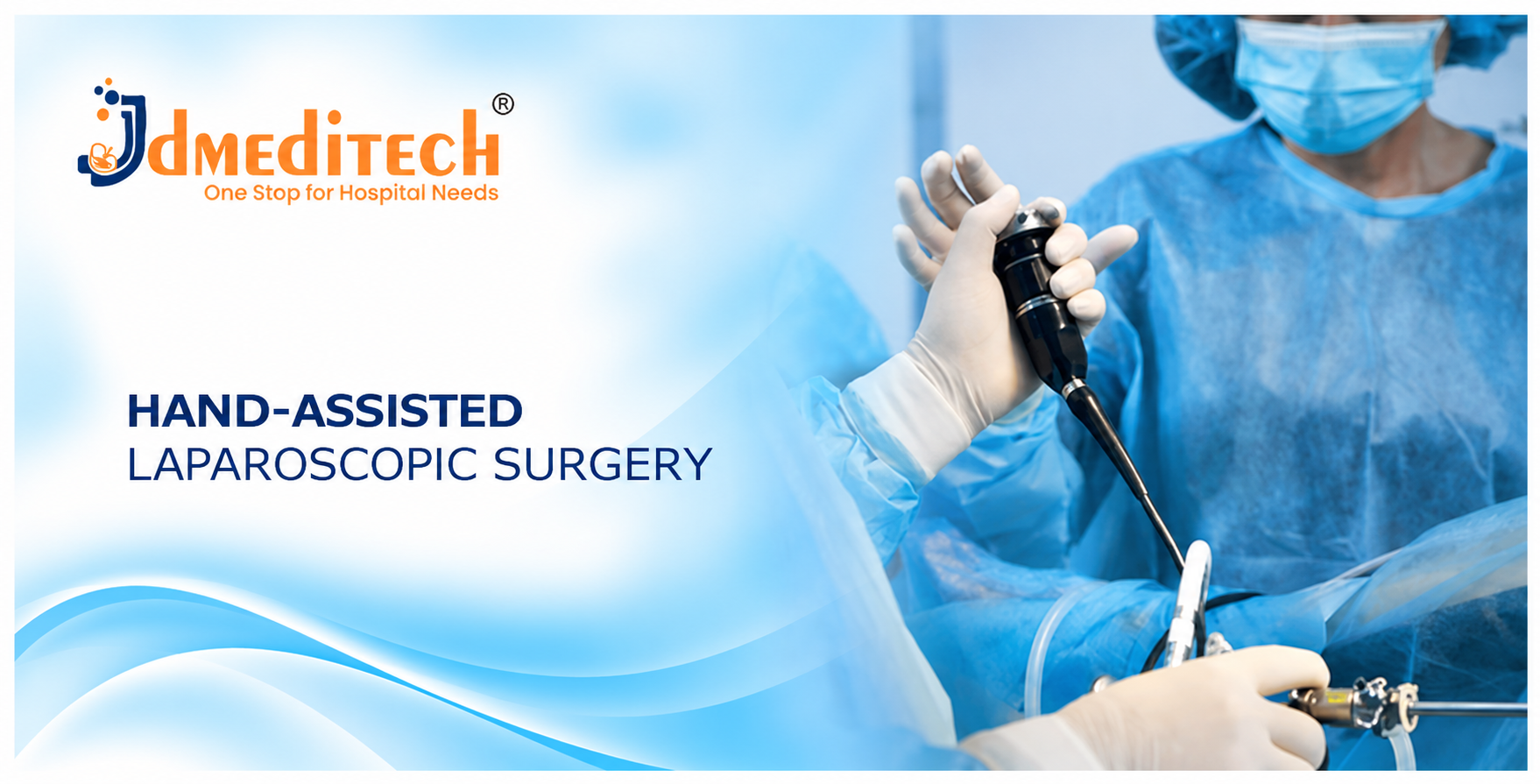
Hand-Assisted Laparoscopic Surgery: Procedure, Instruments, Benefits & Recovery
Hand-Assisted Laparoscopic Surgery (HALS) is a minimally invasive surgical approach that combines conventional laparoscopic visualization with direct manual assistance inside the abdominal cavity.
During hand-assisted laparoscopy, the surgeon introduces one hand through a small abdominal incision using a specialized hand-access device. The device helps maintain pneumoperitoneum while the surgeon performs the operation using laparoscopic instruments.
This hybrid approach provides tactile feedback, controlled tissue manipulation, and additional assistance during selected complex abdominal procedures.
Hand-assisted laparoscopic surgery has been used in colorectal surgery, urology, splenic surgery, and other selected operations.
This JDMeditech guide explains HALS surgery, surgical applications, instruments, advantages, limitations, complications, recovery, and frequently asked questions.
What Is Hand-Assisted Laparoscopic Surgery?
Hand-Assisted Laparoscopic Surgery is a surgical technique in which the surgeon uses a hand-access device to introduce a hand into the abdominal cavity while maintaining laparoscopic visualization.
The procedure combines aspects of open surgery and conventional minimally invasive surgery.
Unlike standard laparoscopy, HALS allows the surgeon to directly feel and manipulate tissues.
However, unlike conventional open surgery, much of the operation is performed under laparoscopic camera visualization.
Therefore, HALS may be useful when a procedure requires additional tactile feedback, controlled retraction, or assistance with a large surgical specimen.
What Does HALS Stand For?
HALS stands for Hand-Assisted Laparoscopic Surgery.
Related terms include:
- Hand-Assisted Laparoscopy
- Hand-Port Laparoscopic Surgery
- Hand-Assisted Minimally Invasive Surgery
- Hand-Assisted Laparoscopic Technique
- Hand-Assisted Abdominal Surgery
- HAL Surgery
These terms generally describe a laparoscopic technique that includes direct manual assistance through a dedicated abdominal access site.
How Does Hand-Assisted Laparoscopic Surgery Work?
HALS uses a specialized hand-access system to maintain the abdominal gas seal while allowing the surgeon’s hand to enter the operative field.
First, the surgical team establishes suitable abdominal access.
Next, the surgeon positions a compatible hand-access device through an appropriately planned incision.
A laparoscope provides internal visualization, while the surgeon’s hand supports selected tissue-handling tasks.
Additional laparoscopic instruments are introduced through suitable trocar ports.
The combination of direct manual assistance and laparoscopic instruments allows the surgeon to perform the planned operation.
However, the exact approach varies according to the operation, patient anatomy, and clinical requirements.
Key Features of Hand-Assisted Laparoscopic Surgery
- Direct tactile feedback during surgery
- Use of a specialized hand-access device
- Maintenance of pneumoperitoneum
- Laparoscopic camera visualization
- Combination of manual and instrument-assisted tissue handling
- Controlled retraction of suitable tissues
- Assistance with large specimen manipulation
- Potential support during selected complex laparoscopic procedures
Common Applications of Hand-Assisted Laparoscopic Surgery
HALS has been used across several surgical specialties.
However, its use is most relevant when direct manual assistance offers a practical advantage over conventional laparoscopy.
1. Hand-Assisted Laparoscopic Nephrectomy
Hand-assisted laparoscopic nephrectomy is used in selected kidney removal procedures.
The surgeon’s hand may assist with tissue manipulation, vascular control, and specimen handling.
2. Hand-Assisted Laparoscopic Donor Nephrectomy
HALS has been used for living-donor kidney removal.
Direct manual assistance may help with kidney handling and retrieval.
However, the selected approach must prioritize donor safety and preservation of the donated kidney.
3. Hand-Assisted Laparoscopic Colectomy
Hand-assisted laparoscopic colectomy involves removal of a selected portion of the colon using laparoscopic instruments and direct manual assistance.
This technique may be useful when extensive tissue mobilization or specimen extraction is required.
4. Hand-Assisted Laparoscopic Splenectomy
Selected splenectomy procedures may benefit from hand assistance, particularly when the spleen is enlarged.
However, the approach depends on spleen size, patient anatomy, and clinical circumstances.
5. Hand-Assisted Laparoscopic Nephroureterectomy
Selected kidney and ureter removal procedures may use a hand-assisted laparoscopic approach.
The surgical plan depends on the underlying disease and applicable oncological requirements.
6. Hand-Assisted Laparoscopic Adrenalectomy
HALS has been described for selected adrenal gland procedures.
However, suitability depends on the size and characteristics of the adrenal lesion.
7. Hand-Assisted Laparoscopic Colorectal Surgery
Hand-assisted techniques have been used for selected colorectal resections involving diverticular disease and other conditions.
8. Hand-Assisted Laparoscopic Gastrectomy
Selected gastric surgical procedures have been performed using hand-assisted laparoscopic techniques.
However, the technique is not routinely required for all gastric operations.
9. Hand-Assisted Laparoscopic Liver Surgery
HALS has been described in selected hepatic procedures where direct manual assistance may help tissue manipulation.
10. Complex Abdominal Surgery
Hand assistance may be considered in selected complex operations involving bulky specimens, difficult tissue handling, or other technical challenges.
However, HALS does not replace conventional laparoscopy or open surgery in every clinical situation.
Hand-Assisted vs Conventional Laparoscopic vs Open Surgery
| Feature | Hand-Assisted Laparoscopy | Conventional Laparoscopy | Open Surgery |
|---|---|---|---|
| Surgical Access | Hand-access incision plus laparoscopic ports | Small laparoscopic ports | Larger surgical incision |
| Visualization | Camera-assisted | Camera-assisted | Direct surgical exposure |
| Tactile Feedback | Direct hand sensation | Limited | Direct hand sensation |
| Tissue Manipulation | Hand and instruments | Laparoscopic instruments | Hands and instruments |
| Specimen Extraction | Hand-access incision may be used | May require incision enlargement | Through open incision |
| Technical Requirements | Hand-access device and laparoscopic equipment | Laparoscopic equipment | Open surgical equipment |
| Recovery | Procedure-dependent | Procedure-dependent | Procedure-dependent |
Common Instruments Used in Hand-Assisted Laparoscopic Surgery
HALS requires suitable equipment for abdominal access, laparoscopic visualization, tissue dissection, coagulation, suturing, and specimen handling.
Instrument requirements depend on the surgical specialty and planned operation.
The following list describes common instrument categories rather than a verified JDMeditech HALS surgical set.
1. Hand-Assisted Laparoscopic Access Device
A specialized hand-access device allows the surgeon’s hand to enter the abdominal cavity while helping maintain pneumoperitoneum.
2. Hand-Port Sealing System
A compatible sealing mechanism limits gas leakage around the surgeon’s hand during the procedure.
3. Laparoscope Telescope
A laparoscope provides internal visualization of the operative field.
4. Laparoscopic Camera System
A compatible camera system transmits images from the laparoscope to a surgical monitor.
5. Medical Light Source
A suitable light source provides illumination through the laparoscopic optical system.
6. Fiber-Optic Light Cable
A compatible light cable transfers illumination to the laparoscope.
7. Laparoscopic Trocar
A trocar forms part of the laparoscopic instrument access system.
8. Laparoscopic Cannula
A suitable cannula maintains access for compatible laparoscopic instruments.
9. CO2 Insufflator
A carbon dioxide insufflator supports pneumoperitoneum during the operation.
10. Laparoscopic Grasping Forceps
Grasping forceps support controlled tissue manipulation.
11. Atraumatic Laparoscopic Grasper
An atraumatic grasper supports delicate tissue handling when required.
12. Maryland Dissector
A Maryland dissector supports selected fine tissue dissection tasks.
13. Laparoscopic Scissors
Laparoscopic scissors support tissue cutting during suitable procedures.
14. Laparoscopic Needle Holder
A laparoscopic needle holder supports intracorporeal suturing when required.
15. Bipolar Forceps
Bipolar forceps support appropriate coagulation and bleeding control.
16. Monopolar Electrosurgical Instrument
A compatible monopolar instrument may support selected cutting and coagulation tasks.
17. Laparoscopic Clip Applicator
A suitable clip applicator may be used for selected tissue or vessel management tasks.
18. Vessel-Sealing Device
A compatible vessel-sealing device may support selected tissue and vessel management tasks.
19. Suction and Irrigation Cannula
Suction and irrigation equipment supports fluid management and operative visibility.
20. Laparoscopic Stapling Device
A suitable stapling device may be used for selected tissue division and closure tasks.
21. Specimen Retrieval Accessories
Appropriate specimen retrieval accessories support controlled removal of surgical tissue.
22. Surgical Sutures
Suitable sutures may be required for reconstruction or wound closure.
23. Surgical Monitor
A medical-grade monitor displays laparoscopic images for the surgical team.
24. Endoscopy Trolley
A suitable trolley supports organized positioning of laparoscopic equipment.
25. Sterile Surgical Accessories
Appropriate drapes, tubing, dressings, and compatible accessories support the planned procedure.
Hand-Assisted Laparoscopic Instruments and Functions
| Instrument | Primary Function |
|---|---|
| Hand-Access Device | Allows direct manual access while maintaining gas seal |
| Hand-Port Sealing System | Helps maintain pneumoperitoneum |
| Laparoscope | Provides surgical visualization |
| Camera System | Transmits surgical images |
| Light Source | Provides illumination |
| Trocar and Cannula | Provide instrument access |
| CO2 Insufflator | Maintains pneumoperitoneum |
| Grasping Forceps | Support tissue manipulation |
| Maryland Dissector | Supports fine dissection |
| Laparoscopic Scissors | Support tissue cutting |
| Needle Holder | Supports suturing |
| Bipolar Forceps | Support coagulation |
| Clip Applicator | Supports selected clip placement |
| Vessel-Sealing Device | Supports selected vessel management |
| Suction and Irrigation | Support fluid management |
| Specimen Retrieval Accessories | Support specimen removal |
How Is Hand-Assisted Laparoscopic Surgery Performed?
A qualified surgeon performs HALS in an appropriately equipped hospital.
First, the healthcare team reviews the patient’s medical history, clinical condition, and planned surgical procedure.
Next, the anesthesia team prepares the patient for surgery.
During the operation, the surgeon establishes suitable laparoscopic access and positions a compatible hand-access device.
The surgeon introduces a hand through the specialized access system while maintaining abdominal insufflation.
A laparoscope provides visualization, while compatible instruments and manual assistance are used to perform the operation.
When appropriate, the hand-access incision may also support surgical specimen removal.
Finally, the surgeon completes the planned procedure and closes the surgical incisions.
However, the exact technique depends on the operation and requires specialist surgical training.
Potential Benefits of Hand-Assisted Laparoscopic Surgery
1. Improved Tactile Feedback
Direct manual contact allows the surgeon to feel selected tissues and anatomical structures.
2. Controlled Tissue Manipulation
The surgeon’s hand can assist with appropriate retraction and manipulation of tissues.
3. Assistance With Large Specimens
HALS may be useful when a large organ or specimen must be handled or removed.
4. Support During Complex Procedures
Direct hand assistance may help with selected technically challenging laparoscopic tasks.
5. Immediate Manual Assistance
In selected situations, the surgeon’s hand may provide temporary compression or assistance during bleeding control.
6. Potential Reduction in Operating Time
Some studies have reported shorter operating times for selected hand-assisted procedures.
However, this advantage is not consistent across every operation.
7. Minimally Invasive Alternative to Open Surgery
HALS may preserve some benefits of laparoscopic access compared with conventional open surgery.
8. Flexible Surgical Approach
Hand assistance may allow selected procedures to be completed laparoscopically when conventional instrument-only techniques become difficult.
However, HALS is not automatically superior to conventional laparoscopy.
Limitations and Challenges of Hand-Assisted Laparoscopic Surgery
1. Larger Access Incision
HALS requires an incision large enough for the surgeon’s hand and compatible access device.
2. Specialized Equipment Requirement
A suitable hand-access device is required to maintain the abdominal gas seal.
3. Reduced Working Space
The surgeon’s hand occupies space inside the abdominal cavity and may interfere with instrument movement.
4. Hand Fatigue
Prolonged manual assistance may cause hand or arm fatigue during some operations.
5. Instrument Positioning Challenges
Port placement and instrument movement must account for the hand-access site.
6. Procedure-Specific Suitability
Not every operation benefits from hand assistance.
7. Additional Equipment Costs
Specialized hand-access systems may increase equipment expenses.
8. Surgical Training Requirements
Surgeons require appropriate training in laparoscopic techniques and hand-assisted procedures.
Risks and Complications of Hand-Assisted Laparoscopic Surgery
HALS is an invasive surgical approach with potential complications.
- Bleeding
- Surgical-site infection
- Injury to nearby organs
- Incisional hernia
- Wound-healing complications
- Postoperative pain
- Gas leakage during surgery
- Adhesion formation
- Anesthesia-related complications
- Need for conversion to open surgery
- Procedure-specific complications
However, the actual risk depends on the operation, patient condition, and surgical technique.
Recovery After Hand-Assisted Laparoscopic Surgery
Recovery depends primarily on the operation performed, the patient’s medical condition, and any postoperative complications.
Some patients may experience a shorter hospital stay and faster recovery compared with conventional open surgery.
However, HALS involves a larger incision than standard multiport laparoscopy, and recovery may not be faster than conventional laparoscopic surgery.
Temporary abdominal discomfort, fatigue, and incision tenderness may occur.
Patients should follow individualized instructions regarding medication, diet, wound care, and activity.
Postoperative Care After HALS Surgery
- Follow prescribed medication instructions
- Keep surgical wounds clean as directed
- Attend scheduled follow-up appointments
- Resume eating according to medical advice
- Follow restrictions on heavy lifting
- Monitor wounds for swelling or discharge
- Report worsening symptoms promptly
When Should Patients Seek Medical Attention After Surgery?
Patients should contact their healthcare team if concerning symptoms develop.
- Persistent or worsening abdominal pain
- High or persistent fever
- Repeated vomiting
- Significant wound redness or discharge
- Increasing abdominal swelling
- Uncontrolled bleeding
- Difficulty breathing
- Severe weakness or fainting
Severe symptoms, breathing difficulties, or uncontrolled bleeding require emergency medical assessment.
Who Is a Suitable Candidate for Hand-Assisted Laparoscopic Surgery?
Suitable candidates are selected according to the planned operation, patient anatomy, and medical condition.
HALS may be considered when direct manual assistance is expected to provide a meaningful surgical advantage.
Important factors include:
- Type of surgical procedure
- Size and location of the target organ
- Expected specimen extraction requirements
- Previous abdominal surgery
- Presence of adhesions
- Patient body habitus
- Associated medical conditions
- Surgeon experience
- Availability of suitable equipment
Therefore, the choice between HALS, conventional laparoscopy, and open surgery should be individualized.
How to Choose Hand-Assisted Laparoscopic Surgical Instruments
Hospitals and surgical departments should evaluate their clinical requirements before purchasing HALS instruments.
First, identify the planned procedures and required hand-access device configuration.
Next, confirm compatibility between the access device, laparoscope, trocar system, and insufflator.
Furthermore, review the requirements for graspers, dissectors, scissors, needle holders, and procedure-specific accessories.
Important Equipment Selection Factors
- Approved intended use
- Hand-access device compatibility
- Hand-access incision requirements
- Gas-sealing mechanism
- CO2 insufflator compatibility
- Laparoscope diameter and viewing angle
- Camera system compatibility
- Light source compatibility
- Trocar and cannula dimensions
- Grasper jaw design and working length
- Maryland dissector specifications
- Laparoscopic scissors configuration
- Needle holder compatibility
- Electrosurgical compatibility
- Vessel-sealing device compatibility
- Suction and irrigation requirements
- Specimen retrieval accessories
- Reusable or single-use classification
- Cleaning and sterilization instructions
- Manufacturer technical documentation
- Applicable regulatory documentation
Hand-Assisted Laparoscopic Surgical Instruments by JDMeditech
JDMeditech welcomes inquiries from hospitals, laparoscopic surgery centers, urology departments, colorectal surgery departments, and international medical distributors regarding laparoscopic surgical instruments and related medical accessories.
Customers can inquire about available laparoscopic telescopes, grasping forceps, dissecting forceps, scissors, needle holders, and compatible surgical accessories.
Furthermore, the JDMeditech team can confirm available product configurations, technical specifications, hand-assisted procedure compatibility, and applicable documentation for individual inquiries.
For product information and quotations, visit www.jdmeditech.com.
Frequently Asked Questions About Hand-Assisted Laparoscopic Surgery
1. What is hand-assisted laparoscopic surgery?
It is a minimally invasive surgical technique that combines laparoscopic instruments with direct manual assistance through a specialized hand-access device.
2. What does HALS stand for?
HALS stands for Hand-Assisted Laparoscopic Surgery.
3. What is a hand-access device?
A hand-access device allows the surgeon’s hand to enter the abdominal cavity while helping maintain pneumoperitoneum.
4. What is the difference between HALS and conventional laparoscopy?
HALS allows direct manual assistance inside the abdomen, while conventional laparoscopy generally uses instruments introduced through small ports.
5. What procedures can be performed using HALS?
Selected nephrectomy, donor nephrectomy, colectomy, splenectomy, and other complex abdominal procedures may use HALS.
6. What is hand-assisted laparoscopic nephrectomy?
It is a kidney removal procedure performed using laparoscopic instruments and direct manual assistance.
7. Is HALS used in kidney transplantation?
HALS has been used for living-donor nephrectomy, where the donor kidney is removed for transplantation.
8. What instruments are used during HALS?
Common equipment includes a hand-access device, laparoscope, camera system, trocars, graspers, dissectors, scissors, and procedure-specific accessories.
9. Why is a hand-access device important?
It allows direct manual access while helping maintain the gas seal required for laparoscopic visualization.
10. Is HALS better than conventional laparoscopy?
Not necessarily. HALS may provide advantages in selected complex operations, but it requires a larger incision and is not appropriate for every procedure.
11. Does HALS provide tactile feedback?
Yes. Direct hand contact allows the surgeon to feel tissues and anatomical structures.
12. Can HALS help with large surgical specimens?
Yes. Hand assistance may support the manipulation and extraction of selected large specimens.
13. Is HALS considered minimally invasive surgery?
Yes. HALS is generally considered a minimally invasive approach, although it requires a larger access incision than conventional multiport laparoscopy.
14. How long does HALS surgery take?
Operation time varies depending on the procedure, patient anatomy, and surgical complexity.
15. How long is the hospital stay?
Hospital stay depends on the operation performed and the patient’s postoperative condition.
16. How long does recovery take?
Recovery varies according to the operation and patient health, ranging from days to several weeks or longer.
17. What are the risks of HALS surgery?
Potential risks include bleeding, infection, organ injury, incisional hernia, anesthesia complications, and procedure-specific problems.
18. Can HALS be converted to open surgery?
Yes. Conversion may be necessary when the surgeon determines that another approach is safer.
19. Is HALS suitable for every patient?
No. Suitability depends on the operation, patient anatomy, clinical condition, and surgeon expertise.
20. Where can hospitals inquire about JDMeditech laparoscopic instruments?
Hospitals and medical distributors can visit JDMeditech to request information about available laparoscopic instruments and accessories.
Conclusion
Hand-Assisted Laparoscopic Surgery is a minimally invasive surgical approach that combines laparoscopic visualization with direct manual assistance.
Furthermore, HALS may offer practical advantages in selected complex procedures involving tissue manipulation, specimen extraction, and difficult laparoscopic tasks.
However, the technique requires a larger access incision and does not guarantee superior outcomes compared with conventional laparoscopy.
Therefore, successful treatment depends on appropriate patient selection, qualified surgical expertise, compatible equipment, and postoperative care.
Contact JDMeditech for laparoscopic surgical instrument inquiries, compatible medical accessories, and international business requirements.
Medical Disclaimer: This article provides general educational information only. It does not replace professional medical advice, patient-specific treatment planning, or surgical training. Qualified healthcare professionals must make treatment and equipment decisions according to current clinical guidelines, local regulations, and approved manufacturer instructions.




