



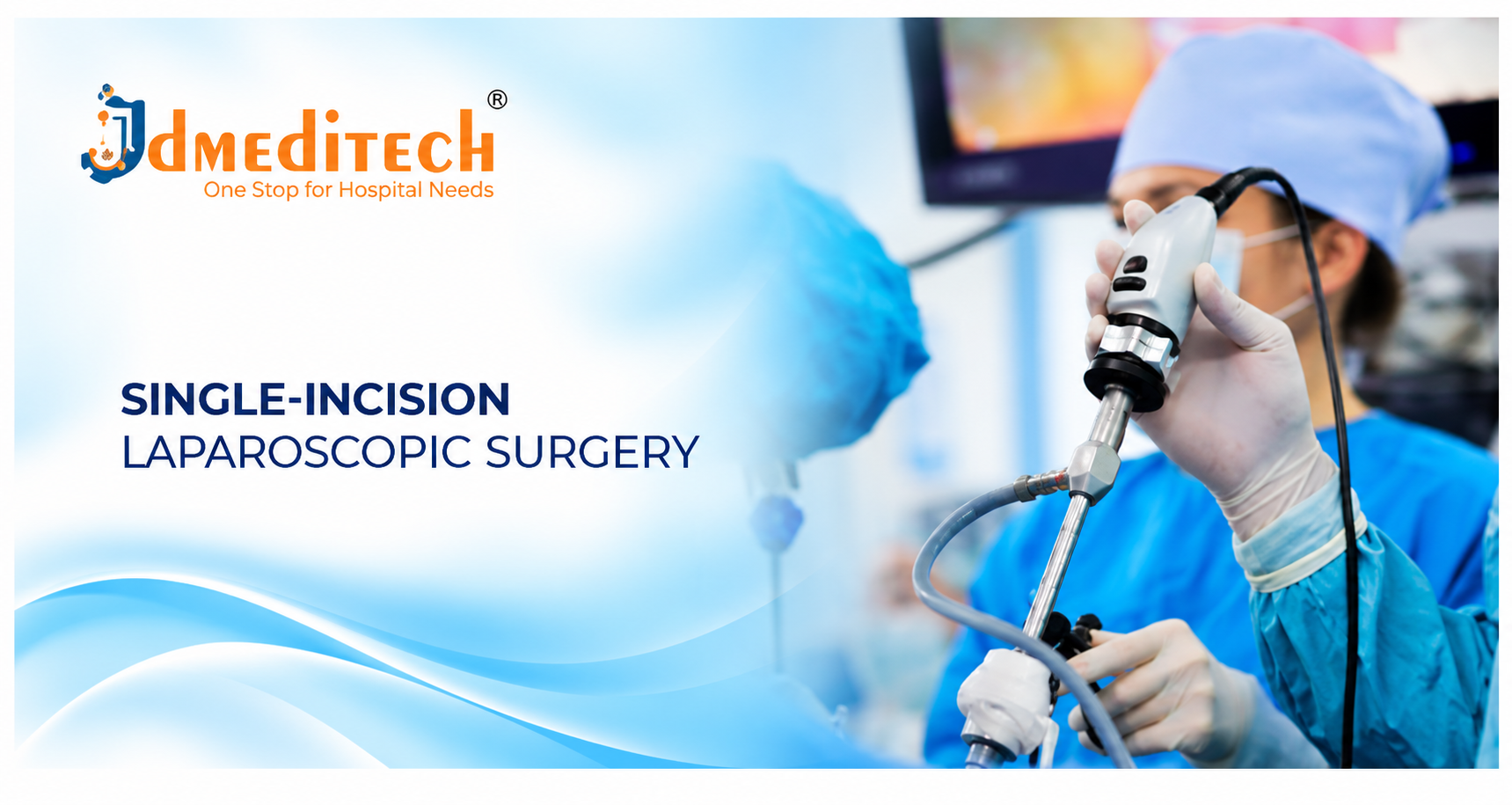
Single-Incision Laparoscopic Surgery: Procedure, Instruments, Benefits & Recovery
Single-Incision Laparoscopic Surgery (SILS) is a minimally invasive surgical approach that allows selected abdominal and pelvic procedures to be performed through a single skin incision, commonly located near the umbilicus.
Unlike conventional laparoscopic surgery, which generally uses multiple small incisions, SILS places the laparoscope and working instruments through one access site.
This approach may offer improved cosmetic outcomes and fewer visible scars. However, the technique presents unique challenges involving instrument movement, visualization, and surgical ergonomics.
Single-incision laparoscopic surgery is used in selected general surgery, gynecology, urology, and pediatric surgical procedures.
This JDMeditech guide explains SILS surgery, its applications, surgical instruments, advantages, limitations, complications, recovery, and frequently asked questions.
What Is Single-Incision Laparoscopic Surgery?
Single-Incision Laparoscopic Surgery is a minimally invasive technique that uses one surgical access site rather than several separate incisions.
The incision is commonly made within or near the umbilicus, where the resulting scar may be less noticeable.
A specialized single-port access device or suitable access arrangement allows the introduction of a laparoscope and working instruments.
The surgeon performs the planned operation using compatible instruments and visualization equipment.
However, the precise equipment configuration depends on the surgical procedure and the chosen technique.
What Does SILS Stand For?
SILS stands for Single-Incision Laparoscopic Surgery.
The technique is also associated with several related terms:
- Single-Port Laparoscopic Surgery
- Single-Incision Laparoscopy
- Single-Site Laparoscopic Surgery
- Single-Port Access Surgery
- Laparoendoscopic Single-Site Surgery (LESS)
- Single-Incision Minimally Invasive Surgery
- Transumbilical Laparoscopic Surgery
However, terminology may vary between conventional single-port laparoscopy and dedicated robotic single-port surgical systems.
How Does Single-Incision Laparoscopic Surgery Work?
Single-incision laparoscopic surgery uses one primary incision to access the abdominal cavity.
First, the surgeon establishes an appropriate access site, commonly near the umbilicus.
Next, a suitable access device is positioned to accommodate the laparoscope and compatible working instruments.
Carbon dioxide insufflation may be used to create a suitable working space inside the abdominal cavity.
The surgeon then performs the planned operation using laparoscopic visualization and specialized instruments.
Finally, the instruments are removed and the incision is closed using an appropriate technique.
However, additional ports or conversion to conventional laparoscopy or open surgery may be necessary when clinically indicated.
Common Applications of Single-Incision Laparoscopic Surgery
Single-incision techniques have been used for a range of abdominal and pelvic operations.
However, suitability depends on patient anatomy, disease severity, surgical expertise, and equipment availability.
1. Single-Incision Laparoscopic Appendectomy
Single-incision laparoscopic appendectomy removes the appendix through a single primary access site.
This technique may be considered for selected patients with appendicitis.
2. Single-Incision Laparoscopic Cholecystectomy
Single-incision laparoscopic cholecystectomy is used to remove the gallbladder in selected patients.
It may offer improved cosmetic outcomes compared with conventional multiport techniques.
3. Single-Incision Laparoscopic Hernia Repair
Selected inguinal or abdominal wall hernia repairs may be performed using single-incision laparoscopic techniques.
However, the chosen approach depends on hernia characteristics and surgical expertise.
4. Single-Incision Gynecological Surgery
Single-incision techniques may be used for selected gynecological procedures, including ovarian cyst surgery and certain hysterectomy approaches.
5. Single-Incision Laparoscopic Nephrectomy
Selected kidney removal procedures may be performed using single-site laparoscopic or robotic-assisted techniques.
6. Single-Incision Laparoscopic Pyeloplasty
Selected reconstructive urological procedures, including pyeloplasty, may be performed through a single-site approach in appropriately equipped centers.
7. Single-Incision Colorectal Surgery
Single-incision approaches have been investigated for selected colorectal resections.
However, these procedures may require advanced surgical expertise and careful patient selection.
8. Single-Incision Bariatric Surgery
Some bariatric procedures have been performed using single-incision approaches.
However, patient body habitus, procedural complexity, and equipment requirements may limit suitability.
9. Single-Incision Pediatric Surgery
Selected pediatric operations may be performed through a single incision using suitable pediatric instruments.
However, pediatric procedures require age-appropriate equipment and specialist surgical expertise.
Single-Incision vs Conventional Laparoscopic Surgery
| Feature | Single-Incision Laparoscopy | Conventional Laparoscopy |
|---|---|---|
| Skin Incisions | One primary incision | Multiple small incisions |
| Access | Single-site access system | Separate trocar ports |
| Instrument Movement | More restricted | Greater instrument separation |
| Instrument Collision | More likely | Generally less likely |
| Cosmetic Outcome | Potentially fewer visible scars | Multiple small scars |
| Operating Time | May be longer | Depends on procedure |
| Postoperative Pain | Benefits vary by procedure | Benefits vary by procedure |
| Recovery | Procedure-dependent | Procedure-dependent |
| Technical Complexity | Often higher | Generally more familiar |
Common Instruments Used in Single-Incision Laparoscopic Surgery
Single-incision laparoscopic surgery requires compatible equipment for visualization, abdominal access, tissue handling, dissection, suturing, and surgical reconstruction.
Instrument requirements vary according to the operation and the selected access platform.
The following list describes general instrument categories rather than a verified JDMeditech SILS surgical set.
1. Single-Port Laparoscopic Access Device
A compatible single-port access device accommodates multiple instruments through one primary incision.
2. Multi-Channel Laparoscopic Port
A multi-channel port provides separate instrument pathways within a single access system.
3. Laparoscope Telescope
A suitable laparoscope provides internal visualization during minimally invasive surgery.
4. Laparoscopic Camera System
A compatible camera system transmits images from the laparoscope to a surgical monitor.
5. Medical Light Source
A suitable light source provides illumination through the laparoscopic optical system.
6. Fiber-Optic Light Cable
A compatible light cable transfers illumination to the laparoscope.
7. CO2 Insufflator
A carbon dioxide insufflator maintains pneumoperitoneum during suitable laparoscopic procedures.
8. Articulating Laparoscopic Grasper
An articulating grasper may improve tissue manipulation when instrument movement is restricted.
9. Curved Laparoscopic Instruments
Curved instruments may help reduce external instrument collision in selected single-site techniques.
10. Atraumatic Laparoscopic Grasping Forceps
Atraumatic graspers support controlled handling of delicate tissues.
11. Maryland Dissector
A Maryland dissector supports selected fine tissue dissection tasks.
12. Laparoscopic Scissors
Laparoscopic scissors support controlled cutting of suitable tissues.
13. Laparoscopic Needle Holder
A compatible needle holder supports suturing during selected surgical procedures.
14. Articulating Needle Holder
An articulating needle holder may assist suturing when instrument angles are limited.
15. Bipolar Forceps
Bipolar forceps support appropriate coagulation and bleeding control.
16. Monopolar Electrosurgical Instrument
A compatible monopolar instrument may support selected cutting and coagulation tasks.
17. Laparoscopic Clip Applicator
A suitable clip applicator may be used for selected tissue or vessel management tasks.
18. Vessel-Sealing Device
A compatible vessel-sealing device may support selected tissue and vessel management tasks.
19. Suction and Irrigation Cannula
Suction and irrigation equipment supports fluid management and operative visibility.
20. Specimen Retrieval Bag
A suitable retrieval bag may support removal of surgical specimens through the access incision.
21. Surgical Sutures
Appropriate sutures may be required for reconstruction or incision closure.
22. Surgical Monitor
A medical-grade monitor displays laparoscopic images for the surgical team.
23. Endoscopy Trolley
A suitable trolley supports organized positioning of laparoscopic equipment.
24. Sterile Surgical Accessories
Appropriate drapes, tubing, dressings, and compatible accessories support the planned procedure.
Single-Incision Laparoscopic Instruments and Functions
| Instrument | Primary Function |
|---|---|
| Single-Port Access Device | Provides single-site access |
| Multi-Channel Port | Accommodates multiple instruments |
| Laparoscope | Provides surgical visualization |
| Camera System | Transmits surgical images |
| Light Source | Provides illumination |
| CO2 Insufflator | Maintains pneumoperitoneum |
| Articulating Grasper | Supports tissue manipulation |
| Curved Instruments | May improve instrument separation |
| Maryland Dissector | Supports fine dissection |
| Laparoscopic Scissors | Support tissue cutting |
| Needle Holder | Supports suturing |
| Bipolar Forceps | Support coagulation |
| Clip Applicator | Supports selected clip placement |
| Suction and Irrigation | Support fluid management |
| Retrieval Bag | Supports specimen removal |
How Is Single-Incision Laparoscopic Surgery Performed?
A qualified surgeon performs single-incision laparoscopic surgery in an appropriately equipped hospital.
First, the healthcare team reviews the patient’s medical history, clinical condition, and planned operation.
Next, the anesthesia team prepares the patient for the procedure.
During surgery, the surgeon establishes an appropriate single-site access point.
A laparoscope and compatible working instruments are introduced through the access system.
The surgeon performs the required operation using laparoscopic visualization and specialized instruments.
Finally, the surgical team completes the procedure and closes the access incision.
However, additional ports or conversion to conventional laparoscopic or open surgery may be necessary for patient safety.
Potential Benefits of Single-Incision Laparoscopic Surgery
1. One Primary Surgical Incision
SILS generally uses one primary skin incision instead of several separate incisions.
2. Potentially Improved Cosmetic Appearance
Placement of the incision near the umbilicus may make the resulting scar less noticeable.
3. Minimally Invasive Access
Single-incision surgery is a minimally invasive alternative to open surgery for selected procedures.
4. Potential Reduction in Postoperative Discomfort
Some studies report reduced early postoperative pain with selected single-incision procedures.
However, findings are inconsistent, and SILS does not consistently provide less pain than conventional multiport laparoscopy.
5. Potentially Rapid Recovery
Selected patients may resume routine activities relatively quickly after uncomplicated minimally invasive surgery.
However, recovery depends primarily on the operation performed and the patient’s clinical condition.
6. Single-Site Access for Selected Procedures
Multiple instruments can be introduced through one suitable access device.
7. Application Across Surgical Specialties
Single-site techniques have been used in selected general surgery, urology, gynecology, and pediatric procedures.
However, SILS is not automatically safer, faster, or more effective than conventional laparoscopy.
Limitations and Challenges of Single-Incision Laparoscopic Surgery
1. Instrument Collision
Instruments positioned close together may collide externally or internally during surgery.
2. Reduced Instrument Triangulation
Conventional laparoscopic instruments are often designed to operate from separate access points.
Single-site access may reduce triangulation and make some movements more difficult.
3. Restricted Working Angles
Instrument movement may be limited because the laparoscope and working instruments share one access site.
4. Increased Technical Difficulty
Single-incision techniques may require advanced training and specialized surgical expertise.
5. Potentially Longer Operating Time
Some procedures may take longer using single-incision techniques.
6. Equipment Compatibility
Specialized ports, curved instruments, or articulating devices may be required for selected procedures.
7. Limited Suitability
Complex anatomy, extensive adhesions, severe inflammation, or other clinical factors may make single-site access unsuitable.
8. Incisional Hernia Considerations
The single access site may require a larger fascial opening than an individual conventional laparoscopic port.
Studies have reported mixed findings regarding the risk of incisional hernia compared with conventional laparoscopy.
Therefore, patients should discuss procedure-specific risks with their surgeon.
Risks and Complications of Single-Incision Laparoscopic Surgery
Single-incision laparoscopic surgery is an invasive approach with potential complications.
- Bleeding
- Surgical-site infection
- Injury to nearby organs
- Incisional hernia
- Postoperative pain
- Seroma formation
- Wound-healing problems
- Anesthesia-related complications
- Need for additional access ports
- Conversion to open surgery
- Procedure-specific complications
However, the actual risk depends on the operation, patient health, and surgical technique.
Recovery After Single-Incision Laparoscopic Surgery
Recovery varies considerably because SILS can be used for different types of operations.
Some patients undergoing uncomplicated procedures may return home on the day of surgery or after a short hospital stay.
However, major abdominal or reconstructive procedures may require longer hospitalization.
Temporary abdominal discomfort, fatigue, or incision tenderness may occur.
Patients should follow individualized instructions regarding wound care, medication, diet, and activity.
Furthermore, the surgical team will determine when the patient can return to work, exercise, and other routine activities.
Postoperative Care After Single-Incision Laparoscopic Surgery
Appropriate postoperative care supports recovery and helps identify complications early.
- Follow prescribed medication instructions
- Keep the incision clean as directed
- Attend scheduled follow-up appointments
- Resume diet according to medical advice
- Follow restrictions on heavy lifting
- Monitor the incision for swelling or discharge
- Report worsening symptoms promptly
When Should Patients Seek Medical Attention After Surgery?
Patients should contact their healthcare team for concerning symptoms.
- Persistent or worsening abdominal pain
- High or persistent fever
- Repeated vomiting
- Significant wound redness or discharge
- Increasing abdominal swelling
- Uncontrolled bleeding
- Difficulty breathing
- Severe weakness or fainting
Severe symptoms, breathing difficulties, or uncontrolled bleeding require emergency medical assessment.
Who Is a Suitable Candidate for Single-Incision Laparoscopic Surgery?
Suitable candidates are selected according to the planned operation, patient anatomy, medical history, and surgical expertise.
Some patients may be appropriate candidates for single-site surgery, while others may benefit more from conventional multiport laparoscopy or open surgery.
Factors influencing selection may include:
- Type of surgical procedure
- Patient anatomy
- Previous abdominal operations
- Presence of adhesions
- Severity of inflammation
- Body habitus
- Associated medical conditions
- Surgeon experience
- Availability of suitable equipment
Therefore, surgical approach selection should be individualized.
How to Choose Single-Incision Laparoscopic Surgical Instruments
Hospitals and surgical departments should evaluate their clinical requirements before purchasing single-site laparoscopic instruments.
First, identify the planned surgical procedures and compatible access systems.
Next, review laparoscope diameter, camera compatibility, instrument working length, and available working channels.
Furthermore, determine whether curved or articulating instruments are required.
Important Equipment Selection Factors
- Approved intended use
- Single-port access system compatibility
- Number and diameter of working channels
- Laparoscope diameter and viewing angle
- Camera system compatibility
- Light source compatibility
- CO2 insufflator compatibility
- Articulating instrument availability
- Curved instrument configuration
- Grasper jaw design
- Dissector working length
- Laparoscopic scissors specifications
- Needle holder compatibility
- Electrosurgical compatibility
- Suction and irrigation requirements
- Specimen retrieval accessories
- Reusable or single-use classification
- Cleaning and sterilization instructions
- Manufacturer technical documentation
- Applicable regulatory documentation
Single-Incision Laparoscopic Surgical Instruments by JDMeditech
JDMeditech welcomes inquiries from hospitals, laparoscopic surgery centers, urology departments, gynecology departments, and international medical distributors regarding surgical instruments and related medical accessories.
Customers can inquire about available laparoscopic telescopes, grasping forceps, dissecting forceps, scissors, needle holders, and compatible surgical accessories.
Furthermore, the JDMeditech team can confirm available product configurations, single-port compatibility, technical specifications, and applicable documentation for individual inquiries.
For product information and quotations, visit www.jdmeditech.com.
Frequently Asked Questions About Single-Incision Laparoscopic Surgery
1. What is single-incision laparoscopic surgery?
It is a minimally invasive surgical approach that uses one primary incision for laparoscopic access.
2. What does SILS stand for?
SILS stands for Single-Incision Laparoscopic Surgery.
3. What is single-port laparoscopic surgery?
Single-port laparoscopic surgery is a minimally invasive technique that introduces compatible instruments through one primary access site.
4. What is LESS surgery?
LESS stands for Laparoendoscopic Single-Site Surgery, a term used for certain single-site minimally invasive techniques.
5. What is the difference between SILS and conventional laparoscopy?
SILS uses one primary incision, while conventional laparoscopy generally uses multiple separate access incisions.
6. Is single-incision surgery better than conventional laparoscopy?
Not necessarily. SILS may offer cosmetic advantages in selected procedures, but other outcomes vary and the technique can be more technically challenging.
7. What procedures can be performed using SILS?
Selected appendectomy, cholecystectomy, gynecological, urological, colorectal, and other abdominal procedures may use single-site techniques.
8. What is a single-port access device?
It is a surgical access system designed to accommodate compatible instruments through one incision.
9. What instruments are used during single-incision laparoscopy?
Common equipment includes a suitable access port, laparoscope, camera system, light source, graspers, dissectors, scissors, and procedure-specific accessories.
10. Are special instruments required for SILS?
Some techniques use curved or articulating instruments to improve movement and reduce instrument collision.
11. Is SILS suitable for every patient?
No. Suitability depends on the operation, patient anatomy, clinical condition, and surgeon expertise.
12. Is single-incision surgery painful?
Postoperative pain varies. Some studies report lower early pain scores, while others show little difference compared with conventional laparoscopy.
13. How long does SILS surgery take?
Operation time depends on the procedure, patient anatomy, and surgical complexity.
14. How long is the hospital stay?
Hospital stay depends primarily on the procedure performed and the patient’s postoperative condition.
15. How long does recovery take?
Recovery varies considerably, from days for selected minor procedures to several weeks or longer for major operations.
16. Does SILS leave a scar?
Yes. SILS leaves a surgical incision, although an umbilical scar may be less noticeable.
17. Can additional ports be required during SILS?
Yes. Surgeons may add ports or convert to another approach when necessary for safe treatment.
18. What are the risks of single-incision laparoscopic surgery?
Potential risks include bleeding, infection, organ injury, incisional hernia, anesthesia complications, and procedure-specific problems.
19. Is SILS the same as robotic single-port surgery?
No. Conventional SILS uses laparoscopic instruments, while robotic single-port surgery uses a dedicated robotic platform.
20. Where can hospitals inquire about JDMeditech laparoscopic instruments?
Hospitals and medical distributors can visit JDMeditech to request information about available laparoscopic instruments and accessories.
Conclusion
Single-Incision Laparoscopic Surgery is a minimally invasive surgical approach that uses one primary incision for selected abdominal and pelvic procedures.
Furthermore, SILS may provide cosmetic benefits while allowing surgeons to perform suitable operations using specialized laparoscopic equipment.
However, single-site access can create technical challenges and does not guarantee superior clinical outcomes compared with conventional multiport laparoscopy.
Therefore, successful treatment depends on patient selection, qualified surgical expertise, compatible equipment, and appropriate postoperative care.
Contact JDMeditech for laparoscopic surgical instrument inquiries, compatible medical accessories, and international business requirements.
Medical Disclaimer: This article provides general educational information only. It does not replace professional medical advice, patient-specific treatment planning, or surgical training. Qualified healthcare professionals must make treatment and equipment decisions according to current clinical guidelines, local regulations, and approved manufacturer instructions.




